Advertising disclosure: This page includes affiliate product links that may earn us a commission, as well as products from our own store.
Trap-bar shrugs look almost too simple: stand inside a loaded hex bar, hold the handles at your sides and raise your shoulders. Yet an impressive load and a productive repetition are not the same thing. The aim is not to deadlift the most weight or make the plates rattle. It is to repeatedly elevate the shoulder blades through a useful range while your body stays controlled.
The neutral handles and balanced frame make this a practical upper-trap accessory for lifters who dislike a straight bar scraping across their thighs. They also create a temptation to overload. This guide covers what the movement trains, how to select your bar and grip, the cues that keep tension in the intended muscles, and a four-week progression that respects grip fatigue and shoulder comfort.
What the movement trains—and what it does not
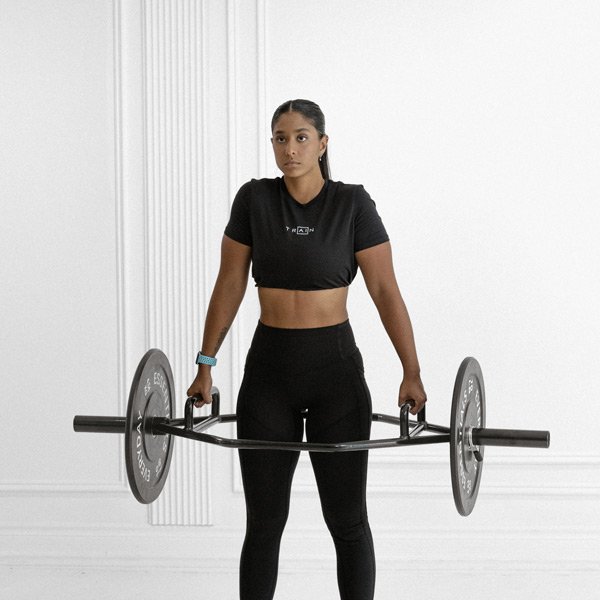
The upper fibers of the trapezius contribute to lifting the shoulder blades. A strict shrug asks you to repeat that action against resistance. The upper traps also contribute to shoulder-blade positioning in other lifts, but a shrug is not a complete training program for all regions of the trapezius. Rows, overhead exercises and movements involving scapular rotation have different jobs.
Because the load hangs from both hands, the forearms have to maintain a strong grip while the trunk resists unnecessary motion. Those are supporting demands rather than proof that the shrug replaces deadlifts, carries or dedicated grip work. If your hands quit before your traps receive meaningful work, that is useful feedback about the set, not a reason to transform every repetition into a partial deadlift.
A trap bar positions the hands alongside the body with the palms facing inward. This often feels more natural than a barbell in front of the thighs. The frame also tends to keep the load close to the body’s central support line. Neither feature automatically makes the lift safer for every shoulder. Handle width, motion quality and the loading choice still matter.
Think about your goal before adding plates. For muscle size, you need repeatable hard sets with visible elevation and a controlled lowering phase. For a lighter accessory finisher, longer sets can work. When bracing and grip are the main targets, keep that objective separate from an upper-trap hypertrophy set so you know what progress means.
Try watching the first and final repetition of a working set from the front or side. Your torso height should remain similar, elbows stay long, and the head stays level. The shoulders move while the rest of you acts as a stable platform. That visual comparison can reveal more than simply counting the kilograms on the bar.
Choose the bar, handle height and starting setup
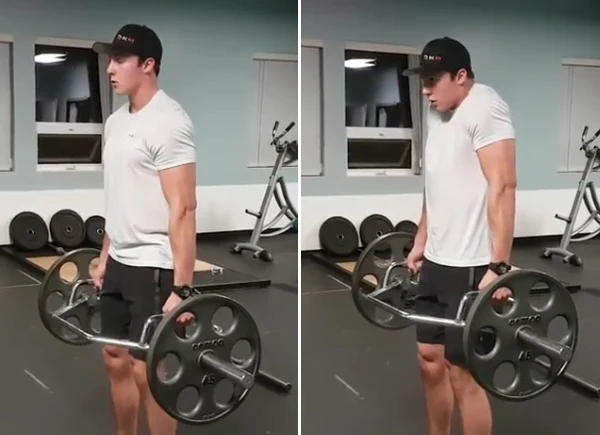
Inspect the actual trap bar before loading. Closed hex bars require you to step inside a frame. Open-ended designs allow a different entry path, while handle position, inside clearance and frame balance still vary. Some bars have two grip heights; others have a single set. Higher handles may ease the pickup, but they should not encourage shortening the shrug itself.
Load the two sleeves evenly and secure the plates with compatible collars. When plates slide or a bar rocks unexpectedly, control disappears. Check the space around your feet, the bar frame and the floor before lifting. The maximum rated load of one brand is not transferable to another: follow the specifications and instructions for the exact bar you own.
Stand with feet roughly hip-width apart and grip both handles symmetrically. Hinge with your hips, bend your knees appropriately and rise to a balanced standing position. Once standing, brace your abdomen, keep your chest comfortably open and let your knees stay softly unlocked. The working repetitions do not require repeatedly straightening your legs.
Allow the shoulders to settle to a natural low position without wrenching them downward. Look straight ahead, keep your chin level, use a secure closed grip and keep the elbows extended. For a first attempt, a load you can shrug cleanly for eight repetitions is a more useful benchmark than a plate combination that allows only tiny shoulder twitches.
Taller lifters or anyone using large plates should pay attention to the relationship between handle height, sleeve length and the available space inside the frame. You should be able to pick up and set down the bar without striking the knees or twisting the shoulders to clear the weights. A different handle position, raised start or alternative shrug may solve poor setup geometry.
Before starting a demanding set, try two or three unweighted shoulder elevations while standing tall. That establishes what your available range looks like today. Compare the movement under load with that baseline, rather than assuming more plates always mean more work for the upper traps.
Perform a strict repetition from bottom to top
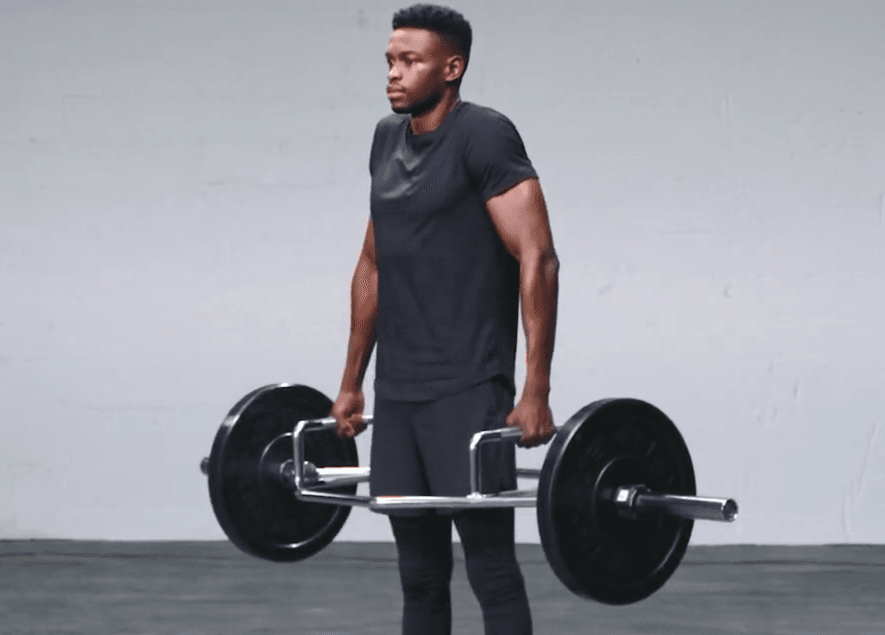
Start from a still, upright standing position. Lift both shoulders nearly straight upward, as though the tops of the shoulders were moving toward the ears. The shoulders should initiate the motion, not the elbows or knees. If the hands rise because the legs extend or the torso leans backward, you have changed the exercise without noticing.
At the top, pause deliberately for roughly one second. Think of finishing a short, vertical shoulder movement rather than pulling the entire bar upward with the arms. Your head should remain forward and level. Jutting the chin out or shortening the neck does not create extra productive shoulder-blade elevation.
Lower the shoulders with control until you return to the starting position. A descent of roughly two seconds is a useful coaching cue, not a magical physiological threshold. Avoid bouncing the bar or rolling the shoulders through a wide circle. For this exercise, the desired action is primarily a vertical shoulder-blade raise followed by a deliberate return.
Breathe in a way that supports the load without turning every repetition into a prolonged breath-hold. A brief brace during the hardest part may help your trunk stay organized. Between repetitions, regain your breath and reset. If you become light-headed, set the bar down safely and stop.
Film the second or third rep and the final rep of your next set. Ask whether they show similar height, a recognizable top pause and the same stable posture. If the final rep loses half of its range, the load or planned number of repetitions was too ambitious for that session. Reduce one of those variables rather than pretending all reps were equivalent.
You should mainly feel muscular work around the upper trapezius. Forearm fatigue is normal because you are gripping a loaded implement. Sharp pain in the neck or shoulder is not a target sensation and should not be used as evidence of an effective workout.

Equipment Worth Exploring
Explore equipment, accessories and gear from our carefully selected range.


Open Hex Bar
Open-frame trap bar with multiple handles for deadlifts, carries, and lower-body training.


Competition Plates
Competition-style bumper plates for Olympic lifts and loaded strength training.

Grip Plates
Rubber-coated weight plates with handholds for loading barbells and machines.

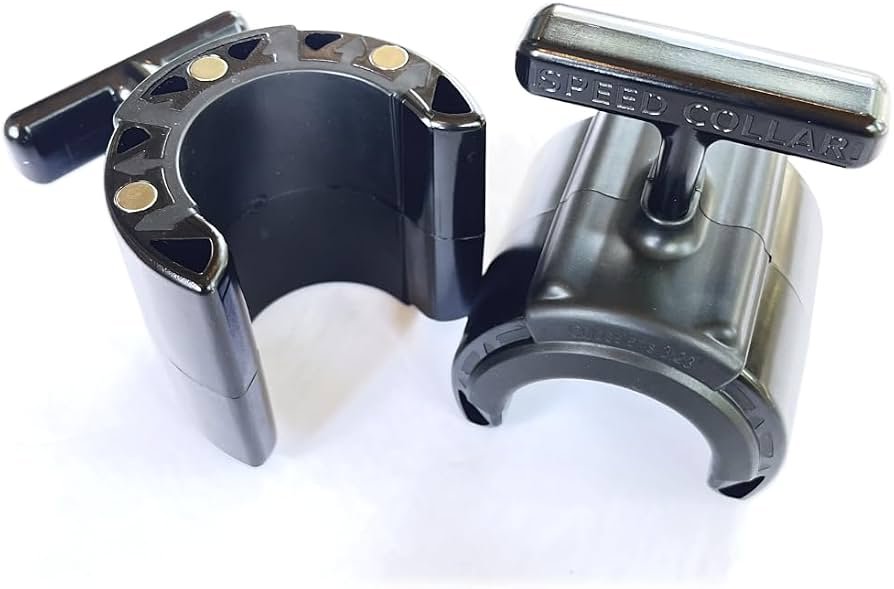
Speed Collar
Quick-release collars designed to secure weight plates on standard two-inch Olympic bars.

Leather Lifting Straps
Padded leather straps support grip during heavy rows, deadlifts and pulling exercises.


Rubber Hex Dumbbells
Rubber-coated hex dumbbell pairs with a stable shape for home and commercial strength training.
Correct the mistakes that quietly steal trap work
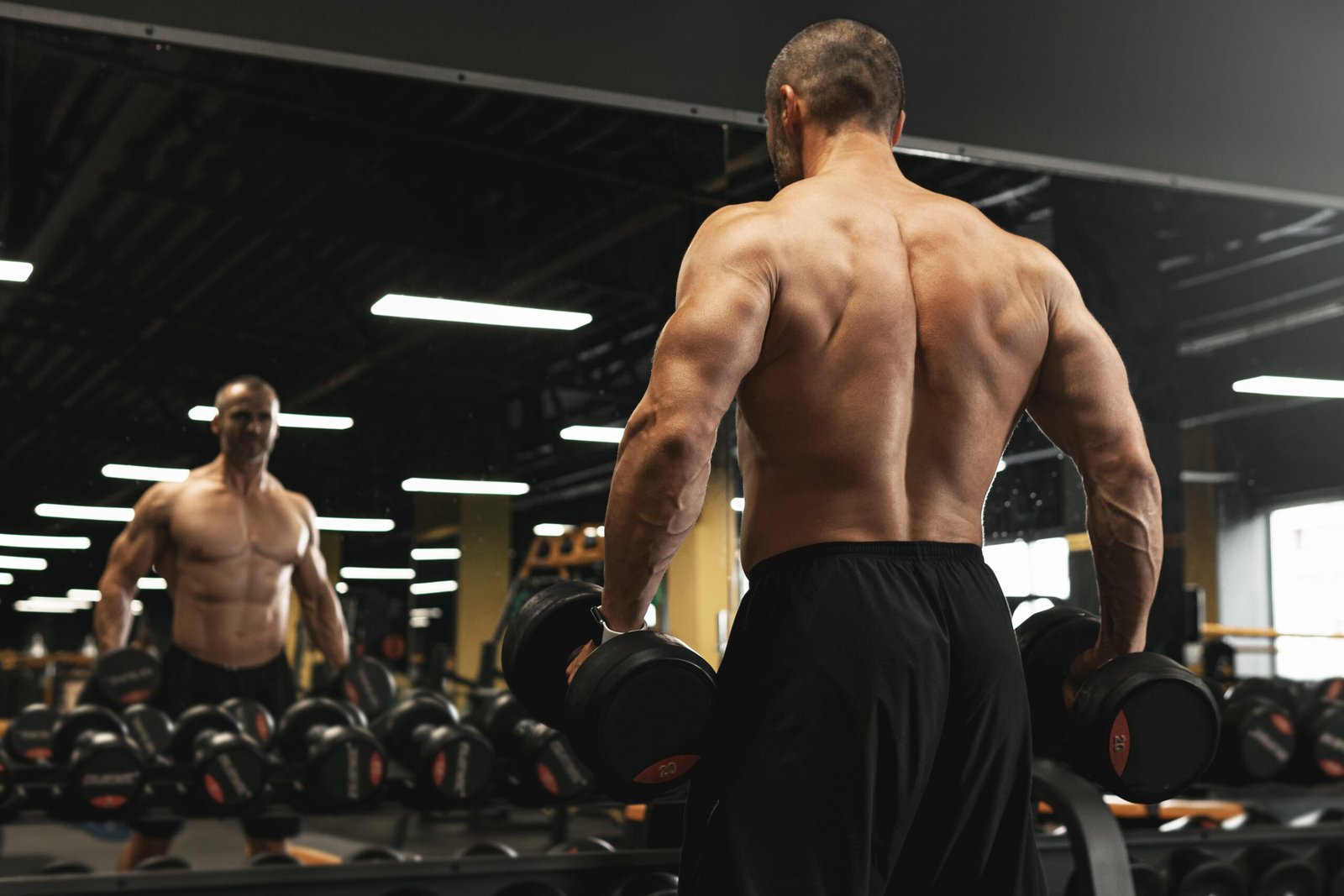
The biggest mistake is loading the shrug by how much you can deadlift. Strong legs can often pick up substantially more than the shoulders can elevate through a useful range. The result is a very heavy static hold decorated with a few short shoulder twitches. Remove plates until the top position and lowering phase return.
Another common error is bending the elbows to curl the handles. A small amount of natural softness is not necessarily a problem, but deliberately pulling with the arms changes the movement and can make the upper traps less central. Imagine the arms as long straps connecting the shoulders to the bar. Keep the elbow angle approximately fixed throughout the set.
Avoid rolling the shoulders forward and backward in circles. Loaded rotation adds motion without making the intended shoulder elevation more precise. Keep the ribs approximately over the pelvis, chest tall but not overarched, and neck neutral. If you cannot stay upright without leaning backward, the load may have passed the point where good repetitions are possible.
Grip is worth tracking separately. If the fingers begin to open at rep seven while your traps still feel fresh, try a better handle, an appropriate lifting strap or a modest decrease in weight. Straps can be useful accessories, not permission to abandon control. If increasing raw grip strength is important, give it separate work rather than having every shrug set end with a slipped handle.
Uneven shrugging is another warning sign. Make sure the plates are loaded symmetrically and hands are centered on the handles. If one shoulder consistently travels less, use a lighter load and inspect range without resistance. Persistent asymmetry accompanied by pain deserves qualified evaluation rather than stubbornly forcing the bar higher.
Finally, recognize accumulating fatigue. A high-rep shrug at the end of a session might feel challenging even at a lighter load because rows, pull-ups and deadlifts have already taxed the hands and upper back. Match the day’s plan to that context; a clean modest set is better than several noisy reps that look nothing like your first repetition.
Trap bars versus dumbbells, straight bars and machines
A trap bar combines plate-based loading, a fixed two-hand frame and neutral grips. A straight barbell can also be loaded substantially but sits in front of the body, may brush the thighs and uses a different wrist position. Neither design automatically wins for upper-trap development. Choose the one you can progressively load while maintaining a consistent shoulder path.
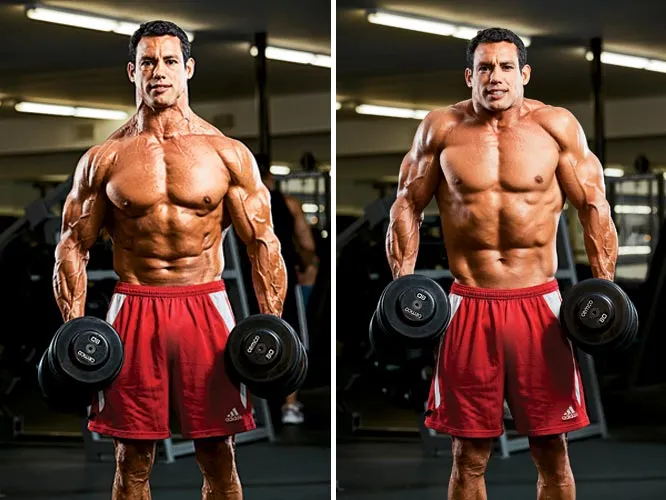
Dumbbells allow the hands to move independently. That flexibility is useful if your comfortable grip width differs from a fixed trap bar, and you can use them without storing another large implement. At very heavy weights, however, getting them into place or maintaining the grip may become the real constraint. That is not a flaw, simply a consideration when choosing equipment.
Cable shrugs create a different line of resistance and may feel smoother at certain points of the motion. A plate-loaded or selectorized shrug machine can reduce the burden of picking up a free bar, offer predictable handle positioning and make certain regressions convenient. Do not compare a machine’s stack number directly with an external bar’s plate total; leverage can differ.
Heavy farmer’s walks also challenge the upper traps to support a load, but the task is not the same as deliberately elevating the shoulders for repeated reps. Carries involve gait and trunk stability, plus time under load. They can coexist in a program if recovery permits. A lifter whose back sessions already feature deadlifts, heavy rows and carries may not need many additional maximal shrug sets.
For a small home gym, equipment efficiency matters. If you already have adjustable dumbbells and they provide a strong shrug, you do not need to buy a specialty bar solely for this movement. If a trap bar is already used for deadlifts and carries, shrugs can add another useful task without occupying more floor space.
The best variation gives you meaningful shoulder movement with minimal avoidable irritation. A reliable moderate set beats a spectacular-looking load that is difficult to control, no matter which implement you choose.
A four-week upper-trap progression with room to recover
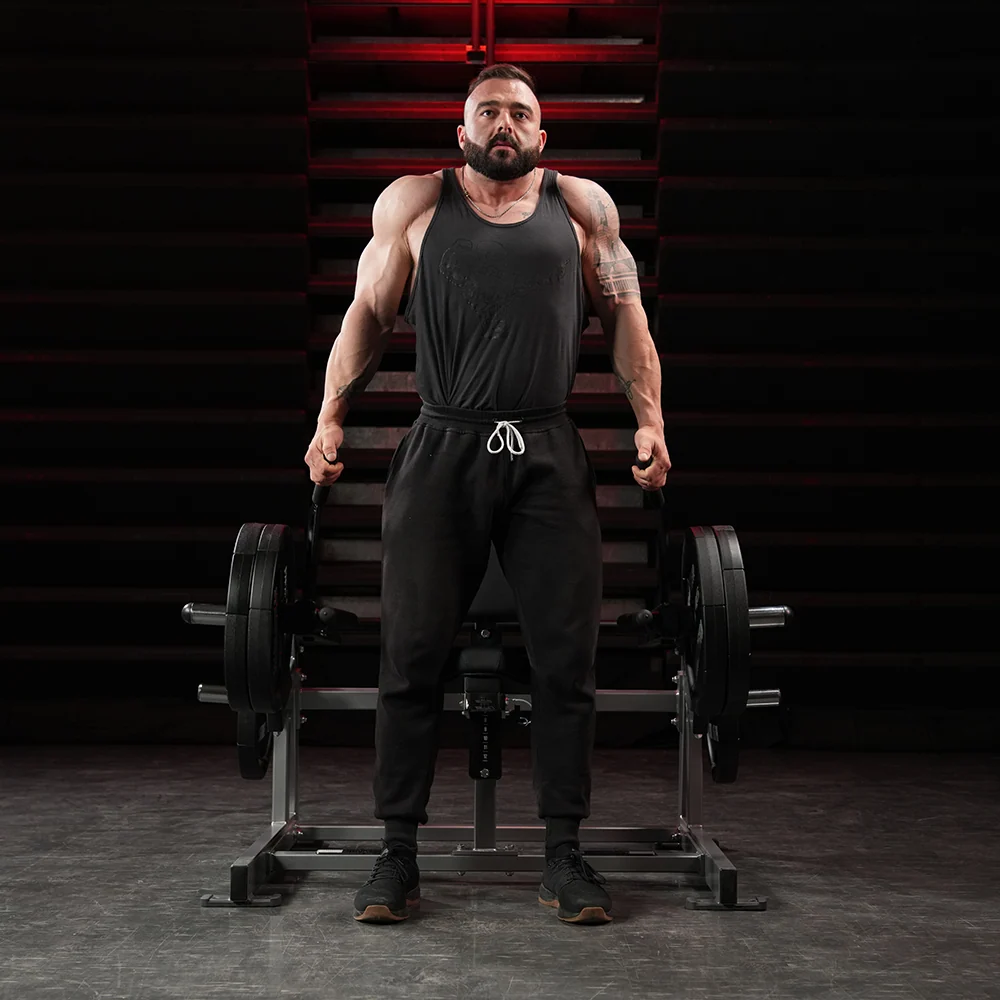
Put trap-bar shrugs near the end of a back, pull or shoulder session, after movements that require more technical attention. Begin with two working sets of 10–12 controlled repetitions and roughly two good reps in reserve. Rest about 90–120 seconds between sets, or longer if grip and breathing have not recovered. If form breaks before the planned number, end the set.
Week one is a baseline. Choose a manageable weight and do two sets of ten with straight arms and a brief top pause. Record the load, reps and whether the final rep still resembles the first. If the last two repetitions are rushed or the chin begins to push forward, keep the weight lighter and learn the repeatable movement.
In week two, aim for 11–12 clean reps at the same load. This is double progression: first add repetitions, then increase weight when the top of your range is reliable. Do not force an increase on a day when the rest of your back workout has already left your grip exhausted.
In week three, once both sets reach the top of the rep range with comparable technique, add the smallest practical plate increment and return to around ten good repetitions. Using one small plate on each side is often enough. If the new loading immediately eliminates your top pause, return to the previous weight instead of counting partial reps as an improvement.
In week four, consolidate the new load or consider adding a third set only if the first two remain useful and recovery between sessions is good. You could also keep two sets and improve consistency at the bottom and top. There is no requirement to escalate both weight and set count every week.
For example, a productive log could look like two sets of ten at a chosen load, then two sets of twelve, then two sets of ten with a modest increase, followed by two sets of eleven at the higher load. Those numbers illustrate the decision rule, not a universal program or a target weight.
If the exercise triggers headaches, unusual neck discomfort, tingling or sharp shoulder pain, do not push through to complete the plan. Set the bar down safely, try a lighter variation if appropriate, and seek qualified assessment for persistent symptoms. Training progress is demonstrated by controlled work that your body can recover from—not simply a larger number written beside the word shrug.

Powerlifting Shirts & Lifting Gear
Powerlifting shirts and gym gear for squat, bench and deadlift lifters who live for heavy numbers.

: Cherry Weight Plates & Gymbros Top T-Shirt
Heavy lifts, good laughs, and a little “: Cherry Weight Plates Graphic” energy.

I Love Deads & Deadlifts Meme – Valentine'S Day Top T-Shirt
Show some deadlift attitude with a playful “I Love Deads & Deadlifts” tee.

5 Plates Deadlift Club Meme Shirt – Motivational T-Shirt
Bring “5 Plates Deadlift Club” humor to your next gym day.

Meme : Squat Rack Top Home T-Shirt
Make gym days more fun with “Powerlifting Gym Meme” style.

Grim Reaper Deadlift Skeleton Bros & Leg Day Lovers Hoodie
Stay casual and show some leg-day attitude with “Grim Reaper Deadlift”.

Zombie Deadlift Lifting Dead Halloween Meme Decal Sticker
Bring “Zombie Deadlift” attitude to your water bottle or laptop.

Praise The Deadlift Holy Lifting Meme Decal Water Sticker
Put “Praise The Deadlift” gym humor on your laptop, bottle, or gym gear.

The Walking Deadlift | Zombie Workout Sweater For Leg D T-Shirt
Bring “The Walking Deadlift” humor to your everyday gym style.

Funny Minecraft Deadlift | Gym Meme Workout Pullover | T-Shirt
Bring “Minecraft Deadlift” humor to your everyday gym style.

Rat Cheese Barbell | Muscle Shirt & Bodybuilding Meme F Tank Top
Add some lifting attitude to training with “Gym Rat Cheese Barbell”.