Advertising disclosure: This page includes affiliate product links that may earn us a commission, as well as products from our own store.
Suitcase Carries: Which Hip Works Harder When You Hold One Weight?
Pick up one kettlebell and walk. The exercise looks almost too simple to deserve a place in a serious strength program, yet the location of that single load changes the task at your hips and trunk. A suitcase carry is useful when you want to practice controlling an uneven load while moving. The useful question is which side you are challenging, how much weight you can control, and what counts as progress beyond merely surviving a longer walk.
The opposite hip has an important job
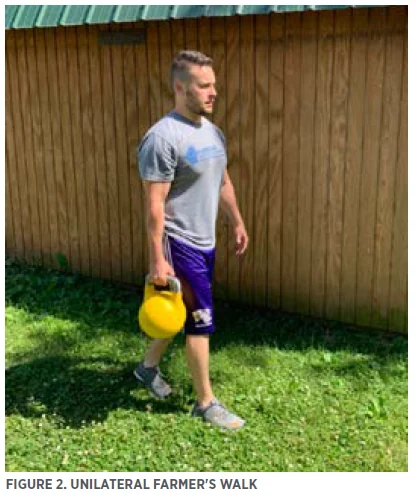
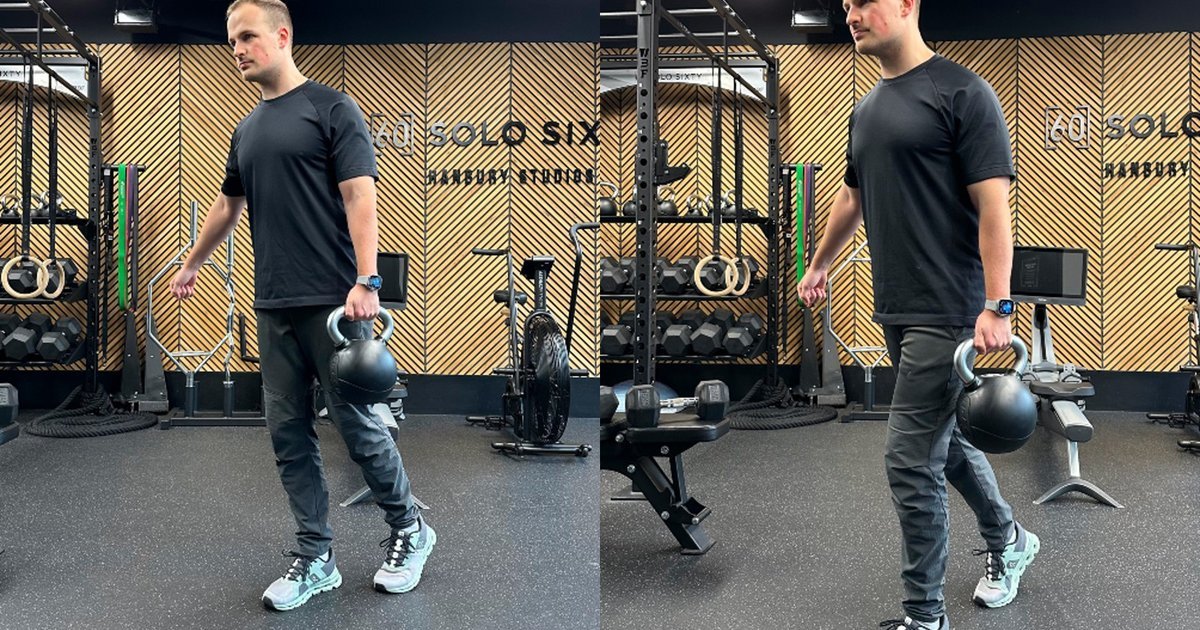
A suitcase carry means holding one weight beside your body while walking. It differs from a farmer’s carry, where both hands hold weights, and from a suitcase hold, where you stay still. Your grip keeps the implement secure, your trunk controls the sideways pull, and each supporting leg must manage your body and the offset load as the other foot leaves the floor.
Picture the kettlebell in your right hand while your left foot supports you. That weight sits across the body from the supporting hip. The muscles around the outside of the left hip have to help manage the extra turning effect around that hip. This is contralateral loading: the hand holding the weight is opposite the leg being considered. When your right foot supports you, the same kettlebell is on the same side as that hip.
This distinction explains why the heavier-feeling hand does not automatically tell you which hip is doing the most stabilizing work. It also explains why you should usually train both carrying sides. One trip with the weight on the right is not a substitute for the same trip with it on the left.
You are still walking, rather than performing a frozen balance pose. Allow a natural arm swing on the unloaded side, keep your eyes on the route, and use ordinary, controlled steps. Turning the exercise into exaggerated knee lifts creates a different task.
What a 26-adult walking experiment actually found
In a laboratory comparison, 26 healthy adults walked with and without a kettlebell in one hand. The load was 15–20% of body weight. Muscle activity, motion and forces were measured during treadmill walking; this was an immediate movement experiment, not a training program.
On the side opposite the weight, gluteus medius activity during the supporting phase was about 58% higher: roughly 22% versus 14% of the reference maximum contraction. That describes an electrical-activity measurement, not a 58% gain in strength or muscle size. Hip-abductor activity on the same side as the weight did not significantly change.
Pelvic drop on the opposite supporting side was approximately two degrees smaller, but trunk lean also changed slightly. Those observations do not prove a permanent posture correction. The findings support using an offset load to alter the immediate hip-stabilizing challenge; they do not establish that suitcase carries prevent injuries, cure pain, or outperform dedicated hip strengthening.
The participants were healthy adults, so the results should not be treated as a rehabilitation prescription. The experimental loading range is a description of the test, not a minimum weight everyone needs to reach.
Make every trip repeatable before making it heavy
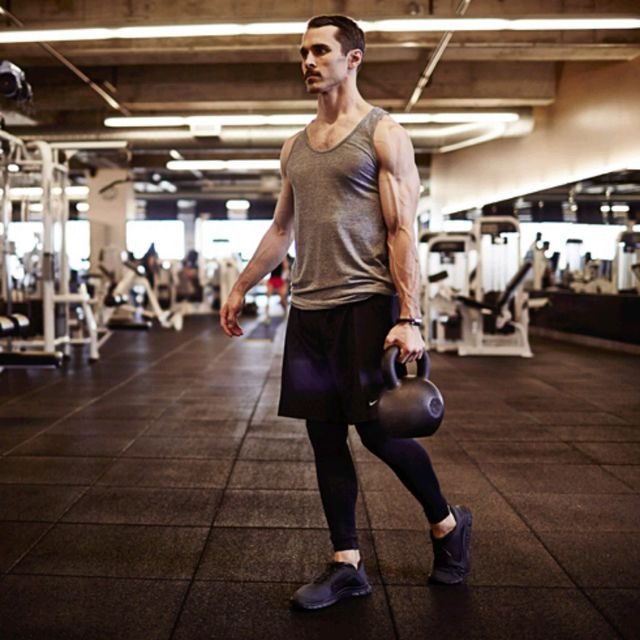
Choose a clear, level lane with enough room to stop and turn. A crowded dumbbell aisle is a poor place to discover that your grip has reached its limit. Move loose plates, bags and other obstacles before picking up the weight. Wear footwear that lets you place each step confidently; the route should be predictable rather than a balance obstacle course.
- Pick up with control. Stand beside the implement, use a comfortable hip-and-knee bend, grip the handle securely and stand up without twisting. An elevated, stable starting surface can simplify the pickup when reaching the floor is awkward.
- Find your standing position. Let the loaded arm hang naturally. Keep the rib cage approximately over the pelvis instead of leaning away to make the weight feel lighter. Avoid forcing the shoulder into a hard shrug or aggressively dragging it downward.
- Walk smoothly. Take controlled steps at a repeatable pace. Keep enough clearance that the weight does not repeatedly hit your leg. The bell should travel with you, rather than swinging like a pendulum.
- Breathe throughout. Use enough trunk tension to stay organized while allowing regular breaths. A brief carry does not require holding your breath until your face changes color.
- Finish before control disappears. Stop, lower the weight deliberately, and rest. Switch hands for the matching trip. If you need to turn mid-set, slow down and take several small steps rather than pivoting sharply under the load.
Film one light trip from the front if you cannot tell whether you are leaning. Compare the first few steps with the last few. A growing tilt, dragging foot or increasingly erratic path gives you a clearer reason to end the set than an arbitrary need to finish the timer.
Start with the side that feels less coordinated, then match its successful time or distance on the other side. Keep the same implement, route and pace when comparing sessions. If something hurts or your balance becomes unreliable, put the weight down and change the task rather than forcing extra steps.
Choose the weight and handle for the task
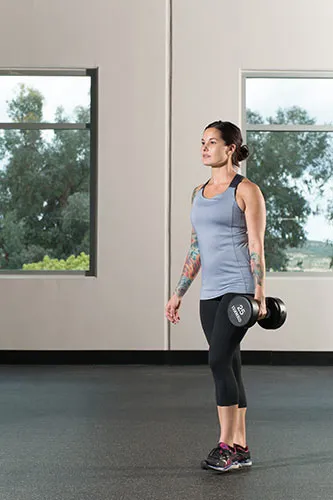
A kettlebell is convenient because its mass hangs below the handle. A dumbbell works too, although the heads may need more space beside your thigh. Neither tool earns an automatic advantage if its shape makes you walk awkwardly. Use the one you can hold securely while preserving a comfortable path.
For an initial practice session, choose a weight that allows a controlled 10–20-second trip on each side with room to spare. This is a conservative coaching starting point, not a tested universal dose. You should finish because the planned practice is complete, rather than because the fingers are peeling open. Someone with substantial lifting experience may need more load than a beginner, but body weight alone does not determine the right choice.
A short stationary hold can help you rehearse the pickup, grip and breathing when you are unfamiliar with the implement. Walking then adds the stepping task. Keep the load modest when making that transition. If ordinary unloaded walking is already painful or unsteady, seek an individual assessment before adding a heavy offset weight.
Adjustable dumbbells and kettlebells make small changes easier. On plate-loaded handles, check the manufacturer’s assembly instructions and secure every plate. Microloading plates can be useful only when they fit and lock correctly on that particular implement. Do not improvise a loose attachment that could fall into your walking route.
Thick grip sleeves create a separate grip challenge. If you use them, reduce the weight, keep the set short and record that setup separately; the result is not directly comparable with your normal handle. When the goal is hip and trunk control, there is little benefit in making the hand fail first. A standard, secure handle is usually the simplest starting point.

Equipment Worth Exploring
Explore equipment, accessories and gear from our carefully selected range.


Cast Iron Kettlebells
Textured cast-iron kettlebells for swings, squats, carries, and full-body training.


Rubber Hex Dumbbells
Rubber-coated hex dumbbell pairs with a stable shape for home and commercial strength training.


Build a four-week practice block without chasing exhaustion
Try two brief sessions a week after your main lifts. Placing them at the end keeps a grip challenge from spoiling heavier rows or deadlifts earlier in the workout. Leave recovery between sessions and adjust the dose if your hands, shoulders or back remain unusually fatigued. The following block is an example for a healthy lifter already comfortable walking with a weight; it is not the protocol from the experiment.
| Week | Work per side | What to improve |
|---|---|---|
| 1 | 2 trips of 10–15 seconds | Repeat the same route, pace and upright position. |
| 2 | 2 trips of 15–20 seconds | Add a little time while keeping the original weight. |
| 3 | 3 trips of 15–20 seconds | Add one set only if the previous sessions stayed controlled. |
| 4 | 2–3 trips of 15–20 seconds | Either consolidate that workload or add the smallest useful weight increment and shorten the trips. |
Rest roughly a minute between trips, or longer if breathing or grip has not recovered. Write down the load, seconds or measured distance, number of turns and whether the last trip looked like the first. Change one variable at a time. Doubling the distance and increasing the weight together makes it difficult to identify what you actually improved.
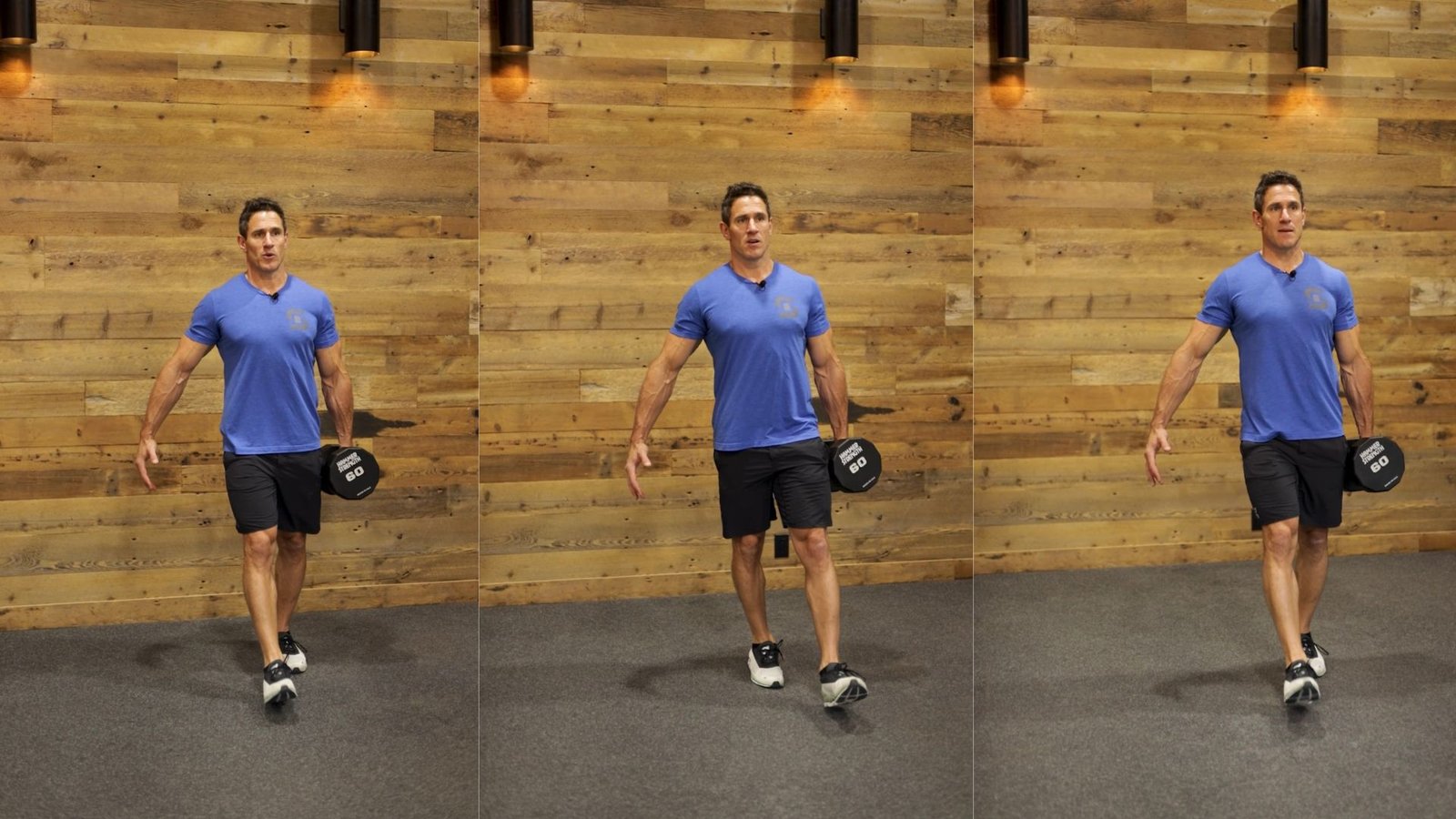
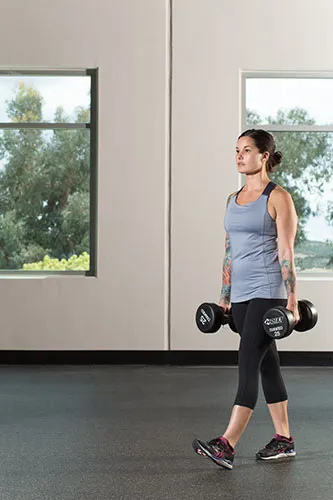
A bilateral farmer’s carry, shown here, is another option when you want to practice carrying a balanced load. It does not reproduce the same offset challenge, and two weights should not be treated as an automatic progression from one. Choose the variation for the quality you want to train. Equally, a suitcase carry need not replace a plank or other direct abdominal work; different positions place different demands on the trunk.
Keep carries as an accessory to a complete program. Squats, hinges, unilateral leg exercises and appropriately selected hip work still have their place. A small training block is most useful when it makes the movement more repeatable: you can handle the same load with smoother steps, cover the same distance with less unwanted lean, or add a modest load without losing those qualities.
If kettlebells become a regular part of your training, keep the routine simple enough to repeat. You do not need a different implement or complicated variation every week. Consistent practice and a clear record make progress easier to recognize than turning each carry into a new test.

Functional Fitness Shirts & Workout Gear
Functional-fitness shirts, tanks and workout gear for athletes who train strength, conditioning and everything in between.

Super Kettlebell Hero Superman & Gymbros Meme Top T-Shirt
Show some superhero attitude with a playful “Super Kettlebell Gym Hero” tee.

Heavy Metal – Kettlebell Rock Music & Gymbros Meme T-Shirt
Heavy lifts, good laughs, and a little “Heavy Metal” energy.

OnlyGains Kettlebell Meme Meme Athletic Shirt Tank Top
Train hard, laugh a little, and rep “OnlyGains”.

Hells Kettlebells Hells Bells Parody AC/DC Heavy Metal Tank Top
Your gym-day look, with a playful “Hells Kettlebells” twist.

Gym Equation Kettlebell Makes Me Happy Meme Crewneck an T-Shirt
Bring “Gym Equation” humor to your everyday gym style.

Vitruvian Kettlebell Tee
Heavy lifts, good laughs, and a little “Vitruvian Man With Kettlebells” energy.

Kettlebell Heartbeat Hooded Pullover Workout Fans Hoodie
Keep it laid-back with a little “Kettlebell Heartbeat” attitude.

Grunge Kettlebell Sticker
Put “Grunge Kettlebell” gym humor on your laptop, bottle, or gym gear.

Atlas Kettlebell Earth Meme Greek God Top T-Shirt
Make gym days more fun with “Atlas Kettlebell Earth Lifter” style.

For Whom The Bell Curls Metallica Kettlebell Workout De Sticker
Bring “For Whom The Bell Curls” attitude to your water bottle or laptop.