Advertising disclosure: This page includes affiliate product links that may earn us a commission, as well as products from our own store.
Smith Machine Bulgarian Split Squats: Find Your Stance and Control the Rep
A Smith machine can make Bulgarian split squats more repeatable, but it cannot pick the right stance for you. The guided bar removes some of the balancing work while your front leg still has to produce force. That makes the exercise attractive for demanding quad and glute sets. It also means a poor bench position or awkward bar track will repeat the same mistake every rep.
The goal is not a dramatic-looking split squat with a mountain of plates. It is to find a steady front-foot position, place your rear foot without twisting your hips, and use the machine’s safeties correctly. This guide covers the setup decisions worth testing, what changes compared with dumbbells, and an original six-week progression that treats control as the first performance metric.
1. Check the Smith machine before you worry about load
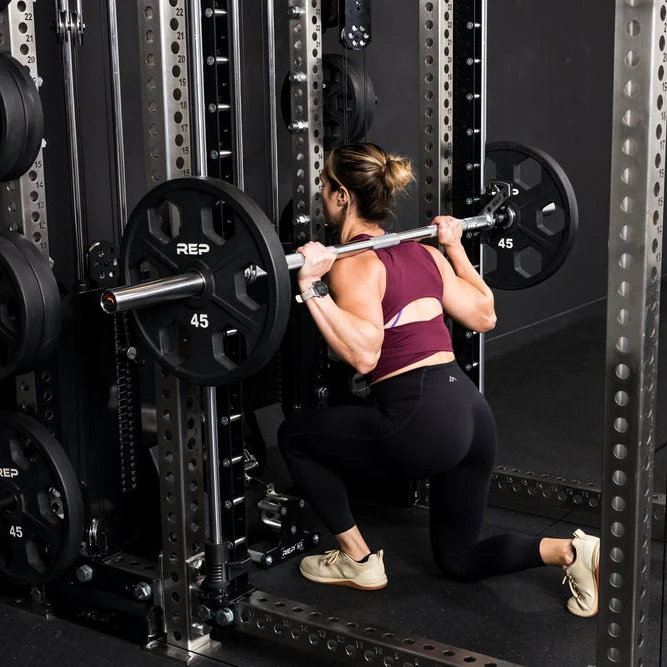
Start by identifying how the machine actually moves. Some Smith bars travel vertically while others follow a slightly angled track. Face the direction that lets the bar move naturally through your chosen split-squat position and confirm that you can rotate the hooks to re-rack without turning your torso. Practice that action on two feet before placing a foot on a bench. A track that feels smooth during a bilateral squat can still feel awkward when only one leg supports most of your weight.
Set the bar near a comfortable upper-back height, not so high that you must rise onto your toes to lift it from the hooks. Place it on the muscular shelf of your upper back rather than directly against your neck. Grip securely, brace your trunk, and make sure neither end of the bar will catch the bench or other rack attachments during the descent. Clear enough space behind the machine that you can step out safely after a full re-rack.
Adjust the safety stops before your first loaded repetition. Their useful setting is just below the lowest controlled position you intend to reach, without allowing a failed rep to collapse dangerously far. The exact stop height depends on your leg length, bench height and the machine’s construction. Test it with no added plates; never assume a fixed-track bar is automatically safer just because it cannot tip sideways like a free barbell.
Finally, check the stated starting resistance. Many Smith machines use counterbalanced bars or different mechanisms, so the resistance you feel may not equal a standard Olympic bar. Record your own machine and plates rather than translating numbers from someone else’s lift. If the machine lacks usable safety stops or you cannot confidently re-rack from your stance, use dumbbells or a supported split squat instead.
2. Set the rear foot without fighting the bench
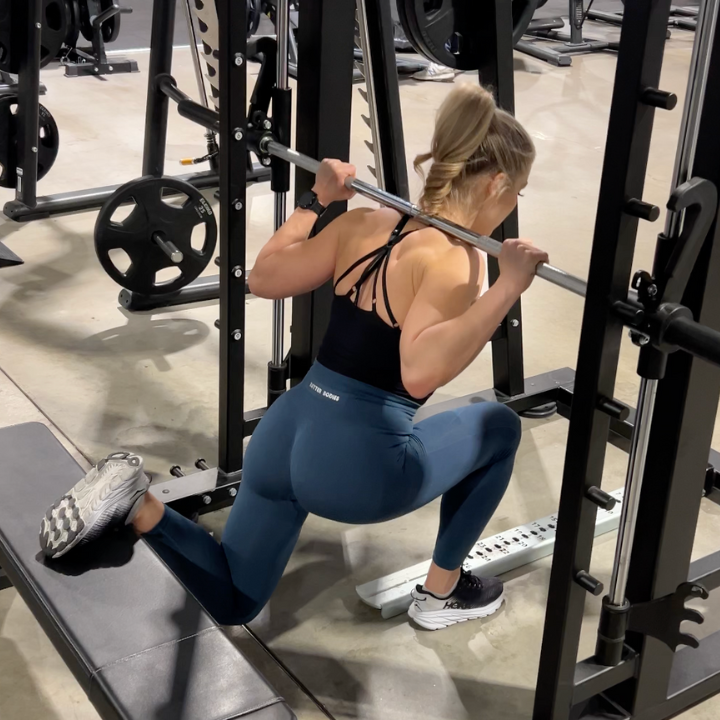
Move a stable bench or purpose-built rear-foot roller behind you, roughly around knee height as a trial rather than a universal measurement. A higher surface is not automatically more productive. If the bench forces excessive hip extension or makes your back leg cramp, lower the support or bring it closer. A padded roller may feel more natural than a flat bench, but only if it is fixed securely and compatible with the rack. Do not improvise a rolling or sliding support.
For most lifters, resting the top of the rear foot on the bench is easier to repeat than balancing on pointed toes. Place the rear leg gently; it is there to provide some balance, not to push you out of the bottom. The leading foot should take most of the load. If the back quad or hip flexor becomes the main limiting sensation, recheck the distance, support height and whether your pelvis is rotating toward that side.
Find the bench position before adding plates. Stand under the guided bar, put the front foot where you expect to lift, then reach the other foot backward without hopping or pulling your hips out of alignment. If that movement is already awkward when the bar is racked, the loaded version will not become cleaner by magic. A low step or assistance from a training partner can help establish the stance while you learn, but never depend on unstable support.
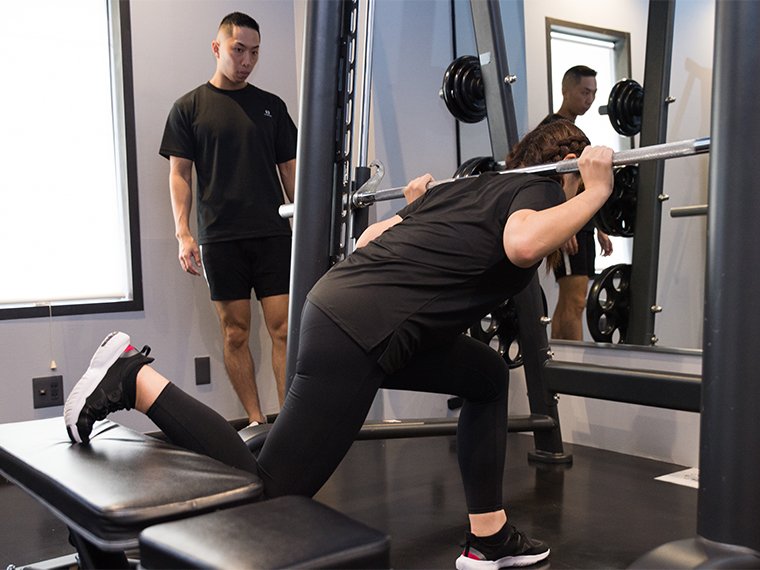
Perform three slow trial descents with the empty Smith bar or its minimum resistance. The rear knee should travel toward the floor without an uncomfortable stretch or contact with the rack. From the side, your hips should stay approximately square and the bench should not shift. Record the machine, support height and front-foot location so your next session begins from a known setup rather than five minutes of guesswork.

Equipment Worth Exploring
Explore equipment, accessories and gear from our carefully selected range.

Multi Pull Smith Rack MPHR-780
All-in-one rack with a Smith machine, functional trainer, lat pulldown and low row.

Multi Bench MBX-650 2.0
Adjustable multi-bench with roller adjustment, 15 backrest positions and accessory mounts.



FID Bench MAX
Adjustable bench offering flat, incline, and decline positions + adjustable headrest.


Foldable Wall Rack
Wall-mounted folding squat rack designed to save floor space between workouts.


3. Put the front foot where your own joints can move
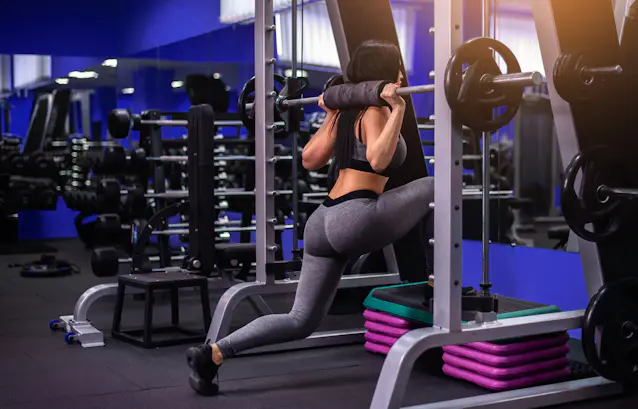
There is no single correct distance between the standing foot and the Smith bar for every body shape. Start with a long but comfortable split stance, heel flat, and enough space for the knee and hip to bend together. Lower slowly. If you are forced onto your toes, jam the front knee forward, or lean awkwardly against the guided bar, move the front foot a small amount and try again. The fixed track makes these small placement changes unusually noticeable.
A knee traveling past the toes is not automatically a technical failure. What matters is whether the knee follows the direction of the toes, the heel stays grounded, the pelvis remains controlled and the chosen depth is tolerable. An overly rigid instruction to keep the shin vertical can create an exaggerated stride and poor balance. Use a position that allows the knee to bend naturally rather than chasing an arbitrary angle from a photograph.
Torso angle changes how the repetition feels. A modest forward lean can allow more hip involvement, while a relatively upright posture may feel more quad-dominant. Neither is a guarantee of selective muscle growth. Keep the trunk braced, avoid a collapsing lower back, and let the hip and knee work together instead of throwing your chest forward at the bottom. Think of your torso as a controlled unit rather than a lever you swing to finish the rep.
Lower until you approach the deepest range you can repeat without bouncing, losing the front heel or twisting your pelvis. The rear knee may finish near the floor, but it does not need to strike it. Pause briefly to check control, then push through the whole front foot to rise. If one side reaches less depth, let the more restricted side set the initial range for both legs; build better movement before adding weight.
4. Compare the Smith version with dumbbells honestly
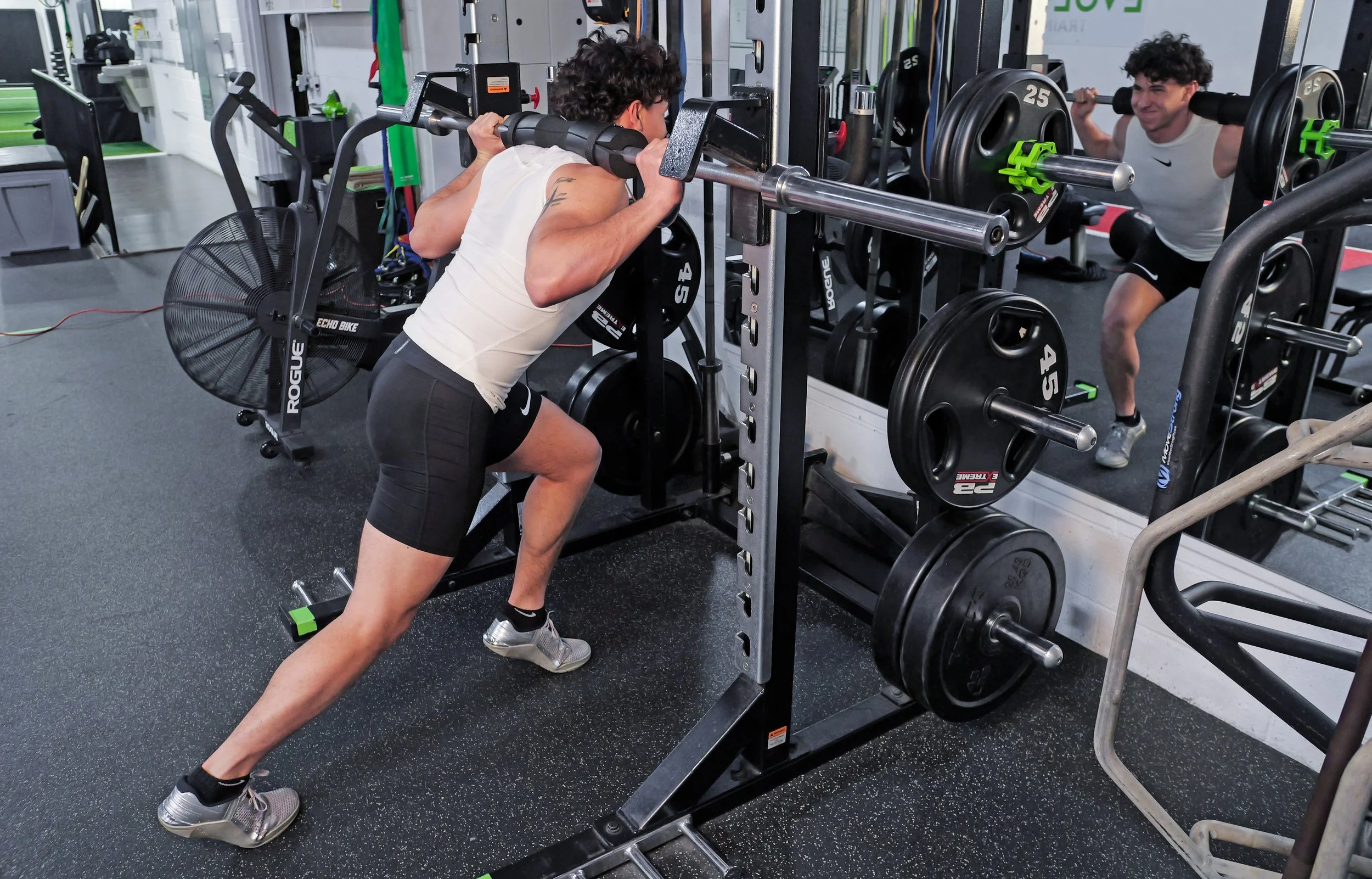
The Smith machine is useful when balancing two dumbbells becomes the bottleneck before the working leg is close to fatigue. With a guided bar, you can devote more attention to repeating the same path and slowing the eccentric phase. That does not make the exercise universally better for hypertrophy. It removes one stability challenge while introducing a fixed path that may or may not suit your build. You still need to find a position that lets the front leg do meaningful work.
Dumbbell Bulgarian split squats have their own advantages. The weights can hang at your sides, your trunk and hips can make small natural adjustments, and you can release the weights more easily if a rep goes wrong. They also demand grip and balance. A conventional split squat with the back foot on the floor is often the better teaching step when someone cannot yet set the rear foot safely or maintain an even pelvis.
Use the same comparison criteria for both versions: controlled depth, clear tracking, honest range, proximity to fatigue and how your joints respond the next day. Do not compare the displayed load directly. Smith counterbalance, bar path and the support leg change how much external weight you are moving. A 60-kilogram Smith set is not interchangeable with two 30-kilogram dumbbells, even if both feel hard for eight repetitions.
For a general leg session, placing this exercise after a heavy bilateral squat or leg press can work well. For a unilateral emphasis, doing it earlier may give you better concentration and a more repeatable range. The best sequence is the one in which your performance can be tracked without compensating. If the fixed path provokes discomfort despite reasonable setup adjustments, choose the free-weight variation rather than forcing your body to fit the machine.
Equipment Worth Exploring
Explore equipment, accessories and gear from our carefully selected range.


Rubber Hex Dumbbells
Rubber-coated hex dumbbell pairs with a stable shape for home and commercial strength training.


Competition Plates
Competition-style bumper plates for Olympic lifts and loaded strength training.

Grip Plates
Rubber-coated weight plates with handholds for loading barbells and machines.


Speed Collar
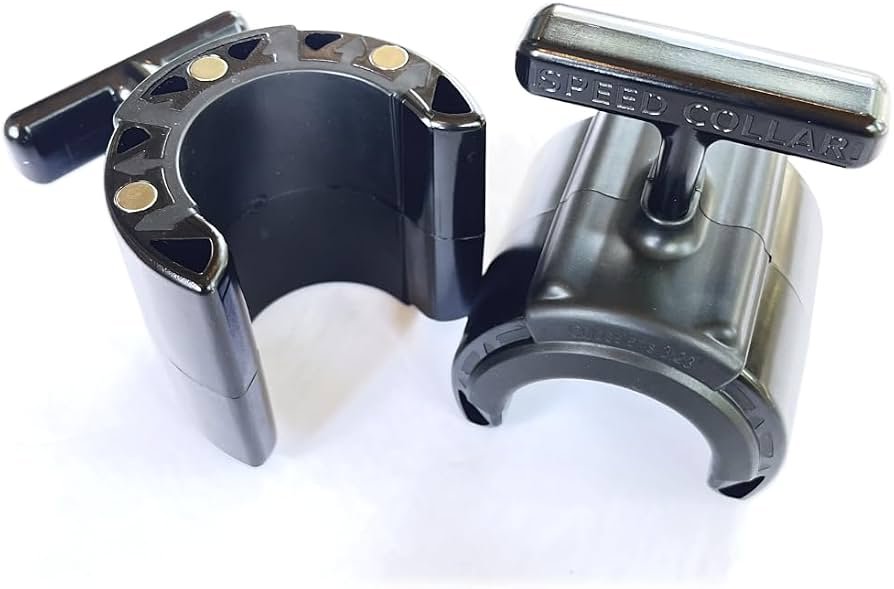
Quick-release collars designed to secure weight plates on standard two-inch Olympic bars.
Keppi Open Collars
C-shaped magnetic Olympic barbell collars with a quick-lock mechanism and grippy lining.

Leg Day Shirts & Workout Gear
Leg-day gym shirts and workout gear for lifters who never skip squats, lunges and lower-body punishment.

I Love Squats – Valentine's Day Leg Day Meme Hooded Pul Hoodie
Keep it laid-back with a little “I Love Squats” attitude.

Quadzilla Massive Quads Sweater Leg Day Squatting T-Shirt
Keep things casual with a little “Quadzilla” attitude.

My Leg Hurts Leg Day & Squat Meme Fans Vest Tank Top
Train hard, laugh a little, and rep “My Leg Hurts”.

Negative Leg Day Review 1 Star Not Recommended Decal Sticker
Stick a little “Negative Leg Day Review” humor on your favorite gear.

The Quadfather Leg Day Meme Top & T-Shirt
Bring “The Quadfather” humor to your next gym day.

3 Plates Squat Club : Essential Meme & Leg Day T-Shirt
Make gym days more fun with “3 Plates Squat Club” style.


Squatzilla Meme Leg Day & Squat Fans Hooded Hoodie
Show off your leg-day humor in a laid-back “Squatzilla” hoodie.

Never Skip Leg Day Chicken Legs Meme Sweater & Bros T-Shirt
Show some gym-day personality with “Never Skip Leg Day”.

Squats R Us Shirt – Leg Day Gains & T-Shirt
Heavy lifts, good laughs, and a little “Squats R Us” energy.
5. Use six weeks to earn load, not just collect plates
Two sessions per week are enough for a focused trial if they fit your overall lower-body workload. Leave at least a day between demanding sessions, and avoid piling this onto every hard squat, lunge and leg-press day. Start conservatively: two working sets per leg, with six to ten smooth repetitions at a load that leaves roughly three repetitions in reserve. A consistent two- to three-second lowering phase is a useful coaching cue, not a scientifically mandated magic tempo.
During weeks one and two, prioritize a repeatable setup. Mark the front-foot placement, record the bench height and film one set from the side if possible. Add a third set in weeks three and four only if you are recovering comfortably and maintaining the same depth on both sides. In weeks five and six, progress by one or two clean repetitions before increasing external weight. Small plate jumps make more sense here than ambitious jumps based on bilateral squat strength.
An example for a lifter starting at two sets of eight per leg is straightforward: week one, 2 x 8; week two, 2 x 9; week three, 3 x 8; week four, 3 x 9; week five, 3 x 10; week six, add a small amount of weight and return to 3 x 8. These are illustrative starting numbers, not an individualized prescription or a trial-proven progression. Slow down or repeat a week when fatigue, balance or range deteriorates.
Track more than plates. Note front heel contact, rear-foot pressure, bottom depth, side-to-side difference and whether the last repetition matched the first. Re-rack deliberately before switching legs. Stop a set if you cannot control the descent, and do not push through sharp knee, hip or back pain. In many cases the biggest upgrade is finding a safer bench location and a better stride, not discovering a new loading trick.
The practical test at six weeks is whether you can make the same movement with better control, more repetitions or a modestly heavier load without losing range. If so, the Smith version has earned its place in your training. If the rail path still feels like a fight, you have learned something useful too: use a dumbbell or floor-supported split squat and keep progressing the legs rather than protecting one exercise variation at all costs.
Leg Day Shirts & Workout Gear
Leg-day gym shirts and workout gear for lifters who never skip squats, lunges and lower-body punishment.

Heavy Squatter Harry Potter Squat Lovers Leg Day Hoodie
Show off your leg-day humor in a laid-back “Heavy Squatter” hoodie.

Squat Inspector Gym | Edgy Leg Day Meme Workout | Booty Hoodie
Make your off-duty look more fun with “Squat Inspector”.

Squat Queen Gym | Funny Burger King Parody Workout | Le Hoodie
Stay casual and show some burger-loving attitude with “Squat Queen”.

Anti Leg Day Leg Day Club Meme Sweater T-Shirt
Show some gym-day personality with “Anti Leg Day Leg Day Club”.

Squat Here | Edgy Workout Decal for Water Bottles & Gym Sticker
A fun “Squat Here” touch for bottles, laptops, and lockers.

Everyday Is Leg Day Octopus Meme & Top T-Shirt
Show some leg-day attitude with a playful “Everyday Is Leg Day Funny Octopus” tee.

Shirt – Legendary Leg Day Meme Gymbros, & Fans T-Shirt
Make gym days more fun with “Legendary Leg Day Meme” style.

Hippo Thrust Meme – Hip Thrusts & Leg Day , Gymbro, T-Shirt
Bring “Hippo Thrust Gym Meme” humor to your next gym day.

I Love Booty Peach Meme – Leg Day Top T-Shirt
Bring “I Love Booty Peach Gym Meme” humor to your next gym day.

Leg Day Squats Deadlifts Decal Meme Vinyl Sticker
Give your everyday gear a playful “Leg Day” twist.