Advertising disclosure: This page includes affiliate links that may earn us a commission at no additional cost to you.
John Grimek’s career challenges a familiar gym argument: do you have to choose between looking muscular and being able to lift impressive weights? He competed in Olympic weightlifting in 1936, then won Mr. America in 1940 and 1941. Those achievements came from very different competitive settings. They are also a reminder that the same body can develop more than one physical quality when the training is organised accordingly.
His results are interesting not because a famous physique proves a particular training method is unbeatable, but because they illustrate the difference between developing muscle, expressing strength under competition rules and learning to present the physique onstage. Modern lifters can use that distinction to make better decisions without copying every detail of a champion’s training from nearly a century ago.
One athlete, two very different competitions
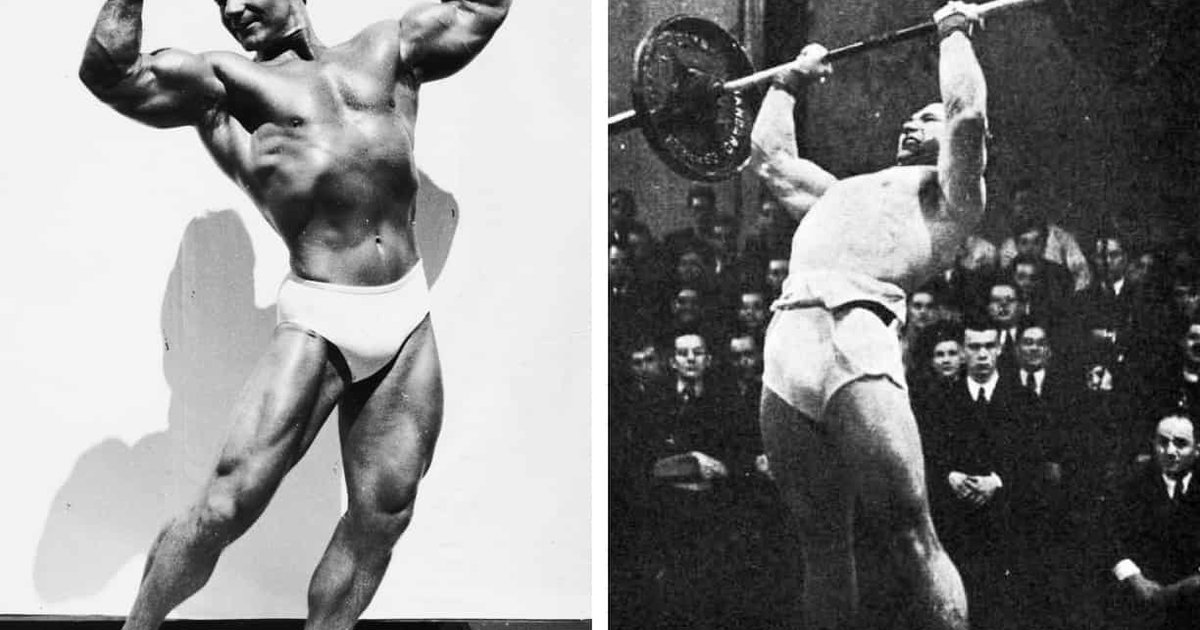
Grimek grew up in New Jersey, took up weight training as a young man and competed in an era when the boundaries between physique exhibitions and competitive lifting were much less rigid than they are today. In 1936 he won the American heavyweight weightlifting championship and qualified for the Berlin Olympics. He placed ninth there. He was not an Olympic champion, and presenting him as one would obscure what actually made his career distinctive.
Four years later he won Mr. America, followed by a repeat victory in 1941. He added the 1948 Mr. Universe title, defeating Steve Reeves, and won Mr. USA in 1949. The competition dates matter: his achievements were not merely a youthful strength phase followed decades later by a physique career. His first national physique title came while he was still competing in weightlifting.
In weightlifting the result depends on completing prescribed movements within the rules, and your total is measured in weight. A physique competition asks judges to evaluate the athlete’s appearance and presentation. The requirements of the contests have changed over time, so neither the lifting rules nor the judging standards of the 1940s should be confused with the modern versions.
This is also why a strong bench press does not automatically settle a bodybuilding comparison, just as a photograph of huge arms does not reveal an athlete’s clean and jerk. The training overlaps, but the tests are different. If you want both, measure both instead of letting one stand in for the other.
The 1940 total behind the physique
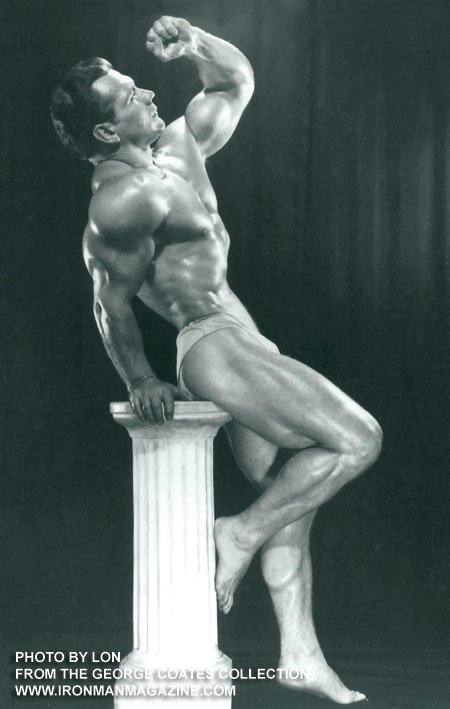
At the 1940 American national weightlifting championships, Grimek recorded a 285-pound press, 250-pound snatch and 325-pound clean and jerk. Together those lifts amounted to 860 pounds, approximately 390 kilograms. The same evening he won his first Mr. America title. The historical combination is much more informative than a list of alleged gym records, because it connects his lifting ability to a specific contest and date.
| 1940 event | Weight | Approximate metric equivalent |
|---|---|---|
| Press | 285 lb | 129 kg |
| Snatch | 250 lb | 113 kg |
| Clean and jerk | 325 lb | 147 kg |
| Total | 860 lb | 390 kg |
The press was then part of competitive weightlifting. Modern Olympic weightlifting uses only the snatch and clean and jerk, so comparing his three-lift total with a contemporary two-lift total would be misleading. Even a historical press should not be treated as identical to a strict standing press performed under today’s gym conventions. Different equipment, rules and judging make comparisons more complicated than converting pounds into kilograms.
For recreational training the lesson is to keep your own standards consistent. Record whether a press is seated or standing, whether you use leg drive, how far you lower the weight and whether a repetition is completed without assistance. A set of six at one weight is not necessarily progress over a set of five if the additional repetition comes from changing the movement. The more clearly you define the lift, the more meaningful your training log becomes.
What muscle control added to the stage
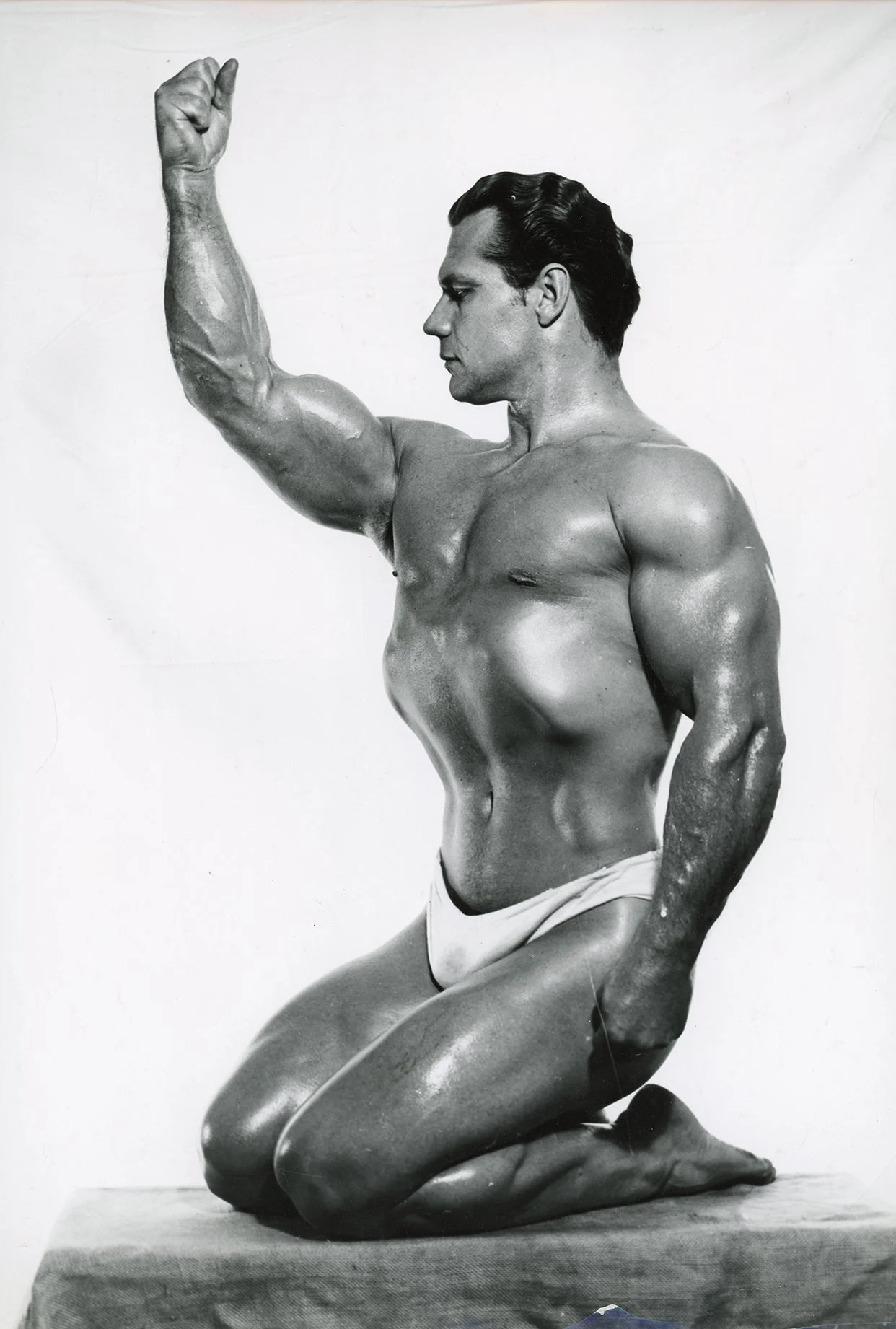
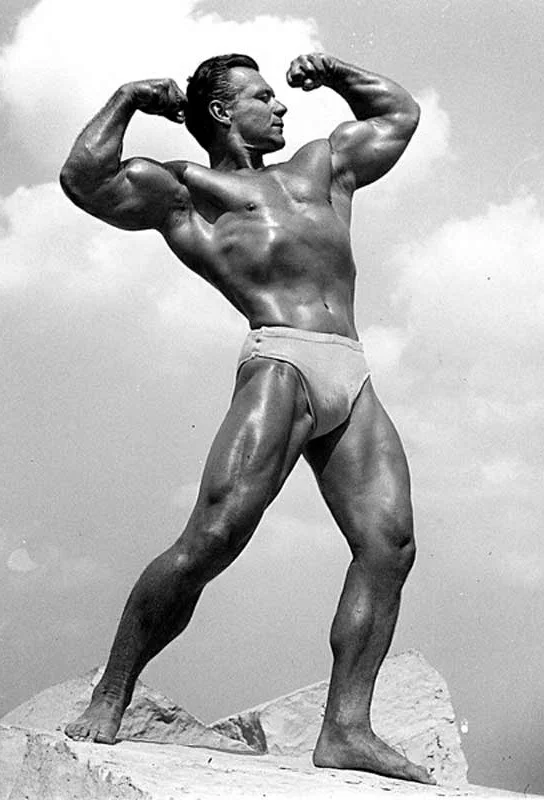
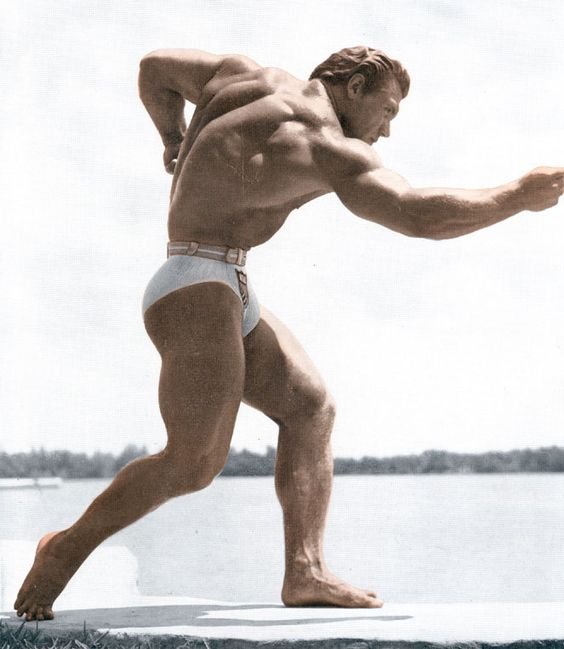
Grimek was also renowned for his ability to control and move his muscular body. His account of the 1948 Mr. Universe competition describes an extended sequence of poses and a display of flexibility and balance. That recollection is evidence of his approach to presentation, not a reason for a modern beginner to attempt advanced gymnastic movements without preparation.
At the time, heavy resistance training was often associated with a belief that muscular athletes would become slow and inflexible. An athlete who could demonstrate substantial muscle mass and coordinated movement helped challenge that assumption. That does not mean every heavily muscled person will automatically become flexible. Training through a controlled range, practising mobility and learning movement skills still matter.
There is a useful distinction between active control and passive range. A lifter may be able to move a shoulder through a wide arc with assistance but struggle to control the same position with a load. For a physique athlete, the ability to hold a pose steadily is another skill entirely. Neither ability can be inferred from muscle size alone.
Practise the movements you actually want to improve. A few controlled bodyweight squats, shoulder movements and easy pose holds can be included after warm-ups or at the end of sessions. Progress gradually and do not force a painful joint position. The objective is to own a comfortable range, not to demonstrate how far you can push it on a single afternoon. A heavier load is not the only way to make a movement more demanding.
Build strength and muscle without chasing two peaks
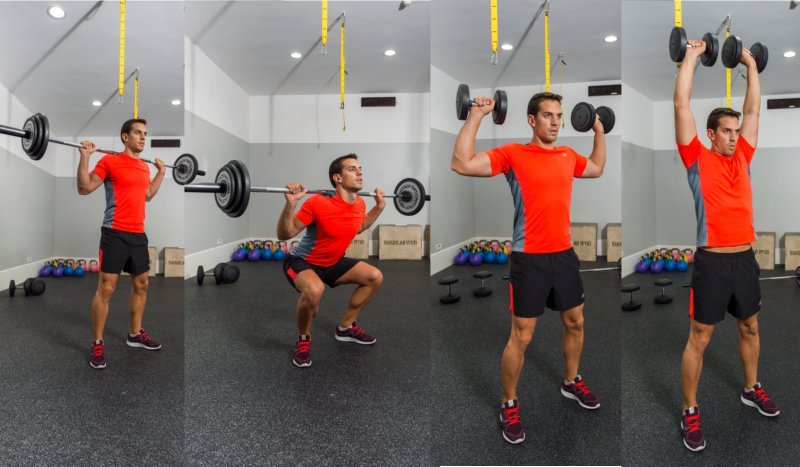
A modern trainee who enjoys both strength training and bodybuilding does not need to enter two competitions. Start by deciding which lifts you want to improve and which muscle groups you want to develop. A squat, a press and a hinge can give you a few repeatable strength measurements. Rows, pulldowns, split squats and isolation exercises let you address areas that the primary lifts might not train sufficiently for your physique goals.
For the main lifts, keep most working sets in a manageable range of repetitions, often around four to eight, with one to three good repetitions left in reserve. For accessory work, a range of eight to fifteen or more can make it easier to control the movement and accumulate quality repetitions. These are useful starting ranges, not a claim that muscle growth only happens within them.
A sensible way to allocate effort is to perform the lift you care about most while fresh. Then use the rest of the session to train the surrounding muscle groups. If your standing press is the priority, put it before lateral raises and triceps extensions. If chest growth matters more that day, a stable bench press or dumbbell press might take the first slot instead. You can alternate those priorities across the week.
Avoid changing the programme every time a session feels difficult. Keep the main movements consistent for several weeks, log the sets and adjust the next exposure according to what you actually achieved. An athlete’s physique and strength are cumulative outcomes; one dramatic session tells you surprisingly little about either. Choose equipment that lets you repeat the movement safely, including appropriate rack safeties, secure plates and a stable bench where required.

Equipment Worth Exploring
Explore equipment, accessories and gear from our carefully selected range.


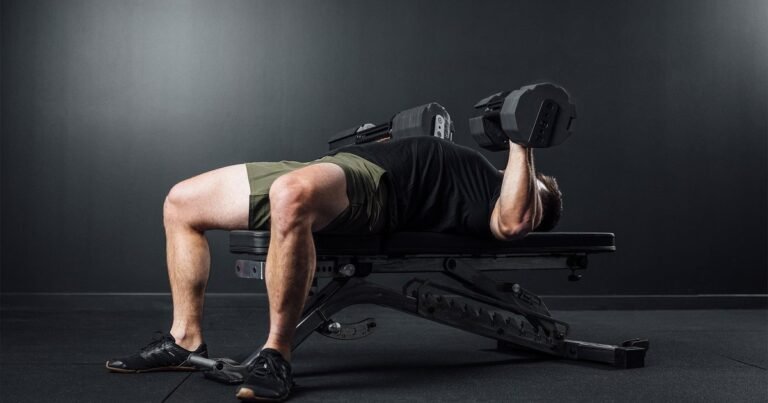
Rubber Hex Dumbbells
Rubber-coated hex dumbbell pairs with a stable shape for home and commercial strength training.


Multi Bench MBX-650 2.0
Adjustable multi-bench with roller adjustment, 15 backrest positions and accessory mounts.

Grip Plates
Rubber-coated weight plates with handholds for loading barbells and machines.
A three-day programme inspired by the crossover
The following is a contemporary example inspired by Grimek’s combination of lifting and physique goals. It is not his documented personal routine. The emphasis is on training the whole body, making steady strength progress and leaving room for muscle-specific work. Place a rest day between sessions when possible, especially if you are returning to lifting.
| Session | Primary work | Additional work |
|---|---|---|
| Monday | Squat 3×5–8; standing press 3×5–8 | Row 3×8–12; leg curl 2×10–15; lateral raise 2×12–15 |
| Wednesday | Romanian deadlift 3×6–8; bench press 3×6–10 | Pulldown 3×8–12; split squat 2×8–12 each side; curls 2×10–15 |
| Friday | Squat variation 3×6–10; dumbbell press 3×8–12 | Chest-supported row 3×8–12; calf raise 2×12–15; triceps extension 2×10–15 |
Use warm-up sets before the primary exercises and rest long enough between demanding sets to perform the next one with similar technique. Choose starting loads that allow roughly two repetitions in reserve. If you reach the top of the range for all prescribed sets with that margin, add a small increment next time. If technique deteriorates or the last repetition becomes a grind, repeat the load or reduce it.
For weeks one and two, establish repeatable technique and loads. In weeks three through six, increase repetitions or resistance gradually where performance allows. If recovery or joint comfort worsens, reduce a set or two rather than trying to force the schedule. At the end of the block, compare your log with the starting week. Assess physique progress over a longer period using consistent photographs or measurements rather than daily fluctuations.
If you want to learn the snatch or clean and jerk, treat that as a separate skill priority and seek qualified coaching; this example deliberately does not prescribe advanced Olympic lifts. You do not need to reproduce historical strength feats to benefit from the underlying idea. Grimek’s career is a useful reminder that muscle size and the ability to use that muscle can coexist, but each deserves its own training decisions and its own measure of progress.

Bodybuilding Shirts & Workout Gear
Bodybuilding shirts, tanks and gym gear for lifters chasing muscle, size, symmetry and the pump.

Old School Weight Strongman – Meme Shirt & Top T-Shirt
Show some powerlifting attitude with a playful “Old School Weight Lifter Strongman Graphic” tee.

Atlas Lifting The Earth Meme Strongman Shirt T-Shirt
Bring “Atlas Lifting The Earth” humor to your next gym day.

Iron Addict Shirt – Weights & Lifting Meme & Gains T-Shirt
Bring “Iron Addict” humor to your next gym day.

Lift Heavy Be Happy Meme Bros & Gains Top T-Shirt
Show some powerlifting attitude with a playful “Lift Heavy Be Happy” tee.

Hardcore Gains Gym | Funny No Pain No Gain Workout Deca Sticker
Put “Hardcore Gains” gym humor on your laptop, bottle, or gym gear.

Hercuflex Greek God Sweatshirt
Add a playful “Hercuflex Gym Motivation” touch to your casual rotation.

Discipline Greek God Statue Stoic Sigma T-Shirt
Heavy lifts, good laughs, and a little “Discipline Greek God Statue Funny Stoic” energy.

Funny Gymrat Mousetrap | Gym Rat Muscle Shirt | Next Cu Tank Top
Train hard, laugh a little, and rep “Gymrat Mousetrap”.

Big Boy Barbell Club Shirt Meme & Essential Top T-Shirt
Make gym days more fun with “Big Boy Barbell Club” style.

Massquatch Bigfoot Sasquatch Sweater & Meme Fans T-Shirt
Bring “Massquatch Bigfoot” humor to your everyday gym style.