Advertising disclosure: This page includes affiliate product links that may earn us a commission, as well as products from our own store.
A half-kneeling single-arm cable pulldown can make back work feel precise: one handle, one elbow path and no second arm to hide the weaker side. The benefit is not automatic. Cable height, kneeling stability, trunk control and the movement of the upper arm decide whether it remains a clean pulldown or turns into a crooked row. This guide explains how to set it up, compare alternatives and progress without confusing more weight with better repetitions.
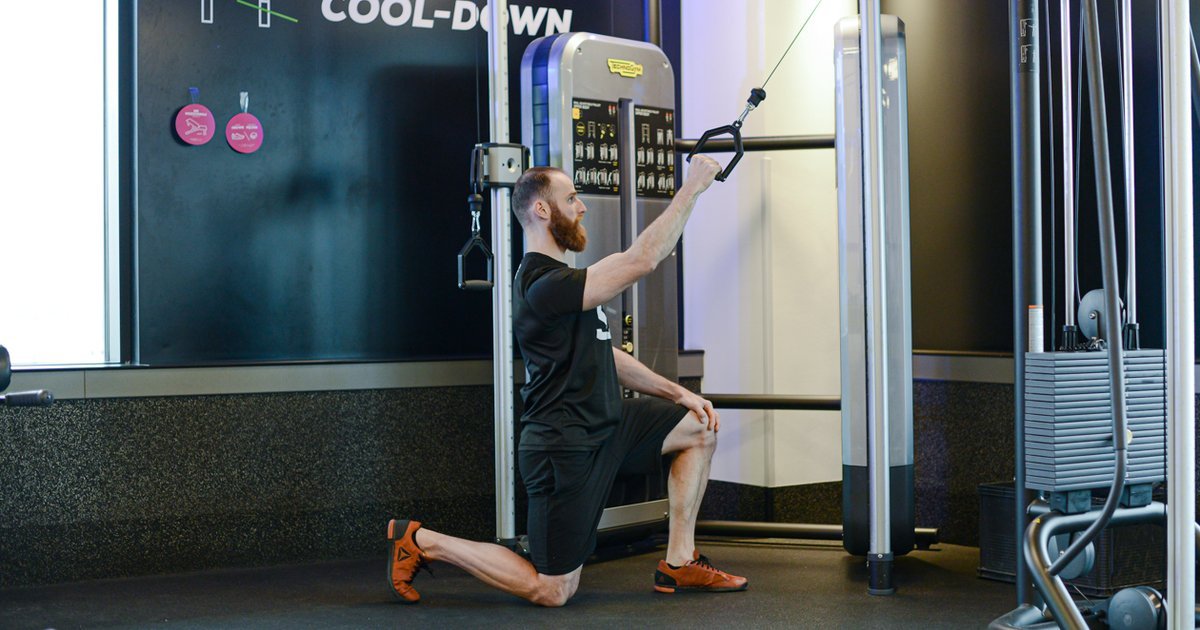
Set the high pulley and stable half-kneeling stance
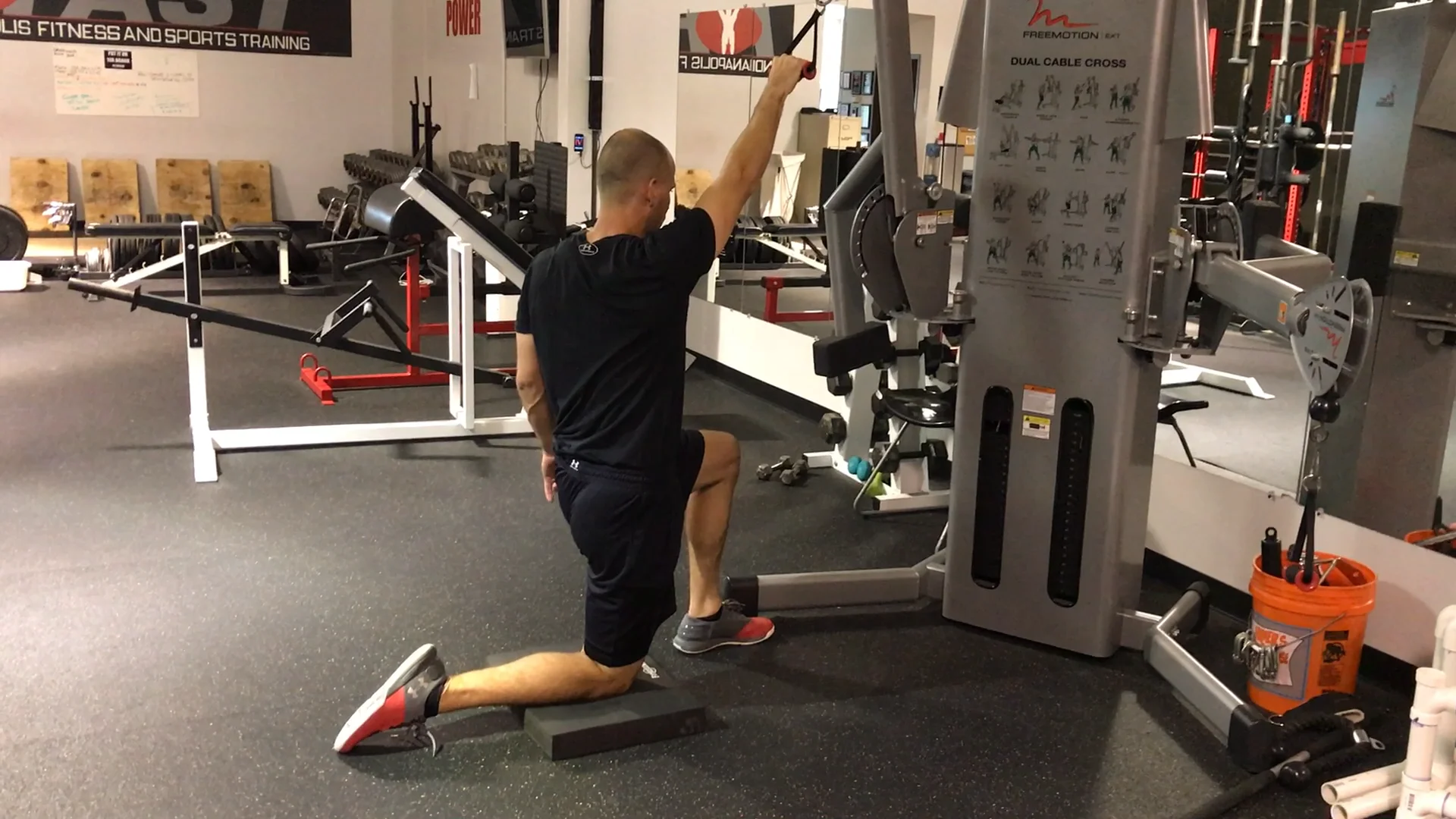
Before adding resistance, make sure the pulley is genuinely overhead. A cable set too low turns the movement into a diagonal row. Clip on a single handle and step back until the cable can run from a high attachment point toward your working hand without the handle, carabiner or machine contacting your shoulder. The path should give you a useful overhead reach as well as enough travel to draw the elbow down beside the torso. Check the stack remains under tension at both ends.
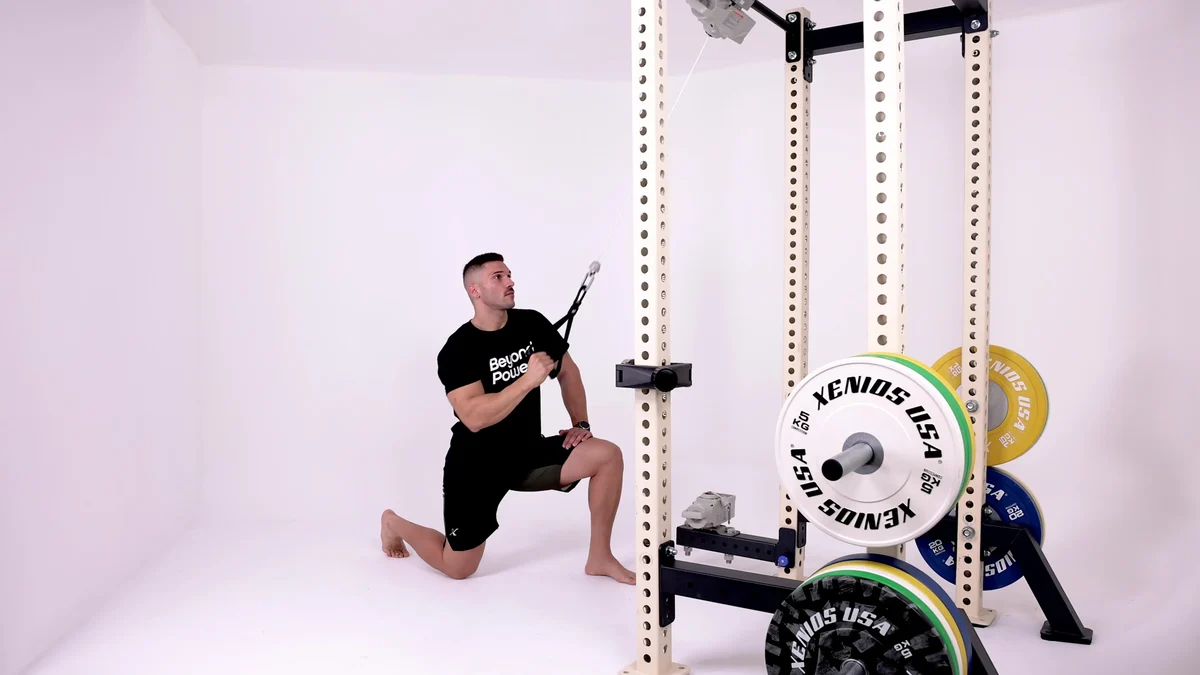
Place a mat under the rear knee and set the forward foot flat. Move the feet far enough apart that you can hold your pelvis fairly level rather than balancing on a narrow line. The knee under the working arm versus the opposite knee is not a universal rule: both can work, provided the position feels stable, the hips stay oriented toward the pulley and the working shoulder has freedom to move. Try both with a light load instead of treating a particular knee position as a growth secret.
Keep the ribs over the pelvis and the neck long. The free hand can rest on the front thigh as a reference, not as a lever to twist your chest. If the first cable pull tips you forward, choose less weight and reset your distance rather than leaning back to counterbalance the stack. A stable rep starts before the handle moves, because the trunk should not need to invent a new posture at the bottom of every repetition.
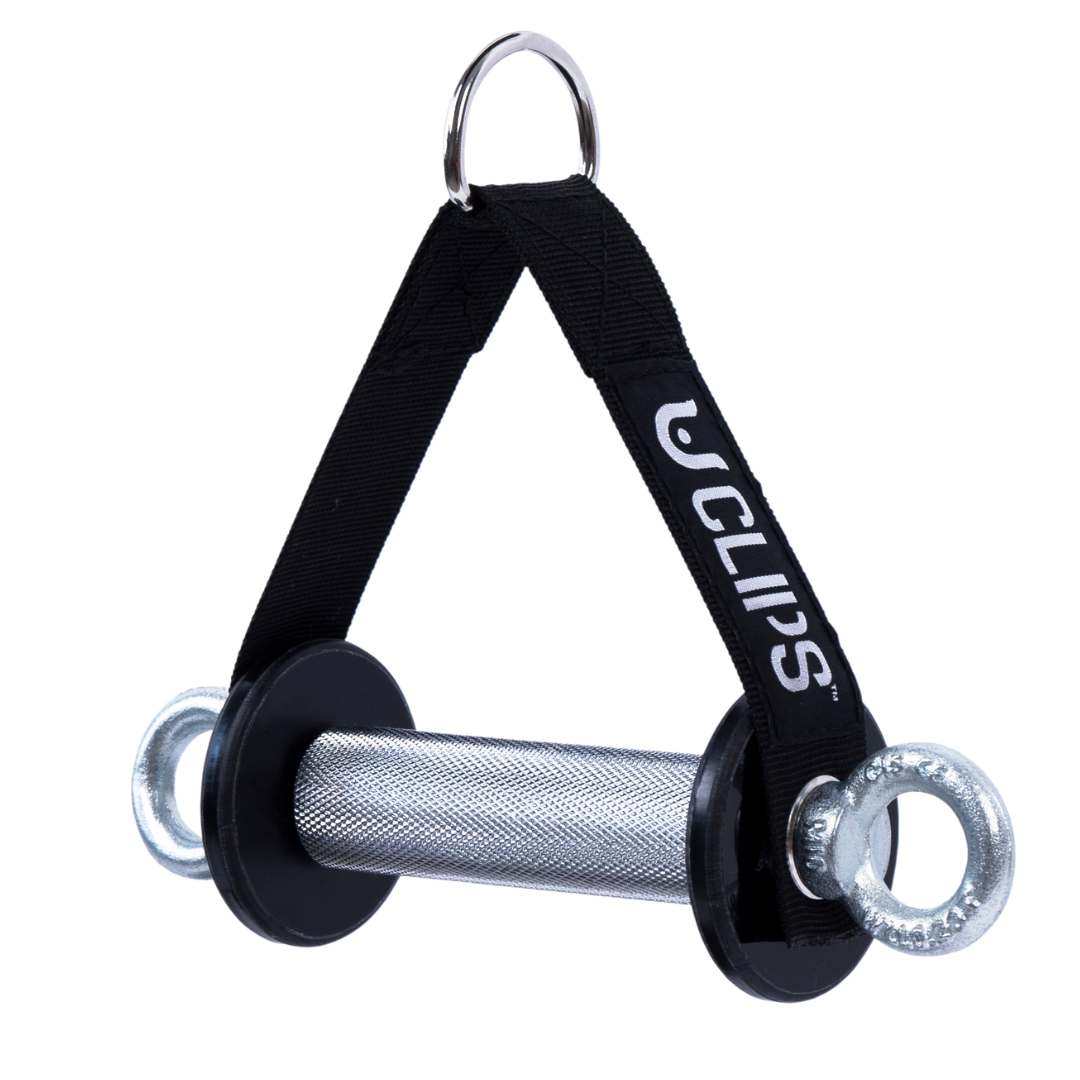
Use a neutral-grip D-handle or another comfortable single-hand attachment. Let the elbow straighten into an overhead reach you can control, and allow the shoulder blade to move naturally instead of locking it down. Painful shoulder positions are not prerequisites for full range of motion. A five-rep practice set on each side should confirm that the cable clears your body, the knee stays comfortable and you can finish where you began.

Equipment Worth Exploring
Explore equipment, accessories and gear from our carefully selected range.

Trinity Lat Machine LSW-850
Weight-stack pulldown tower offering three cable directions and adjustable seated support.

VForce Lat Tower
Wall-mounted cable tower with pivot arms and adjustable 1:1 or 2:1 pulley ratios.

Multi Pull Smith Rack MPHR-780
All-in-one rack with a Smith machine, functional trainer, lat pulldown and low row.

Lat Pulldown Set
Multi-grip cable attachment set for pulldowns, rows, and varied upper-body training.

GymPin D Handle Bar
Multi-use steel D-handle bar for cable rows, pulldowns and other cable exercises.


Angles 90 Grips
Flexible grip attachments that allow natural wrist movement during pulling exercises.

GymPin Ergo Handles
Pair of ergonomic cable handles shaped for comfortable triceps and pulling exercises.
A rack-mounted cable trainer can provide the required height, but use only manufacturer-approved mounting positions and secure attachments before kneeling near the rack. A taller lifter may need a higher anchor or slightly greater distance from the rack. Neither measurement is universal. If the cable meets your head or the loading pulls you off the floor, a seated pulldown can be the better choice for the session.
Pull your elbow toward the hip rather than hauling the handle
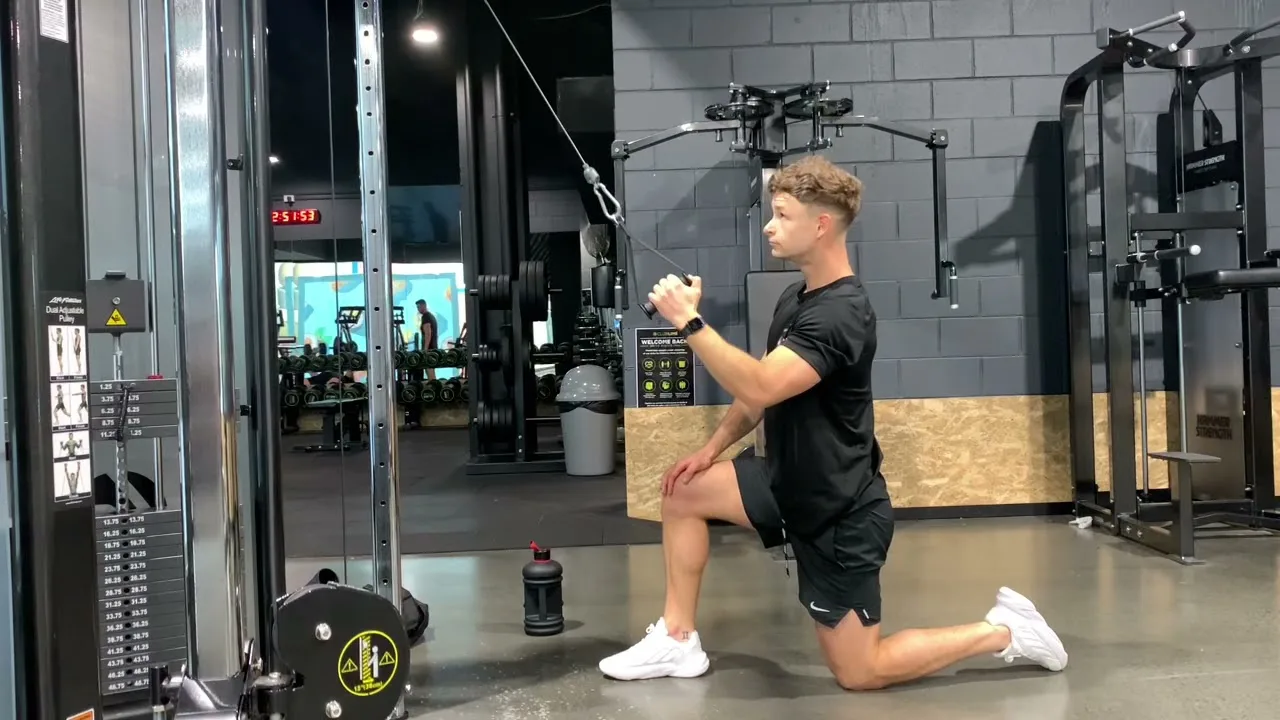
The latissimus dorsi helps bring your upper arm down and toward the trunk. The hand is a connection to the cable, not the muscle you are trying to train. From the overhead reach, guide your elbow down toward the ribs and hip with the palm oriented comfortably. Your shoulder blade is free to rise as the arm reaches overhead and move as you pull; trying to freeze it in one depressed position throughout the rep can make the motion unnecessarily stiff.
Keep the chest facing approximately forward. A small natural shift is normal with a one-sided cable load, but a deliberate twist that makes the weight easier changes the task. You should not need to throw the shoulder backward, bend your wrist sharply or lean into a row to complete the final few inches. Stop when the elbow has completed the intended path and the torso remains controlled, even if the handle does not touch your chest.
Lowering the weight should look like a deliberate reversal, not a sudden release. Let the elbow travel upward, gradually extend the arm and recover the same overhead reach without letting the stack yank the shoulder. An approximately two-second return is a useful training cue, although the exact tempo is less important than making all repetitions comparable. If you have to speed up the return to avoid losing balance, the load is too demanding for the stance.
A neutral grip generally allows the wrist to find a comfortable line; a rotating handle may make that easier but is not essential. Keep the grip secure rather than intentionally loose. The elbow flexors will contribute to this movement, so feeling your biceps work does not mean the lats are doing nothing. What matters more is whether you maintain the chosen upper-arm path and challenge it through a repeatable range.
An uncomplicated way to check your form is filming three repetitions from the front-quarter angle. Watch for a torso turn, a collapsing top position and an elbow that flares or travels far behind the body. These signs are usually more informative than counting how far the cable handle moves. A lighter stack with consistent body position creates a clearer record of your actual pulling progress.

Bodybuilding Shirts & Workout Gear
Bodybuilding shirts, tanks and gym gear for lifters chasing muscle, size, symmetry and the pump.

Dost Thou Even Pull Tee
Make gym days more fun with “Dost Thou Even Pull Medieval Knight Lat” style.


Strong Back Bodybuilder Tee
Show some lifting attitude with a playful “Strong Back Bodybuilder” tee.


Shirt Pull Day – Back & Biceps Meme Top T-Shirt
Heavy lifts, good laughs, and a little “Pull Day Graphic” energy.

Unbreakable Gains Back Tee
Make gym days more fun with “Unbreakable Gains: Strong Back Greek God” style.

Big Back SpongeBob Decal Water Bottles Meme Sticker
A fun “Big Back” touch for bottles, laptops, and lockers.
Let one-arm work reveal differences without exaggerating them
Training one side at a time prevents the stronger arm from quietly doing more of a shared-bar repetition. This can reveal that one side reaches higher, controls the return better or completes a few more clean reps. Those observations are useful coaching information, not proof of a medical asymmetry or evidence that unilateral pulldowns are always superior for muscle growth. Handedness, fatigue and unfamiliar setup can also affect your first results.
Start with whichever side has the less consistent technique. Use a load both sides can manage and match the number of clean reps rather than chasing two separate personal records. If one arm produces twelve controlled reps and the other only ten, a practical strategy is ten on both until the weaker side catches up. You do not need to add an entire corrective workout because one shoulder moves a little differently.
The exercise still recruits several muscles. Lats and teres major contribute to shoulder motion; the elbow flexors help bend the arm; the shoulder girdle moves and stabilizes; the trunk resists rotation and bending. Exact contributions depend on the cable direction, hand position and how you move. Feeling muscles other than the lats is expected, not evidence of a failed exercise.
Grip fatigue can limit a back set before the pulling muscles become the main challenge. Choose a handle that does not dig into the hand, and consider appropriate straps or supported grips when they genuinely improve back-work consistency. Do not assume a premium attachment automatically builds more muscle. The best comparison is whether it reduces irritation and makes the same range and effort easier to reproduce across sessions.
If one shoulder is painful, catches repeatedly or cannot comfortably follow the overhead path, stop and choose a comfortable alternative. Do not force the shoulder to match the other side just for visual symmetry. Persistent or recurrent symptoms deserve appropriate assessment. An exercise becomes productive when it helps you train consistently over time, not when you tolerate a sharp sensation to finish an arbitrary rep target.
Seated, tall-kneeling and two-arm pulldowns are useful alternatives
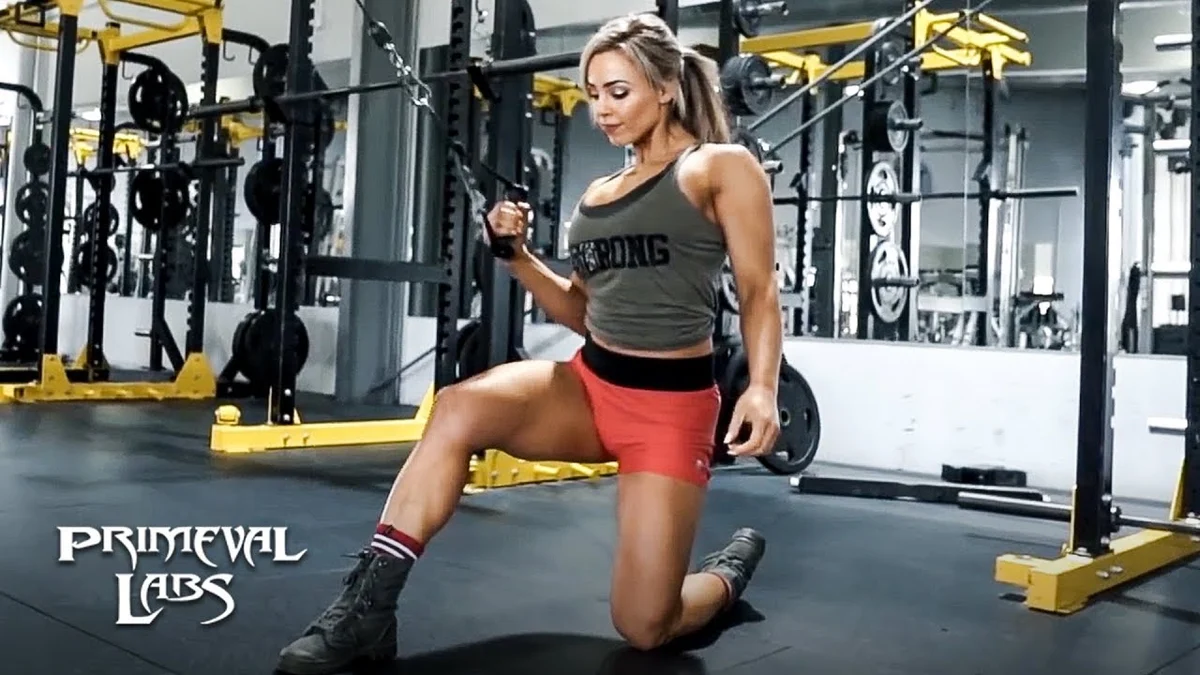
A half-kneeling pulldown removes the conventional machine thigh pad, so the torso and hips have to resist the sideways pull. This is a meaningful difference in stability demand, but extra stabilization does not automatically mean extra lat growth. When the trunk fails well before the lats, it becomes difficult to accumulate hard, comparable back sets. The exercise is valuable only if it serves the training goal you have chosen.
A seated single-arm pulldown gives the pelvis a firmer base and can be easier to load progressively. Adjust the seat, thigh pad and foot placement so the cable does not rotate the hips with each repetition. A tall-kneeling version places both knees down, removing the split stance but sometimes reducing the base of support. Neither variation should be forced if kneeling causes pain or instability.
A standard two-arm lat pulldown lets many lifters use more total load and offers straightforward progression on a stable machine. One-arm pulling can complement it by providing a different comfortable arm path and side-to-side feedback. That does not establish a clear hypertrophy hierarchy among every variation. If heavier bilateral pulldowns are going well, keep them and use a small amount of unilateral work as an accessory instead of replacing everything.
Rows are not identical substitutes because the upper arm typically moves along a more horizontal line. A program with a vertical pull, a row and some rear-shoulder work often covers more useful pulling patterns than four nearly identical versions of a cable pulldown. When you lack a suitably high pulley, a supported one-arm row may provide more productive loading than trying to improvise a dangerously low anchor.
Equipment Worth Exploring
Explore equipment, accessories and gear from our carefully selected range.
VOLTRA
Compact digital cable trainer with smooth, adjustable resistance.

Go-Tone Pro
Portable digital cable trainer with up to 66 lb (30 kg) of adjustable resistance.

VForce Wall Trainer
Space-saving wall-mounted functional trainer with pivoting cable arms and variable resistance ratios.

VForce 2IN1
Half rack and pivot-arm functional trainer with switchable 1:1 and 2:1 pulley ratios.

VForce Lat Seat
Rack-mounted seat attachment for supported lat pulldowns and seated cable exercises.

Original GymPin
Adds Olympic plates to compatible cable-machine weight stacks for extra resistance.

Horizon Grip
Ergonomic V-style cable grip for rows and back training.

GymPin D Cuffs
Adjustable wrist cuffs with textured grips for supported cable-machine exercises.
Handle choice also depends on which movement comes first in the workout. Use the most comfortable attachment for the joint angles you actually reach, not the one claiming a magical lower-lat isolation effect. A wider or fixed bar can limit the path of a single arm, while a compact handle allows a more natural inward or outward turn of the wrist. Evaluate grip comfort, range, machine clearance and repeatability before buying another accessory.
Progress for six weeks without chasing a crooked rep
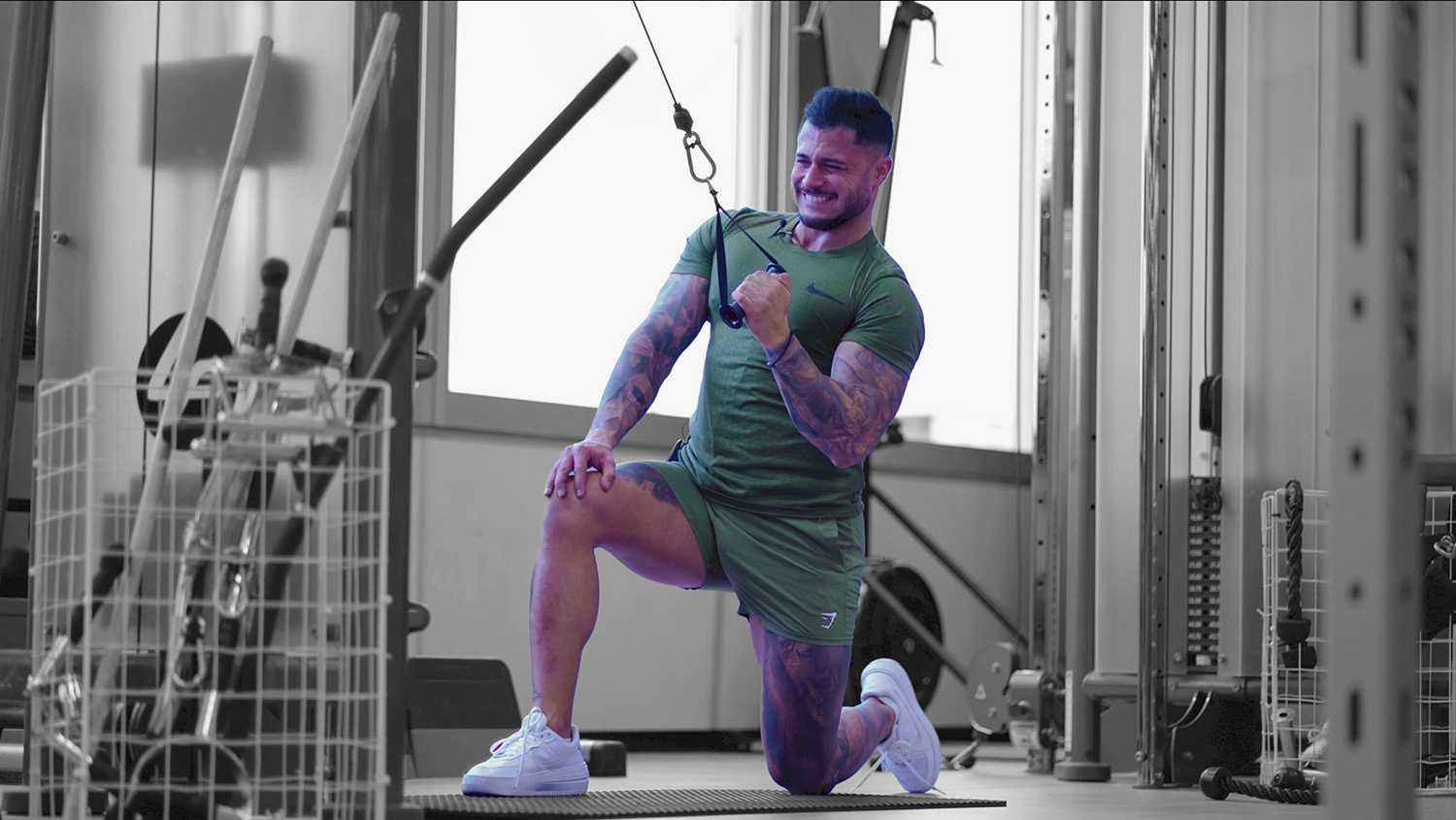
Use the half-kneeling single-arm cable pulldown as a deliberate back accessory. Begin with two sets of eight to twelve reps per side, once or twice weekly, at a weight that leaves about two or three technically solid reps in reserve. Rest roughly sixty to ninety seconds between sides or sets, increasing that interval if your breathing or stability has not recovered. If your weekly back training is already extensive, replace another accessory rather than stacking extra sets blindly.
During weeks one and two, focus on the setup. Use the same high pulley, handle, knee placement and cable distance each session. Keep the load modest and record the number of controlled reps, not just the weight pin. Cable systems have different pulley ratios, so one machine’s marked weight is not necessarily comparable with another. A steady path and consistent effort offer a better baseline than a flattering number.
In weeks three and four, add reps within an eight-to-fifteen range before adding weight. For example, ten clean reps might become eleven and then twelve at the same setting. Consider a third set if your recovery and shoulder comfort are good, but do not assume everyone needs more volume. A tired day after heavy rows is a reason to repeat a load, not a demand to force a personal best by twisting harder.
In weeks five and six, increase the stack by its smallest step once all prescribed sets reach the top of the range with controlled repetitions and no obvious torso compensation. Expect the rep count to drop toward the low end again. This double-progression method helps keep the performance comparison meaningful. If the kneeling stance repeatedly fails before the back muscles, try one seated set and compare how stable the lat effort feels.
Write down one quality cue alongside the numbers: perhaps the elbow remained by the ribs, the pelvis stayed square or the shoulder reached overhead without a jerk. Progress does not require perfect visual symmetry. Stop if pain or unusual symptoms appear rather than completing a calendar target. At the end of six weeks, retain the half-kneeling pulldown if it adds comfortable, repeatable back work; otherwise a stable seated variation remains an excellent choice.
Bodybuilding Shirts & Workout Gear
Bodybuilding shirts, tanks and gym gear for lifters chasing muscle, size, symmetry and the pump.

Funny Yoda Gym | Train Back You Must Bodybuilding Meme Tank Top
Show some personality between sets with “Funny Yoda Gym Tank”.

Hardcore Gains Gym | Funny No Pain No Gain Muscle Shirt Tank Top
Add some lifting attitude to training with “Hardcore Gains”.


Always Pull Yourself Up Crewneck Calisthenics Pullover T-Shirt
Bring “Always Pull Yourself Up” humor to your everyday gym style.


Black Panther Big Back Gym Funny Workout Crewneck Pullo T-Shirt
For laid-back days and superhero humor: “Black Panther Big Back”.

Nice Traps Big Back Tee
Heavy lifts, good laughs, and a little “Nice Traps Big Back” energy.

Back To The Sci-Fi Meme Gains T-Shirt
Keep things casual with a little “Back to the Gym” attitude.

Back Sabbath Back Day Heavy Metal Back Training Workout T-Shirt
Bring “Back Sabbath Back Day” humor to your next gym day.