Advertising disclosure: This page includes affiliate links that may earn us a commission at no additional cost to you.
A stalled bench press can produce a very busy training plan. More triceps work, another press variation, extra shoulder work: each addition sounds plausible, but the original lift can disappear under the attempted fixes. Ed Coan’s approach to weak-point training offers a useful starting question: what is the assistance exercise supposed to improve?
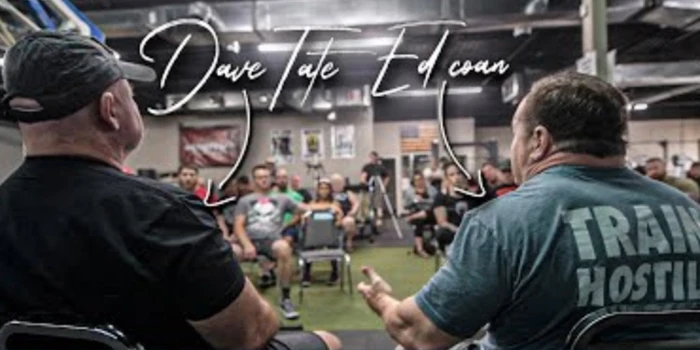
In a discussion with Dave Tate published in August 2019, Coan explained that he chose variations of the main lifts to address the weakness he wanted to improve. The point was transfer back to the squat, bench press or deadlift. That is a decision-making principle, rather than a universal list of exercises.
The framework below is an editorial way to apply that principle. It is not a newly discovered Coan routine, a reproduction of his full training cycle or a promise that an accessory will add a particular amount to your total.
1. Name the lift and the result you want
Start with something more precise than “get stronger.” You might want to keep a squat more consistent as the load rises, make a paused bench press more reliable or finish deadlift sets without changing your position dramatically. Those are different tasks, even when the same assistance exercise appears in more than one plan.
Coan’s older descriptions of his training also show why copying one exercise name misses the larger picture. In 2001, he described planning his workouts ahead, using pause and high-bar squats in his training, and allowing assistance work to vary. Those were descriptions of his own training at that time, not instructions that every lifter should adopt every detail.
Write the intended benefit next to a proposed exercise. “Practise staying organised through the pause” is a more useful reason than “a strong lifter does this.” The first gives you something to review later. The second gives you someone else’s result without their training history or circumstances.
Keep the goal proportionate to your experience. If you are still learning a lift, more consistent practice of that lift may deserve priority over a collection of specialised variations. An accessory should earn its place by helping the task you have identified.
2. Look for a repeatable pattern before naming a weak muscle
One failed repetition provides a clue, not a complete diagnosis. Compare it with successful repetitions and with other sessions. Was the setup different? Did the problem appear only at the end of a demanding workout? Did the bar move differently before it slowed? A useful explanation should fit more than the most dramatic clip on your phone.
A squat in which the hips rise faster than the shoulders, for example, deserves attention to both position and the demands on the legs and back. It does not justify confidently naming a single weak muscle from one camera angle. An experienced coach can help distinguish a technical habit from a strength limitation and choose an appropriate response.
Keep comparisons reasonably consistent: similar camera position, range of motion, equipment and place in the session. A shallow repetition with a heavier load does not demonstrate improvement in the deeper version you are trying to train. Nor is a tired final set a fair comparison with a fresh first set.
If several lifts suddenly feel worse, broaden the investigation before adding work to each of them. Our guide to checking a strength plateau and changes in readiness explains why performance fluctuations deserve context. A difficult day and a persistent limitation call for different decisions.
3. Choose an exercise that tests your explanation
Once you have a plausible explanation, choose a variation or assistance exercise with a clear purpose. A pause changes the task by making you control a position. A different stance, grip or range of motion changes other parts of the task. None of those changes automatically makes an exercise the answer to your problem.
For a lifter who struggles to stay organised near the bottom of a squat, a controlled pause variation might provide useful practice. That is an example of matching a task to an observation, not a claim that all difficult squats require the same fix. Use a manageable load and an appropriate rack setup rather than trying to prove the variation works with an immediate maximum.
Pin squats are another possible tool, but the details matter. Starting from supported pins and lowering onto pins are related, distinct tasks. Our pin-squat setup and progression guide covers the practical differences. Choose the task you intend to practise, then keep its setup consistent.
For the bench press or deadlift, apply the same questions: what changes, what stays similar to the main lift, and why should the change help? An exercise that feels hard can still be poorly matched to your goal. Equally, an isolation exercise can have a place when there is a clear reason for it; the principle is purposeful selection, not a ban on smaller movements.
Avoid replacing your entire assistance menu at once. Keeping the experiment understandable makes the next review more useful. You do not need to turn every training session into a search for a new solution.
4. Give assistance work a place in the training week
A suitable exercise can still be badly dosed. Extra squats, presses and hinges take time and contribute to the demands of the week. Before adding a variation, decide where it will go, what it will replace and how you will judge whether the overall plan remains manageable.
Suppose a bench-focused lifter adds another demanding press after every session while keeping all existing work. If the main bench sessions then deteriorate, “I need even more assistance” is only one possible interpretation, and not an especially useful default. Review the total work and its timing as well as the exercise choice.
Daily performance can fluctuate with fatigue. That makes the warm-up and recent training record useful information when choosing the day’s load. A written plan gives you direction; it does not make every planned weight equally appropriate under every set of circumstances. Avoid treating a difficult session as an obligation to force a maximum.
There is no single set-and-repetition prescription here because the right dose depends on the lifter, the movement, the rest of the plan and the goal. Record what you actually did, including load, repetitions and the quality of the work. Start with a change you can recover from and evaluate, rather than several additions you cannot distinguish from one another.

Powerlifting Shirts & Lifting Gear
Powerlifting shirts and gym gear for squat, bench and deadlift lifters who live for heavy numbers.

Shirt – Squat Bench Deads Gains T-Shirt
Heavy lifts, good laughs, and a little “Squat Bench Deads” energy.


Meme : Squat Rack Top Home T-Shirt
Make gym days more fun with “Powerlifting Gym Meme” style.

Deadlifts & Gains Meme – Essential T-Shirt
Heavy lifts, good laughs, and a little “Deadlifts & Gains” energy.

Lift O'Clock Gym | Funny Workout For Bodybuilding Gains Hoodie
Bring “Lift O'Clock” gym humor to lazy days and post-workout plans.

Be Happy Lift Heavy Happy Weights Emoji Weight Plate De Sticker
Give your everyday gear a playful “Be Happy Lift” twist.

Iron Is My Therapy – Lifting Bodybuilding Powerlifting Tank Top
Your gym-day look, with a playful “Iron Is My Therapy” twist.

Six Plates Deadlift Club Motivational T-Shirt
Heavy lifts, good laughs, and a little “Six Plates Deadlift Club” energy.

Leg Day Leg Sweater Squats & Meme T-Shirt
Bring “Leg Day” humor to your everyday gym style.

I Love Bench Press Gym | Funny Bench Press Meme Crewnec T-Shirt
For laid-back days and gym-girl humor: “I Love Bench Press”.
5. Review the main lift, not just the accessory record
Getting better at a variation is useful information, but it is not the whole result. If your aim was a more consistent squat, return to that question. Has your position become more repeatable? Can you perform the intended range of motion under comparable conditions? Are your main training sessions progressing in a way you can sustain?
A new accessory personal best can reflect familiarity with that exercise as well as changes that help the main lift. Keep the distinction visible in your log. You can enjoy improving at the variation while still asking whether it deserves the same place in the next block of training.
Review across several comparable exposures rather than demanding an answer from the next workout. If the original problem remains, reconsider the explanation, the exercise and its dose. More effort applied to the wrong explanation does not make that explanation more convincing. Feedback from a coach or a consistent video record can make the review less dependent on memory.
Coan’s useful lesson is the relationship between a training choice and its intended result. Name the task, observe what happens, choose assistance for a reason and check whether it helps. A shorter list of exercises with clear jobs is easier to evaluate than a growing collection of things that merely feel difficult.