Advertising disclosure: This page includes affiliate product links that may earn us a commission, as well as products from our own store.
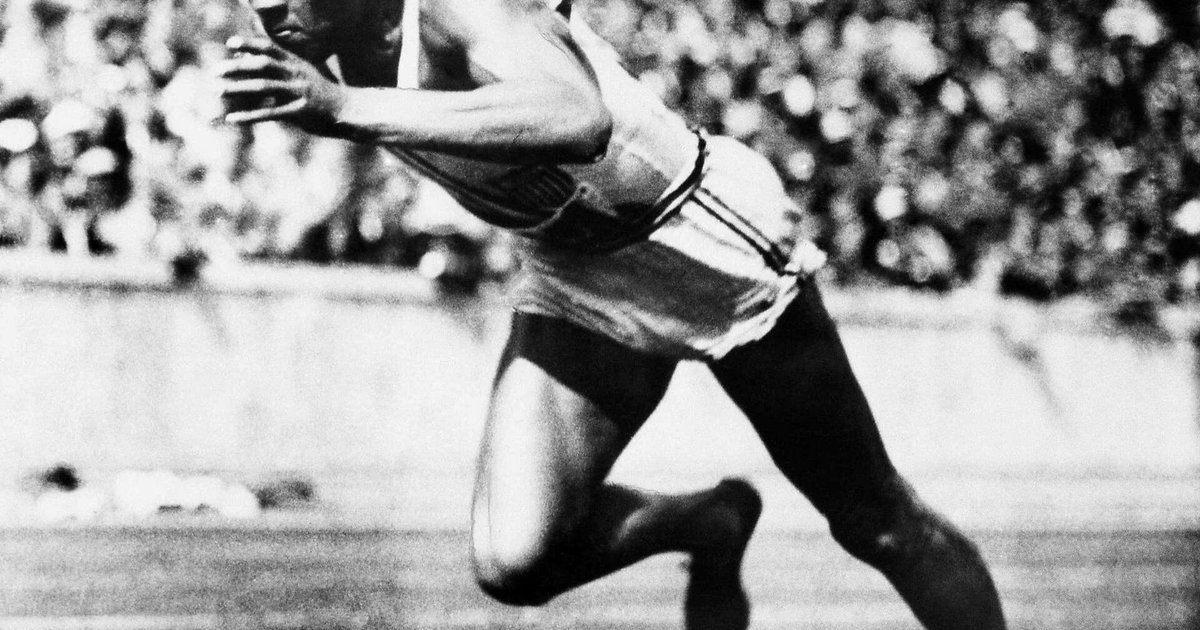
Jesse Owens won four gold medals at the 1936 Berlin Olympics: the 100 metres, 200 metres, long jump and 4×100-metre relay. The number is famous enough to hide the variety behind it. He had to sprint straight, race around a bend, convert a run-up into a jump and contribute to a team performance. For fitness readers, that makes his achievement more interesting than a simple claim that he was fast. It is a reminder that related athletic qualities still require different skills.
Berlin was the headline, not the beginning
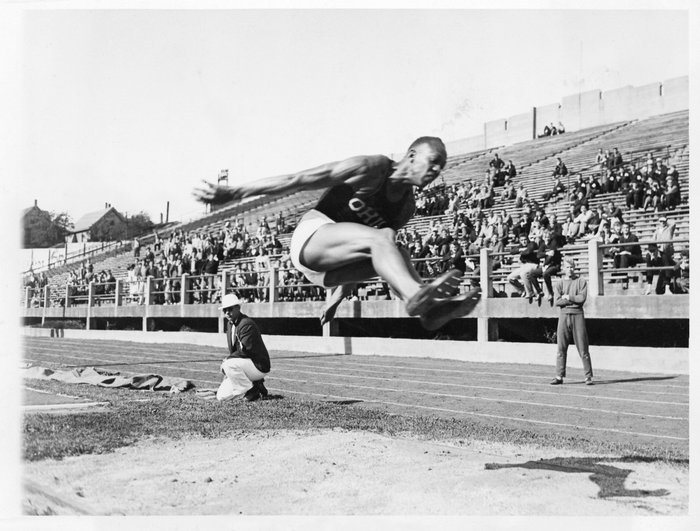
Owens arrived at the Olympics with extraordinary performances already behind him. On 25 May 1935, competing for Ohio State at the Big Ten championships, he produced a remarkable sequence across sprinting, hurdling and long jumping. His 8.13-metre long jump became a world record that survived until 1960.
The often-repeated count of records from that day needs context. Straightaway races measured in yards could also earn recognition at their shorter metric equivalents. Consequently, a list of record categories is not the same thing as a list of separately run races. Counting the labels without understanding the distances can make an already exceptional performance harder to follow.
This is a useful distinction whenever an athletic achievement becomes a short social-media caption. Ask what the athlete actually did, what was measured and how the result was classified. Clarifying those questions does not diminish the performance. It gives the achievement a more accurate shape.
There is also a difference between a spectacular day and the preparation that made it possible. An archival competition photograph cannot reconstruct a training week, identify an ideal exercise split or tell you which session caused the improvement. The photograph here shows Owens jumping in an Ohio State uniform; it is not evidence for a complete workout.
For your own training, keep that separation between preparation and demonstration. A test day shows what you can express under its conditions. A training block should help you return to that test better prepared. Trying to make every session a historic personal-best day confuses those jobs.
Two sprint medals still asked different questions
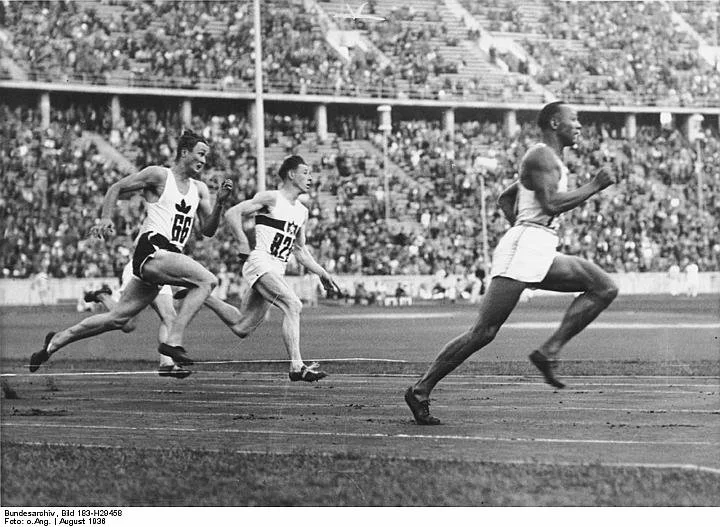
Owens won both the 100 metres and 200 metres in Berlin. They belong to the same sprinting family, but adding distance does not simply duplicate the shorter race. The 200 includes a bend and more time at racing speed. A sprinter must carry useful mechanics through a different task rather than merely reproduce the first few strides twice.
That distinction matters to lifters who use the word cardio for every form of running. An easy continuous run, a short acceleration and a hard sustained effort are different sessions. They have different purposes even when all three happen on the same track. Choosing the purpose comes before choosing a heroic athlete to imitate.
Our look at Emil Zátopek’s three distance-running golds explores another version of this problem. Several medals can come from related events while still requiring the athlete to meet distinct demands. A medal total compresses the story; it does not explain the preparation.
For an ordinary gym session, write down the intended running task in plain language. Are you practising a smooth acceleration, accumulating comfortable running time or testing a fixed distance? Keep comparisons within that task. A longer effort completed more slowly is not automatically a worse performance than a shorter effort completed quickly.
Do not treat Owens’s results as evidence that an unfamiliar lifter should immediately attempt maximal sprints. Enjoy the speed on display while choosing work that fits your experience, surface and current preparation. The lesson is specificity, not a universal instruction to run harder.
The long jump turned speed into a different result
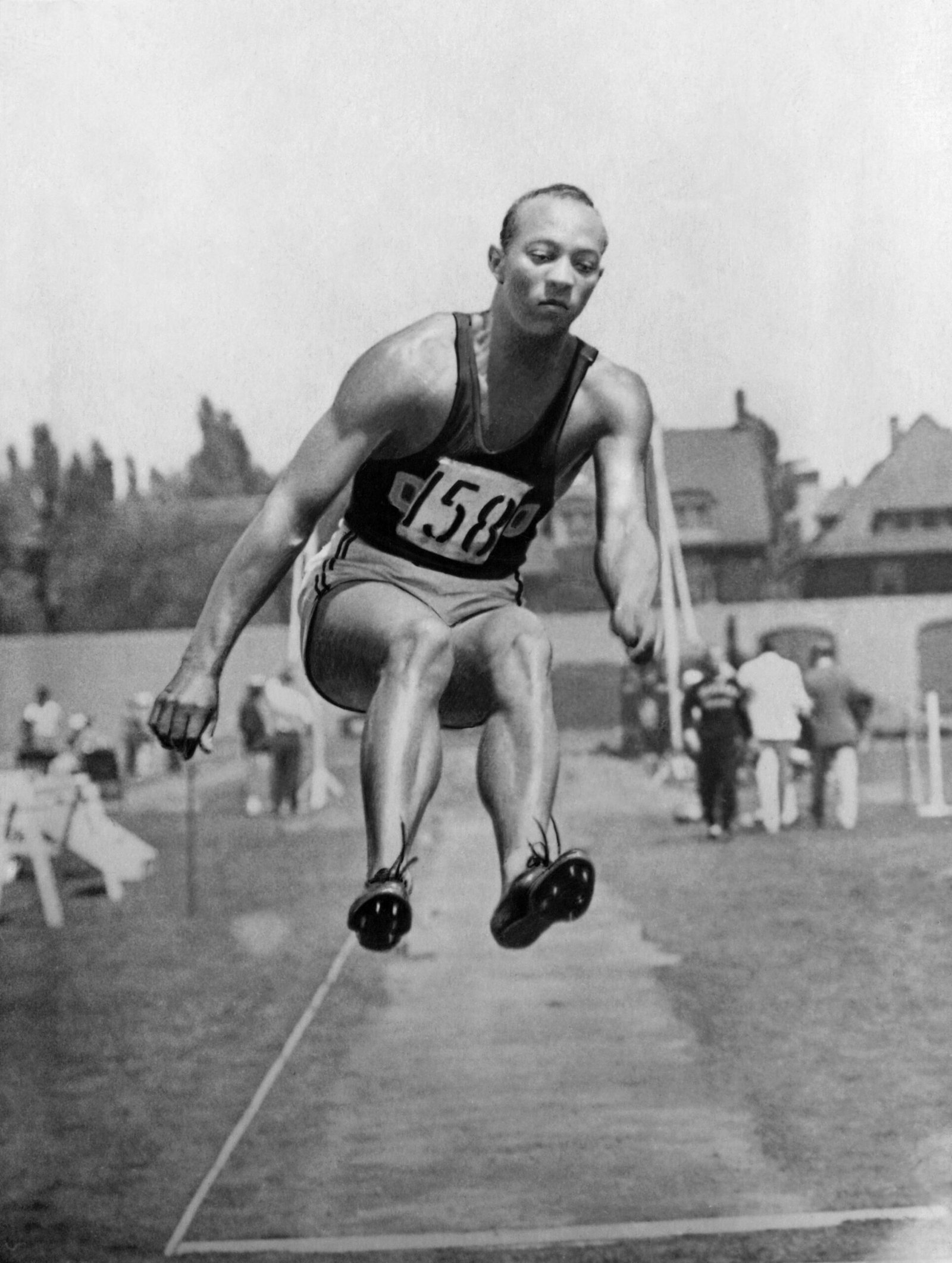
The long jump gives this four-medal story a different dimension. Owens had to produce a measured distance from a legal take-off, rather than reach a finish line first. Running ability helps explain why sprinting and long jumping can complement each other, but it does not make the take-off board or landing irrelevant.
His famous 8.13-metre world record belongs to the 1935 Big Ten meeting. His Olympic long-jump gold belongs to Berlin the following year. Keeping those achievements separate avoids turning two exceptional performances into one invented result.
The photograph in this section shows Owens airborne with a numbered bib. It illustrates the athlete and the event; it is not presented as a measurement of either the 1935 record or his Olympic winning jump. An image without a verified attempt record cannot establish a distance by itself.
A run-up also changes the comparison with a standing jump. Our article about Ray Ewry’s standing-jump events explains why the starting conditions belong in the description of the feat. Both athletes jumped, but the same everyday word does not make the tests interchangeable.
If you measure jumps in your own training, keep the arrangement consistent. Record whether there was a run-up, which starting position you used and how you measured the landing. Treat a change of method as a new test. A clearer record lets you recognise real progress without having to inflate the number.
The fourth gold belonged to a relay team
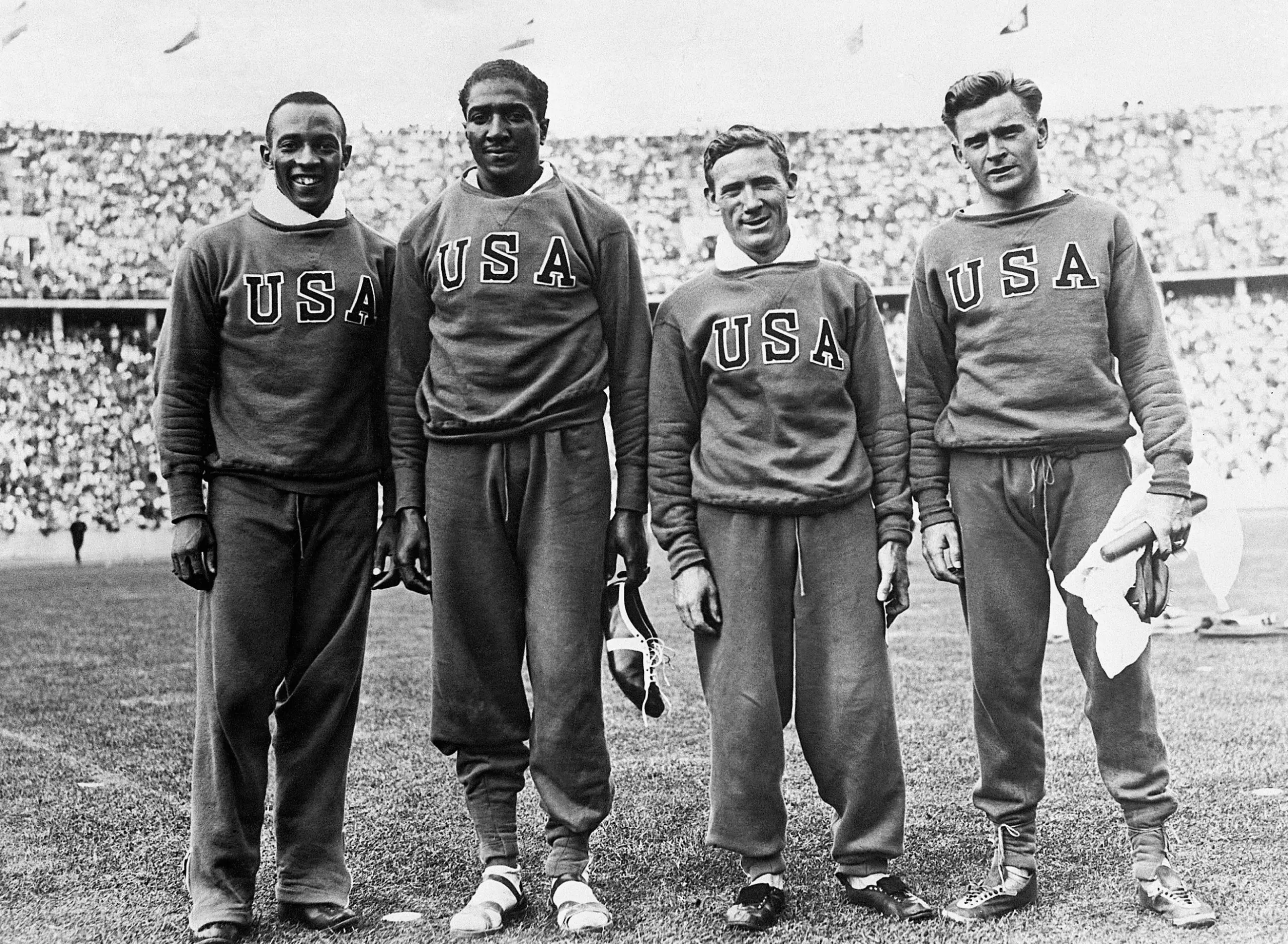
The 4×100-metre relay added a team event to Owens’s individual victories. The winning American quartet included Owens, Ralph Metcalfe, Foy Draper and Frank Wykoff. Their performance produced a world record. Calling it Owens’s fourth gold is correct; describing it as something he accomplished alone leaves out three teammates and the structure of the event.
A relay combines individual running with the transfer of a baton. A team cannot be evaluated solely by adding four reputations. The exchange creates a shared task: one athlete must deliver something another can receive while both remain part of a continuous race.
That offers a practical lesson beyond track athletics. In a partner workout, define what is shared and what each person must complete. A team result is easier to interpret when the contribution, changeover and finish condition are clear. Otherwise, two groups can report the same headline number after doing different work.
The team photograph belongs beside this part of the story because the people matter. It is a reminder to look beyond the best-known athlete when discussing a collective result. Supporting athletes should not disappear merely because one name attracts most of the attention.
There is no need to turn the historical relay into a modern training prescription. Its value here is the distinction between individual capacity and coordinated performance. Owens’s sprinting was exceptional, and the fourth medal still required a successful team.
Appreciate the legacy without inventing a workout
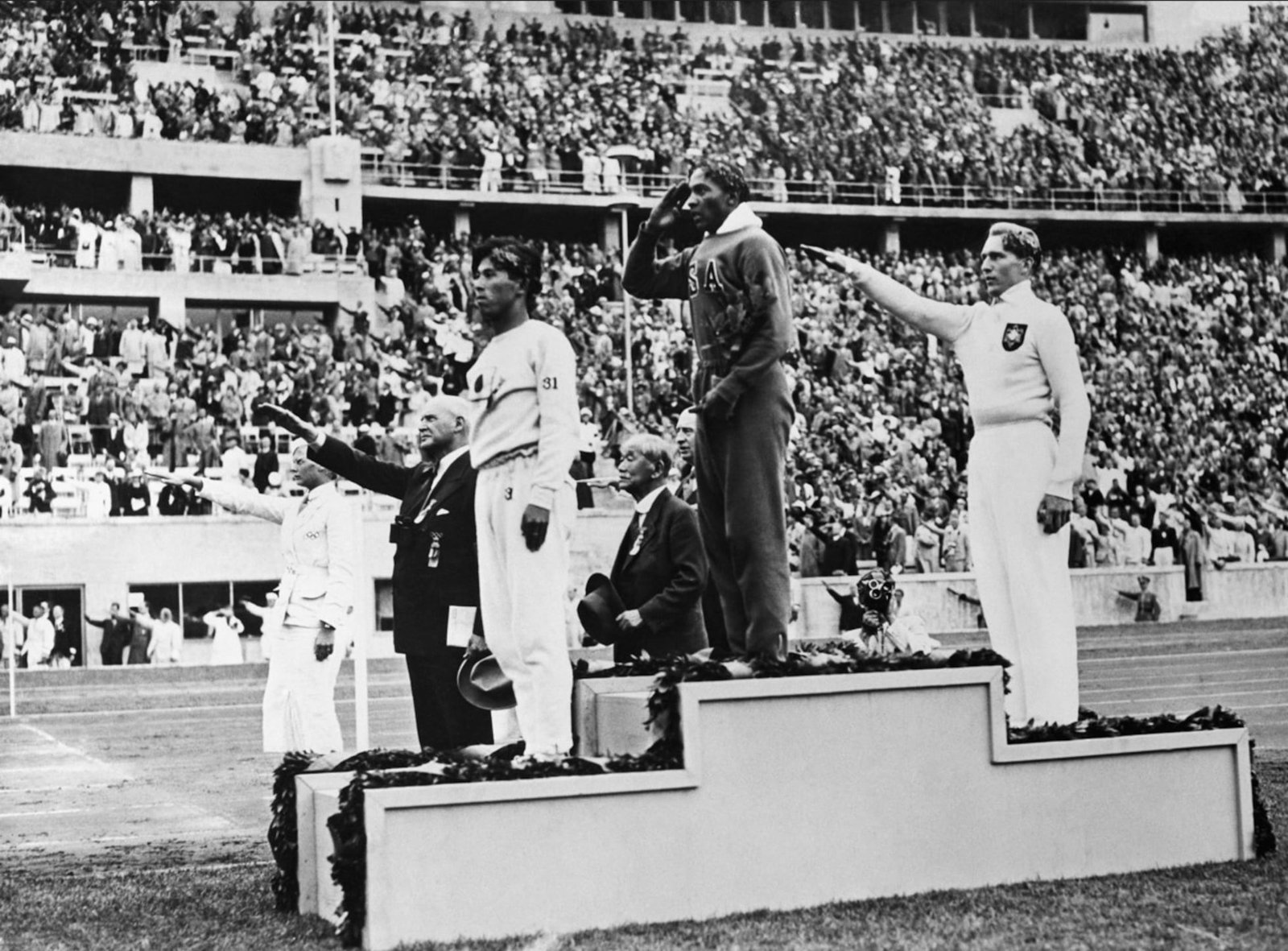
Owens competed in Berlin under a Nazi regime that promoted racist ideas. His victories carried significance far beyond the track. They also did not end the racial discrimination that Black athletes faced when they returned to the United States. The sporting achievement and the continuing injustice both belong in an honest account.
A podium image captures a public moment, not the whole life surrounding it. Avoid using the photograph to suggest that winning automatically removed the barriers Owens encountered. Celebrating the athlete does not require simplifying the conditions in which he lived.
For a fitness reader, the useful inspiration is the breadth of accomplished skills. You can admire the sprinting, jumping and teamwork without claiming that one exercise, one body type or one motivational phrase explains all four gold medals. The results show what Owens achieved; they do not provide a ready-made programme for somebody else.
If the story encourages you to broaden your own training, begin with one clearly defined addition that fits your existing routine. Decide what you want to practise, how you will recognise an improvement and what other work it must coexist with. Review the result before adding another challenge. This is an editorial planning suggestion, not Owens’s historical routine.
The enduring appeal of four golds is that one athlete excelled in several connected tasks. The more carefully you distinguish those tasks, the more impressive the achievement becomes. Keep the history accurate, give the relay team its place and let inspiration guide a sensible goal rather than an imitation of an Olympic week.

Cardio Shirts & Workout Gear
Cardio and conditioning gym gear for runners, endurance athletes and anyone who earns the sweat.

Cardio Is Hardio – Workout Meme Decal for Water Bottles Sticker
Put “Cardio Is Hardio” gym humor on your laptop, bottle, or gym gear.

Anti Running Club Tee
Heavy lifts, good laughs, and a little “Anti Running Running Club” energy.

Cardio Is Calling Decline Vest Meme Tank Top
Show some personality between sets with “Cardio Is Calling”.

Negative Cardio Review Cardio Sucks 1 Star Vest Tank Top
Bring “Negative Cardio Review” humor to your next lifting session.

Cardio Sucks Shirt Meme & Gymbros Top T-Shirt
Make gym days more fun with “Cardio Sucks” style.

Cardio Kills Gains Shirt 'S Meme & Top T-Shirt
Rep “Cardio Kills Gains” humor in and out of the gym.

Death By Cardio Shirt Meme & Top T-Shirt
Bring “Death By Cardio” humor to your next gym day.

Cardio Heartbeat for Runners, Cyclists, Rowers and Fitn Sticker
Give your everyday gear a playful “Cardio Heartbeat” twist.

Running Dost Thou Even Trot Medieval Knight Treadmill D Sticker
Give your everyday gear a playful “Running” twist.

Don't Quit Do It – Motivational Workout Hooded Pullover Hoodie
Show off your cardio humor in a laid-back “Don't Quit Do It” hoodie.