Advertising disclosure: This page includes affiliate product links that may earn us a commission, as well as products from our own store.
The single-leg hip thrust looks simple until you try to keep both sides of the pelvis level while one foot does the work. It is a direct way to train hip extension, but the challenge comes as much from positioning and control as from chasing a hard squeeze at the top. The bench must stay put, the working foot must be repeatable, and the trunk should not arch to rescue the last few centimeters of motion.
This guide breaks down the practical details that determine whether the rep is useful: bench contact, working-leg stance, pelvic rotation, how to add resistance, and which easier variations to use when the movement becomes messy. The aim is not to turn every leg workout into a balance test. It is to make a unilateral glute exercise measurable and progressively trainable.
What the single-leg thrust trains—and what it does not
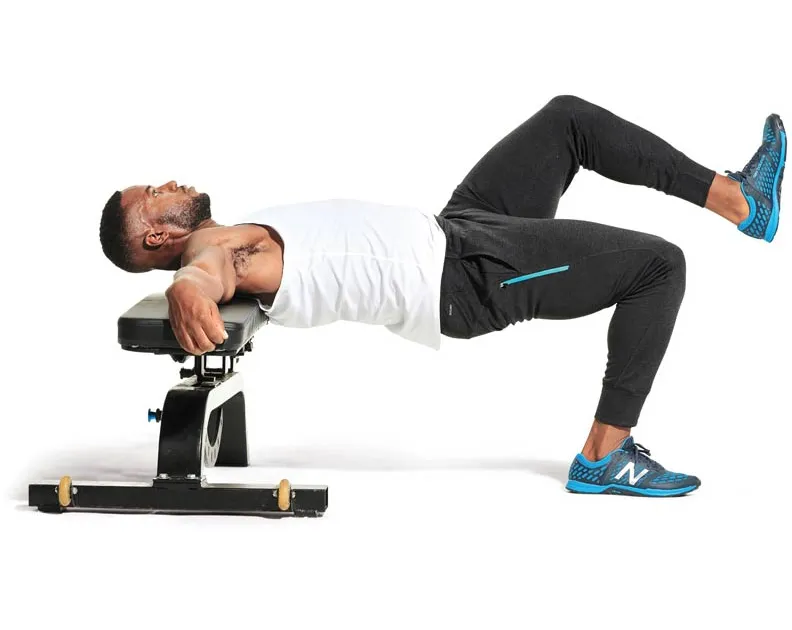
Taking one foot off the floor turns a familiar bilateral hip thrust into a much more demanding coordination exercise. The planted hip still extends against gravity, but now the working side must also prevent the pelvis from rolling toward the floating leg. That makes the movement useful when you want focused glute work without immediately loading a heavy barbell. It does not make the nonworking side vanish from the task: your abdominal wall, spinal muscles, hip stabilizers and the rest of the lower body still help organize the movement.
The gluteus maximus is a principal hip extensor, so extending the planted hip is the core action. The gluteus medius and other lateral-hip muscles help keep the pelvis from tilting or rotating. Hamstrings can contribute to hip extension, especially when the working foot sits farther away; how much you feel them depends on your setup and technique. You should not need an extreme hamstring cramp to know the exercise is working.
Single-leg work may make a left-right difference more obvious because each side has to complete its own repetitions. That observation is useful for coaching; it is not a medical diagnosis or evidence that the weaker side has a structural problem. Keep the load, bench, range and rest equal before comparing. A side that loses its pelvic position at rep eight might simply need more practice with the skill.
Nor is a single-leg thrust automatically superior for building glutes. Squats, split squats, regular hip thrusts and other hip-extension patterns offer different loading and range-of-motion opportunities. The sensible reason to include it is the combination of concentrated hip-extension work, independent side-to-side practice and modest equipment demands.
Set up the bench, shoulder contact and working foot
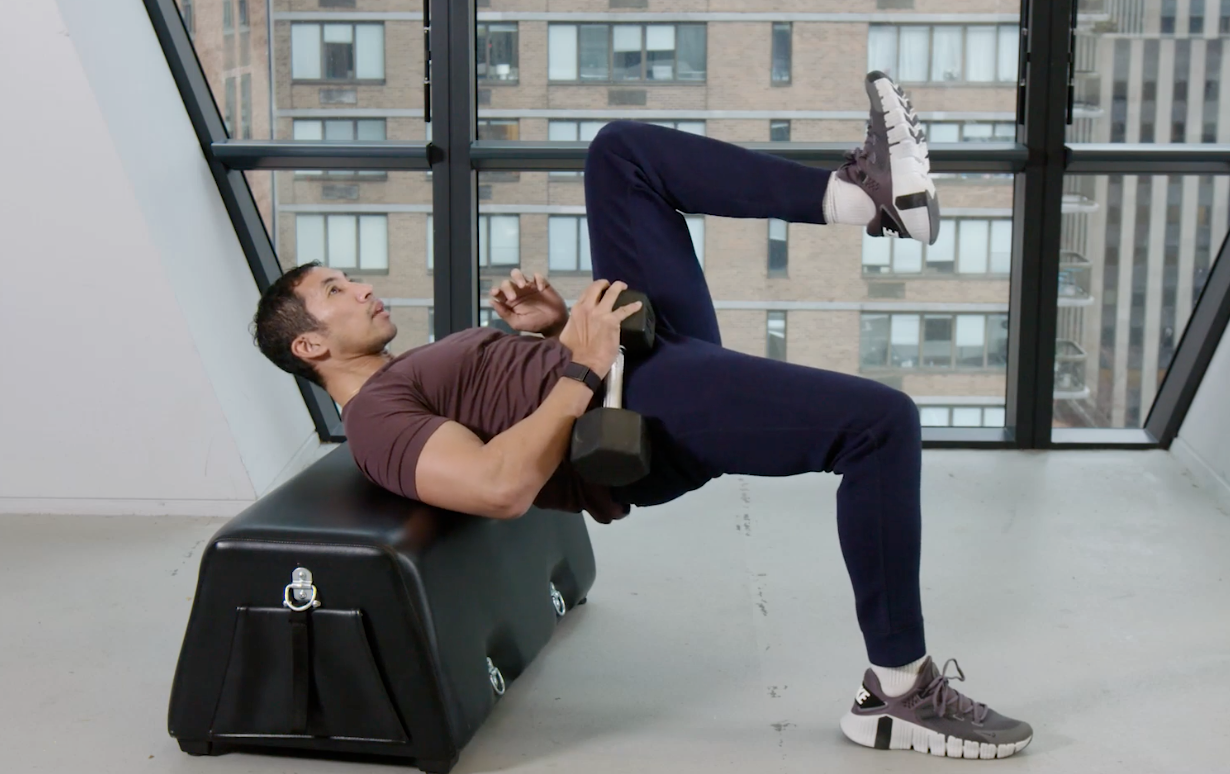
Start seated on the floor with your back against a fixed, stable bench. Let the lower edge of the shoulder blades rest against the bench rather than placing its edge under your neck. A bench that rocks, slides or has loose adjustment hardware is the wrong platform. Put a grippy mat beneath the feet if the floor is slick, and confirm the bench will not travel backward as your shoulders push into it.
Place both feet down to establish a bilateral starting position. Slide the foot you plan to keep planted until its knee is roughly over its ankle near the top of a test rep. That is a useful initial landmark, not an anatomical law: long femurs, foot length, bench height and individual comfort affect the stance. A foot too far from the hips often shifts more work toward the hamstrings. A foot tucked uncomfortably close may make the knee or ankle position awkward.
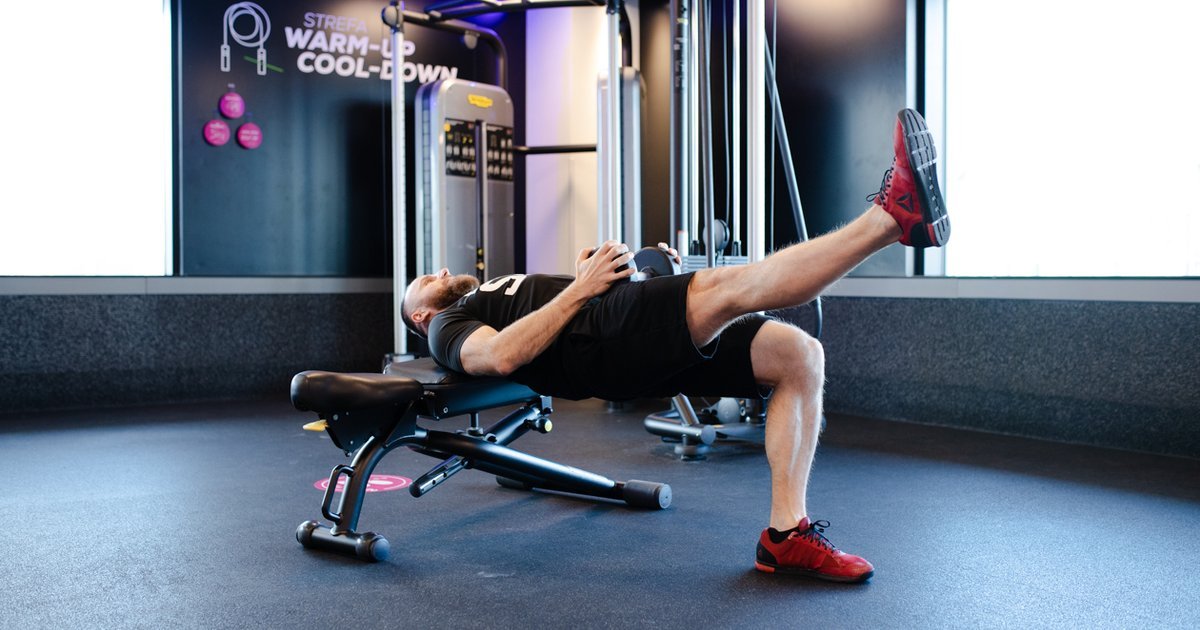
Now lift the opposite foot slightly, keeping its knee bent or extending the leg forward as control permits. Neither position is inherently a better glute exercise. The bent-knee option often makes it easier to keep the floating limb quiet, while a straight leg creates a longer lever that can challenge balance. Choose one and keep it consistent across repetitions.
Brace lightly, keep the ribs stacked over the pelvis and look forward instead of throwing the head backward. Your upper back pivots against the pad, but your arms are there for balance, not to push the hips up. Before counting a set, make one slow practice repetition with both feet down, then one with a single foot. If the bench shifts, the working heel slips or the shoulder contact feels unstable, fix those issues before adding volume.
Lift through the hip while the pelvis stays level
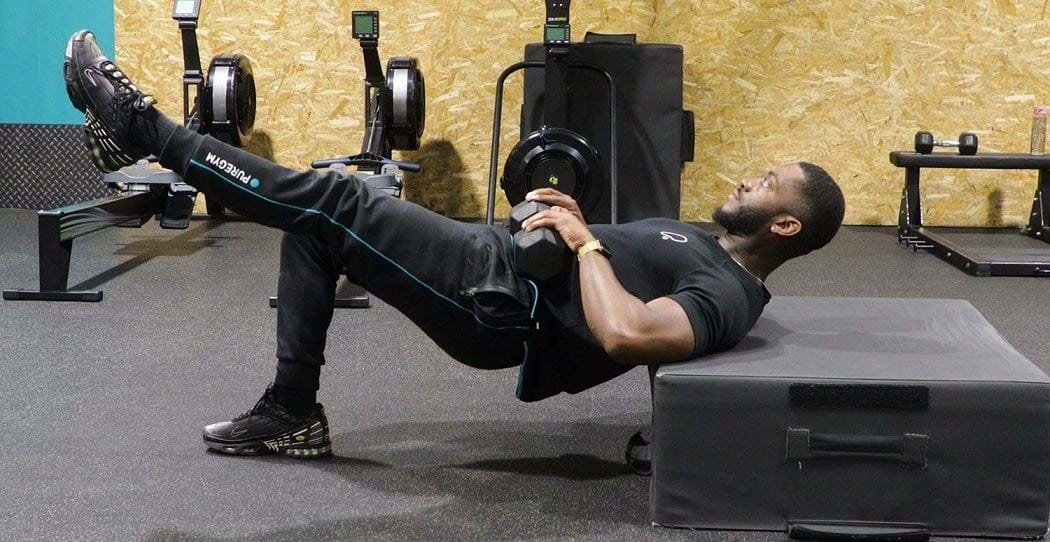
Begin with your hips lowered under control, a planted foot and a floating leg held without swinging. Exhale gently as you drive the working foot through the floor and lift the pelvis. Think about bringing your belt line upward by extending the hip, not by arching the low back. The torso and working thigh should approach a straight line near the top, although you do not need to force a higher position once the hip has extended.
A particularly useful check is whether the two hip bones appear to remain level. From the front, watch for the raised-leg side dropping toward the floor or rotating outward. From the side, check that the lower ribs do not flare dramatically to manufacture additional height. A small natural change in spinal position happens during movement, but an exaggerated lumbar extension is not a substitute for finishing with the glute.
Pause briefly near the top while keeping your body quiet. Lower for about two seconds until you reach the same bottom position used on the prior repetition. The lowering phase should be a controlled return, not an abrupt collapse onto the floor. Keep pressure through the whole planted foot rather than turning the lift into a tiptoe calf exercise, and allow the knee to track naturally over the toes.
Three cues usually suffice: foot still, hips square, ribs down. If you can preserve those while performing smooth repetitions, you do not need to micromanage every millimeter of your pelvis. If the unloaded leg swings, shorten the set or hold it in a compact knee-bent position. A narrower or shorter movement performed consistently is more informative than a full-looking rep achieved through twisting.
Sharp pain in the low back, hip or knee is a reason to stop and change the exercise, not a challenge to push through. A muscular effort in the working glute is expected; a particular sensation is not required for a productive set.
Add load without sacrificing the one-leg position
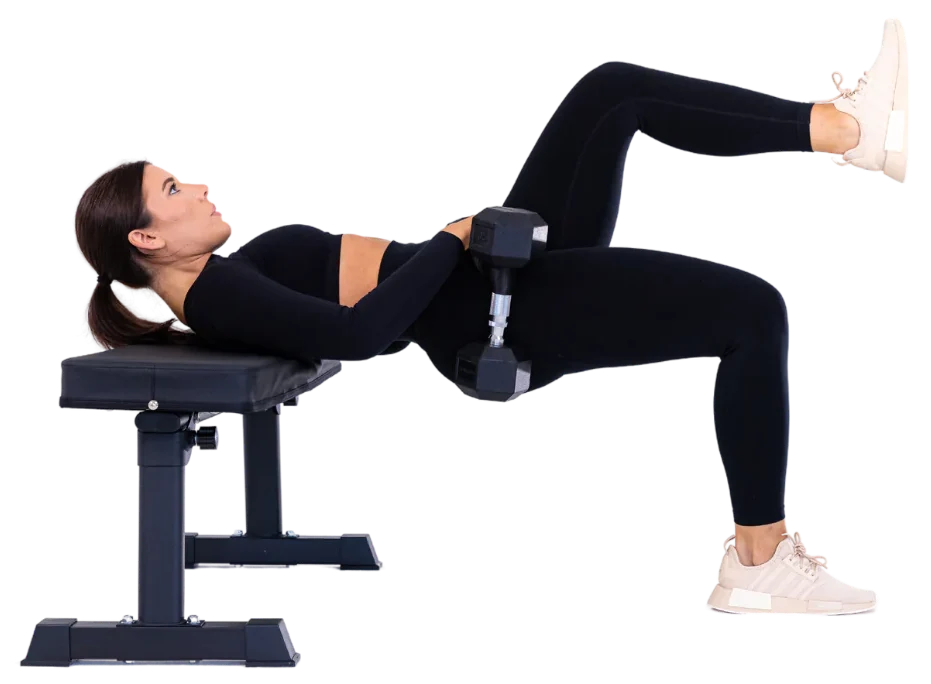
Bodyweight is the logical first load for a new variation. If you cannot hold the pelvis level for eight smooth reps on each side, an added dumbbell will likely train a compensating movement rather than the pattern you intended. Once repetitions are repeatable, place a light dumbbell or kettlebell across the working-side hip crease with padding as needed. Keep one hand securely on the weight so it cannot roll toward the abdomen or fall off the pelvis.
Begin conservatively. An illustrative progression might move from three clean sets of ten at bodyweight to three sets of ten with a modest dumbbell, but the load itself depends on your current capacity. Adding five kilograms does not help if you must rotate the pelvis on every rep. For some lifters a single weight is easier to stabilize than a barbell. A barbell across the hips may be reasonable with a secure bench, correct padding and a controlled path, but it introduces setup complexity that is rarely necessary early on.
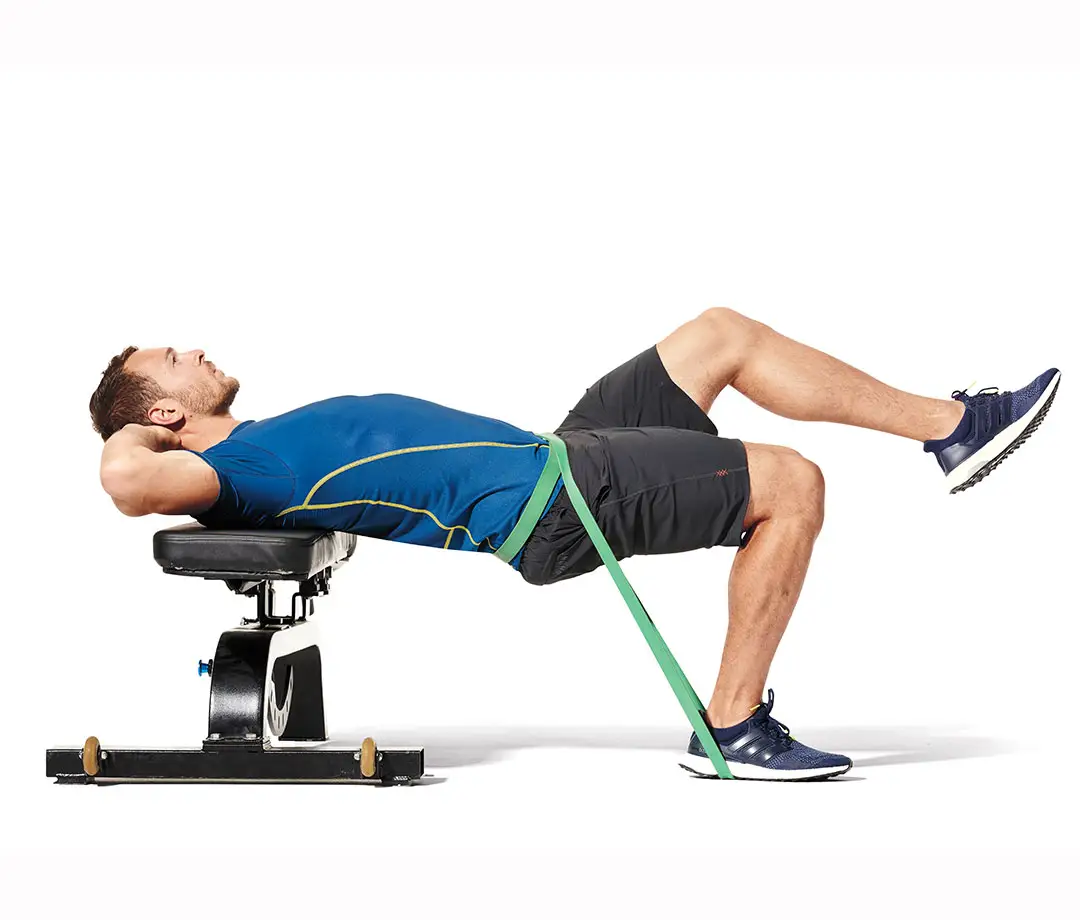
A resistance band is another option, provided it can be anchored in a way that will not snap free or roll across the body. A band under the working foot and over the hips generally adds resistance as the hips rise, whereas free weights supply a different gravitational challenge. The two choices are not interchangeable by nominal resistance: band tension changes with stretch and position.
Use a simple rule before increasing load: keep the same bench, stance, range, pause and tempo for two or three sessions. If all target reps are clean, add a small amount of resistance or a couple of repetitions, not both at once. Strength movements are easier to evaluate when the target changes only one variable at a time.

Equipment Worth Exploring
Explore equipment, accessories and gear from our carefully selected range.

Studio Glute Drive
Plate-loaded hip-thrust machine with supported back pad and adjustable foot platform.



Rubber Hex Dumbbells
Rubber-coated hex dumbbell pairs with a stable shape for home and commercial strength training.


Multi Bench MBX-650 2.0
Adjustable multi-bench with roller adjustment, 15 backrest positions and accessory mounts.

Standing Abductor
Plate-loaded standing hip abductor for targeted outer-glute and hip-stability training.


Grip Plates
Rubber-coated weight plates with handholds for loading barbells and machines.
Regressions and the common mistakes they reveal
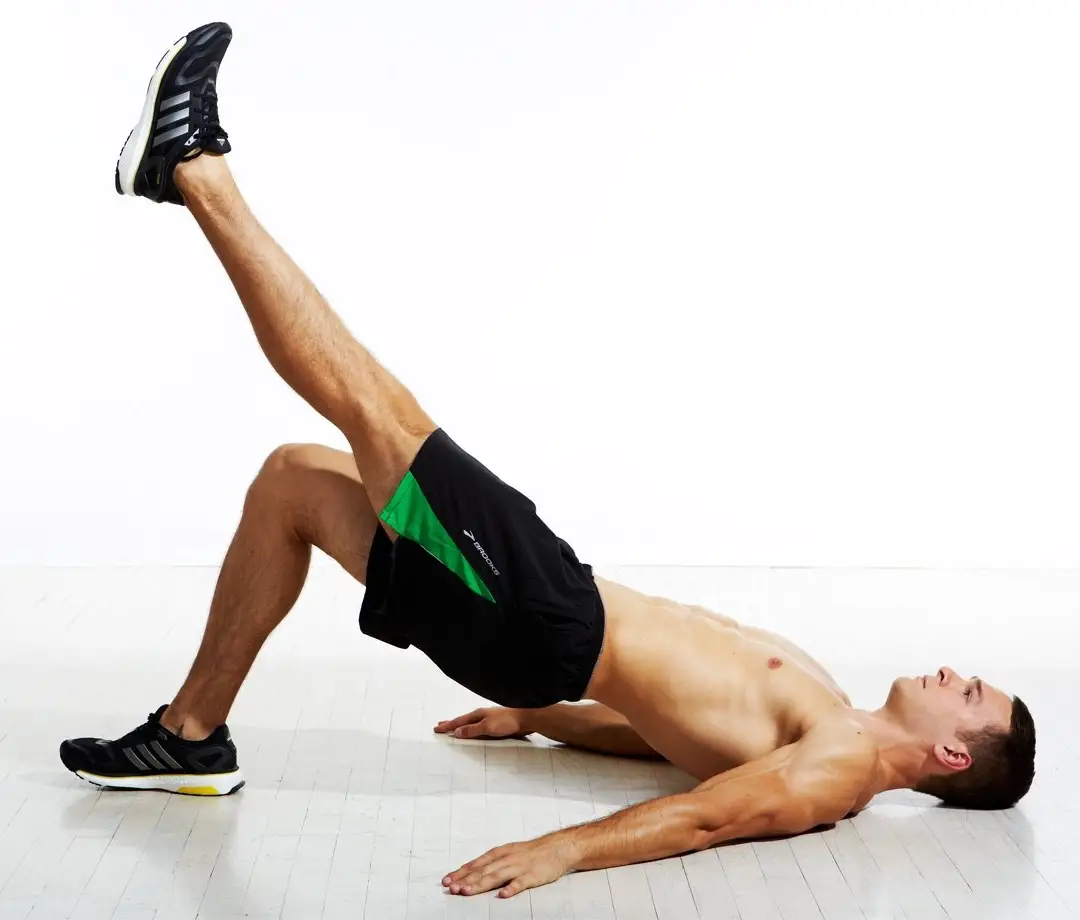
If balancing on the bench is too difficult, perform a single-leg floor bridge first. The shoulders stay on the floor, the planted foot pushes the hips up, and the floating leg remains quiet. The shorter travel changes the exercise slightly, but it gives you a stable way to practice not rotating the pelvis. Another sensible regression is a bilateral bench hip thrust with a pause, followed by a B-stance version where the second foot assists lightly rather than carrying half the load.
The most common mistake is treating a higher hip position as a bigger glute contraction even after the hip has finished extending. Watch for a flared rib cage and a deep lower-back arch. Shorten the top range, exhale and try to bring the front of the pelvis and rib cage into a comfortable relationship. In many cases the result will look less dramatic while feeling more controlled.
A second problem is drifting off the planted foot. If the foot slides outward or the working knee collapses inward, pause the set, check traction and select a stance you can repeat. A third is allowing the elevated leg to act like a counterweight—swinging it upward at the same moment the hips rise. Keep that knee position fixed; the working glute should raise the pelvis, not a kick from the free leg.
Hamstring cramping deserves a setup check before being interpreted as insufficient glute activation. Bring the foot slightly closer, reduce the rep range, lower the effort and experiment with a deliberate top pause. The hamstrings are legitimate contributors, so there is no reason to chase zero hamstring sensation. Persistent cramps, unusual pain or symptoms outside ordinary exertion call for a different choice and, when appropriate, professional advice.
There is also no requirement to force an unstable bench variation onto a program. A two-leg thrust that can be progressively loaded, a split squat with good depth, and a controlled floor bridge may collectively suit a lifter better than a sloppy one-leg thrust.
A four-week plan with benchmarks worth recording
Here is an illustrative four-week progression for a healthy lifter who already performs lower-body training. It is not a tested clinical or hypertrophy protocol. Place the exercise after the main squat or hinge if stability is limited by fatigue; on other days it can be an accessory after a leg session. Leave at least a day of recovery between challenging efforts for the same muscle group and adjust the schedule to your broader training plan.
Week one: complete two sessions of two sets of eight controlled reps per leg, bodyweight only. Use a brief pause at the top and stop each set with roughly two or three clean repetitions in reserve. Record the bench height, stance and whether the pelvis remained level. Choose the weaker-feeling side first and match its completed reps on the other side.
Week two: keep the same setup and build toward three sets of eight to ten reps per side. Do not add load merely to tick a calendar box. When one side starts rotating, end that set even if the other side could continue. Equal technical standards matter more than equal discomfort.
Week three: if the previous work was smooth, try a light dumbbell across the working hip for two or three sets of eight to ten. If the weight complicates balance, return to bodyweight with a slightly longer top pause instead. Both versions can make training more demanding without pretending to be equivalent loads.
Week four: repeat the same test setup and compare reps at the same resistance, with the same pause and range. Progress might be two additional clean reps, a slightly heavier load without pelvic drift, or fewer balance resets. A lighter load with better movement quality can also be useful progress.
Film one set from the front and one from the side occasionally if you are comfortable doing so. Note the working leg, stance distance, bench position, load, repetitions and an honest quality score. This captures what the exercise can actually tell you: how well you control and load a unilateral hip-extension pattern. It does not prove one leg has gained more muscle than the other, and the mirror is a poor substitute for consistent training records.

Leg Day Shirts & Workout Gear
Leg-day gym shirts and workout gear for lifters who never skip squats, lunges and lower-body punishment.

Hippo Thrust Leg Day Meme Sweater Glutes & Booty Day T-Shirt
For laid-back days and leg-day humor: “Hippo Thrust”.

I Love Booty – Valentine's Day Peach Meme Vest Muscle S Tank Top
Your gym-day look, with a playful “I Love Booty” twist.

Juicy Booty Booty Builder Decal Water Bottles & Sticker
Stick a little “Juicy Booty” humor on your favorite gear.

Shirt – Thickers – You'Re Not You With A Small Booty T-Shirt
Make gym days more fun with “Thickers” style.

Let It Grow Booty Builder Hip Thrust Meme Hoodie
Stay casual and show some gym-girl attitude with “Let It Grow”.

Brains Beauty Booty Focused On Glute Gains & Memes Hoodie
Keep it laid-back with a little “Brains Beauty Booty” attitude.

Bootybuilder Gym Girl Funny Workout T
Show some gym-girl attitude with a playful “Bootybuilder Gym Girl” tee.

GymTok – TikTok Parody Peach Workout Vest for Booty Tra Tank Top
Bring “GymTok” humor to your next lifting session.

Big Ass Energy Sweater & Meme Fans T-Shirt
Add a playful “Big Ass Energy” touch to your casual rotation.

Leg Day Gains Gym | LEGO Parody Workout Decal for Water Sticker
Give your everyday gear a playful “Leg Day Gains” twist.