Advertising disclosure: This page includes affiliate product links that may earn us a commission, as well as products from our own store.
The landmine 180 is a standing rotational exercise, but the goal is not to whip a weighted barbell from hip to hip. A clean rep combines a secure pivot, coordinated hips and torso, stable shoulders and an actively controlled change of direction. This guide breaks down how to set it up, what it really trains, how to avoid turning the movement into a lower-back twist, and when to use other core exercises instead. The programming examples are coaching suggestions, not claims from a personal equipment test.
Why the landmine 180 is more than an ab twist
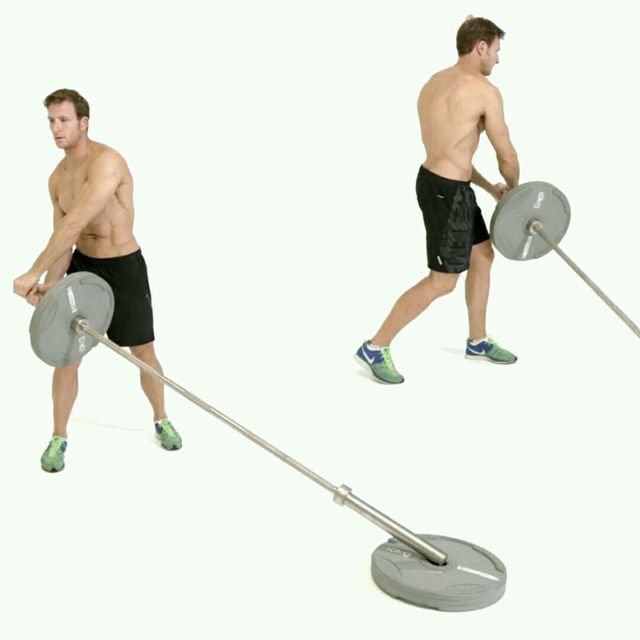
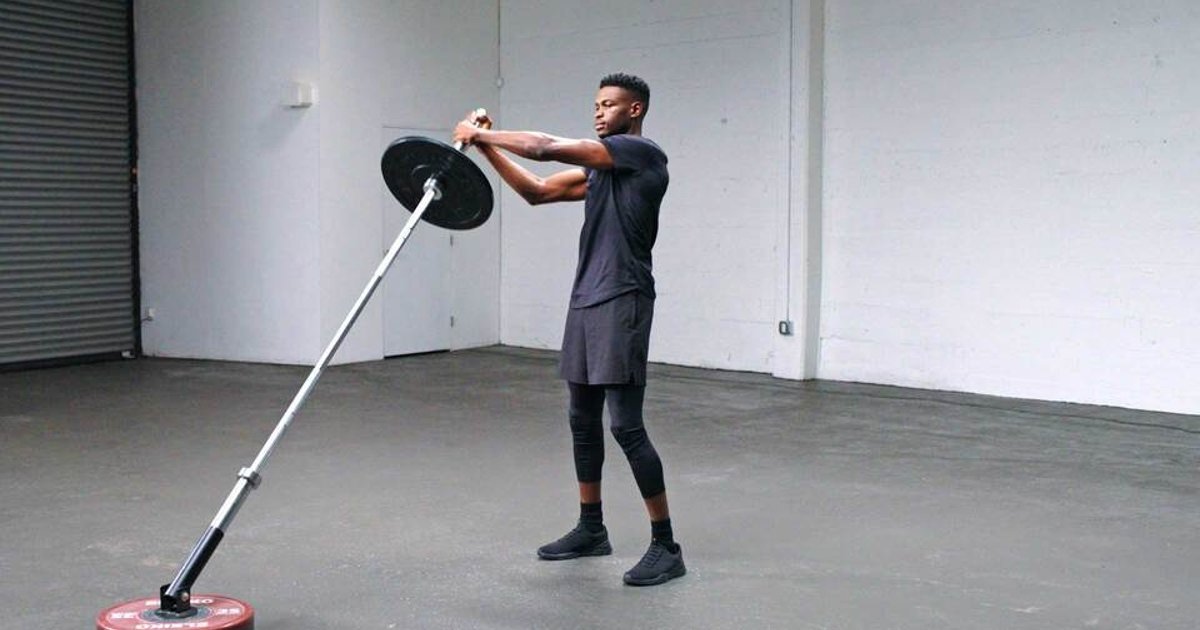
The landmine 180, often called a rainbow or standing landmine rotation, puts one end of a barbell in a fixed pivot while you guide the free end in a broad arc across your body. The movement looks simple until you try to keep the bar moving at an even speed near the bottom of each side. Your shoulders must support the long lever, your feet manage the turning force, and your trunk has to accelerate and then brake the load without losing its position.
The obliques contribute to turning and controlling the rib cage, but calling the drill an isolated oblique exercise misses the point. The shoulders, serratus, forearms, hips and glutes all help organize the motion. The rectus abdominis and deeper trunk muscles also contribute to maintaining a useful position as the bar travels. Different athletes may experience the effort in different places depending on their height, range, technique and working load.
Unlike a crunch, the landmine 180 is performed on your feet and asks the whole body to coordinate rotation. Unlike a stationary anti-rotation hold, the goal is to allow controlled turning rather than resist every degree of it. That makes the drill a useful accessory for lifters and athletes who want to practice transferring force between the lower and upper body. It does not prove that adding it will automatically improve a specific punch, throw, golf swing or sprint; those outcomes depend on skill practice and the rest of the training program.
Anchor the bar and choose the first load
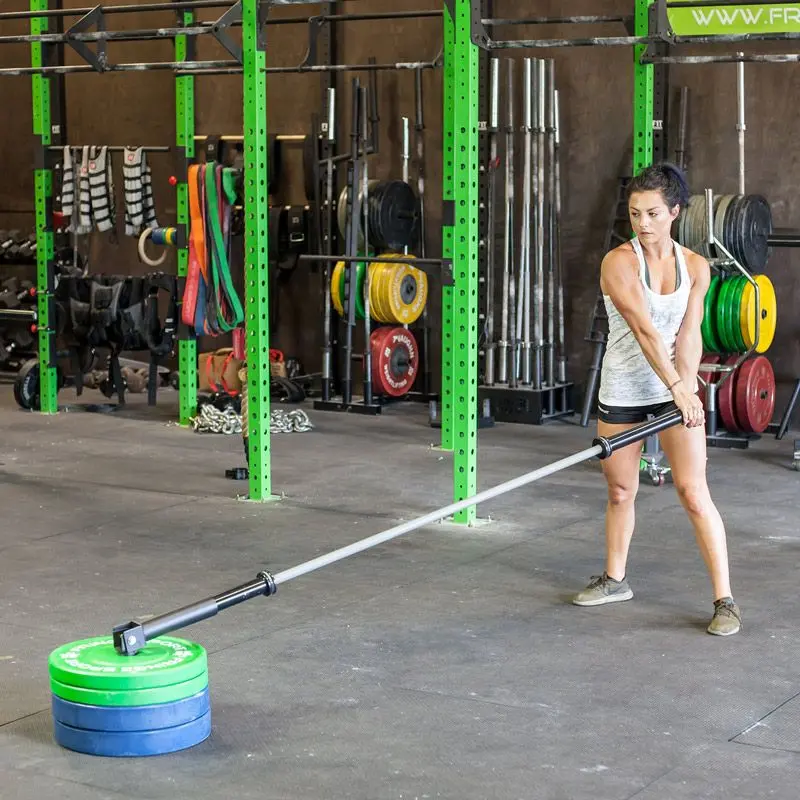
The most important piece of equipment is not a heavy plate: it is a landmine pivot that stays where it belongs. Seat the unloaded end of an appropriate Olympic bar fully inside a compatible landmine sleeve. Check that the pivot moves smoothly from side to side and that the frame, weight plates or rack mount holding it cannot roll, tip or slide. Give the moving sleeve enough clear floor space so it cannot catch a bench, another barbell or somebody walking past.
An improvised corner can sometimes hold a bar, but a loose end pressing into a wall is less predictable and may damage the bar, floor or wall. A purpose-made attachment is preferable, especially when the exercise involves repeated changes of direction. If you do not have a secure anchor, select a cable rotation or Pallof press rather than pretending a sliding bar is safe.
Start with the empty bar. A barbell pivoted at one end does not feel like lifting its entire stated weight vertically, because the support point carries part of the load and the hand position changes the leverage. Yet the long lever can still demand substantial control, especially with your hands far from the pivot and at the end of a low arc. The first few passes should establish the range and rhythm, not determine your maximum strength.
If you add a plate, use a small increment and secure it with a suitable collar where the sleeve and exercise setup require one. Before moving, verify the plate has room to travel across your intended arc. Grip the free end securely with both hands; a stable stacked or overlapping hold is preferable to a grip that lets the bar rotate loose within your hands. Keep the wrists comfortable, the knees softly bent and the floor under both shoes free of slipping hazards.
Build a hip-to-hip arc without twisting through a fixed pelvis
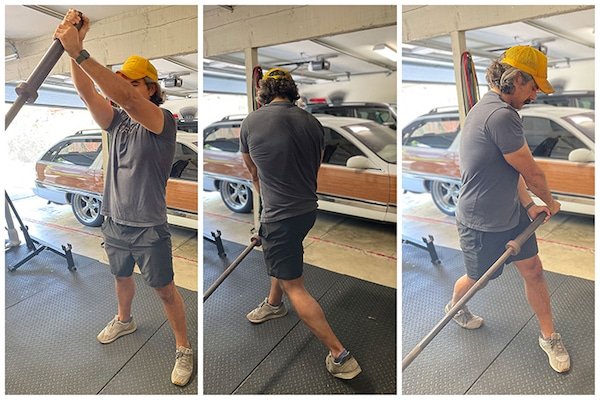
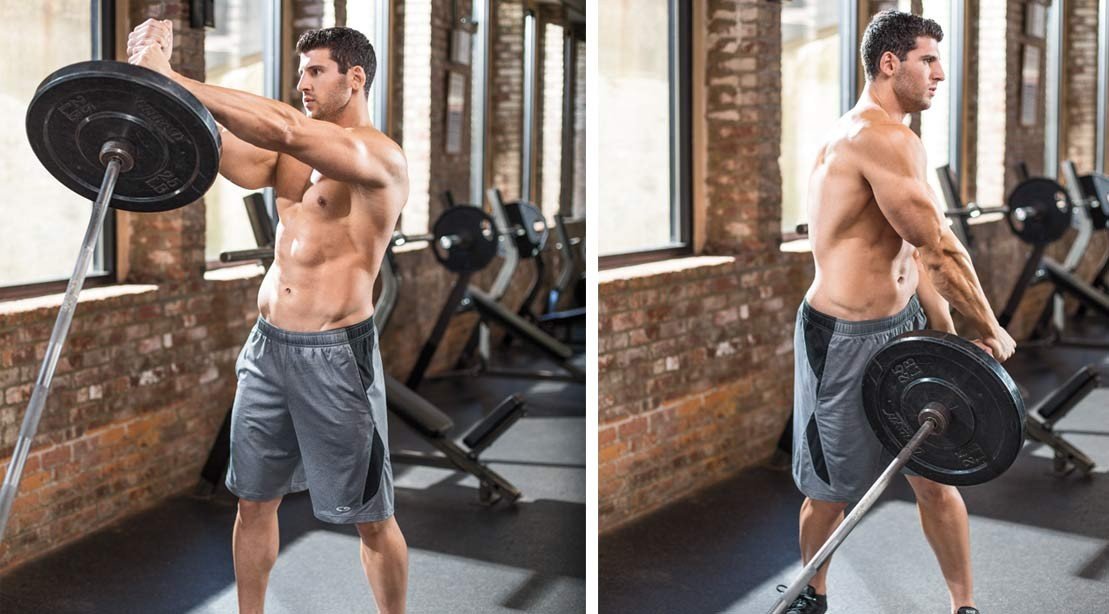
Stand facing the landmine anchor with your feet approximately shoulder-width apart. Hold the bar end in front of your chest with both hands and take a slight athletic knee bend. Your arms can remain nearly straight with a small comfortable elbow bend; the key is to keep the arm shape similar from one side to the other. Brace as though a partner were about to tap your midsection, but do not hold your breath so aggressively that you lose control of the repetition.
Guide the free end diagonally toward the outside of one hip. As it descends, allow the rib cage, shoulders and hips to turn together within a range you can control. The foot opposite the direction of the turn may pivot so that the knee and hip can follow the movement. If you lock both feet and force your chest to rotate far beyond your pelvis, the movement becomes needlessly uncomfortable for many lifters.
Now reverse the direction smoothly and bring the bar back across the front of the body. Pass through the middle without throwing it upward; continue toward the opposite hip while your other foot and hip adjust. The bar is tracing a rainbow-shaped path, but the exact endpoint does not need to be identical for every lifter. A taller trainee, an athlete with different shoulder mobility or a different bar length can use a somewhat shorter arc and still train effectively.
Think of a good repetition as three linked skills: initiate a deliberate turn, carry the load past the center, then stop it before it drags the torso beyond a useful position. The hips are not supposed to stay frozen, and the arms are not supposed to do a frantic lateral raise. Record a left-side and right-side endpoint that you can repeat. If the motion looks asymmetric on video, reduce the load and work on the less controlled direction rather than adding more speed.

Equipment Worth Exploring
Explore equipment, accessories and gear from our carefully selected range.


Grip Plates
Rubber-coated weight plates with handholds for loading barbells and machines.

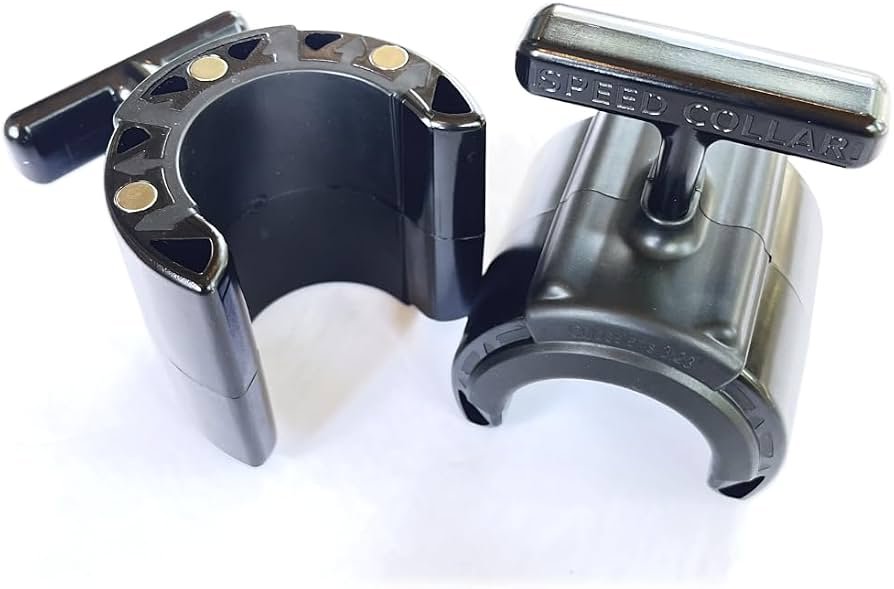
Speed Collar
Quick-release collars designed to secure weight plates on standard two-inch Olympic bars.

Competition Plates
Competition-style bumper plates for Olympic lifts and loaded strength training.


Deceleration is where heavy rotations go wrong
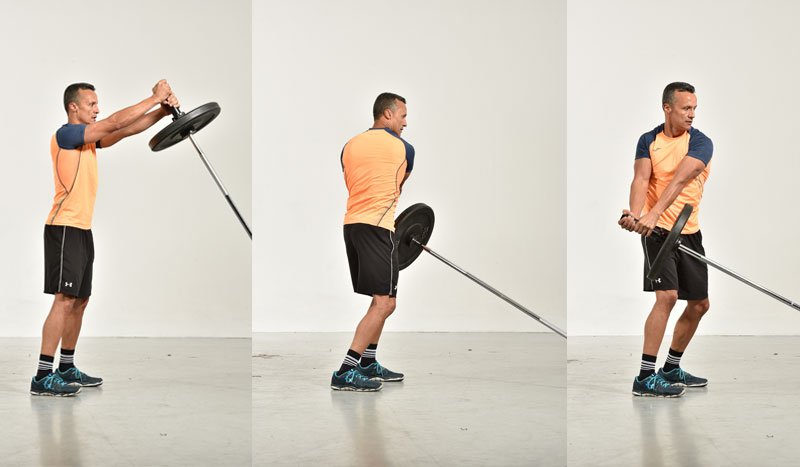
The bottom of the arc is often the most revealing part of a landmine rainbow. Gravity and the moving bar can make the final few inches feel faster than the middle of the pass. If your knees collapse inward, your torso bends sideways, or the bar jerks you into an extra twist, you have reached the end of your present control rather than a productive stretch.
Practice pausing the bar briefly near each side. That does not mean stopping it on your thigh or bouncing it from your hip; it means maintaining your grip and resisting its momentum before making the next pass. Start with deliberate two- to three-second sweeps and a visible change of direction. Once you can manage the braking phase on both sides, a faster athletic version may make sense, but speed should be earned instead of used to hide an overly heavy load.
The shoulders also matter. Repeated shrugging, rapidly bending the elbows, or letting one wrist fold under the sleeve can make a core drill feel like an awkward shoulder workout. Keep the hands connected, the shoulders moving naturally and the ribs roughly stacked over the pelvis. You should feel muscular effort without sharp pinching, tingling or back pain. Stop or modify the movement if those symptoms occur.
Do not confuse a sensation of working hard with proof of superior muscle growth. A landmine 180 can be an effective accessory for rotational control, yet it does not replace progressively overloaded squats, deadlifts, rows or other compound exercises. Nor is it necessarily the ideal direct hypertrophy exercise for every abdominal muscle. Select it for the coordination and controlled rotation it demands, and use other trunk work to fill gaps.
Landmine 180 versus presses, chops and Pallof work
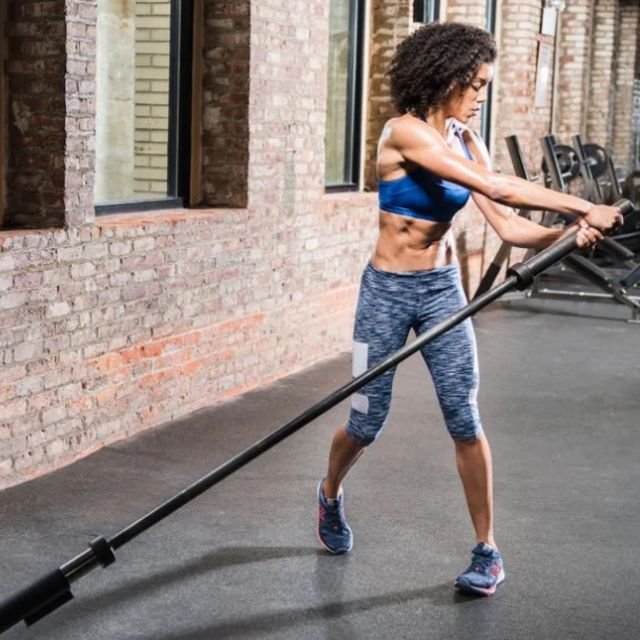
Several exercises use the same anchored bar but ask for different things. A rotational landmine press pushes the bar away from the shoulder, often with one hand and a contribution from the hips and legs. A landmine row pulls the bar toward the body. Neither automatically counts as a landmine 180, where a two-handed bar end travels across the torso in a controlled hip-to-hip arc. Distinguish the movement when comparing videos or logging sets.
A cable woodchop also crosses the body but has a different line of force. The pulley can be positioned high or low and the cable pulls toward its anchor, whereas the landmine bar follows the mechanical arc of its floor pivot under gravity. If you find one version comfortable and another awkward, that does not mean one is universally better. It often reflects your setup, range or the way the external load meets the body.
A Pallof press is a particularly useful alternative when you want to resist unwanted rotation without performing repeated loaded turns. Stand sideways to a cable or band, press the handle away from the chest, and maintain the same trunk orientation. Beginners can build basic bracing tolerance there before adding a larger landmine sweep. Kneeling or half-kneeling variations can also reduce how freely the hips move, so they should be lighter and have a more conservative range rather than forcing an identical standing arc.
If your shoulders feel uncomfortable with the long two-hand lever, use a shorter range, lighter resistance or a different exercise. The purpose is to train the intended pattern, not to defend one attachment at all costs. In a wider strength program, you can use a landmine 180 for dynamic rotation, a suitcase carry for side-bending resistance and a Pallof hold for anti-rotation without treating the drills as interchangeable.

Funny Gym Shirts & Workout Gear
Funny gym shirts, tanks, hoodies and workout gear for lifters who like training hard.

Steering Wheel Weight Plate 45LB Plate Cars & Weights W T-Shirt
Show some powerlifting attitude with a playful “Steering Wheel Weight Plate” tee.

Sisyphean Gains: Meme Shirt Rolling Weight Plate T-Shirt
Rep “Sisyphean Gains:” humor in and out of the gym.

Work Ethic On Display: Stoic Greek God Marble T-Shirt
Make gym days more fun with “Work Ethic On Display: Stoic Greek God” style.

Happy Weights Emoji Weight Plate Smiley Face Weight Gym Hoodie
Show off your powerlifting humor in a laid-back “Happy Weights Emoji Weight Plate” hoodie.

Weight Plate Heartbeat Decal for Water Bottles Laptops Sticker
Give your everyday gear a playful “Weight Plate Heartbeat” twist.

Grind Stoic Sigma Bodybuilder – Meme Shirt & T-Shirt
Bring “Grind Stoic Sigma Bodybuilder” humor to your next gym day.

Gymhead Skull Weight Plate Meme T-Shirt
Make gym days more fun with “Gymhead Skull Weight Plate” style.

No Days Off Motivation Workout for Lifting, Bodybuildin T-Shirt
Show some powerlifting attitude with a playful “No Days Off” tee.

Car Wheel Weight Plate 45LB Plate Cars & Weights Workou T-Shirt
Show some powerlifting attitude with a playful “Car Wheel Weight Plate” tee.

I Love Gym Pink Heart Weight Plate | Valentine's Workou Tank Top
Train hard, laugh a little, and rep “I Love Gym Pink Heart Weight Plate”.
A four-week progression and the errors to track
Use the landmine 180 as an accessory after your main strength work, or put light technique practice early in an athletic session when you are fresh. Begin with two sets of six controlled passes per direction. Here, a pass means taking the bar from one hip across to the other; log your counting convention so future sessions are comparable. Rest about 60 to 90 seconds and stop a set when the last two repetitions are clearly less controlled than the first two.
During week one, use an empty bar and film a short set from the front. Check whether the pivot stays planted, each foot can turn naturally, and your hips and chest move together. In week two, keep the same load and add two passes per side only if the bar path remains smooth. In week three, add a third set or use a slightly slower lowering phase; do not automatically change both volume and loading at once. In week four, test the smallest sensible plate increase if your original setup is consistent, then return to the previous load if you lose the braking phase.
This is a practical progression example, not a controlled research protocol or a guaranteed route to a performance improvement. If you have demanding rotational sport training, throwing sessions or heavy trunk work on the same day, you may need fewer sets. The correct amount is what your recovery and technique can support across the week.
Log four items: bar and plate setup, total controlled passes, endpoint range, and whether your hips and feet pivoted without discomfort. Counting only the plates overlooks the most important quality changes. Watch for the common failure pattern of a very light first set followed by an overambitious plate jump: the bar falls to the bottom, the elbows bend, and the athlete twists sharply to rescue it. Reduce the load, reset your stance and rebuild a repeatable arc. A controlled last rep is more useful than one extra rep that pulls you out of position.