Advertising disclosure: This page includes affiliate product links that may earn us a commission, as well as products from our own store.
The Kensui AdaptaBELL turns loose weight plates into adjustable dumbbells. Its appeal depends on the plates you own, the exercises you want to perform and how often you change weight. A large headline capacity cannot answer those questions. Before choosing a model, check the exact configuration, assemble a realistic plate stack and consider where that stack will sit against your body. This is a specifications-based buying and setup guide, not a claim of hands-on MMP testing. It focuses on the practical details that can make a plate-loaded dumbbell either useful or frustrating.
Start with the exact handle and retention system
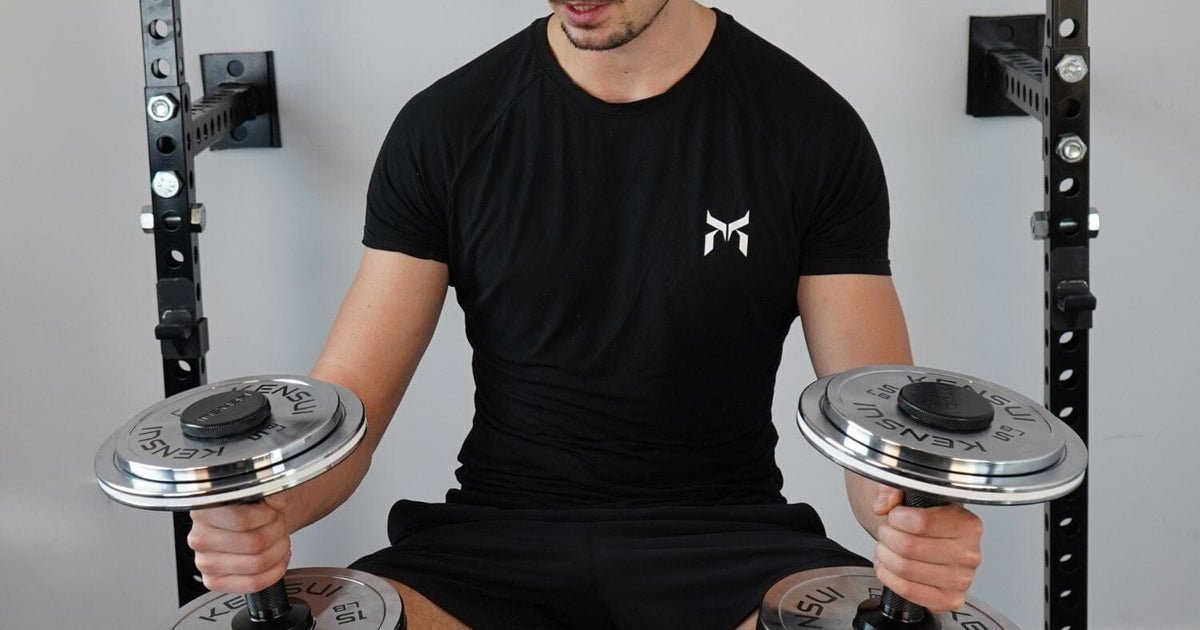
AdaptaBELL is a family of plate-loaded handles, rather than a selector that picks a weight from a cradle. The product listing distinguishes PRO and MAX configurations. Match the model name in your cart to its own instructions, supplied components and load rating. A photograph of a loaded handle does not establish the capacity of every version sold under the same family name.
The threaded loading hardware is central to the design. Before a first workout, identify which pieces retain the plates, which components adapt their fit and how the manufacturer instructs you to assemble them. Do not improvise missing parts or assume a familiar barbell collar replaces the required hardware. If the version or instructions are unclear, resolve that before loading it above your body.
The design reduces the exposed sleeve projection associated with conventional loadable dumbbell bars. That can improve practical clearance, but it does not make the complete implement narrow in every direction. Plates still have diameter and thickness. A compact handle with a broad plate stack can occupy more room than the empty handle suggests.
Inspect the unloaded equipment on a clear surface. Check for visible damage, incomplete assembly and anything that prevents the retention hardware seating as instructed. Repeat the assembly with a light load before considering your usual working weight. A controlled first check is more useful than treating the advertised maximum as the starting point for a test.
Plate compatibility includes bore, thickness and quantity
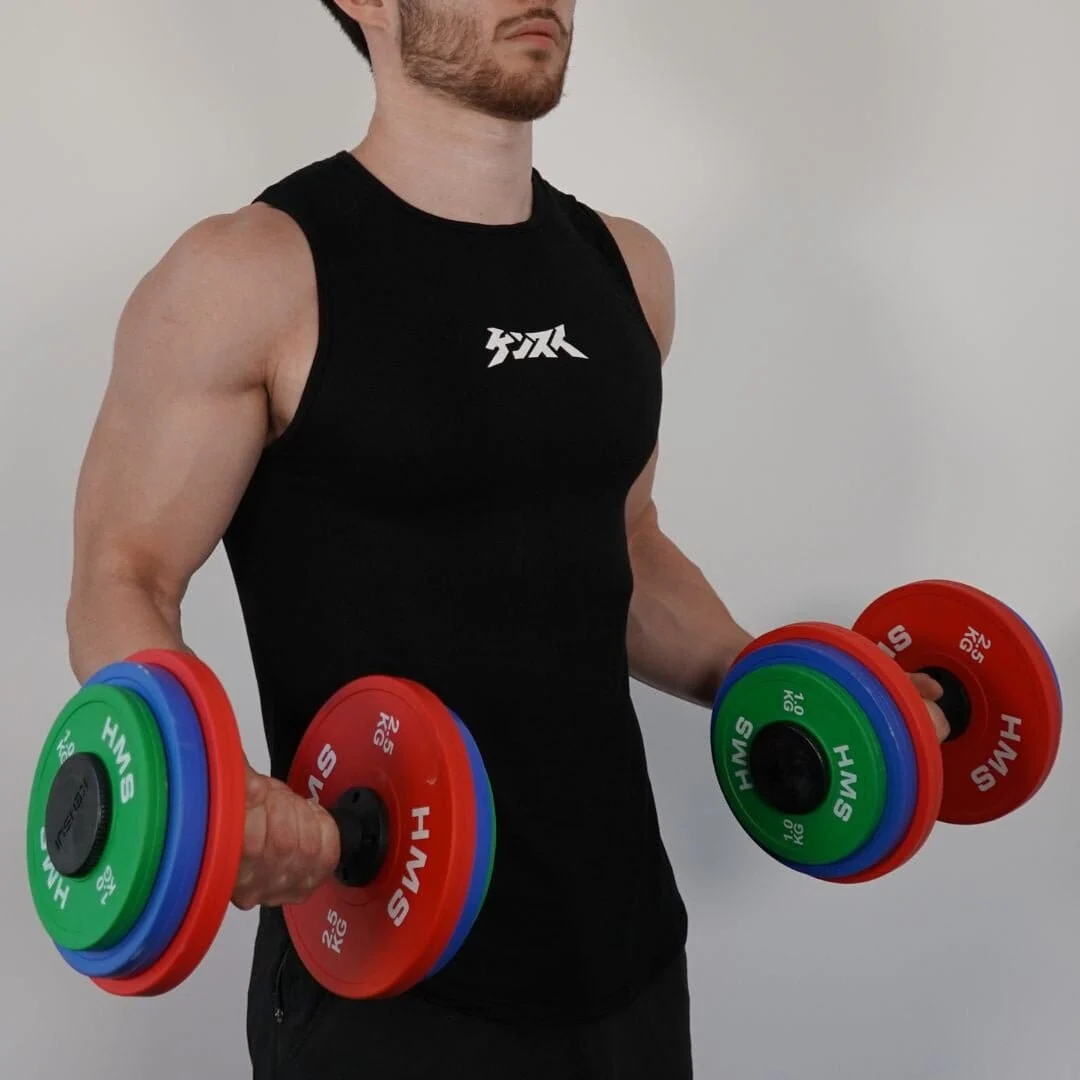
The system is advertised for standard and Olympic plate formats. Those labels describe a starting point for checking fit, not a guarantee that every plate in a mixed collection will behave identically. Confirm the actual bore, the adapters required by your chosen model and the amount of usable loading space. Plate coatings and manufacturing tolerances can affect the practical fit.
Lay out enough matching plates for two dumbbells. For an ordinary balanced pair, both ends of each dumbbell need equivalent loading, and the second dumbbell needs the same arrangement. A collection that provides a useful barbell weight may not divide into four matching stacks. Count the pieces you need before comparing the price of handles with a complete adjustable set.
Thickness can become the limiting factor before mass. For example, if one plate occupies twice the axial space of another, the same available loading space accepts fewer of them. This is simple geometry, not a performance test of the AdaptaBELL. Measure your own plates and leave the space required for the correct retention engagement; do not solve a fit problem by reducing that engagement.
Include handle and hardware mass when recording the total. A hypothetical handle assembly weighing 2 kg with two 5 kg plates is a 12 kg dumbbell. Two such dumbbells make a 24 kg pair. Keep each-dumbbell weight separate from pair weight in your log, and do not transfer this example to a capacity rating without checking how the manufacturer defines that rating.
Test clearance for the exercises you actually use
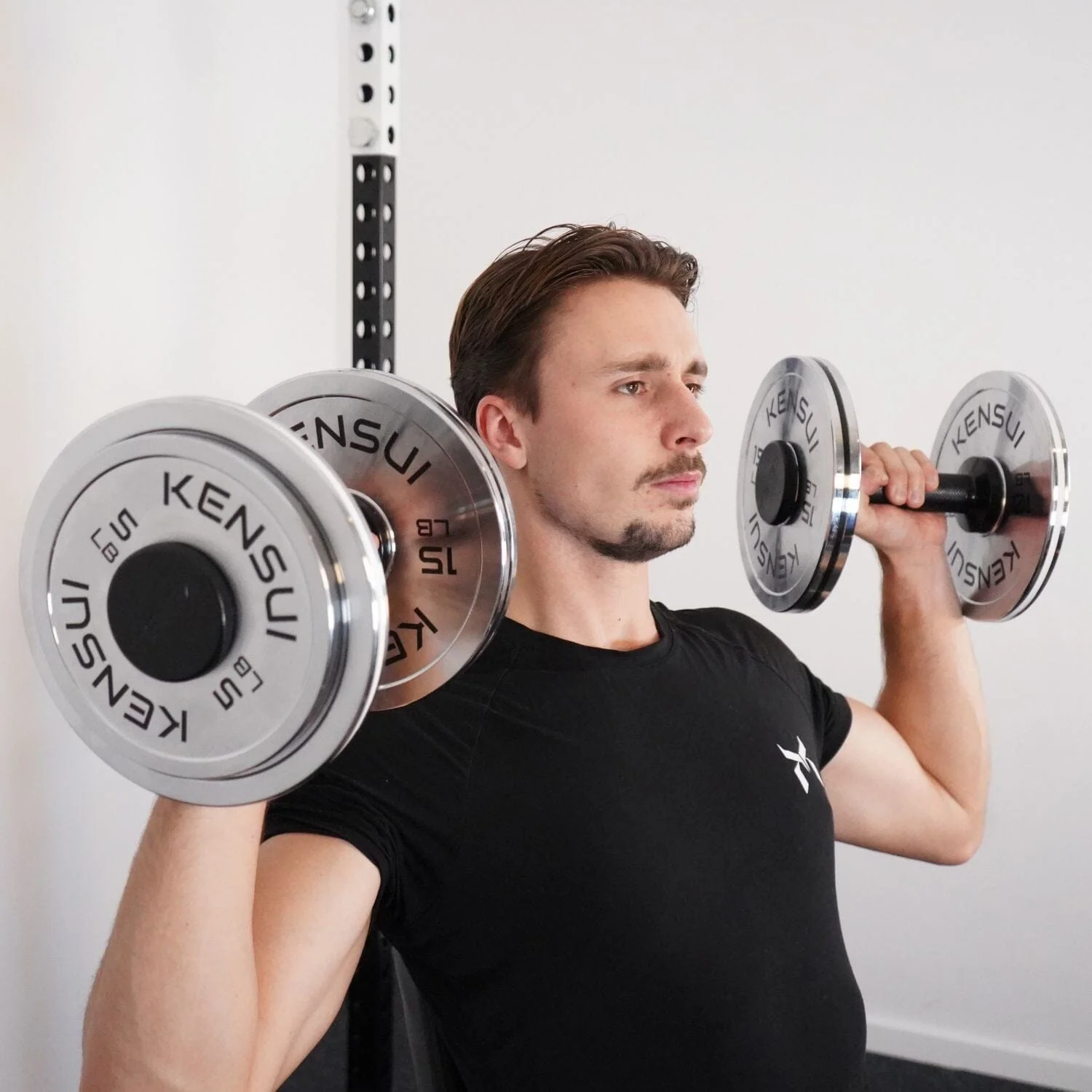
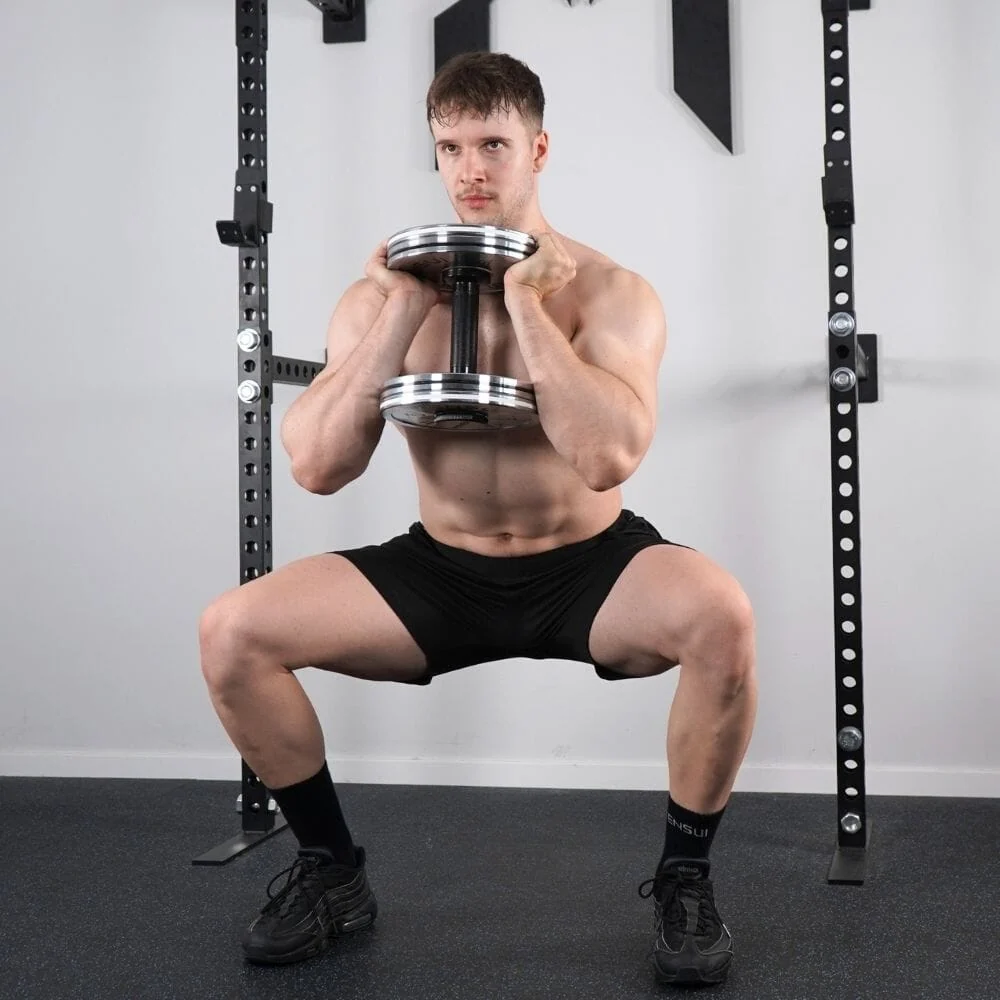
Begin with a light goblet hold and a comfortable squat pattern if those movements are already part of your training. Notice where the plates sit against the hands, forearms and chest. Do not assume that removing a protruding sleeve also removes every contact point. A plate diameter that works well for a row may feel awkward when the dumbbell is held close to the torso.
For shoulder pressing, check the starting position and the overhead path before adding load. Avoid bringing two large stacks together simply because a smaller fixed dumbbell allowed that path. Keep the movement comfortable and controlled. Contact between the implements should not dictate your shoulder position or force a last-second change of grip.
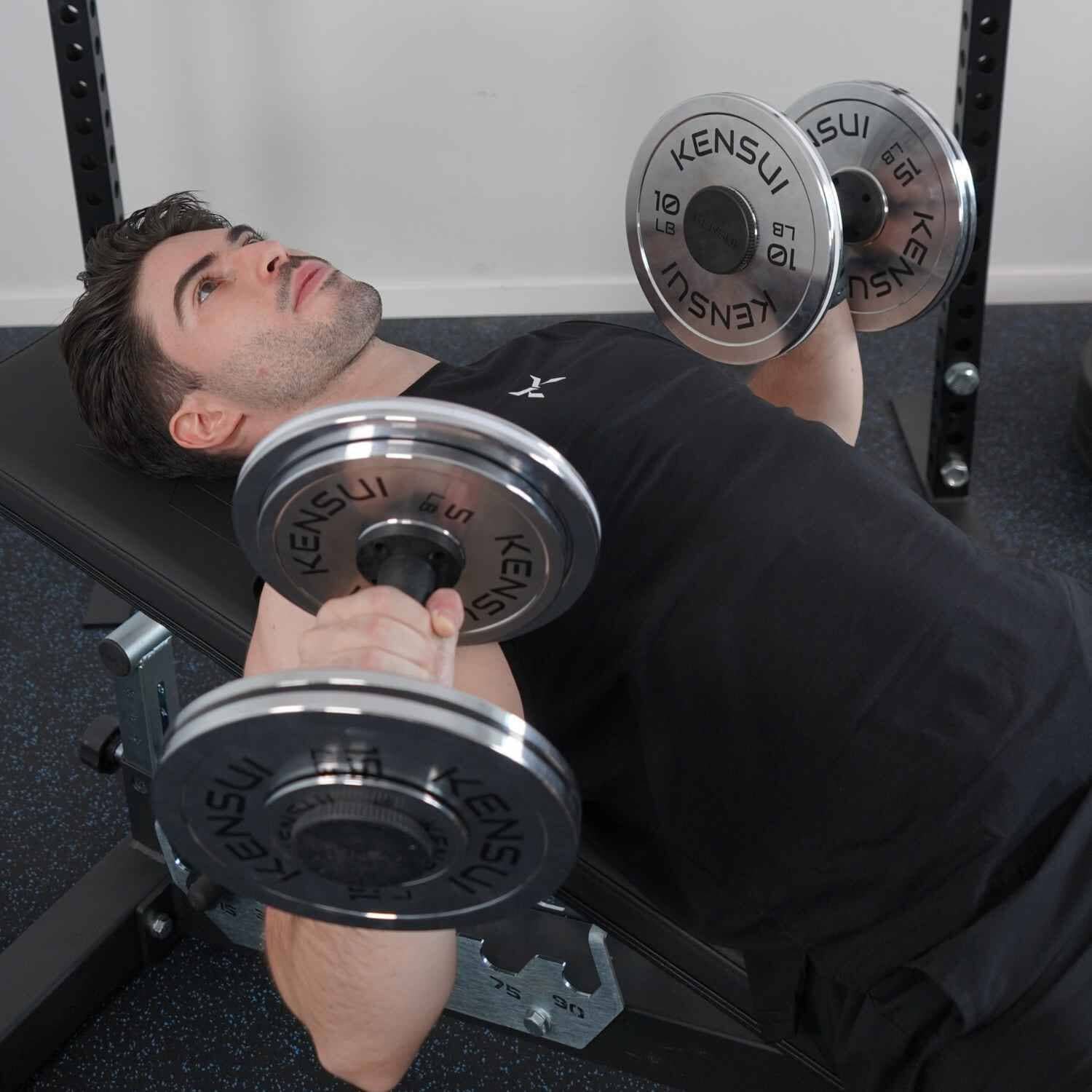
For bench pressing, consider the whole sequence: getting the weights into position, the pressing repetitions and returning them to a safe resting place. Use a stable bench and a load you can control. If you need assistance, arrange it before the set. End shape and plate security matter during setup as much as they do while the dumbbells are moving above the chest.
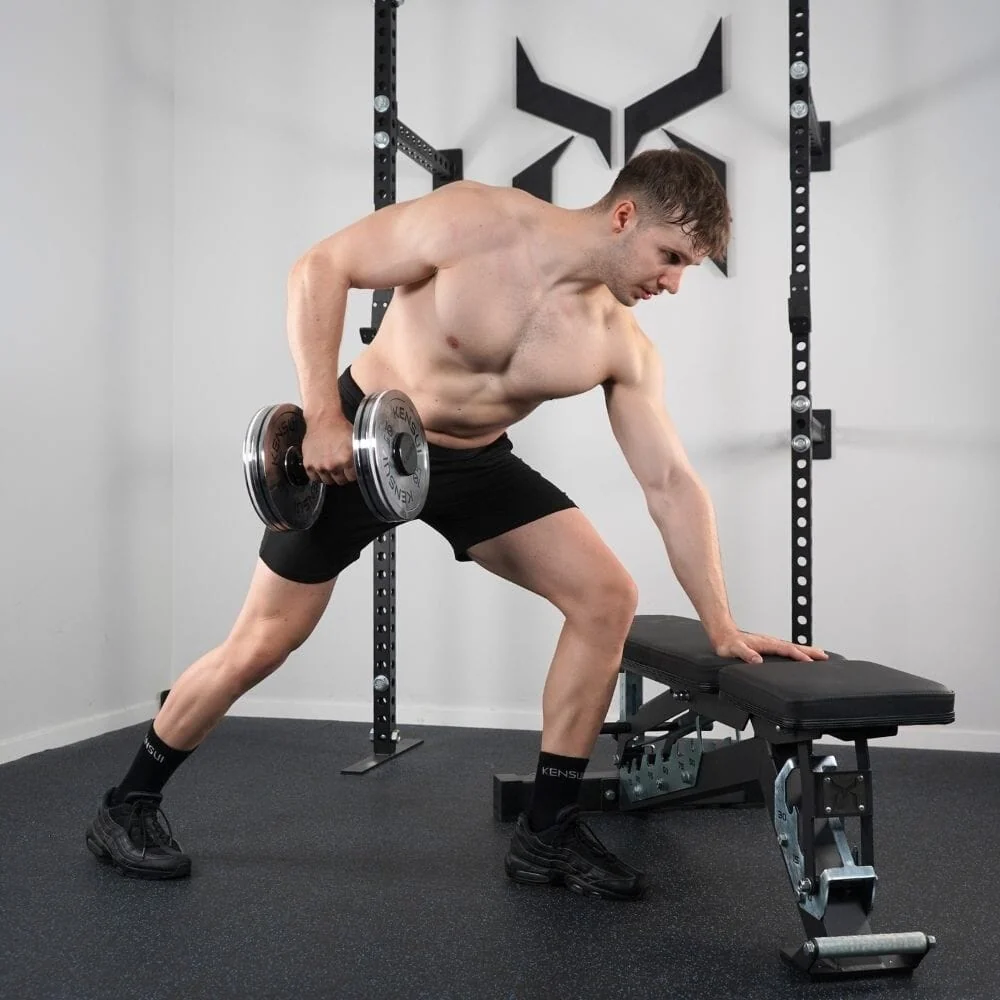
Try a supported row with a light assembly as another clearance check. Keep unused plates out of the area where you place your feet and hands. The relevant question is whether your chosen stack lets you perform your intended movement without unwanted contact. The answer can differ across exercises even when the total dumbbell weight is unchanged.

Equipment Worth Exploring
Explore equipment, accessories and gear from our carefully selected range.


Rubber Hex Dumbbells
Rubber-coated hex dumbbell pairs with a stable shape for home and commercial strength training.


Grip Plates
Rubber-coated weight plates with handholds for loading barbells and machines.

FID Bench MAX
Adjustable bench offering flat, incline, and decline positions + adjustable headrest.


Plan weight changes and progression before the session
Manual loading is easiest to evaluate against a real session. Write down your warm-up loads and working loads for a press and a row, then work out the plate combinations. Count how many pieces must come off and go back on between those loads. A setup that is convenient for three straight sets may be less convenient for rapid alternating exercises.
Small plates can provide useful progression options, but the smallest available change is determined by how you load the implement. Adding one 0.5 kg plate to each end increases one dumbbell by 1 kg. Repeating that change on the second dumbbell increases the combined pair by 2 kg. Those are different ways of reporting the same adjustment, so choose one convention and keep it consistent.
Use a planned rest interval to make changes without rushing the hardware check. Separate the plates for the next load from the plates you have removed, and rebuild matching stacks. If a piece is left over unexpectedly, stop and check the arrangement. Do not infer that the second dumbbell matches the first merely because the two look similar from a distance.
A practical introduction is to use the same moderate configuration for a few familiar exercises before experimenting with frequent changes. Record the plate recipe as well as the total. If the setup becomes cumbersome, reorganising the session into straight sets may be enough to make the equipment useful. Buying more accessories should follow a specific loading problem rather than precede one.

Funny Gym Shirts & Workout Gear
Funny gym shirts, tanks, hoodies and workout gear for lifters who like training hard.

Bench Press and Chill Funny Gym T
Make gym days more fun with “Bench Press and Chill” style.

Grip Training Get A Grip Hoodie
Show off your lifting humor in a laid-back “Grip Training” hoodie.

Control Your Gains Stoic Greek God Marble Sculpture T-Shirt
Make gym days more fun with “Control Your Gains Stoic Greek God Marble” style.

4 Plates Bench Club Chest Day Meme & Top T-Shirt
Make gym days more fun with “4 Plates Bench Club” style.

Anti Rowing Rowing Club Shirt – Meme & Top T-Shirt
Show some cardio attitude with a playful “Anti Rowing Rowing Club” tee.

Dumbbell Heartbeat Crewneck Pullover Sweater Workout Fa T-Shirt
Add a playful “Dumbbell Heartbeat” touch to your casual rotation.

Dumbbell Meme Shirt – Essential & Gymbros Seeking T-Shirt
Make gym days more fun with “Dumbbell Gym Meme” style.

I Love Bench Press Valentine'S Day Meme – Chest Day T-Shirt
Make gym days more fun with “I Love Bench Press Funny Valentine's Day” style.

Safety Practice Safe Sets Hooded Jumper Top Hoodie
Show off your bodybuilding humor in a laid-back “Gym Safety” hoodie.

Compare complete systems rather than bare-handle prices
Conventional Olympic loadable dumbbell bars use exposed sleeves and collars. Their useful comparison points include sleeve length, plate clearance and the cost of securing four loaded ends. Some are sold individually, so check quantity carefully. A pair of inexpensive handles is not a complete pair of training dumbbells unless you also have the necessary plates and retention equipment.
A dedicated locking-plate system offers another approach: its supplied plates and handles work together as a defined package. A switch-selected adjustable system instead prioritises changing the selected load while the dumbbell is in its cradle. These are different workflows. A faster adjustment mechanism can matter more for a dense session than a capacity you will rarely use.
Fixed dumbbells provide the simplest changeover if several pairs are already available, but storing multiple pairs takes space. Plate-loaded handles can reuse an existing collection, while two people sharing the same plates may find that advantage disappears during simultaneous training. Include the actual household or gym workflow in the comparison rather than considering the handles in isolation.
Build a complete cost list: two correct handles, required adapters, matching plates, any approved extensions and a sensible place to store the loose pieces. Check current regional shipping, availability and model instructions when buying; this guide does not freeze a price or delivery promise. Keep different manufacturers' capacities and drop policies separate instead of transferring a claim from one system to another.
AdaptaBELL is most interesting when it solves an identifiable equipment problem: you have compatible plates, can build balanced stacks and prefer manual loading. It is less compelling if achieving useful pairs requires buying nearly an entire plate collection, or if frequent changes are the main priority. Choose the arrangement that supports repeatable pressing, rowing and other intended movements, then progress the training without compromising the assembly checks.