Advertising disclosure: This page includes affiliate product links that may earn us a commission, as well as products from our own store.
Hack Squats: Dial In Foot Position, Depth and Quad Training
Hack squats can turn a complicated leg day into a straightforward challenge: find a stable stance, move the sled through a repeatable range and make the quadriceps do meaningful work. But the machine is not self-explanatory. Foot height, carriage design, safety stops and how deeply you bend all change the experience. The most productive setup is not necessarily the most extreme one.
This guide separates useful technique from overconfident foot-position rules, shows how to compare hack squats with other leg machines and gives a six-week progression you can actually track. It focuses on the common angled, plate-loaded linear hack squat; check your gym’s specific model before applying any release or adjustment instructions.
1. What the hack squat machine actually changes
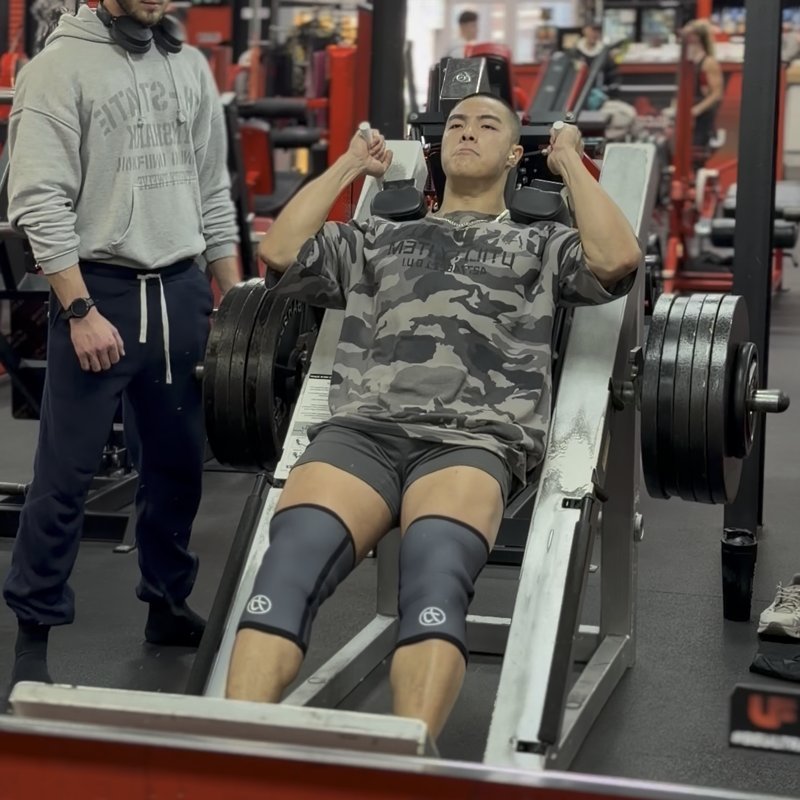
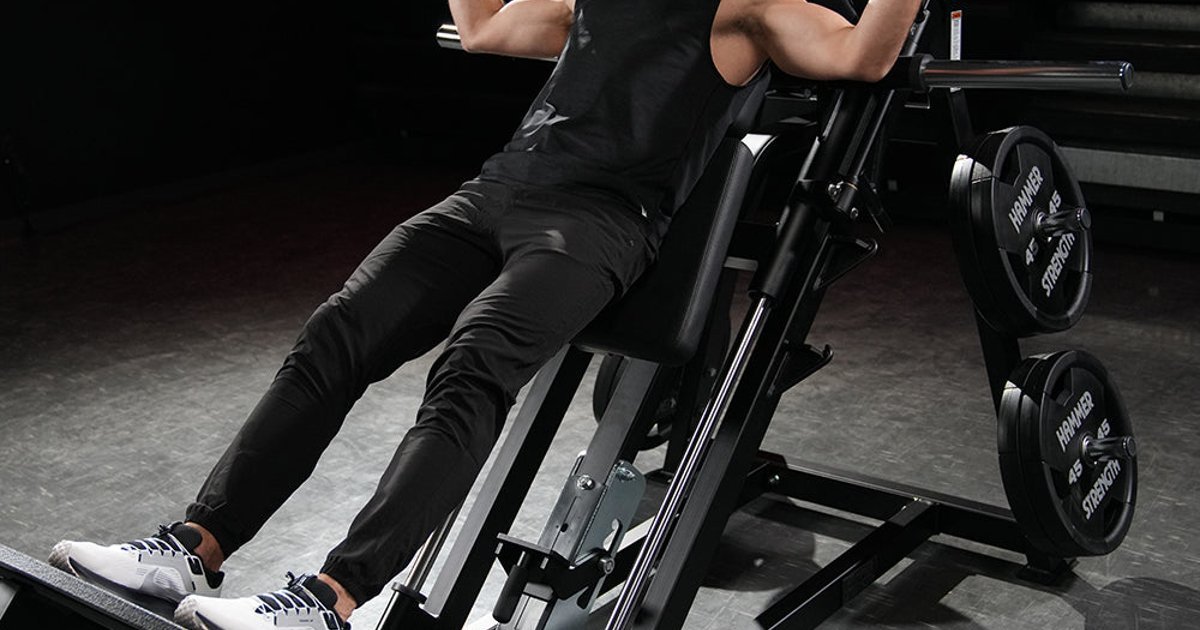
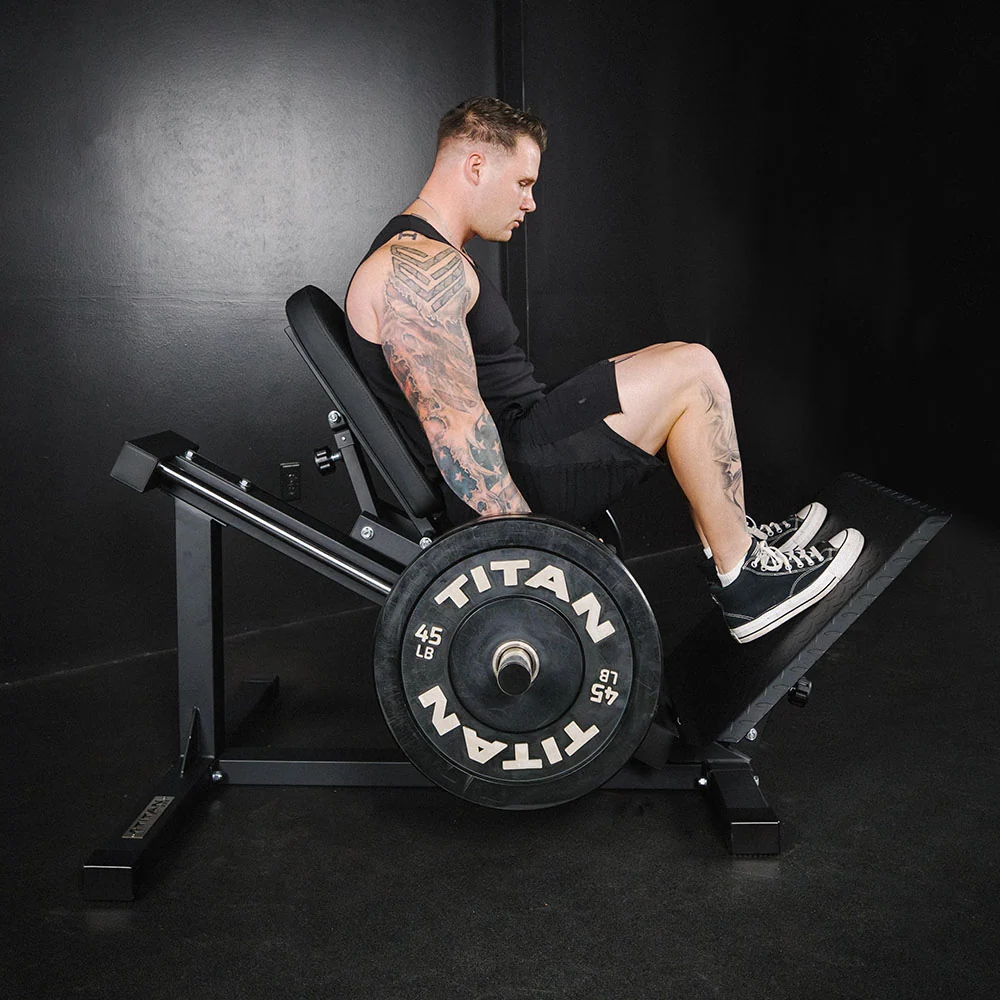
A plate-loaded hack squat is a squat pattern guided by a carriage rather than a bar balanced across your shoulders. On the familiar angled version, your shoulders and back rest against pads while your feet press a fixed platform. As the sled moves along rails, the knees and hips both bend and straighten. This is why the movement often feels immediately accessible to someone who knows how to squat, but the loading can feel surprisingly different from a barbell.
The quadriceps extend the knees, so they take substantial work during a well-executed hack squat. The glutes help extend the hips, particularly when meaningful hip flexion is present. The backrest reduces the need to control a free bar in space, which can make it easier to give the legs a hard set without your balance being the main limitation. That does not mean the machine automatically eliminates spinal loading or that every repetition is safe regardless of technique.
Machine design changes the exercise. Some units have a steep sled, others a different rail angle, shoulder-pad geometry, adjustable platform or substantial empty-carriage weight. There are also pendulum squats, V-squats and Smith-machine versions that are not identical to a linear hack squat. If two gyms have different machines, the same number of plates may represent very different resistance. The carriage weight, friction, lever arm and range all matter.
This makes the hack squat valuable as a repeatable leg-training option rather than an exercise that somehow replaces every other squat. You can keep foot markers and depth consistent, concentrate on effort, and measure progress over several weeks. A barbell squat still demands coordination and balance that a guided sled doesn’t reproduce. Use the machine because it suits the goal and your joints, not because a fixed path is inherently superior.
2. Foot placement: find a repeatable position before chasing emphasis
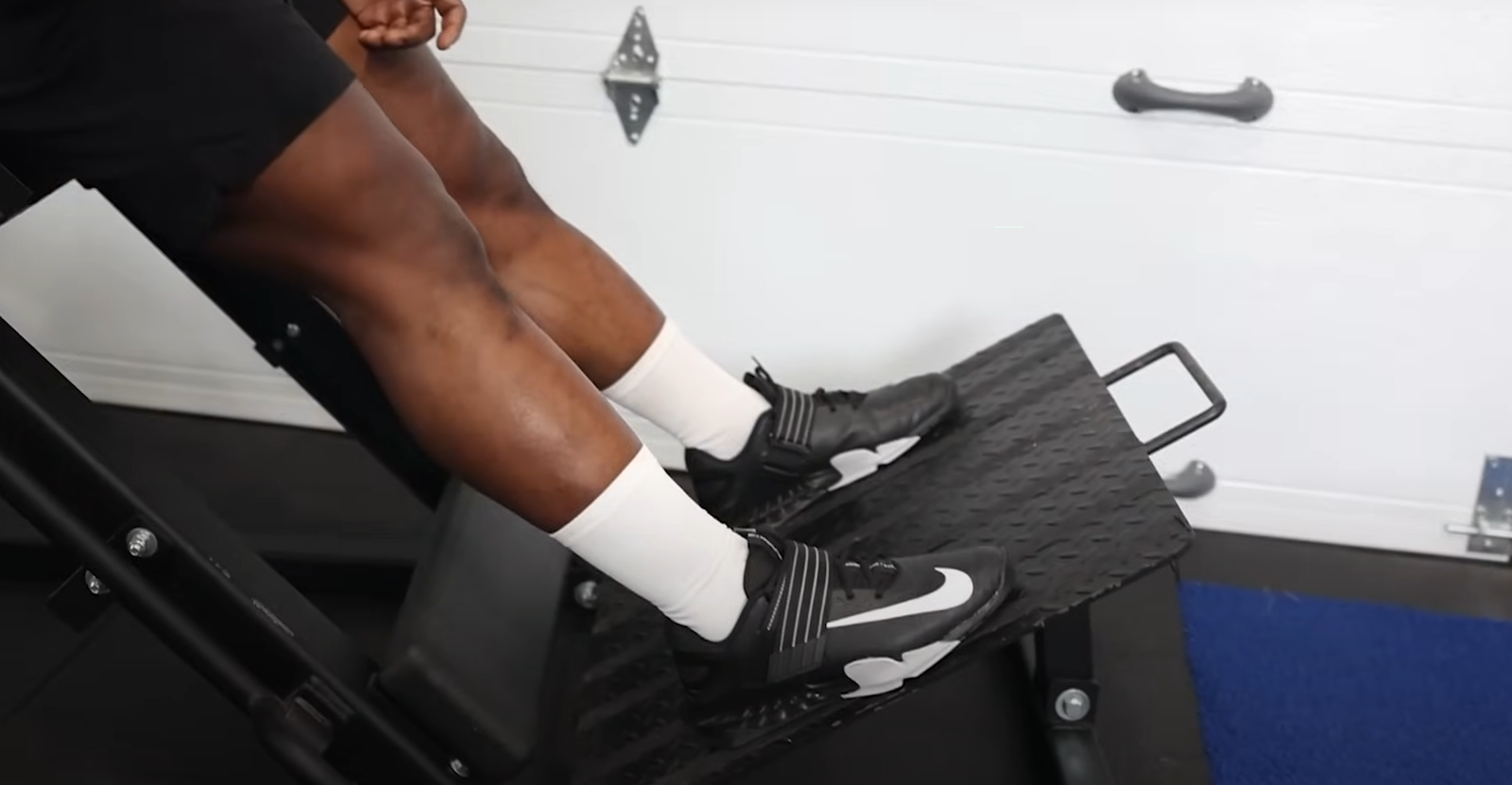
Start in the middle region of the platform, approximately hip- to shoulder-width apart, with the toes turned slightly outward if that matches your natural squat. Sit your entire foot on the platform, including the heel. With an unloaded carriage, descend through a comfortable range and watch whether the knees track generally in the direction of the toes. Mark or photograph the starting position so you can repeat it in your working sets.
Moving the feet lower usually asks for more knee travel and ankle bend. That can be useful when the goal is a substantial knee-extension demand, but it can also make the heel lift or force you to stop higher than expected. Moving the feet higher can change the relative knee and hip motion, though the exact effect differs among machines and limb proportions. Treat the popular low-feet-equals-quads, high-feet-equals-glutes rule as a starting hypothesis, not a guaranteed muscle-isolation switch.
A small stance-width adjustment can help your hips and knees move freely. Going very narrow solely to chase an imagined outer-quad target may sacrifice a stable foot position. Likewise, a very wide stance isn’t automatically a better glute-builder. Leg-press and free-squat observations sometimes inform these suggestions, but they cannot precisely predict muscle recruitment or long-term growth on every hack-squat model.
Try this three-position screen without heavy weight: five controlled reps at a middle platform position; five with feet only a few centimeters lower; and five a few centimeters higher. Keep stance width, range, tempo and footwear similar. Notice heel contact, knee comfort, whether the lower back stays supported and which position allows a deep, stable repetition. Choose the version you can load and progress rather than treating a temporary muscle burn as conclusive evidence.
If your heels rise or the toes carry nearly all the pressure, move slightly up the platform or reduce depth. If your knees feel crowded by your torso, change stance or the carriage’s lowest stop rather than forcing contact. A different pair of shoes can alter the feel through heel height and sole stiffness, so keep footwear consistent when comparing sessions.

Equipment Worth Exploring
Explore equipment, accessories and gear from our carefully selected range.

Leg Press/Hack Squat BPR-790
Convertible 45-degree leg press and hack squat machine with a broad footplate and band pegs.

Compact Leg Press CLP-700
Compact reverse-style leg press with a moving seat carriage and an adjustable footplate.

Studio V-Squat
Plate-loaded V-squat machine for supported lower-body strength training.

Leg Extension/Curl BCO-780
Leg extension and lying leg curl combo with plate loading, band pegs and a cable-loading option.

Seated Leg Combo BCO-680
Adjustable seated leg extension and leg curl machine with band pegs for added resistance.


Squat Harness
Wearable harness for hands-free cable squats, sled work, and lower-body training.


Standing Abductor
Plate-loaded standing hip abductor for targeted outer-glute and hip-stability training.
3. Set the stops, release the carriage and perform clean reps
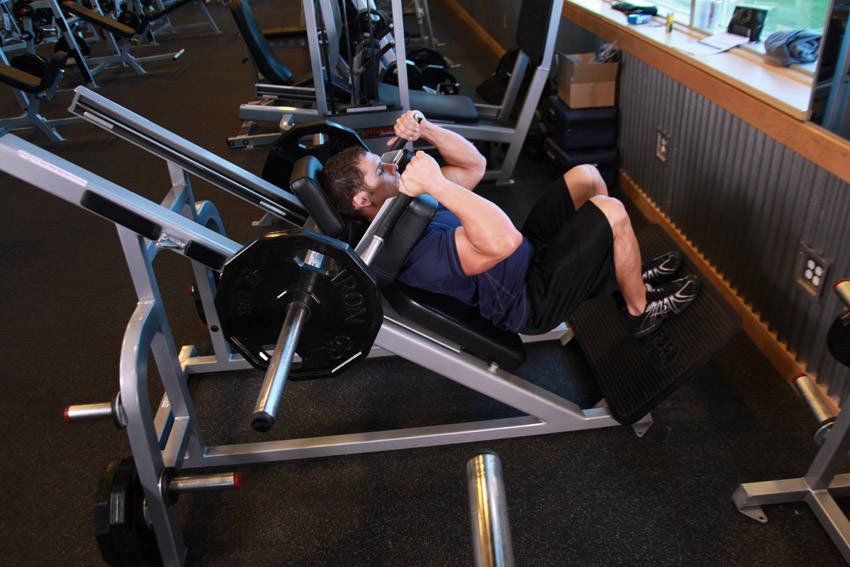
Before you load plates, inspect the machine. Find the safety catches, release levers and adjustable bottom stops, and practice engaging them with an empty carriage. Every model differs: don’t assume the side handles rotate or lock in the same direction as the machine you used last week. Set a bottom safety position that prevents the sled from trapping you if a rep fails, while still allowing your chosen comfortable depth. If the setup is unfamiliar, ask gym staff to demonstrate it.
Step onto the platform with feet matched left to right. Place your upper back and shoulders firmly against their pads, keep your pelvis supported, and hold the handles without yanking yourself into the machine. Establish a steady rib-cage and pelvic position rather than pushing your lower back into an exaggerated arch. Extend the legs enough to unhook the catches, then confirm the sled is free before descending. Don’t twist your torso or pull a latch with one hand while the sled is falling.
Take about two or three seconds to lower on the first few warm-up reps. Allow the knees to bend and travel in line with your foot angle while the heels remain down. Stop at the depth where you still have support, control and useful joint range. The goal isn’t necessarily to touch the safety stops. A pause just above the bottom removes the temptation to bounce off stretched tissues, padding or a mechanical stop.
Drive through the whole foot to raise the sled. Think about moving the platform away while keeping both legs contributing, rather than pushing only with the toes or lifting one hip. Finish the repetition under control; there’s no need to slam into a hard knee lockout. Re-brace between reps if you need to, especially near the end of a tough set. At the end, fully reengage both safeties and verify they hold before stepping out.
Use an unloaded practice set, one modest warm-up set and another progressively heavier warm-up before a demanding working weight. Some carriages are heavy even without plates, and some glide easily. A person with long legs, short ankles or unusually tall stature may need the platform and pads adjusted differently from the lifter before them. Never copy the previous person’s loading without first checking the actual machine.

Leg Day Shirts & Workout Gear
Leg-day gym shirts and workout gear for lifters who never skip squats, lunges and lower-body punishment.

Shirt – I Want You To Squat Uncle Sam Patriotic – T-Shirt
Bring “I Want You To Squat Uncle Sam Patriotic” humor to your next gym day.

SwoleBob Squatpants – Leg Day Meme , Top & T-Shirt
Heavy lifts, good laughs, and a little “SwoleBob Squatpants” energy.

Funny Squat Game Gym | Squid Game Parody Workout Sweate T-Shirt
Add a playful “Squat Game” touch to your casual rotation.

Never Skip Leg Day – NSLD Meme Fried Chicken Jumper Pul T-Shirt
Add a playful “Never Skip Leg Day” touch to your casual rotation.

Legendary Leg Day – Squat Meme Decal for Gym Bottles & Sticker
Put “Legendary Leg Day” gym humor on your laptop, bottle, or gym gear.

Never Skip Leg Day Flamingo – Fitness Meme Hooded Pullo Hoodie
Bring “Never Skip Leg Day Flamingo” gym humor to lazy days and post-workout plans.

Squats Leg Day Heavy Weights Meme – Essential Top T-Shirt
Bring “Squats Leg Day Heavy Weights” humor to your next gym day.


Squatbucks & Coffee Meme Leg Day, & Gains Top T-Shirt
Show some leg-day attitude with a playful “Squatbucks Gym & Coffee” tee.

Funny Legday of Legends Gym | League of Legends Parody T-Shirt
Show some gym-day personality with “Legday of Legends”.
4. Depth, knee travel and discomfort: separate control from fear
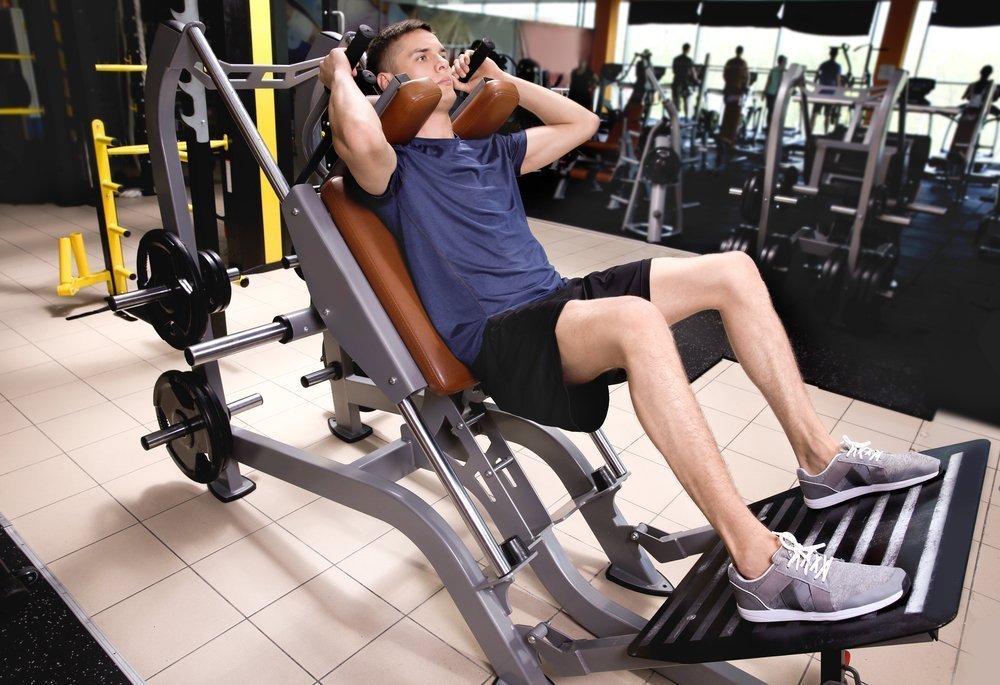
Squatting deeper creates more joint flexion and changes the mechanical challenge. Many lifters can make use of substantial depth when the movement remains controlled, feet stay planted and the pelvis and back do not abruptly peel away from the pad. However, deeper is not a competition independent of anatomy. A rep that ends slightly above your maximum because the knee, hip or ankle runs out of comfortable motion may be more productive than forcing another few centimeters with a different joint position.
Knees moving forward over the toes are not automatically a technique error. A hack squat naturally asks for knee flexion, and a low foot placement commonly increases forward knee travel. What matters is whether the movement is smooth, the knee follows the foot direction and the position can tolerate the chosen load. Knee position alone does not reveal tissue tolerance, injury risk or which muscle will grow fastest.
Sharp, catching or escalating joint pain is a reason to stop or alter the set, not an invitation to muscle through. First reduce the load, adjust foot height slightly and shorten the range until the motion is comfortable. If pain continues, substitute a movement you tolerate and seek qualified clinical assessment when appropriate. This is different from ordinary quadriceps fatigue, which usually feels like a diffuse muscular effort and resolves during recovery.
Common movement errors are easier to correct one at a time. Heels lifting: adjust feet upward or choose stable footwear. Hips shifting: reduce the load and check left-right symmetry. Back lifting off the pad: reduce depth or reposition the torso and shoulders. Sudden pauses caused by the carriage catching: inspect the machine rather than forcing the sled through an obstruction. Knees collapsing erratically: slow down and find a stance you can control, without assuming perfectly vertical shins are required.
A useful filming angle shows the entire footplate, sled and hips from the side or three-quarter view. Compare a warm-up rep with a demanding rep. If depth shrinks by half or the final reps bounce hard off the bottom, the set has stopped being a controlled test of the same movement. Lower the weight before treating that change as progress.
5. Hack squats, leg presses and barbell squats are not interchangeable
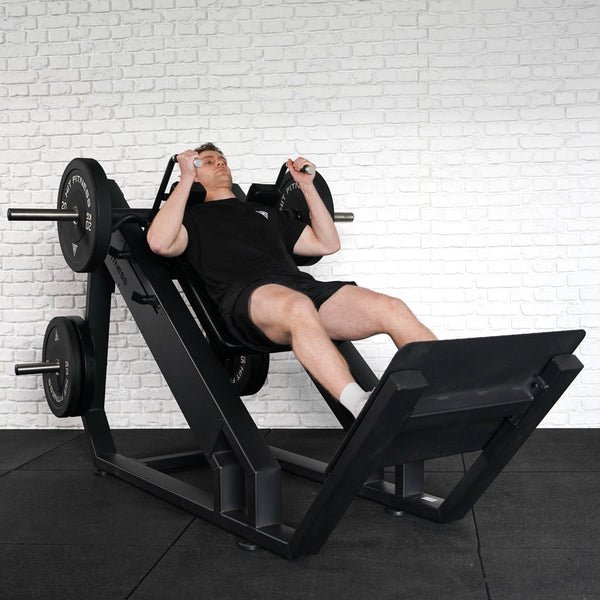
Hack squats and leg presses both let you push against a platform, but they arrange the torso, hips and moving weight differently. In a leg press, the seat typically supports you while the legs push a sled away or drive a platform; in a hack squat you stand in a supported squat pattern while the loaded carriage follows rails. Neither design guarantees identical joint angles, muscle activation or range of motion. Foot placement studies on one machine cannot be pasted onto the other as exact numbers.
A Smith-machine squat gives a guided bar rather than a shoulder carriage and large footplate. You still determine how your feet relate to the vertical or angled bar path, and that can change your mechanics appreciably. A free-weight squat demands balance, upper-back support and more whole-body coordination. If improving the barbell back squat is your main goal, regular barbell practice remains important even if the hack squat is an excellent additional source of hard quadriceps work.
For muscle building, the equipment choice is often about which lift allows repeatable hard sets at a manageable recovery cost. Someone whose lower back fatigues before the legs on squats might benefit from hack squats as a supported accessory. Someone whose knees dislike a particular sled angle may do better with a different hack machine, a leg press, split squats or another squat variation. No single machine wins for every body or training phase.
An effective lower-body session might pair a skilled barbell squat or hinge with two or three hard hack-squat sets, followed by a leg curl. A different session can lead with hack squats, then use a split squat and calf work. The machine does not become superior just because you can pile more plates on its horns. Compare effort and performance at a consistent range on the same apparatus, not plate counts across different exercise types.
Commercial and compact gym buyers should also distinguish a genuine linear hack squat from a V-squat, pendulum unit or combined leg-press/hack machine. Check usable footplate depth, shoulder-pad clearance, empty weight, safety stops, ceiling height, motion path and whether you can enter or exit without being squeezed. Those practical details can matter more than the marketing label.
Equipment Worth Exploring
Explore equipment, accessories and gear from our carefully selected range.

GymPin Squat Wedges
Non-slip 15-degree squat wedges help elevate the heels for deeper quad-focused squats.

Safety Squat Handles
Barbell squat handles that reduce shoulder positioning demands during high-bar squats.


Multi Pull Smith Rack MPHR-780
All-in-one rack with a Smith machine, functional trainer, lat pulldown and low row.


Foldable Wall Rack
Wall-mounted folding squat rack designed to save floor space between workouts.


Competition Plates
Competition-style bumper plates for Olympic lifts and loaded strength training.


Open Hex Bar
Open-frame trap bar with multiple handles for deadlifts, carries, and lower-body training.
6. A six-week quad progression built around stable technique
Use the first week to establish your foot position and a reliable depth, not to hunt a maximal load. Start with two work sets of about eight to twelve reps, finishing with roughly two or three technically controlled reps in reserve. Repeat the same stance and range for both sets. If you can reach the rep target while your back stays supported, heels remain down and the final rep looks like the first, the load is appropriate to progress.
In week two, keep two sets and try to add a rep or two across the session before adding a plate. During weeks three and four, add a third set if recovery and the rest of your lower-body plan allow it, and increase the load only once all working sets reach the top of the rep range with stable form. Small jumps are sufficient. Record the actual machine, plate load, reps, rest interval, stance and depth. Simply writing ‘three plates’ is not a reproducible training log if the sled and rail angle later change.
For weeks five and six, keep the strongest repeatable stance and work in a six-to-ten or eight-to-twelve rep range according to your goal. The lower end can suit heavier controlled sets; the upper end can make it easier to practice smooth repetitions and accumulate work. End the set when you no longer have an honest full-range controlled rep, not after the carriage has started bouncing or one leg is doing all the pushing. If your knees or hips become irritated, reduce intensity or replace the exercise rather than forcing a six-week calendar.
Allow enough rest between difficult working sets for performance to recover, often roughly two to three minutes. If repetitions fall dramatically despite consistent depth, you may need more rest or less accumulated work from earlier exercises. You don’t need to add hack squats to every leg session. Two or three quality working sets once or twice a week may be plenty alongside squats, lunges, hinges and leg extensions, especially for a lifter already training hard.
Use the same short checklist every session: Is the machine set and both safety catches functioning? Are the heels down and foot positions symmetrical? Does the back stay against the pad? Can you control the last repetition? Is progress visible in reps, load or execution without changing the movement to make the numbers bigger? Consistent answers make this a useful training tool. If one factor fails, fix the setup before adding another plate.
The hack squat’s real advantage is that it can make substantial leg work more repeatable. Choose a foot position you own, use as much range as your joints comfortably permit, and progress by measurable performance rather than by dramatic platform experiments. Strong quads are built by weeks of controlled work, not one perfect foot-placement trick.
Bodybuilding Shirts & Workout Gear
Bodybuilding shirts, tanks and gym gear for lifters chasing muscle, size, symmetry and the pump.

Rack Panther Black Panther Workout Squat Rack Bodybuild T-Shirt
Show some gym-day personality with “Rack Panther Black Panther”.

Swoledemort He Who Must Not Skip Leg Day | Swolecraft W Sticker
Bring “Swoledemort He Who Must Not Skip Leg Day” attitude to your water bottle or laptop.

Heavy Enough Tee
Bring “If You're Not Scared It's Not Heavy Enough” humor to your next gym day.

Squat Bench Deadlift Read Shirt Literary Bookworm Top T-Shirt
Bring “Squat Bench Deadlift Read” humor to your next gym day.

Don'T Fart Squats & Leg Day Meme Hoodie
Show off your leg-day humor in a laid-back “Don't Fart Squats” hoodie.


Christmas – I'M Still Gonna Squat You Monster – T-Shirt
Heavy lifts, good laughs, and a little “Christmas” energy.

Squat Here Adult Humor With Meme Pickup Line , & T-Shirt
Make gym days more fun with “Squat Here” style.


Freedom To Skip Leg Day Patriotic Statue Of Liberty T-Shirt
Make gym days more fun with “Freedom To Skip Leg Day Patriotic” style.