Advertising disclosure: This page includes affiliate links that may earn us a commission at no additional cost to you.
Louis Cyr became famous by making heavy things move: stones, dumbbells and platforms loaded with people. More than a century later, his name still starts arguments about the strongest man who ever lived. The more interesting question is what those performances actually measured.
Cyr belongs in strength history without needing an imaginary head-to-head contest against every modern champion. His career reveals how exceptional ability, unfamiliar implements and a good spectacle can combine into a legend. It also offers a useful way to watch a remarkable lift without letting the headline replace the details.
Before the legend, a working life
Born in Quebec in 1863, Cyr moved with his family to Lowell, Massachusetts, in 1878. His early working life included manual labour, and he later served as a police officer in the Montreal area. Professional strength performances eventually became his livelihood. He defeated David Michaud in 1886 and gained recognition as Canada’s strongest man.
That background makes for an appealing origin story: strength developed through work, then discovered by an astonished public. It is also easy to romanticize. A demanding occupation is not a complete explanation of an exceptional athlete, and a childhood anecdote is not a reproducible training method. The existence of a remarkably strong farmworker does not mean every lifter should replace a planned program with exhausting manual tasks.
Cyr’s rise is more useful as a reminder that strength can become visible outside familiar gym exercises. Handling an awkward object asks a different question from moving a well-balanced bar. Neither task cancels the other; each needs to be understood on its own terms.
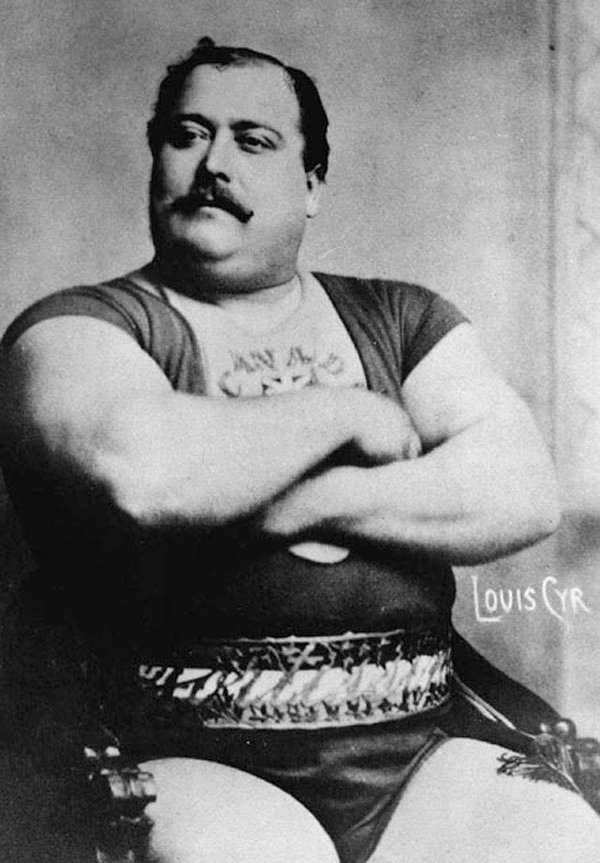
His appearance also resists a common shortcut. A historical portrait can show how someone presented himself, but it cannot tell you the loads he moved, the quality of a particular performance or the training that preceded it. Looking powerful and demonstrating power are related interests, not interchangeable evidence.
A strength act had to hold an audience

Cyr’s career included North American circus work and performances involving members of his family. He toured with major circus companies before operating a circus with fellow strongman Horace Barré. The travelling show helped turn a local reputation into a much larger attraction.
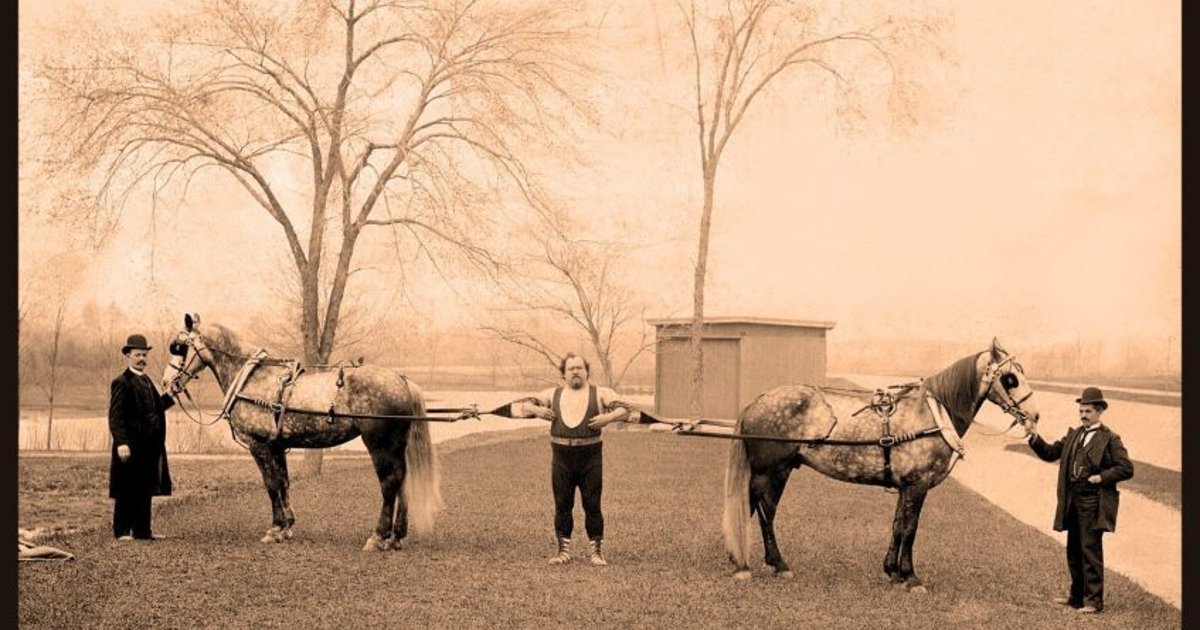
A platform full of people communicates weight immediately. So does a pair of horses held in opposing directions. Spectators do not need a detailed understanding of lifting technique to see why the scene looks extraordinary. These were memorable ways of presenting strength to a crowd, long before a slow-motion clip could be shared around the world.
Showmanship alone does not make an athlete fraudulent. It does change the questions a viewer should ask. Was this a contest against another lifter, a demonstration repeated for paying audiences, or a posed promotional photograph? Those situations produce different kinds of evidence. A dramatic image may document the performer beautifully while revealing very little about a measured attempt.
The overlap with Eugen Sandow’s use of posing and photography is instructive. Strength culture has long involved both doing something difficult and making that achievement legible to spectators. Today’s camera angles, captions and personal-record announcements sit inside that older tradition, even when the equipment and audience are completely different.
The number needs the name of the lift
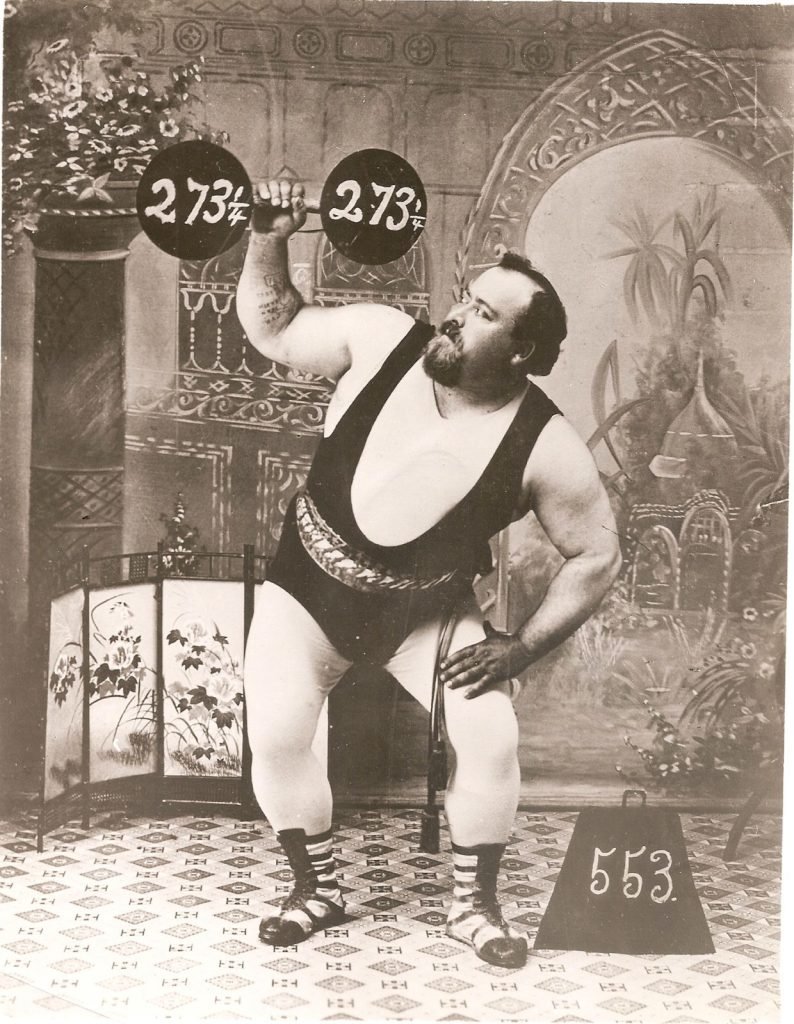
The famous 273¼-pound one-arm lift associated with Cyr’s 1892 London performances is approximately 124 kilograms. Historical descriptions differ over the precise date and terminology. Repeating the weight without identifying the movement makes the claim sound clearer than the surviving accounts allow.
His backlift needs even more explanation. This involved getting beneath a supported platform and raising it clear of its supports. It was not a deadlift pulled from the floor into a standing lockout. Very different starting positions and travel distances make the largest number a poor shortcut for ranking every kind of strength.
Accounts of the celebrated 1895 Boston backlift give differing totals, including 4,300 and 4,337 pounds. Questions about how the people and platform were weighed further limit the precision. These are historical performance claims with imperfect documentation, not a modern results sheet from which to calculate a universal all-time ranking.
The studio photograph accompanying this section adds another caution. The object marked 273¼ has been identified as a wooden photographic prop. That explains a posed image; it does not establish that Cyr’s separate lifting performances were fake. Equally, a photograph of a labelled object cannot verify its mass. Treating either conclusion as automatic loses the distinction between promotion and an actual attempt.
A sensible record comparison starts with the implement, measured load, starting position, permitted technique, range of motion and judging. If those details are missing or differ substantially, preserve the achievement’s context instead of converting it into a confident claim that one man would beat another.
What a modern lifter can borrow

The transferable lesson is to define the task. A better grip, a more stable overhead position and a stronger pull from the floor are separate goals, even when all three contribute to moving a heavy object. Choose which capacity you want to improve before choosing the most dramatic exercise.
For ordinary training, a barbell or dumbbell offers a repeatable reference. Record the load, repetitions and exercise setup, then keep the comparison consistent. If one session uses a shorter range or assistance that the previous session did not, log that change rather than quietly calling it the same lift. This is an editorial application of the story, not a recovered Louis Cyr workout.
For example, someone tracking a dumbbell press can keep the same implement and starting position while judging whether another controlled repetition is available. A stronger-looking photograph is not the progress measure. Nor is a heavier load meaningful if the exercise has changed enough to become a different test.
Modern strongman makes the importance of specific skills particularly visible. Our look at Tom Stoltman’s stone and carrying skills explains why handling an implement matters alongside general strength. Enjoying Cyr’s performances does not require attempting horse restraint or building a loaded platform to stand beneath. Familiar equipment and repeatable technique provide a much more useful personal benchmark.

Equipment Worth Exploring
Explore equipment, accessories and gear from our carefully selected range.


Competition Plates
Competition-style bumper plates for Olympic lifts and loaded strength training.

Grip Plates
Rubber-coated weight plates with handholds for loading barbells and machines.

Rubber Hex Dumbbells
Rubber-coated hex dumbbell pairs with a stable shape for home and commercial strength training.

Cast Iron Kettlebells
Textured cast-iron kettlebells for swings, squats, carries, and full-body training.
There is room for the fun of lifting culture here too. The barbell, the weight plate and the running joke about plate maths all make sense because lifters recognize the work behind them. Keep the actual training record more precise than the slogan on a shirt.

Powerlifting Shirts & Lifting Gear
Powerlifting shirts and gym gear for squat, bench and deadlift lifters who live for heavy numbers.

Dost Thou Even Hoist Sir? – Water Bottles & Gear Sticker
Put “Dost Thou Even Hoist Sir?” gym humor on your laptop, bottle, or gym gear.

Funny Lift O'Clock Gym | Muscle Shirt For Gym Bros & Li Tank Top
Show some personality between sets with “Lift O'Clock”.

Forged In Iron Shirt – Essential & Top T-Shirt
Heavy lifts, good laughs, and a little “Forged In Iron” energy.

Meme – "Shhh I'M Doing Plate Math" Hooded Hoodie
Bring “"Shhh I'm Doing Plate Math" Workout Hooded” gym humor to lazy days and post-workout plans.

Old School Weight Strongman – Meme Shirt & Top T-Shirt
Show some powerlifting attitude with a playful “Old School Weight Lifter Strongman Graphic” tee.

Lifting Is My Therapy – Bodybuilding Powerlifting Meme T-Shirt
Add a playful “Lifting Is My Therapy” touch to your casual rotation.

Be Happy Lift Heavy Happy Weights Emoji Weight Plate De Sticker
Give your everyday gear a playful “Be Happy Lift” twist.

I’m Strong Barbell Heartbeat Hooded Pullover for Streng Hoodie
Make your off-duty look more fun with “I’m Strong Barbell Heartbeat”.

Lift Eat Repeat Sweater & Meme Fans T-Shirt
For laid-back days and lifting humor: “Lift Eat Repeat”.

Lift Eat Sleep Repeat Meme & Lifting Vest Tank Top
Show some personality between sets with “Lift Eat Sleep Repeat”.
A legacy bigger than an all-time ranking
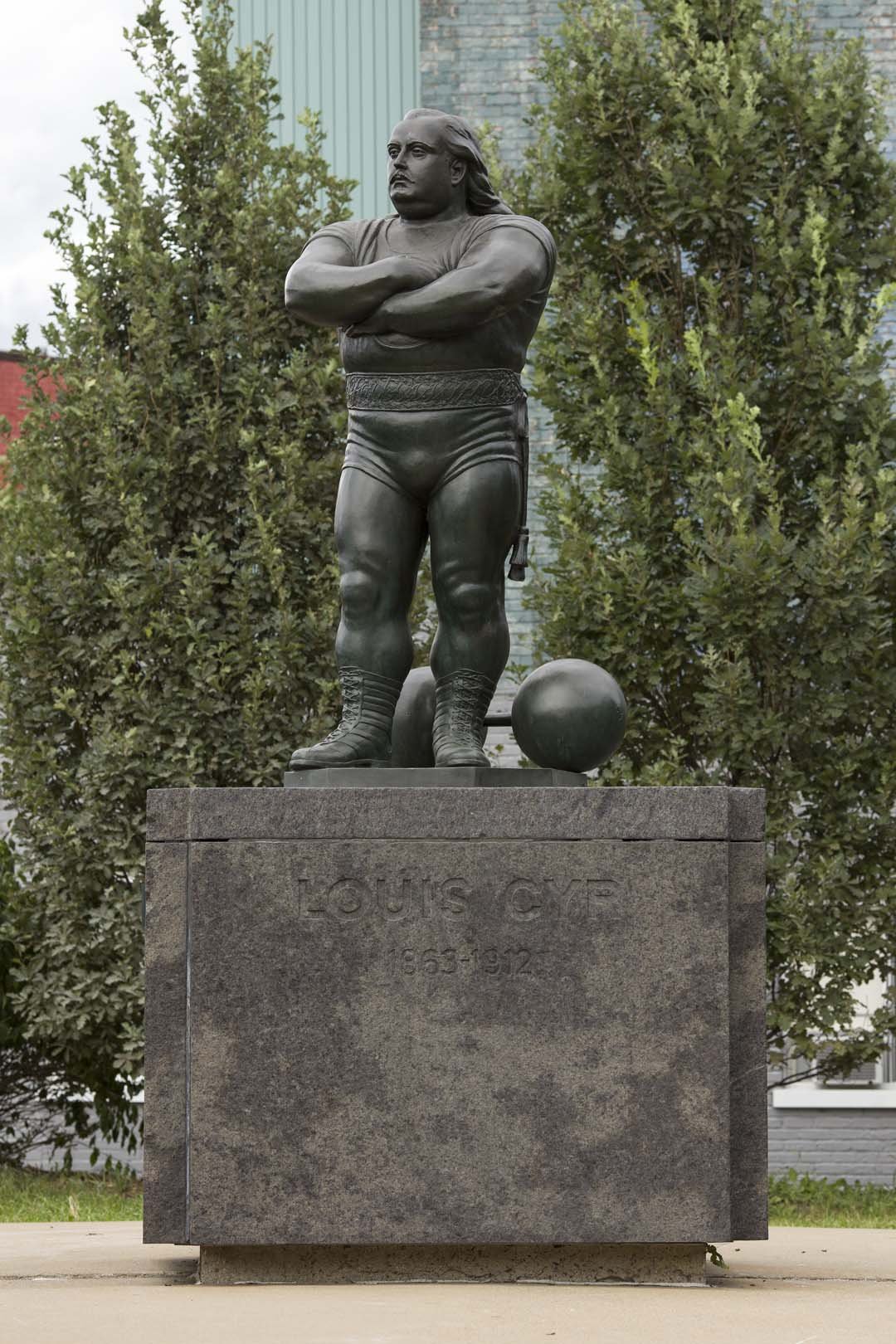
Cyr died in 1912, aged 49. His place in Canadian cultural memory outlasted the travelling strength act. The Montreal monument portrays him with crossed arms, a lifting outfit and a barbell at his feet: a public reminder of the strength celebrity he became.
A monument records what a community chooses to remember. It is not another piece of evidence for a disputed poundage. That distinction lets you appreciate the cultural achievement without asking the sculpture, a publicity portrait or a later retelling to settle technical questions they cannot answer.
Cyr’s story remains compelling because it sits where athletic ability meets public imagination. Unusual objects made the feats accessible, performances built a reputation, and retelling made the strongest claims travel furthest. That pattern is still recognizable whenever a lifting clip circulates faster than its rules and context.
The most rewarding way to follow strength history is to keep both interests alive. Enjoy the personality and spectacle, then ask what was lifted and how. You do not need to crown an unquestionable strongest human of all time to recognize Louis Cyr as one of the enduring figures of the strength world.