Advertising disclosure: This page includes affiliate product links that may earn us a commission, as well as products from our own store.
Stir-the-Pot Planks: Move the Ball, Keep the Torso Still
A stability ball can make a plank harder without adding a plate to your back. In the stir-the-pot variation, your forearms guide the ball through small circles while you try to hold the rest of your body steady. The movement is deliberately modest. A large wobble is not automatically a better repetition.
The useful distinction is between moving your support and moving your trunk. If your hips draw the same circle as your elbows, you have changed the task. Treat this as a controllable core exercise, with a repeatable setup and a clear stopping point, rather than a contest to see how far the ball can travel.
Establish the support before adding circles
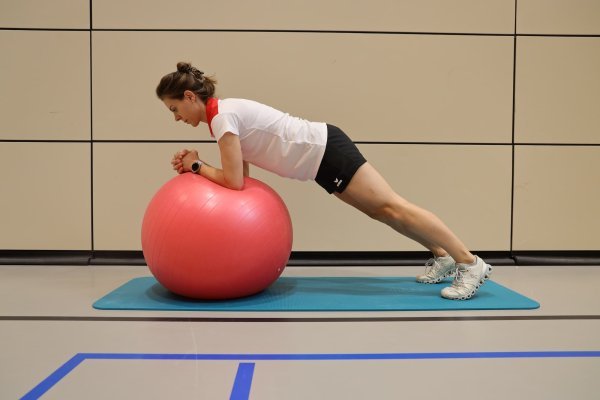
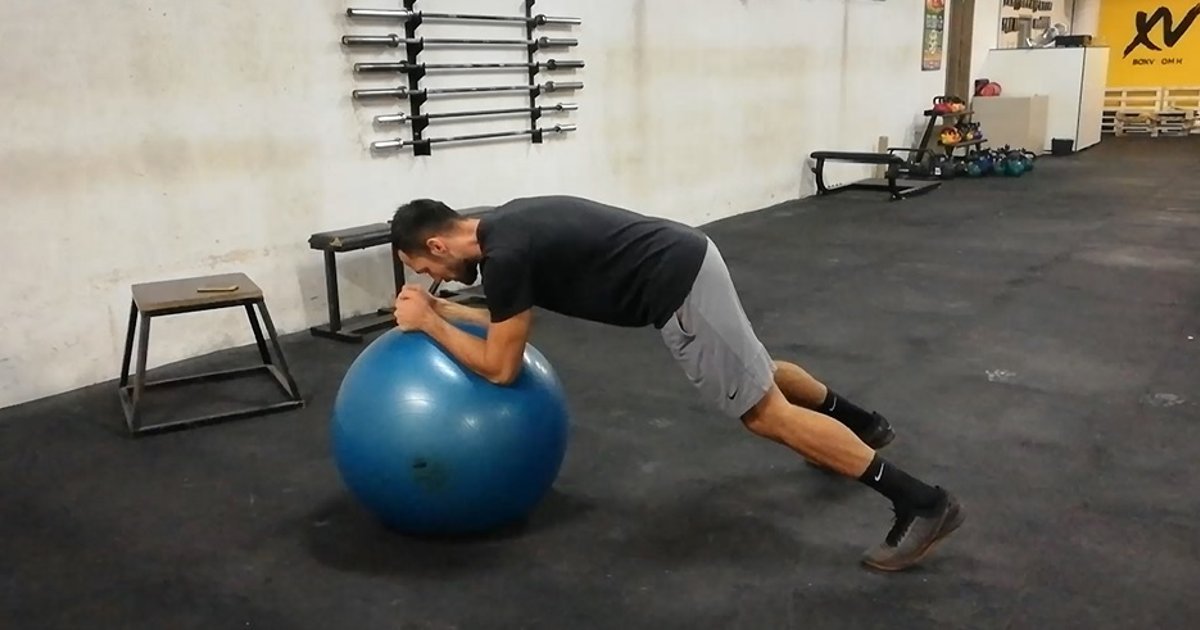
Begin kneeling with your forearms supported on the ball. Extend your legs into a plank only when you can keep the ball under control. Position your feet far enough apart to give yourself a manageable base. Keep your head in a comfortable line with the rest of your body instead of craning upward to watch the room.
Choose a clear area with dependable footing. Check the ball’s condition, inflation guidance and load rating against its manufacturer’s instructions. A ball that slides across the floor adds a problem that is different from the intended exercise. Remove nearby objects that could catch a foot or obstruct a controlled exit.
Spend the first few moments simply holding the position. This gives you a reference for where your elbows, ribs and hips start. If you cannot maintain that reference without circling, adding movement will not make the starting position more reliable. Use a simpler floor plank, a static ball support or a knee-supported version as appropriate.
A useful setup note identifies the actual ball and foot spacing rather than just saying “plank on ball.” Different equipment or a changed stance can make the next session feel different. Keep the first comparison simple: the same setup, a similar effort and the same definition of a successful hold.
Let the forearms trace the circle
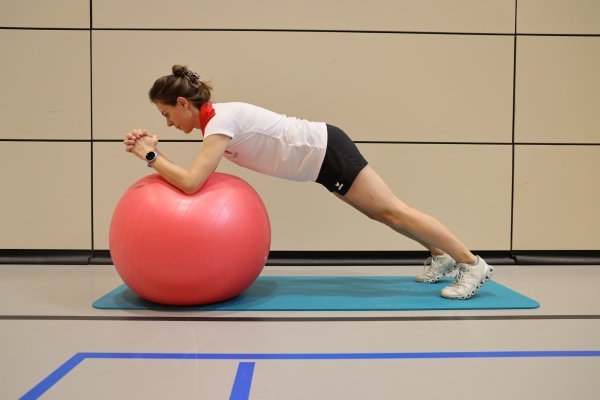
Guide the ball slowly through a small circular path, then work in the other direction. The aim is to move the support while keeping the pelvis and trunk comparatively quiet. Do not chase a huge circle that pulls you beyond the position you can control.
Think of the starting point as the centre of a small working area. You should be able to return to it without a sudden shove or a last-second change of body shape. If the ball repeatedly escapes forward and you drag it back by dropping your hips, reduce the excursion or return to a static hold.
Keep the direction change deliberate. Finish the current circle, settle the movement and begin the next direction. A rushed reversal makes it harder to distinguish controlled work from momentum. Neither direction needs to look dramatic on camera to count as useful practice.
For logging, define one full circuit as one circle and count the directions separately. “Four clockwise plus four counterclockwise” is more informative than “eight reps” if the latter might mean eight each way. The numbers here illustrate a recording convention; they are not a required dose or a progression test.
Watch the torso instead of chasing the burn
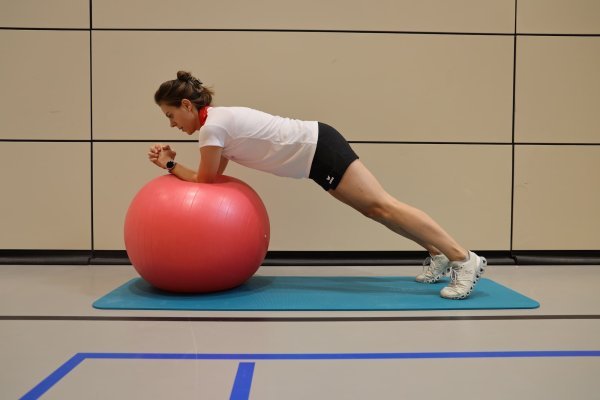
The common loss of control is visible away from the ball: the lower back sags, the hips rotate or the pelvis rises enough to change the plank. Those changes are useful feedback. They tell you that the current combination of circle size, support and fatigue no longer matches the task you planned.
Keep breathing rather than using a prolonged breath hold to rescue the position. If you cannot take a comfortable breath while preserving your chosen shape, simplify the movement. A tightly braced appearance does not make every repetition worthwhile, and more shaking does not tell you which muscle is receiving a better training stimulus.
A short side-view recording can help compare your first and last circles. Place the camera where it can see the hips and ball, without putting equipment in the working area. Look for a change in body position rather than trying to calculate an exact spinal angle from a casual phone video.
Separate effort from discomfort. Abdominal fatigue can accompany the exercise, but pain is not a target to pursue. Stop when something feels wrong and choose an appropriate alternative or get individual guidance. This guide does not establish that the exercise treats back pain or prevents injury, and an instructional photograph cannot make that claim either.
Change one difficulty variable at a time
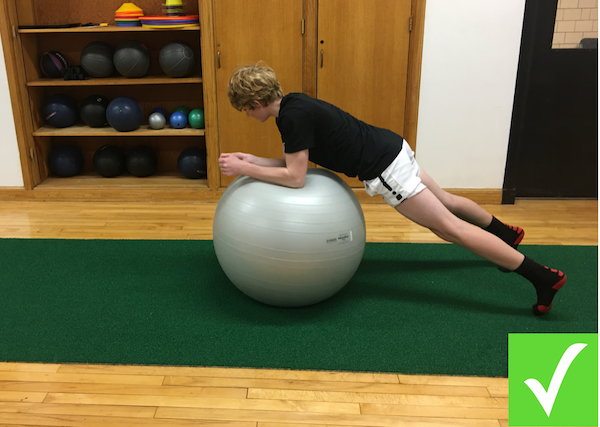
A knee-supported version shortens the lever. A wider foot stance provides a broader base, while a static hold removes the circular movement. These are ways to scale the task, not failed versions that you must rush past. Pick the version in which you can actually practise the intended control.
When the current setup becomes dependable, change one element and observe the result. You might make the circles slightly larger while keeping stance and duration familiar. Alternatively, keep the same circles and gradually narrow the stance. Doing both at once makes it harder to identify why the set suddenly became less controlled.
Use an exit you can repeat. Stop the ball’s motion, then bring the knees down rather than collapsing out of the final circle. Leave enough room for that transition. If you cannot end the set deliberately, choose an easier version before the next attempt.
Progress can mean maintaining the same circle with less unwanted motion, completing both directions more consistently or repeating the session with a clearer record. Added load is only one possible change and is unnecessary for learning the exercise. A weighted vest should not be the first solution to a ball that you cannot yet stabilise.
Give core work a clear place in your training
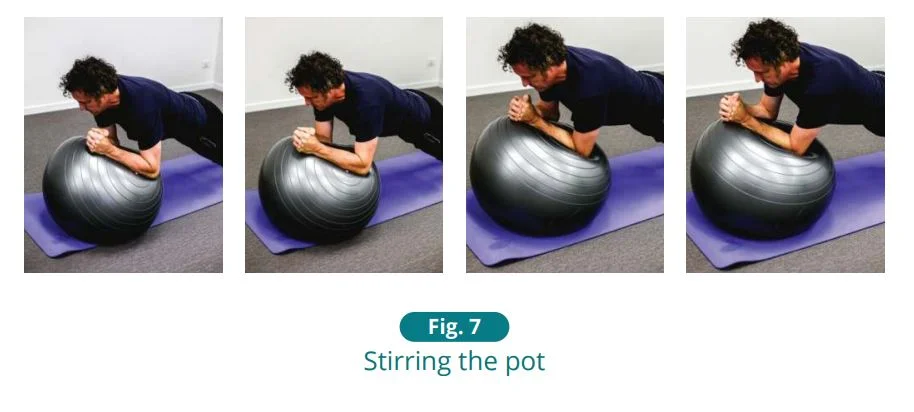
Choose the purpose of the exercise before adding it to a session. Here the purpose is controlled support as the forearms move. It does not need to replace every other form of abdominal training, and getting better at it does not automatically demonstrate a larger squat, a better sport performance or a visible six-pack.
Keep a brief record: support version, ball, stance, circles in each direction, approximate circle size and the reason you stopped. If you also time the set, record time separately from circle count. A slower set and a faster set with the same number of circles are different exposures.
For example, one entry might say that the final circle caused hip rotation. On the next session, keeping the earlier circles controlled is a clearer objective than forcing one more repetition. If you can only compare your total count, the record may reward a less demanding version of the movement without you noticing.
Other core tasks can belong alongside this one. A cable Pallof press challenges resisting a sideways pull, a loaded carry involves supporting an external weight while walking, and a supported ring plank changes the support arrangement again. These tasks need their own technique and progression. Do not treat their loads or durations as interchangeable with ball circles.
The equipment selection below is for those broader cable, carry and supported-plank options: cable units and compatible handles, dumbbells, kettlebells, rings and a vest for an appropriate later progression. None is a substitute stability ball, and the registry currently offers no eligible ball for this exercise. You can learn the movement without buying any item shown.

Equipment Worth Exploring
Explore equipment, accessories and gear from our carefully selected range.

Go-Tone Pro
Portable digital cable trainer with up to 66 lb (30 kg) of adjustable resistance.
VOLTRA
Compact digital cable trainer with smooth, adjustable resistance.



Rubber Hex Dumbbells
Rubber-coated hex dumbbell pairs with a stable shape for home and commercial strength training.

The abs jokes, bodyweight-training artwork and consistency-themed designs below are optional merchandise. Visible abs, novelty slogans and a harder-looking exercise are separate from the practical goal here: make the support move deliberately while keeping the torso under control. Choose a manageable version and repeat it consistently enough to compare your work honestly.

Funny Gym Shirts & Workout Gear
Funny gym shirts, tanks, hoodies and workout gear for lifters who like training hard.


Check Out My Six Pack Tacos – Taco Jumper Pullover T-Shirt
Keep things casual with a little “Check Out My Six Pack Tacos” attitude.

Check Out My Six Pack Donut – Donut Meme Hooded Pullove Hoodie
Make your off-duty look more fun with “Check Out My Six Pack Donut”.

Check Out My Six Pack Beer – Gym Meme Decal for Coolers Sticker
Bring “Check Out My Six Pack Beer” attitude to your water bottle or laptop.

Consistency King Tee
Make gym days more fun with “Consistency King Stoic Greek God Marble” style.

Consistency Is Key Stoic Greek God Marble Sculpture T-Shirt
Make gym days more fun with “Consistency is Key Stoic Greek God Marble” style.

Calisthenics Muscle Shirt Athletic Vest for Bodyweight Tank Top
Your gym-day look, with a playful “Calisthenics” twist.

Calisthenics Evolution Hooded Pullover for Bodyweight W Hoodie
Keep it laid-back with a little “Calisthenics Evolution” attitude.

Calisthenics Workout Sweatshirt
Add a playful “Calisthenics” touch to your casual rotation.

Be Stronger Than Your Excuses – Motivational T-Shirt
Rep “Be Stronger Than Your Excuses” humor in and out of the gym.