Advertising disclosure: This page includes affiliate links that may earn us a commission at no additional cost to you.
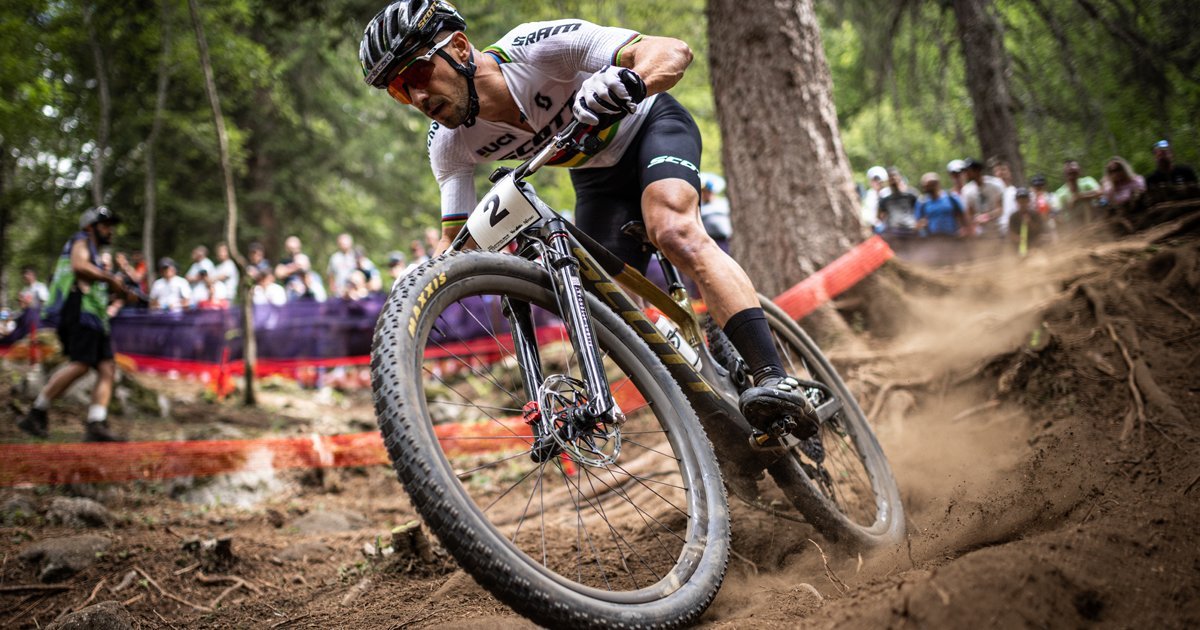
A steep climb burns your legs, a root catches your front wheel and the next corner demands a precise change of direction. The effort is far from over when you stop pedaling. For a cross-country mountain biker, a downhill section is often a chance to recover some metabolic capacity while the upper body, trunk and legs continue to manage the bike.
Swiss mountain biking legend Nino Schurter made that combination of endurance, power and control a priority in his gym preparation. He won Olympic gold in Rio in 2016 and accumulated ten elite cross-country world titles between 2009 and 2022. His unusual gym drills are fascinating, but the lesson is more useful than the spectacle: train the physical quality you actually need, and know when an exercise is testing something different.
Why cross-country riders need more than a strong engine

Cross-country Olympic mountain biking is a race over repeated laps of a technical circuit. The same rider might climb seated at a steady cadence, sprint from a low speed, stand over the pedals to absorb an obstacle and then brake for a tight switchback. It is an endurance event with repeated demands for short bursts of power and accurate decisions.
Average power can hide this variation. A descent with little pedaling may still require the rider to hold a position, adjust body weight, maintain grip and choose a line while breathing hard. A cyclist with excellent steady-state fitness may lose time whenever the terrain becomes complicated. Conversely, a technically excellent rider cannot make up indefinitely for a weak aerobic base.
A 2026 review of 53 studies on modern cross-country racing found that the sport still requires exceptional aerobic capacity alongside substantial intermittent high-intensity efforts. In the available race observations, riders could spend roughly a quarter of their time above maximal aerobic power. That is not a prescription to spend a quarter of every workout at maximum effort. It describes the variable demands of competition, and the evidence for the best race-specific training interventions remains limited.
Think about your own weakest moments on a ride. Do you lose speed because you cannot produce another hard effort, because your legs can produce force but your upper body tires, or because you brake too early when the trail becomes technical? Those are three different problems. An extra interval on an exercise bike may help the first, but it is unlikely to fix the third by itself.
The 30-minute circuit that challenged coordination under fatigue
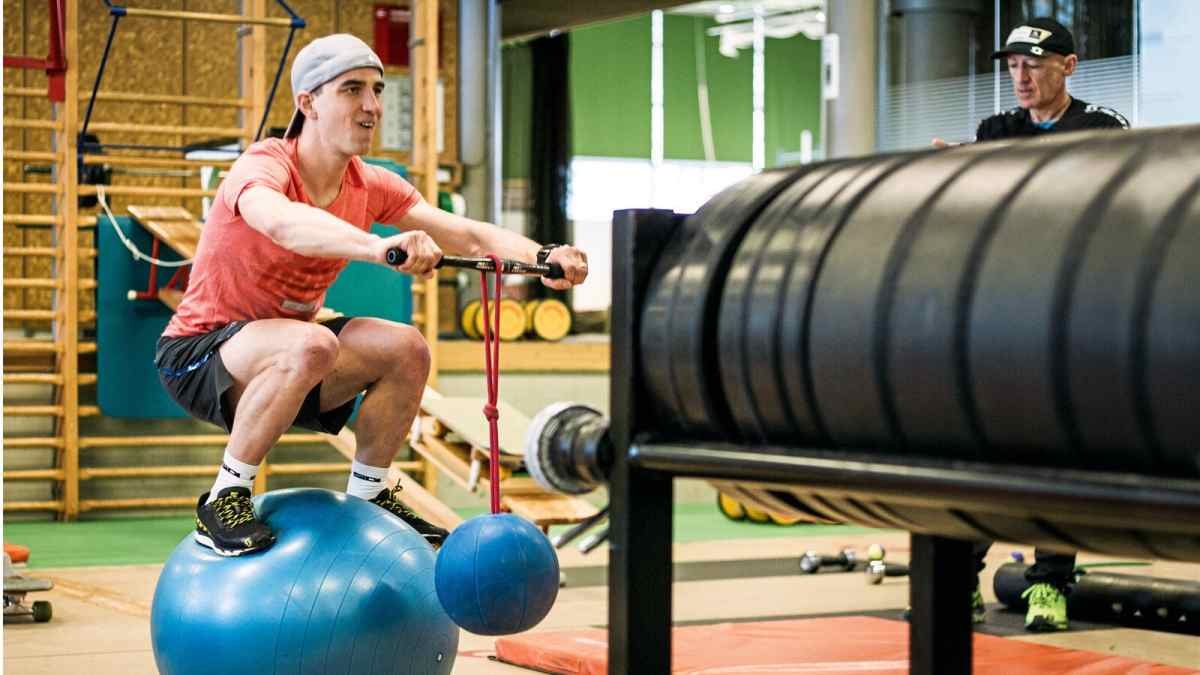
In his pre-Rio preparation, Schurter and coach Nicolas Siegenthaler developed a roughly half-hour indoor workout combining muscular work and coordination challenges. Their program included nine principal movements divided among the legs, arms and trunk. The distinguishing feature was the use of active coordination drills during short recovery periods rather than simply standing still between demanding efforts.
Schurter’s demonstrations included unstable equipment such as exercise balls and balance boards. Some of the advanced balance tasks even involved closing his eyes. These drills were intended to challenge control when fatigued, in the way a technical downhill can follow a demanding climb. This was the approach of an experienced professional with years of practice, not a beginner’s exercise prescription.
The idea can be separated into three ingredients: a movement that challenges muscular endurance, a short interval that allows partial recovery, and a controlled skill task. The skill task should be easy enough to perform reliably. If it is so difficult that you keep falling, the exercise becomes a test of luck or fatigue tolerance instead of useful movement practice.
For example, do a set of controlled step-ups, then stand on one leg on a firm floor near a wall for ten to twenty seconds per side. Alternatively, perform a set of cable rows, then practice a stable split stance while maintaining a relaxed grip and breathing steadily. You can create a challenge with ordinary equipment and a little attention to the goal.
Do not copy the exercise-ball squat pictured here. A fall from an unstable ball can cause injury, and adding resistance or closing your eyes makes the risk harder to manage. Schurter’s ability to perform it does not make it an essential movement for recreational cyclists. Use the underlying concept, not the most dramatic version of it.
How to train stability without turning every lift into a circus trick
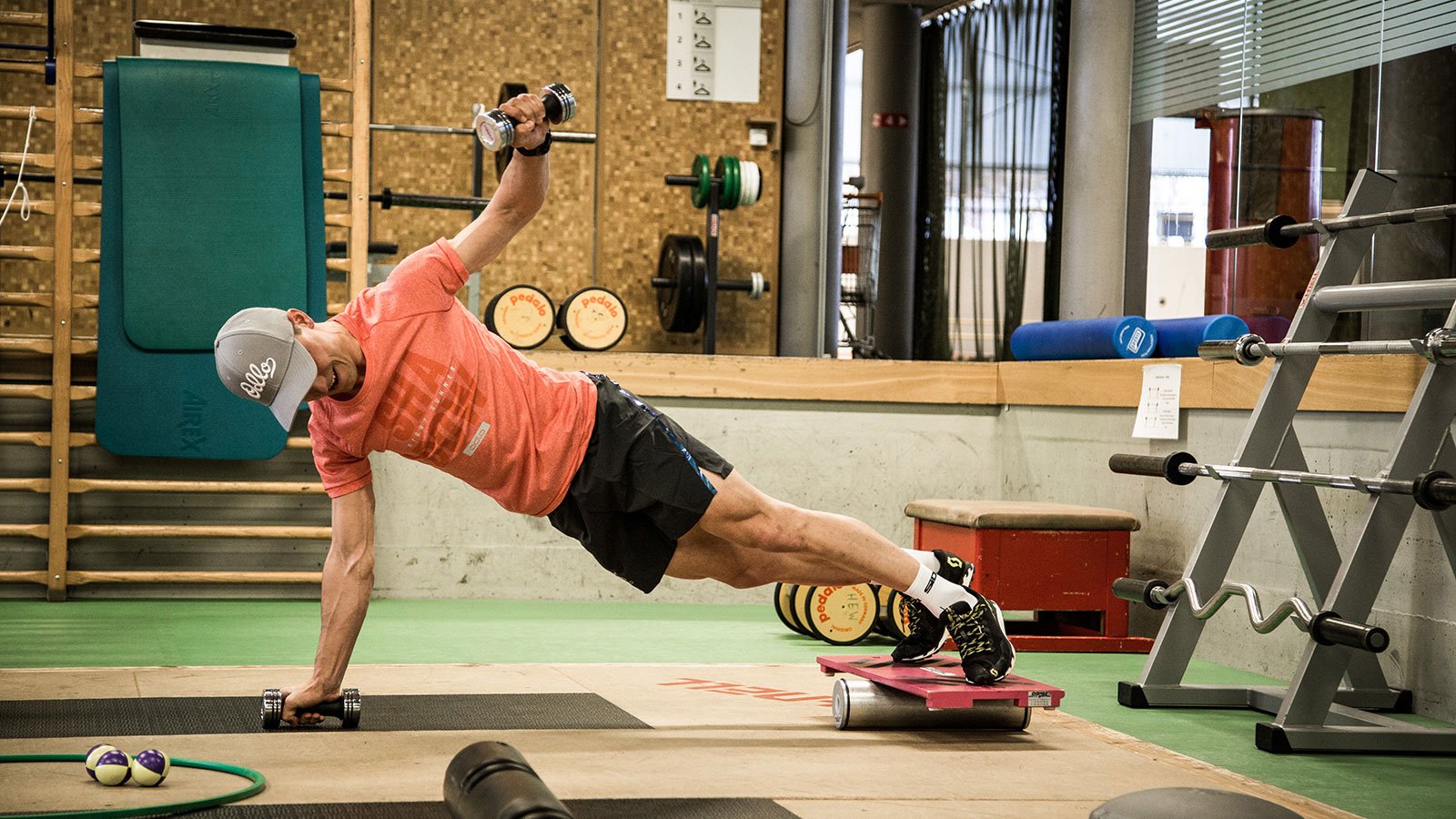
Stability does not mean remaining rigid. On the trail your arms and legs need to move while your torso remains sufficiently controlled to support efficient movement. When you lift weights, the appropriate amount of bracing also changes with the load. A heavy squat requires substantial stiffness; an easy coordination drill calls for more freedom to make small adjustments.
Start with a few movement patterns that are measurable. A split squat challenges single-leg force production; a chest-supported or cable row trains the upper back; a side plank trains the ability to resist unwanted lateral movement; a push-up provides a closed-chain upper-body exercise. Each can be adjusted to your current ability without introducing an unstable platform.
For a side plank, bend the lower knee and use a short lever if holding your body straight is difficult. Progress to both legs extended, then gradually lengthen the hold. Do not add a dumbbell or a rolling surface until the basic version is consistently controlled. A fifteen-second hold with good positioning is a better starting point than a minute spent twisting and collapsing.
A useful test is to compare quality before and after moderate exertion. Perform a simple single-leg balance task for twenty seconds while fresh. Repeat after one minute of brisk cycling or step-ups. Observe unnecessary foot taps, loss of posture and whether you can breathe normally. If your technique deteriorates significantly, shorten the preceding effort rather than adding more instability.
Keep the exercises on the floor or on a stable bench. The actual riding skill should be developed on a familiar, low-consequence trail with appropriate equipment and a pace that leaves room to correct mistakes. Gym balance work is supplemental. It cannot reproduce traction, terrain feedback or the handling of a moving bicycle.
Heavy strength belongs in a different session
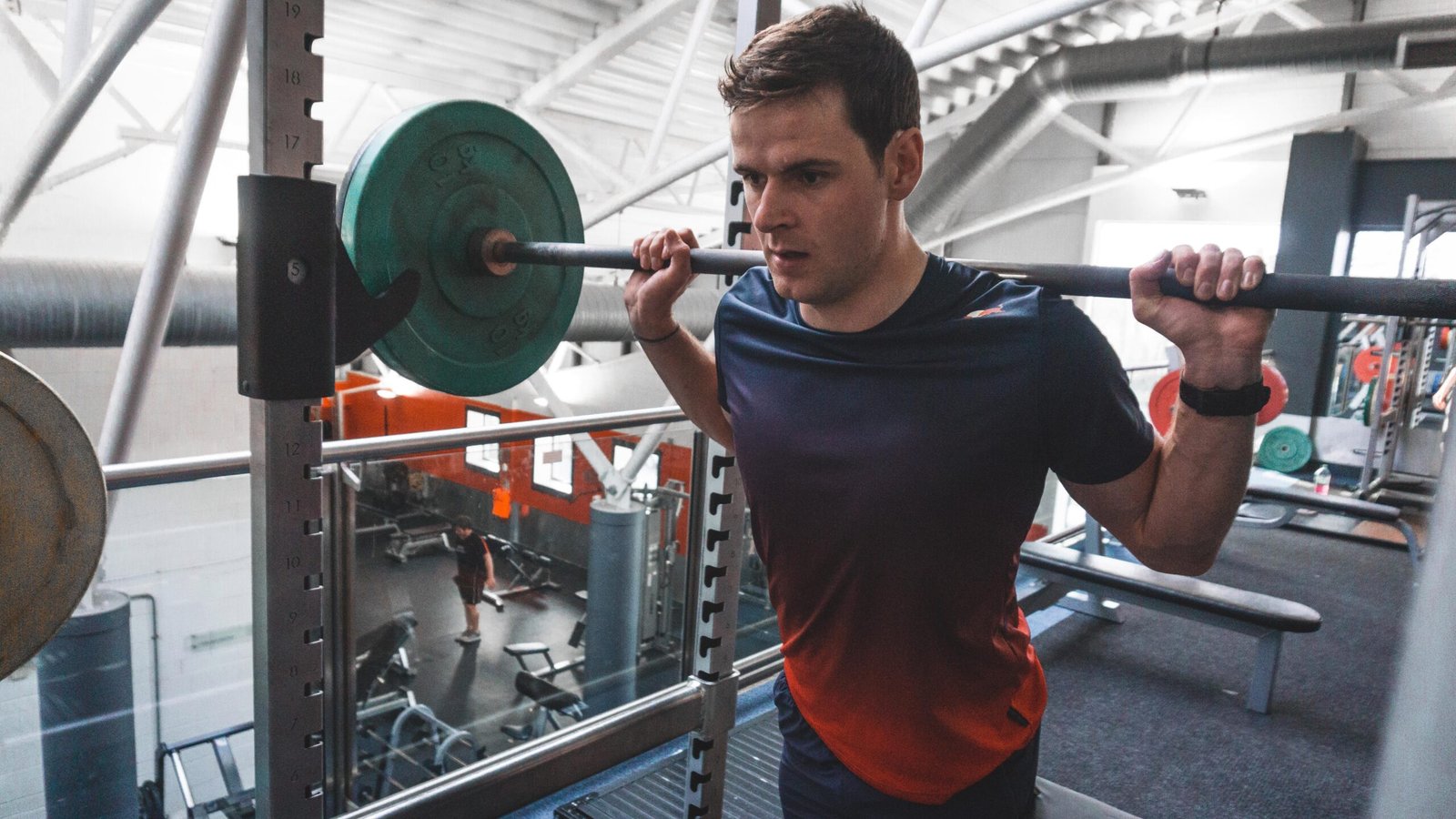
Schurter also used conventional strength training. In a later demonstration he described lifting heavy weights during a build-up phase two or three times per week, separately from his general fitness circuit. That distinction is important. A technically demanding recovery drill and a heavy squat are not competing versions of the same exercise; they develop different qualities.
A 2025 analysis of 17 heavy resistance-training studies involving 262 endurance cyclists found modest improvements in cycling efficiency and moderate improvements in cycling performance and anaerobic power. There was no clear improvement in maximal oxygen uptake. The certainty of the evidence was low, so the exact dose and magnitude of benefit should not be treated as guaranteed. Still, the findings give a sensible reason to train strength without expecting lifting to replace aerobic work.
Choose a squat or trap-bar deadlift that you can perform smoothly, then complement it with a unilateral leg exercise and a row. A beginner can use dumbbell goblet squats and a kettlebell hip hinge instead. For a rider with lifting experience, three sets of four to six repetitions on a main exercise with two or three repetitions left in reserve is a reasonable starting point. Rest two to three minutes, or longer if necessary to maintain control. Accessories can use six to twelve repetitions.
Free weights, racks with appropriate safeties, plates, dumbbells and kettlebells make it straightforward to progress without relying on complex balance equipment. A stable barbell setup is especially useful if you want to increase force over time. Choose equipment based on your exercise, space and ability to load safely, not on whether an Olympic athlete used that particular model.
Adding a few hard lower-body sets can initially leave you sore. Keep the first weeks conservative, place the gym session away from your hardest riding day when possible and adjust the volume if it compromises important sessions. The goal is greater usable strength, not to arrive at the trail with legs that are too tired to respond.

Equipment Worth Exploring
Explore equipment, accessories and gear from our carefully selected range.


Rubber Hex Dumbbells
Rubber-coated hex dumbbell pairs with a stable shape for home and commercial strength training.

Cast Iron Kettlebells
Textured cast-iron kettlebells for swings, squats, carries, and full-body training.


A four-week strength and skills plan for ordinary riders
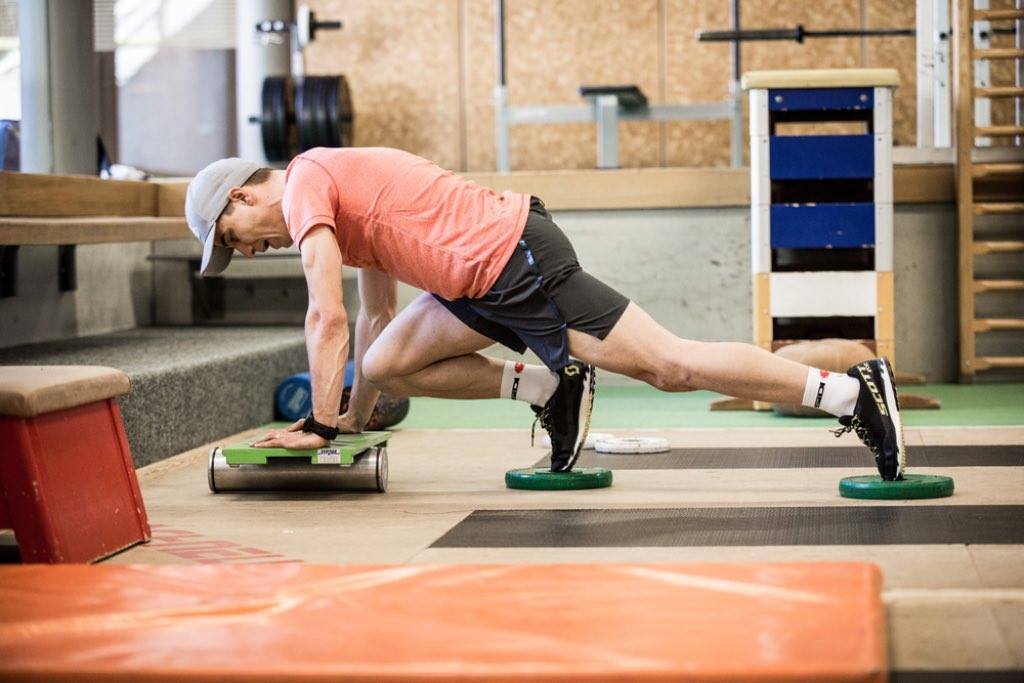
Here is an example inspired by Schurter’s approach, not his actual training schedule. It assumes you already ride recreationally and can safely perform basic resistance exercises. Start with one strength session and one short coordination session per week, alongside your usual riding. Keep the most demanding skills practice separate from exhaustion.
Week one: perform two sets of six goblet squats, two sets of eight rows, two sets of eight split squats per side and two short side planks. Use comfortable loads. On a different day, practice simple balance and slow direction changes on flat ground for fifteen minutes. The aim is to establish what normal movement quality feels like.
Week two: add a third set to the squat or hip hinge if the previous week was well tolerated. For the circuit, alternate three rounds of thirty seconds of moderate step-ups with twenty seconds of standing balance near a support. Rest as needed between rounds. Do not increase resistance and balance difficulty simultaneously.
Week three: if your strength work has been smooth, add a small amount of load while maintaining two or three repetitions in reserve. Include an easy ride with four short, controlled accelerations on a safe straight section. Keep technical trail practice fresh rather than combining your hardest intervals with difficult obstacles.
Week four: reduce the gym volume by roughly a third and repeat the baseline measurements. Compare the same load, repetitions and perceived effort. Assess a familiar easy trail at a comfortable pace and note whether you feel more composed after the climbs. Do not turn this check into a maximum-speed trial.
Record gym load, riding duration, sleep and perceived fatigue. If the weights are increasing but your rides are consistently worse, remove a set or move the gym day. If your balance task is improving but the trail still feels intimidating, spend more time on actual handling skills rather than inventing harder gym tricks.
Schurter’s career illustrates why a complete athlete needs more than one physical quality. For a recreational rider, the most valuable takeaway is not to replicate his elaborate circuit. Build strength on stable ground, develop aerobic capacity on the bike and practice coordination at a level where you can still make good decisions. Then combine manageable amounts of those demands as your skills improve.

Leg Day Shirts & Workout Gear
Leg-day gym shirts and workout gear for lifters who never skip squats, lunges and lower-body punishment.


Never Skip Leg Day Flamingo – Fitness Meme Pullover Jum T-Shirt
Keep things casual with a little “Never Skip Leg Day Flamingo” attitude.


Everyday Is Leg Day Octopus Meme & Top T-Shirt
Show some leg-day attitude with a playful “Everyday Is Leg Day Funny Octopus” tee.

Squats Leg Day Heavy Weights Meme – Essential Top T-Shirt
Bring “Squats Leg Day Heavy Weights” humor to your next gym day.

3 Plates Squat Club : Essential Meme & Leg Day T-Shirt
Make gym days more fun with “3 Plates Squat Club” style.

Squats R Us Shirt – Leg Day Gains & T-Shirt
Heavy lifts, good laughs, and a little “Squats R Us” energy.

Funny Squatbucks Gym | Starbucks Parody Workout | Leg D Hoodie
Bring “Squatbucks” gym humor to lazy days and post-workout plans.

Leg Day Thou Shalt Not Skip Leg Day Medieval Gym Crewne T-Shirt
Show some gym-day personality with “Leg Day”.