Advertising disclosure: This page includes affiliate product links that may earn us a commission, as well as products from our own store.
A low-to-high cable fly is easy to recognize and surprisingly easy to perform as another exercise entirely. Two low pulleys pull your hands toward the floor; you guide them upward and inward while your torso stays quiet. The useful goal is not to lift the biggest number on the weight stack. It is to give your chest a repeatable line of resistance and enough control that the next workout means something.
This guide deals specifically with the standing, two-handle low-to-high version. It explains how changing the pulleys and finishing height changes the movement, how to separate a fly from a cable press, and how to judge progress without mistaking momentum or a different cable angle for stronger pecs.
What the rising cable path changes in your chest
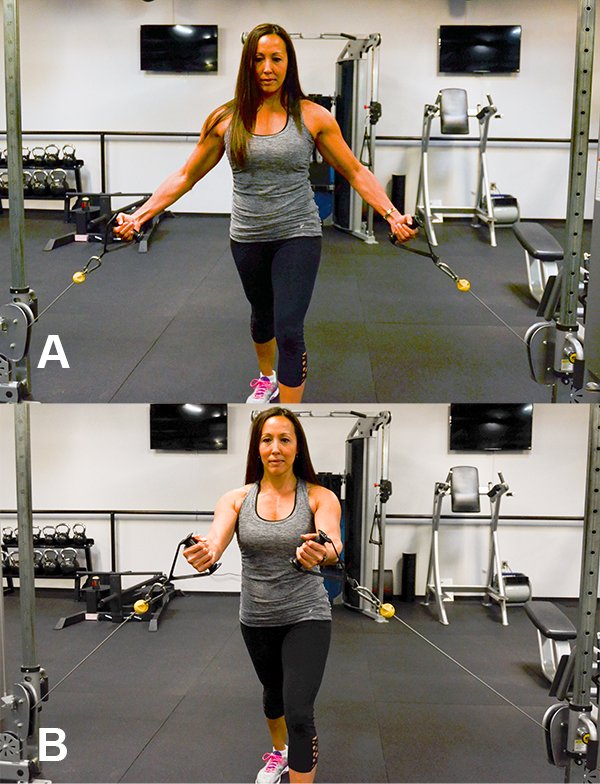
The upper, clavicular portion of the pectoralis major helps bring the upper arm forward and across the body. With handles originating below your hands, a rising fly can be a practical way to emphasize that action. The front of the shoulder helps too. There is no invisible boundary that switches one part of the chest on and the others off; the pec is one muscle with fibers running in different directions. Think of pulley position as a way to change the line of resistance, not a promise of isolated growth.
That distinction matters if someone says a low cable fly is automatically better than an incline bench press. A fly challenges the shoulder while the elbow angle changes very little. A press allows substantial elbow extension and usually supports more external loading. They are different tools. Neither can be declared the winning upper-chest builder from the appearance of a single repetition. A useful program can put progressive presses first and controlled flyes later, or use flyes when equipment and comfort favor them.
Cable resistance is not perfectly constant at the shoulder merely because the weight stack stays lifted. The cable’s angle relative to your arm changes through the arc. Step length, pulley width, how high you finish, and how far you let the arms open all affect leverage. If these details change every session, a heavier stack does not prove stronger tissue. Set a consistent station before drawing training conclusions.
Finally, a low-to-high fly is not the same as a high-to-low crossover. With overhead pulleys, you pull downward and inward. With chest-height pulleys, you typically meet near the horizontal midline. Name the variation you actually performed in your training log, rather than treating every cable fly as interchangeable.
Build a stable setup before pulling the first repetition
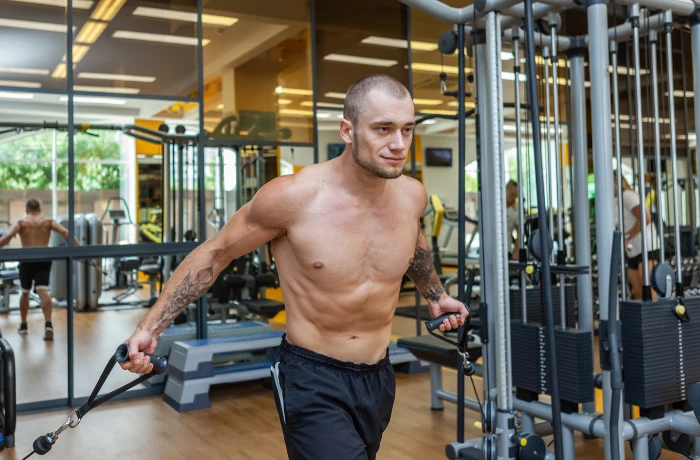
Place a single-hand handle on each of two adjustable pulleys and set both near the bottom. Confirm that both sides have the same effective resistance and that the cables move freely without rubbing a rack upright or each other. In a compact home gym, two separate cable units can mimic the station if the anchor positions are secure and symmetric. A dual-cable machine works well, but it is not essential that both stacks look identical if their resistance systems are different; aim for a repeatable load and geometry on each side.
Take one handle in each hand while the cables still have slack, then move forward deliberately until they become taut. A short staggered stance helps prevent your body from tipping backward under the pull. Keep your knees soft, ribs stacked over your pelvis, and shoulders away from your ears. The arms begin down and a little behind the torso, without forcing the shoulder into a painful stretch. Make sure the weights do not slam into their stops at either end.
Set a small bend in each elbow and keep approximately that bend throughout the set. You do not need to lock your arms, rotate your wrists aggressively, or squeeze the handles hard enough to make your forearms the limiting factor. A neutral-to-slightly-supinated hand orientation is often comfortable. If one side feels awkward, turn the handle a little before assuming that more load will fix the problem.
Before adding working weight, rehearse two or three slow repetitions. Watch whether your hands rise in similar arcs, whether the cable paths remain clear, and whether you have a little room to move behind you. Record the pulley notch and how far you stand forward. Those two notes are often more useful than trying to remember how the exercise felt next week.

Equipment Worth Exploring
Explore equipment, accessories and gear from our carefully selected range.
VOLTRA
Compact digital cable trainer with smooth, adjustable resistance.

Go-Tone Pro
Portable digital cable trainer with up to 66 lb (30 kg) of adjustable resistance.
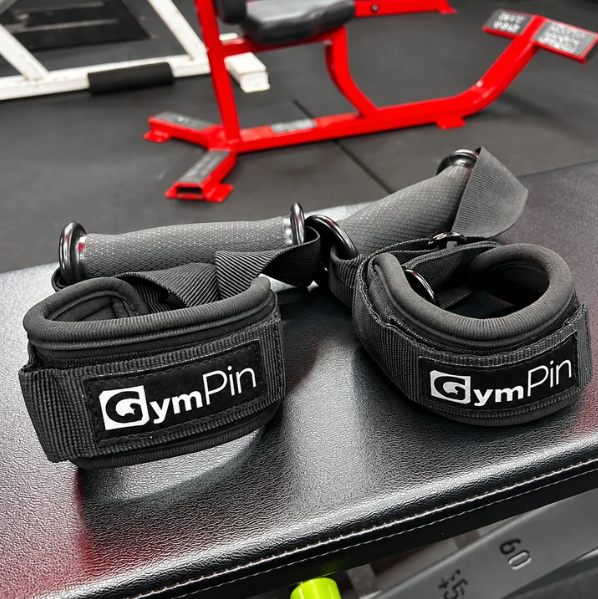
GymPin D Cuffs
Adjustable wrist cuffs with textured grips for supported cable-machine exercises.
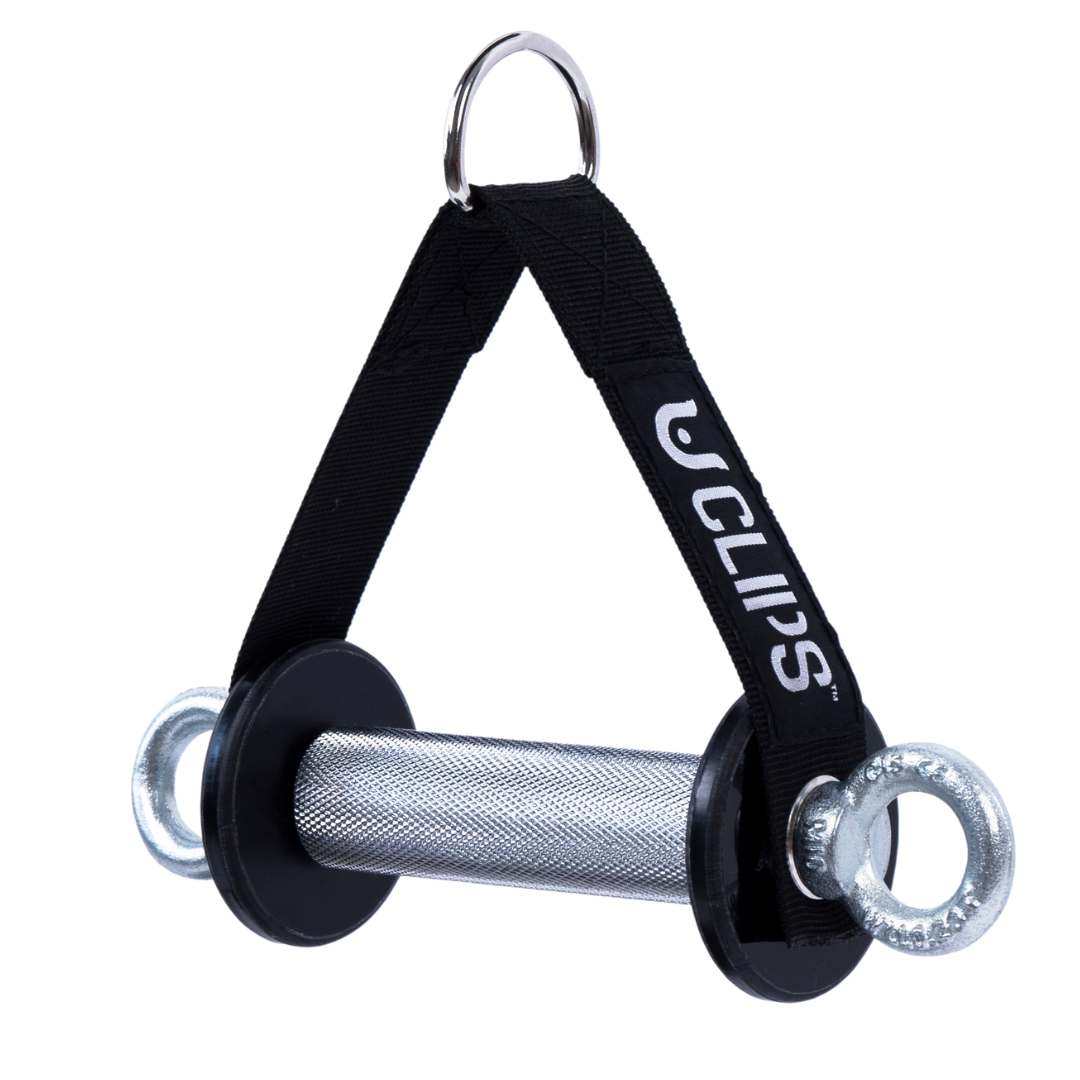


GymPin Ergo Handles
Pair of ergonomic cable handles shaped for comfortable triceps and pulling exercises.

GymPin D Handle Bar
Multi-use steel D-handle bar for cable rows, pulldowns and other cable exercises.

VForce Wall Trainer
Space-saving wall-mounted functional trainer with pivoting cable arms and variable resistance ratios.

VForce 2IN1
Half rack and pivot-arm functional trainer with switchable 1:1 and 2:1 pulley ratios.

Pec Fly/Rear Delt PEC-650
Combination machine with adjustable movement limits for chest fly and rear-delt exercises.
Sweep the handles up and in without turning it into a press
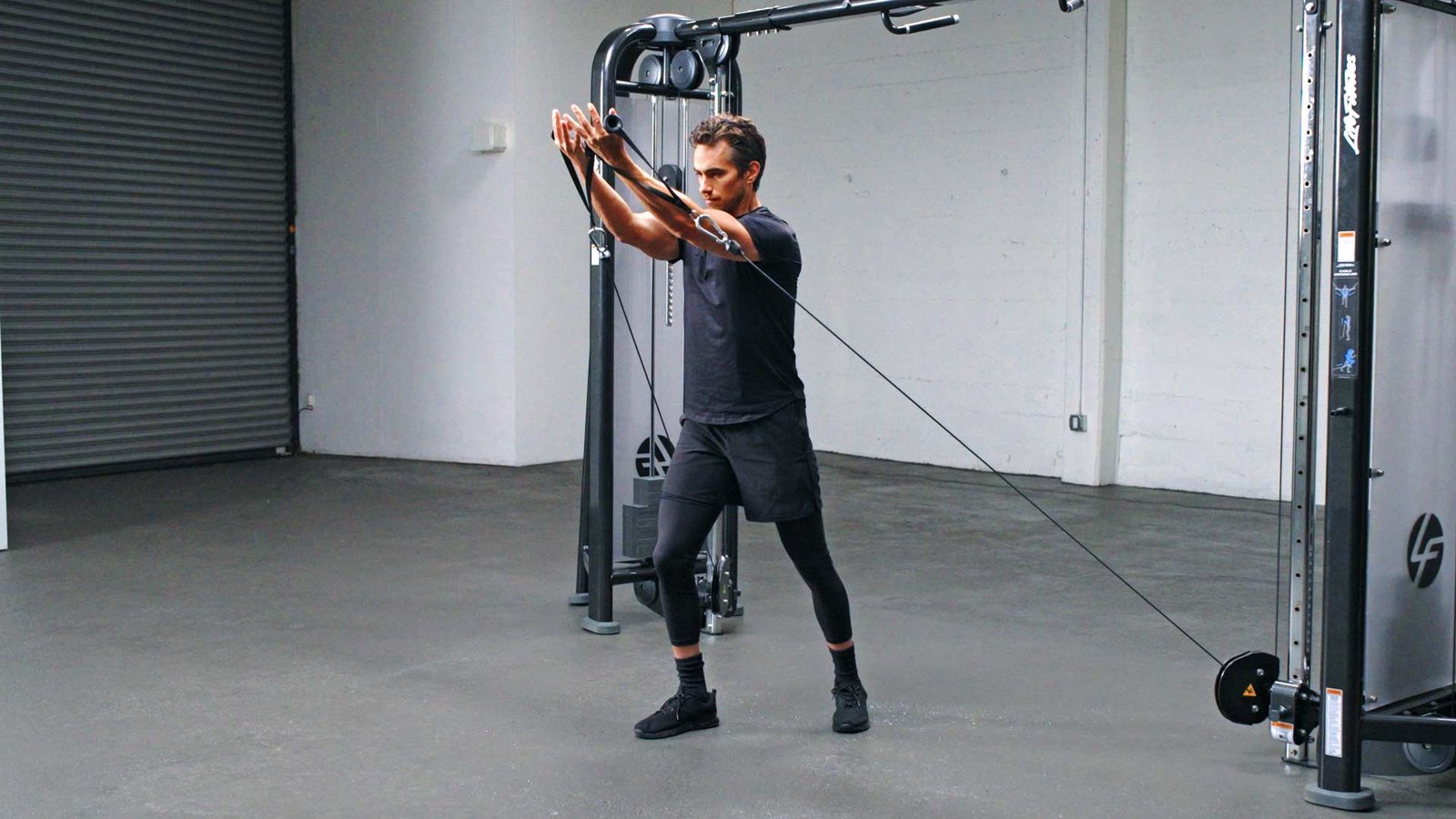
Begin with the chest and shoulders set, not with a hard torso swing. Imagine wrapping your arms around a wide tree that is slightly above you: move both hands forward, upward, and toward the center while preserving your modest elbow bend. Let the upper arms guide the motion. If you suddenly straighten the elbows to shove the handles up, the repetition is drifting into a cable press. That is not inherently bad, but it is a different movement and should be logged separately.
Finish with the hands meeting roughly in front of the upper chest, or a little higher if that remains comfortable and consistent. There is no need to hit your face, cross the hands dramatically, or jam the handles together. Many demonstrations disagree about the exact endpoint because shoulder structure and cable geometry vary. Pick a height you can reproduce without shrugging, leaning back, or letting the shoulders roll forward. The goal is a controlled adduction arc, not an exaggerated end-range pose.
Pause briefly while retaining tension, then open the arms along the same path. The lowering portion is not permission to let the stack drag your shoulders backward. Slow down enough to recognize the same elbow angle and the same comfortable bottom position on every rep. One count up and about two counts down is a useful learning rhythm, not a claim that a particular tempo is physiologically superior.
Breathe naturally instead of bracing so hard that the chest rises and the low back arches on every repetition. The last two clean reps of a set should look much like the first two. When the hands stop tracking evenly, the elbows begin pumping or the torso rocks, stop the set rather than inventing another partial repetition. Good repetitions create useful progression data.
Troubleshoot shoulders, stack swings, and mismatched cables
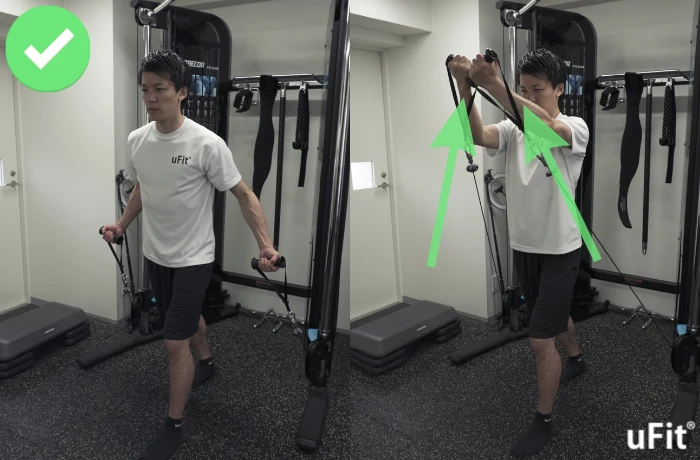
If you mostly feel the front of your shoulders, first check whether the handles travel too far upward. A very high finish can turn the motion into a front-raise-like action. Bring the endpoint down toward upper-chest height, reduce the weight, and preserve the wide inward sweep. You should still expect some anterior-deltoid contribution; a feeling in the front delts does not automatically mean the exercise is useless or technically wrong.
If you lose your stance or the body moves backward, the resistance may be too demanding for that setup. Take a slightly more stable split stance, brace the trunk, then use less weight. Resist the temptation to lean farther and farther forward as the set gets hard. A small, consistent hinge is fine if it improves balance; a hinge that changes halfway through the set makes every repetition a new variation.
If the cables touch your forearms or cross awkwardly, adjust how far you stand from the uprights and verify that both pulleys are at the same height. In a narrow home gym, an alternating single-arm low-to-high fly may give you cleaner clearance than forcing a symmetric two-handed fly. Keep your free hand lightly on a stable support and avoid rotating the torso to drag a heavier cable across the body.
Stop if you feel sharp pain, catching, or an unfamiliar pinch in the front of the shoulder. A smaller opening arc or lighter handle may feel better, but no article can determine the cause of individual joint symptoms. Persistent pain belongs with a qualified clinician rather than with a technique hack. Muscular effort is useful; joint irritation is not something to chase.
Finally, if you notice the stack clanking at the bottom, start a little farther ahead of the machine or slightly shorten the finishing travel. Do not turn the exercise into an isometric balancing trick: you want smooth movement that remains loaded through most of the chosen range, not a contest to keep the plates hovering at all costs.

Funny Gym Shirts & Workout Gear
Funny gym shirts, tanks, hoodies and workout gear for lifters who like training hard.

Dost Thou Even Fly Tee
Make gym days more fun with “Dost Thou Even Fly Medieval Knight Pec Fly” style.


I Love Bench Press Gym | Funny Bench Press Meme Crewnec T-Shirt
For laid-back days and gym-girl humor: “I Love Bench Press”.

Gym Sir Swole of Benchalot Medieval Knight Bench Press Sticker
Give your everyday gear a playful “Sir Swole of Benchalot Medieval Knight” twist.

If You're Reading This Its Chest Day Gym | Drake Meme W Tank Top
Train hard, laugh a little, and rep “If You're Reading This Its Chest Day”.


The Chestfather Arnold – Big Chest , Meme Shirt, T-Shirt
Bring “The Chestfather Arnold” humor to your next gym day.

Six Plates Bench Club Meme Shirt – Chest Day T-Shirt
Heavy lifts, good laughs, and a little “Six Plates Bench Club” energy.

Run a four-week upper-chest accessory experiment
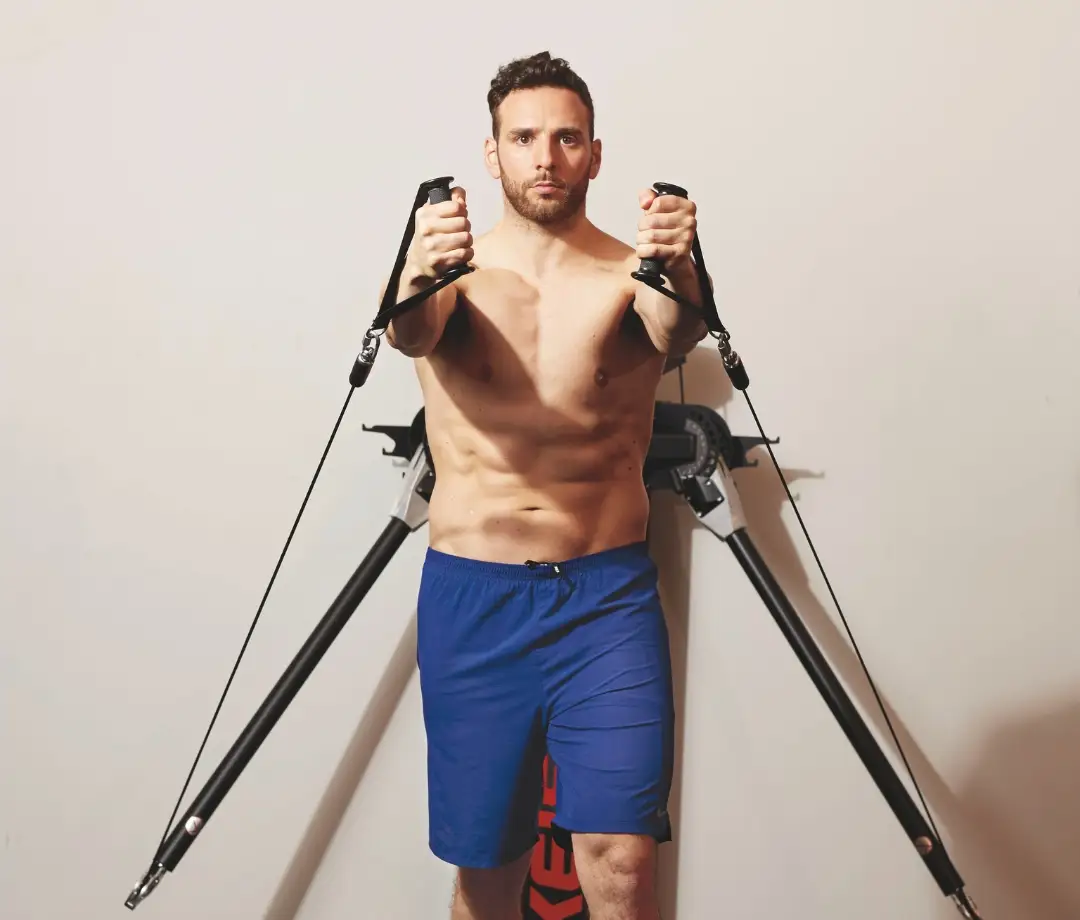
Start with one or two sessions per week after your principal chest press. Try two working sets of roughly ten to fifteen controlled repetitions, resting long enough to reproduce the same arc. This is a practical starting experiment, not a universal optimum. If you already have a demanding pressing schedule, one modest fly exposure may be plenty; add volume only if your shoulders and recovery tolerate it.
During week one, use a resistance you can control with two or three repetitions left in reserve. Write down both pulley settings, attachment, foot position, approximate finish height, load displayed on each side, and reps. If you use a digital resistance unit, record its mode and settings rather than comparing its displayed number directly with an unrelated weight stack. A filmed side view can show whether the finish drifts toward the shoulders as you fatigue.
In week two, keep every setup detail identical and try to add one clean repetition per set before adding load. In week three, if both sets reach the top of your chosen range with the same tempo, add a small increment and return to the lower end of the rep range. If the next increment is large, stay at the current load and make the repetitions more uniform rather than forcing a jump. In week four, compare the first and latest sessions on technique as well as the numbers.
Do not judge this accessory by an immediate pump, by a single workout’s soreness, or by whether it feels different from a dumbbell fly. You can also track your incline-press performance, because total chest training matters more than a clever attachment. Keep the exercise if it feels comfortable, fits the session, and offers measurable progress. Change it if setup time, shoulder comfort, or repetition quality keeps getting worse.
A final equipment check: a cable machine, compatible independent handles, and clear floor space are enough. Specialty handles can improve comfort but will not substitute for pulley symmetry or sound technique. If you cannot reproduce the same trajectory with the equipment you have, a regular cable press or incline press may be the more useful choice that day.