Advertising disclosure: This page includes affiliate product links that may earn us a commission, as well as products from our own store.
A leaning dumbbell lateral raise can make side-delt training feel different, but the payoff depends on a stable anchor, honest repetitions and sensible progression. This six-part guide explains how to use the exercise without confusing altered leverage with guaranteed faster muscle growth.
Choose a secure anchor before picking up a dumbbell
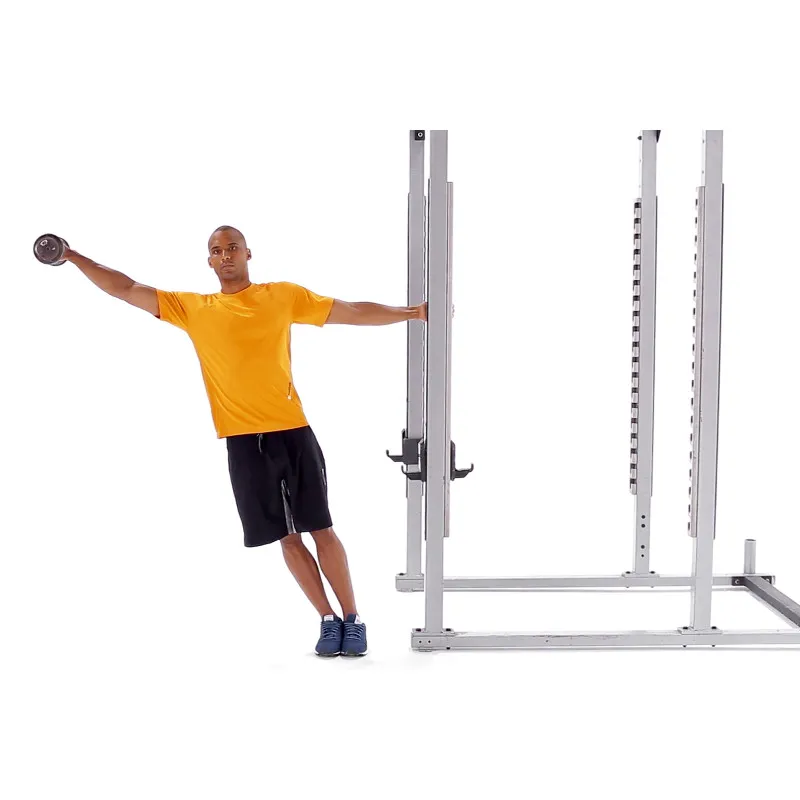
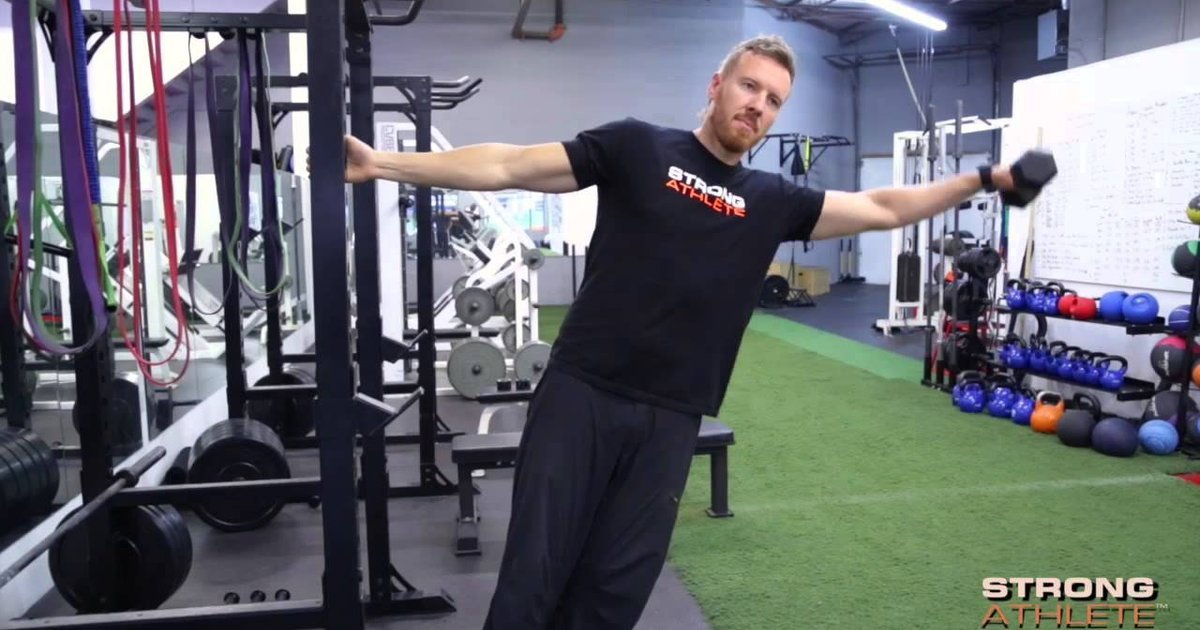
The lean-away lateral raise looks like a modest change to an ordinary shoulder exercise. You hold something solid with one hand, angle your body away, and raise a dumbbell with the other. But your first decision is not the dumbbell weight. It is whether the object you hold can safely resist the sideways force. Use a fixed, properly assembled rack upright rather than a freestanding pole, loose attachment or bar resting unsecured on J-cups. A lightweight stand can tip as your feet move away.
Stand beside the upright with your near foot close to the rack base. Grip at a comfortable height, straighten the support arm without aggressively locking it, and take a small step that lets you lean from ankles to shoulders as one unit. Check your shoes against the floor and keep the working arm clear of hooks, plates and neighboring stations. Practice getting in and out of the position without a weight. You should be able to return upright at any point, including when tired.
One person’s setup is not necessarily your setup. A long-armed lifter may need more space, a slightly different grip height or a shallower angle. If you must bend sideways at the waist just to reach the anchor, adjust the feet and grip instead. Make the support solid before experimenting with angles. Your chosen lean should be repeatable on the left and right, and the dumbbell must not collide with the rack as the arm lowers.
Do not treat a dramatic lean as a sign of harder or better training. Film a few repetitions from the front and side, checking whether the rack stays motionless and your trunk remains in a straight line. If the rack shifts or your foot slips, stop and choose another exercise. A less impressive angle with a safe anchor is preferable to an unstable setup that makes every repetition a balance test.
What the new torso angle does to the side delts
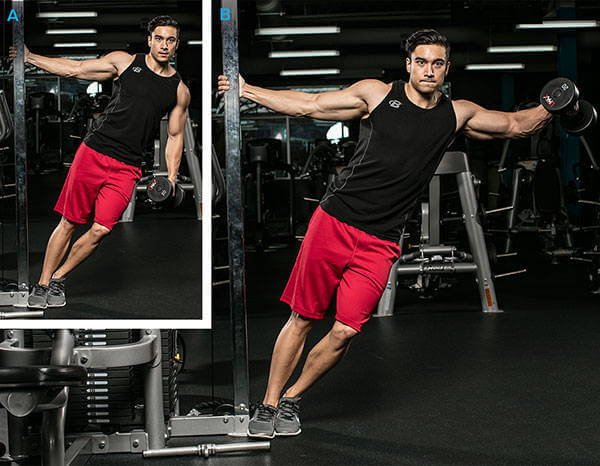
The lateral deltoid assists in raising your upper arm out to the side. A dumbbell is always pulled toward the floor by gravity, and how difficult the lift feels at the shoulder depends on the distance between that downward line of force and the joint. Leaning changes the relationship of the arm to the floor through the repetition. In practice you can feel more load in a different part of the arc than you would with a standard upright lateral raise.
That change is not proof that the leaning version grows more muscle. Resistance curves matter, but so do effort, total hard sets, recovery and the ability to repeat progressive training. An exercise feeling unusually demanding in one position says something about leverage, not necessarily what will happen to your shoulders in eight weeks. Treat the altered challenge as a possible reason to include the variation, not as a scientific shortcut.
Pick a weight lighter than your normal standing two-dumbbell raise. A straight or nearly straight arm gives the weight a long lever; small increments matter. Keep a slight and consistent elbow bend, avoid rotating the arm into an uncomfortable thumb-down position, and allow the shoulder blade to move naturally. Raise the upper arm out to the side or slightly forward of that line according to what feels comfortable and controllable.
Some demonstrations finish above shoulder level while others stop closer to the horizontal. Neither height is a universal target. Choose a repeatable end position free from pinching or significant trunk rotation. You may feel the traps work as well; they are part of normal shoulder mechanics. The goal is a controlled side-delt-focused movement rather than an impossible attempt to make every other muscle completely silent.

Equipment Worth Exploring
Explore equipment, accessories and gear from our carefully selected range.


Rubber Hex Dumbbells
Rubber-coated hex dumbbell pairs with a stable shape for home and commercial strength training.




Foldable Wall Rack
Wall-mounted folding squat rack designed to save floor space between workouts.


FID Bench MAX
Adjustable bench offering flat, incline, and decline positions + adjustable headrest.

Multi Bench MBX-650 2.0
Adjustable multi-bench with roller adjustment, 15 backrest positions and accessory mounts.
Make every repetition look recognizable
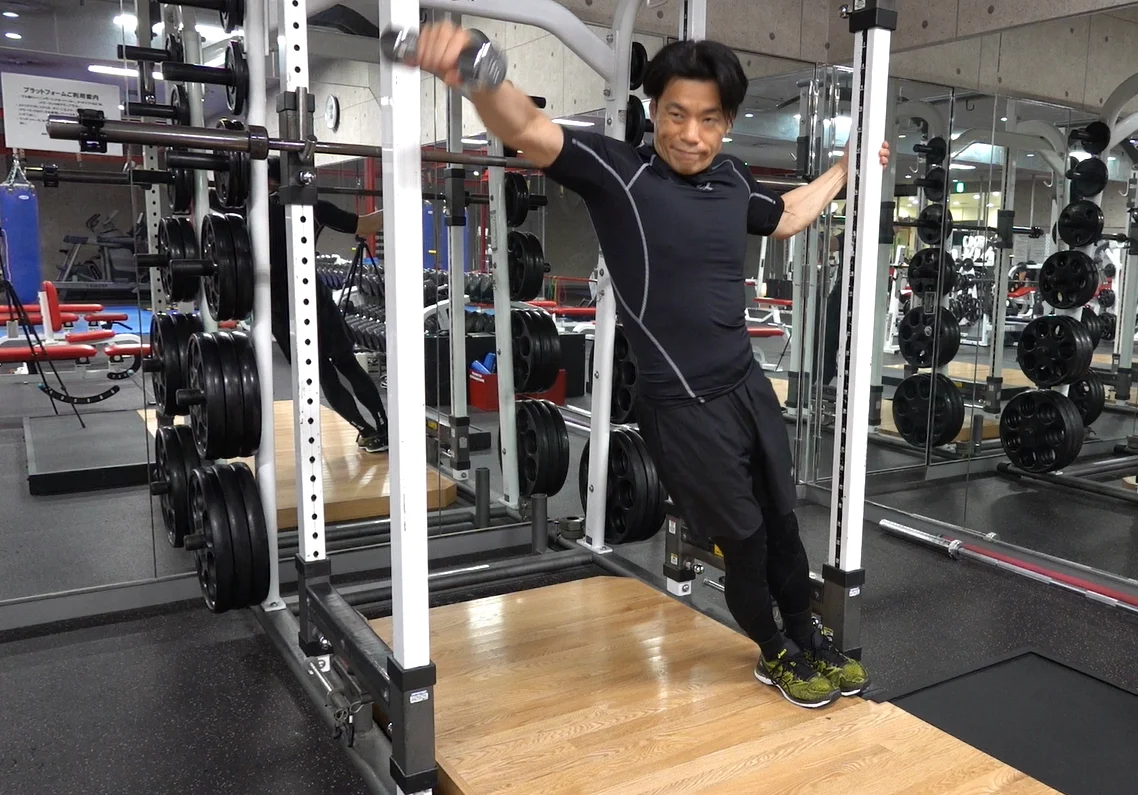
Start with the dumbbell hanging freely at the working side and your supporting hand holding the same place on the rack. Lift smoothly, pause briefly at a consistent endpoint, then lower without dropping the weight. An approximate one-to-two-second rise and two-second descent can be a useful starting rhythm. There is no requirement to follow a stopwatch at the expense of a comfortable shoulder motion, but a deliberately controlled tempo helps you identify when the weight has become too heavy.
The supporting hand should keep your body angle quiet throughout the set. If you pull yourself upright to get through the difficult section of a raise, the resistance profile changes. Leaning farther away on the last few reps changes it again. Your working shoulder should perform the visible lifting while your legs and support arm create a stable platform. Avoid a sudden kick through the hips, a shoulder shrug that lifts your neck, or a swinging dumbbell.
Watch the relationship between your elbow and hand. A gentle elbow bend is reasonable; bending much more as the load gets difficult shortens the lever and turns the repetition into a different task. If you must reduce range on the last rep, record it honestly rather than counting it as equivalent to your clean work. Consistency is what lets you tell whether progress comes from your muscles or from shifting your technique.
Train the weaker arm first if that helps you keep sets comparable. You can stop the stronger side at the same clean repetition count without trying to hide a difference. Leave enough room to change sides without reaching around other equipment. In a compact home gym, moving the rack handle position or bench may be tempting; log those changes so next week’s numbers refer to the same exercise.

Bodybuilding Shirts & Workout Gear
Bodybuilding shirts, tanks and gym gear for lifters chasing muscle, size, symmetry and the pump.


Swole Jesus Lateral Raises – Easter Bodybuilding Meme G Sticker
Give your everyday gear a playful “Swole Jesus Lateral Raises” twist.


Yeah Buddy Ronnie Tank
Add some lifting attitude to training with “Yeah Buddy Lightweight”.


Mass Monster Bane Tee
Show some superhero attitude with a playful “Mass Monster Gym Hero” tee.


Brain and Biceps Tee
Make gym days more fun with “Mind Muscle Perfection Brain and Biceps” style.

Dumbbell Heartbeat Crewneck Pullover Sweater Workout Fa T-Shirt
Add a playful “Dumbbell Heartbeat” touch to your casual rotation.

Vitruvian Man With Dumbbells Shirt: Leonardo Da T-Shirt
Bring “Vitruvian Man With Dumbbells” humor to your next gym day.
Four mistakes that hide your real progress
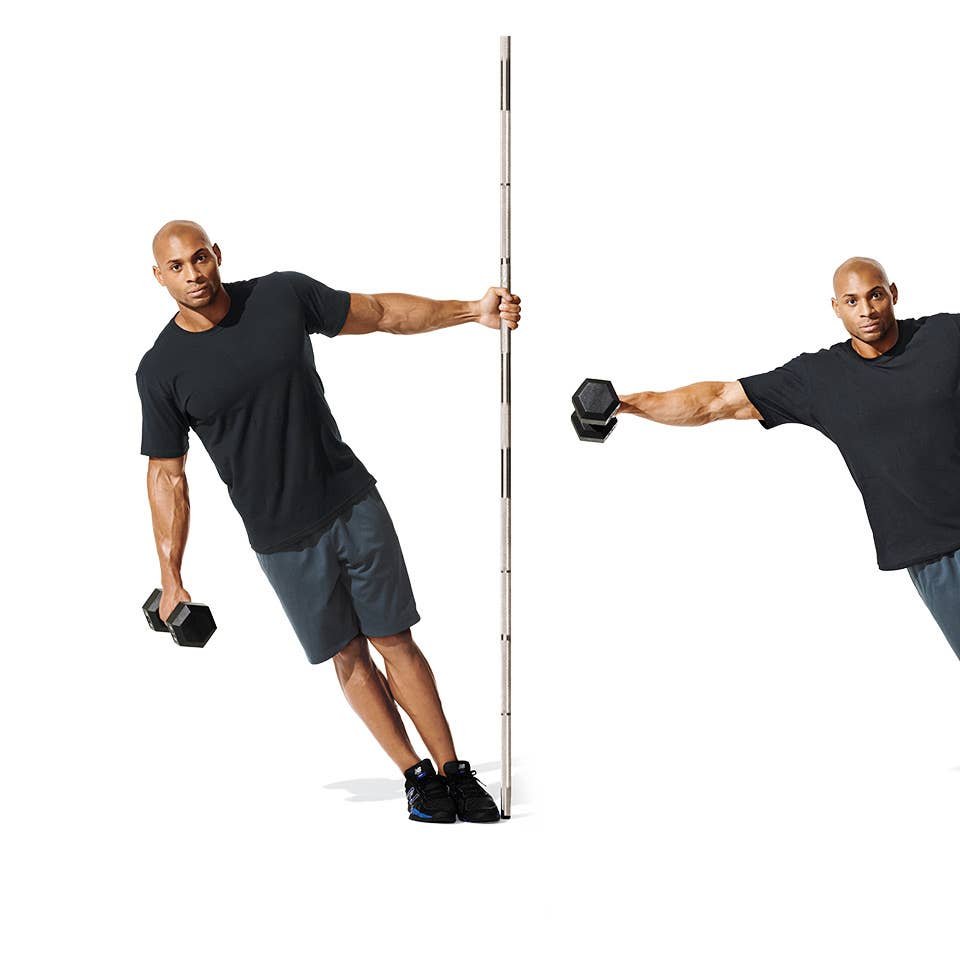
First, bending sideways from the waist is not the same as leaning away as a straight unit. It often means your support hand is too low, your feet are too far from the base or you are seeking an angle you cannot comfortably support. Reset the setup without a dumbbell and rehearse the straight-line lean. If the position never feels stable, use ordinary standing lateral raises instead.
Second, allowing the dumbbell to bounce from your thigh or swing behind you makes the beginning of each repetition inconsistent. Lower until the arm returns to the same comfortable starting position while keeping clearance from your leg. You need not hold the bell rigidly away from the body between every rep, but a large backswing should not launch the next one.
Third, the last few reps often become much shorter than the first. A ten-repetition set in which the final five barely leave your side should not be compared directly with ten controlled full-range reps. Keep a stable range and add repetitions before adding weight. If your gym’s next dumbbell jump is large, choose better control or one extra clean rep instead of forcing a new number.
Fourth, chasing a higher arm path with aggressive internal rotation can provoke discomfort. Do not turn shoulder pain into an activation goal. Shorten the range, rotate the hand to a more natural angle or choose a different exercise. If there is persistent pain, instability or weakness, seek individual guidance instead of copying the deepest or highest range from a video.
Equipment Worth Exploring
Explore equipment, accessories and gear from our carefully selected range.
VOLTRA
Compact digital cable trainer with smooth, adjustable resistance.

Go-Tone Pro
Portable digital cable trainer with up to 66 lb (30 kg) of adjustable resistance.

GymPin D Cuffs
Adjustable wrist cuffs with textured grips for supported cable-machine exercises.

VForce Wall Trainer
Space-saving wall-mounted functional trainer with pivoting cable arms and variable resistance ratios.

VForce 2IN1
Half rack and pivot-arm functional trainer with switchable 1:1 and 2:1 pulley ratios.

Multi Pull Smith Rack MPHR-780
All-in-one rack with a Smith machine, functional trainer, lat pulldown and low row.

GymPin Ergo Handles
Pair of ergonomic cable handles shaped for comfortable triceps and pulling exercises.


VForce 3IN1
All-in-one rack combining an adjustable Smith machine, functional trainer, and free-weight station.

GymPin MiniPin
Compact Olympic-plate loading pin for compatible cable stacks with limited clearance.
Lean-away dumbbells versus cables and incline-bench raises
A normal standing dumbbell lateral raise is the simplest option: there is no anchor, no leaning angle to reproduce and less equipment to occupy. The lean-away version changes the torso angle and may alter where the load feels hardest, but it demands a secure handhold and a repeatable stance. If those are hard to arrange in your space, the ordinary raise remains a perfectly useful shoulder exercise.
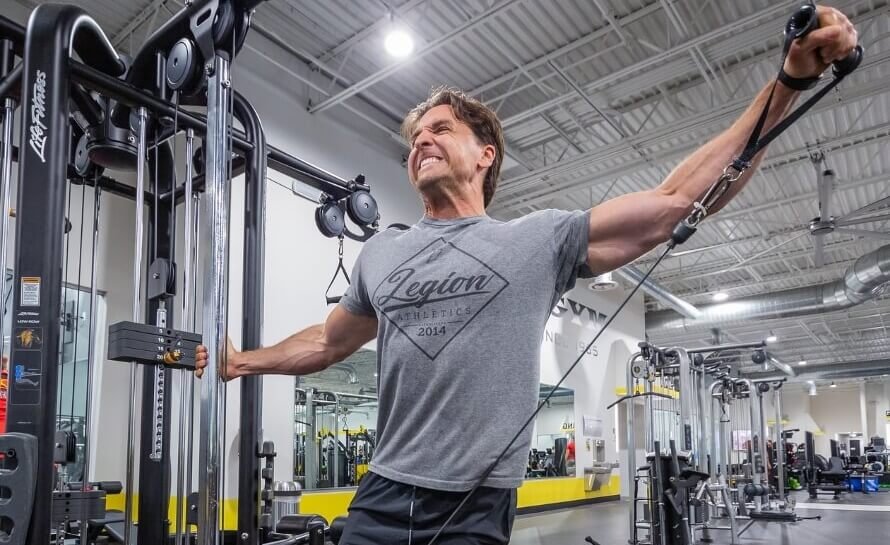
A low-pulley cable lateral raise changes the direction of resistance. The cable pulls back toward the pulley rather than straight downward, so cable position and the distance you stand from the machine affect the load at different arm angles. This can make it easier to change where tension feels strongest without leaning on a separate upright. It does not automatically make cables superior for muscle growth.
One controlled eight-week study in resistance-trained participants compared conventional cable and dumbbell lateral raises, with the movement range matched. Measured lateral-deltoid thickness increased in both conditions, without a clear growth advantage for either. The study did not compare the lean-away dumbbell version, so it cannot answer which lean angle is best or prove that longer tension at a particular shoulder length guarantees additional hypertrophy.
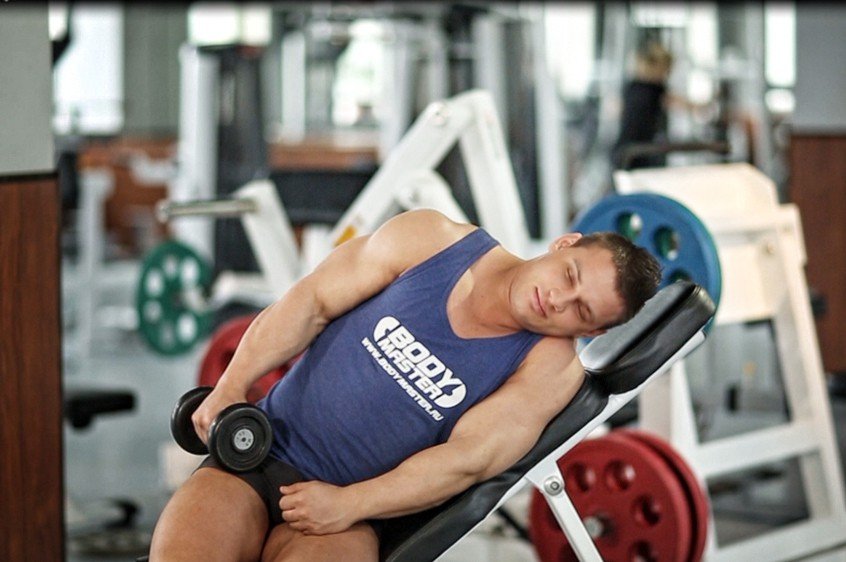
An incline side-lying dumbbell raise places your torso against a bench rather than suspending it from one hand. This changes your support and the relationship of the bell to the shoulder. It can be useful when rack space is limited, but its starting position and range should be logged separately. Choose a version that permits controlled work and a measurable progression; the name of the device is not the progress itself.
Four weeks of repeatable side-delt training
Begin with two sessions each week, ideally separated by a recovery day. Add the lean-away raise after larger upper-body work if that sequencing fits your routine. In week one, use two sets of ten to twelve controlled repetitions on each arm, finishing with roughly two more clean repetitions available. The load should let you maintain the same anchor, body angle and arm path from the first repetition to the last.
In week two, keep the weight constant and work toward an extra clean repetition per set without shortening the range. Week three can introduce a third set if the first two remain consistent and your total weekly shoulder training is recoverable. The third set is an option, not a compulsory escalation. In week four, aim for the top of a ten-to-fifteen-repetition bracket while preserving the same movement standard, then consider the next modest dumbbell increment.
Track more than the number printed on the dumbbell. A useful entry might read ‘right 6 kg 12, 11; left 6 kg 11, 10; fixed rack upright; slow lower; same foot position.’ Note if you change hand height, grip, shoes, range or exercise order. Those details are what let future you compare two sessions that otherwise look identical in a graph. If your next available dumbbell jumps too much, improving clean reps is still progress.
Count hard work already done by pressing and other shoulder exercises instead of stacking endless isolation sets onto an overfull routine. If performance or recovery deteriorates, scale the extra volume back. At four weeks, look first for better control, a stable setup and more equivalent reps. Visible growth takes time and varies between people; the practical win is a plan you can repeat without pretending the lean angle alone creates it.
Funny Gym Shirts & Workout Gear
Funny gym shirts, tanks, hoodies and workout gear for lifters who like training hard.

Heart And Brains Dumbbell Meme : The Ultimate T-Shirt
Make gym days more fun with “Heart and Brains Dumbbell Gym Meme” style.


Buff Smiley Grunge Hoodie
Stay casual and show some metalhead attitude with “Buff Smiley Face”.

Calisthenics Heartbeat Tank
Add some lifting attitude to training with “Calisthenics Heartbeat”.

Lifting Is Freedom Gym | Statue of Liberty Meme Muscle Tank Top
Bring “Lifting Is Freedom” humor to your next lifting session.

Lift Eat Repeat & Weightlifting Meme Vest Tank Top
Add some lifting attitude to training with “Lift Eat Repeat”.

Gymhead Meme Mind Muscle Connection Hooded Hoodie
Make your off-duty look more fun with “Gymhead”.

Iron Knight Motivational & Bodybuilders Vest Tank Top
Bring “Iron Knight” humor to your next lifting session.

Train Hard Gains Gym | Funny Thomas The Tank Engine Wor Hoodie
Show off your lifting humor in a laid-back “Train Hard Gains” hoodie.

Swole David Meme : Michelangelo'S Renaissance T-Shirt
Heavy lifts, good laughs, and a little “Swole David Gym Meme” energy.