Advertising disclosure: This page includes affiliate product links that may earn us a commission, as well as products from our own store.
Dumbbell Floor Press: Control the Pause, Setup and Progression
The dumbbell floor press has a useful built-in boundary: your upper arms meet the floor before they can travel as far behind your torso as they would on a bench. That changes the repetition, but it does not automatically make every load manageable or every shoulder comfortable. The useful skill is controlling that boundary while keeping the weights balanced above your hands.
Use the exercise as a distinct chest-and-triceps press, with its own setup and training log. A repeatable floor contact, a manageable transition into position and a clear stopping point make the numbers easier to interpret. Here is how to establish those details before adding weight.
1. Set up the floor and plan the finish
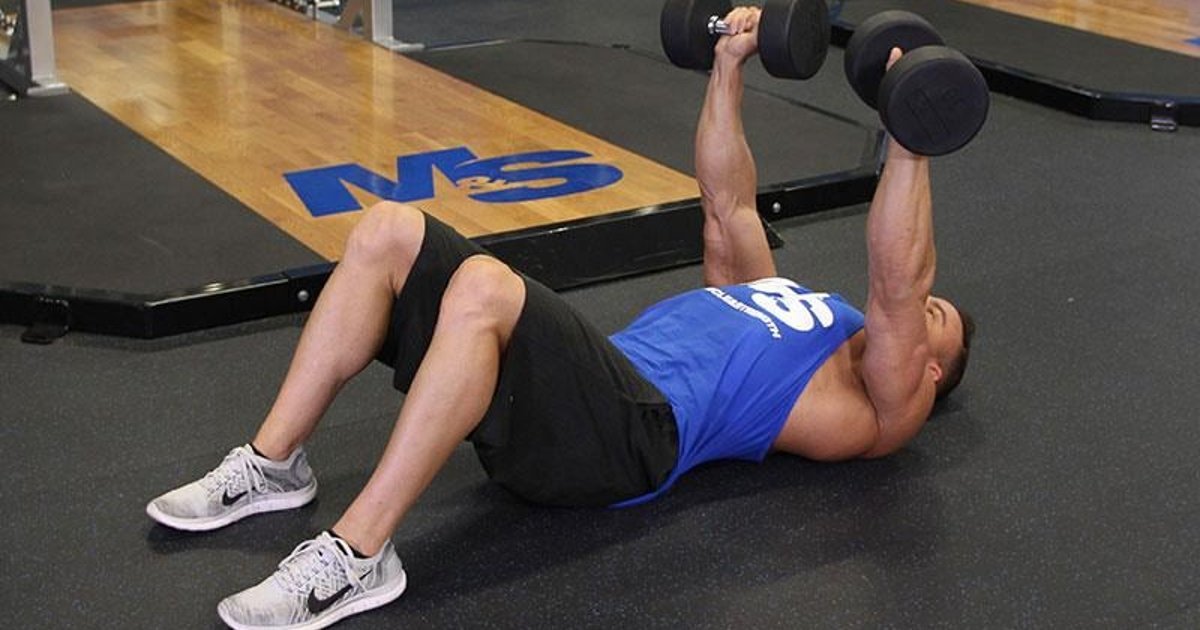
Choose a level, uncluttered surface with room beside your arms and behind your head. A thin exercise mat can make contact more comfortable, but a deep cushion that shifts under you creates a different base. Keep the surface consistent between sessions. Moving from bare flooring to thick foam can also change where your arms stop and how much movement remains.
Start with light dumbbells while you learn the transition. Sit with the weights close to your hips, then bring them with you as you move onto your back. Avoid extending a loaded arm far away to retrieve a weight once you are down. Bend your knees and plant your feet, settling your upper back and head before pressing. If you cannot position or finish with control, use a lighter pair or agree on help from a competent spotter.
Plan the last repetition before the first. Return the weights toward your torso under control and use a practiced, manageable transition out; do not improvise a heavy sit-up with loose dumbbells or throw them aside. Stop before fatigue makes that exit uncertain. Space, other people and the shape of the dumbbells matter as much as the nominal load.
Fixed hex dumbbells and adjustable pairs offer different handling and storage trade-offs. With plate-loaded handles, check the manufacturer’s loading limits and secure every compatible plate and lock before lifting. Kettlebells are a separate pressing option with a different hand and wrist arrangement; they are not interchangeable with dumbbells simply because the weight matches.

Equipment Worth Exploring
Explore equipment, accessories and gear from our carefully selected range.


Rubber Hex Dumbbells
Rubber-coated hex dumbbell pairs with a stable shape for home and commercial strength training.


Cast Iron Kettlebells
Textured cast-iron kettlebells for swings, squats, carries, and full-body training.


2. Let the upper arms settle without bouncing
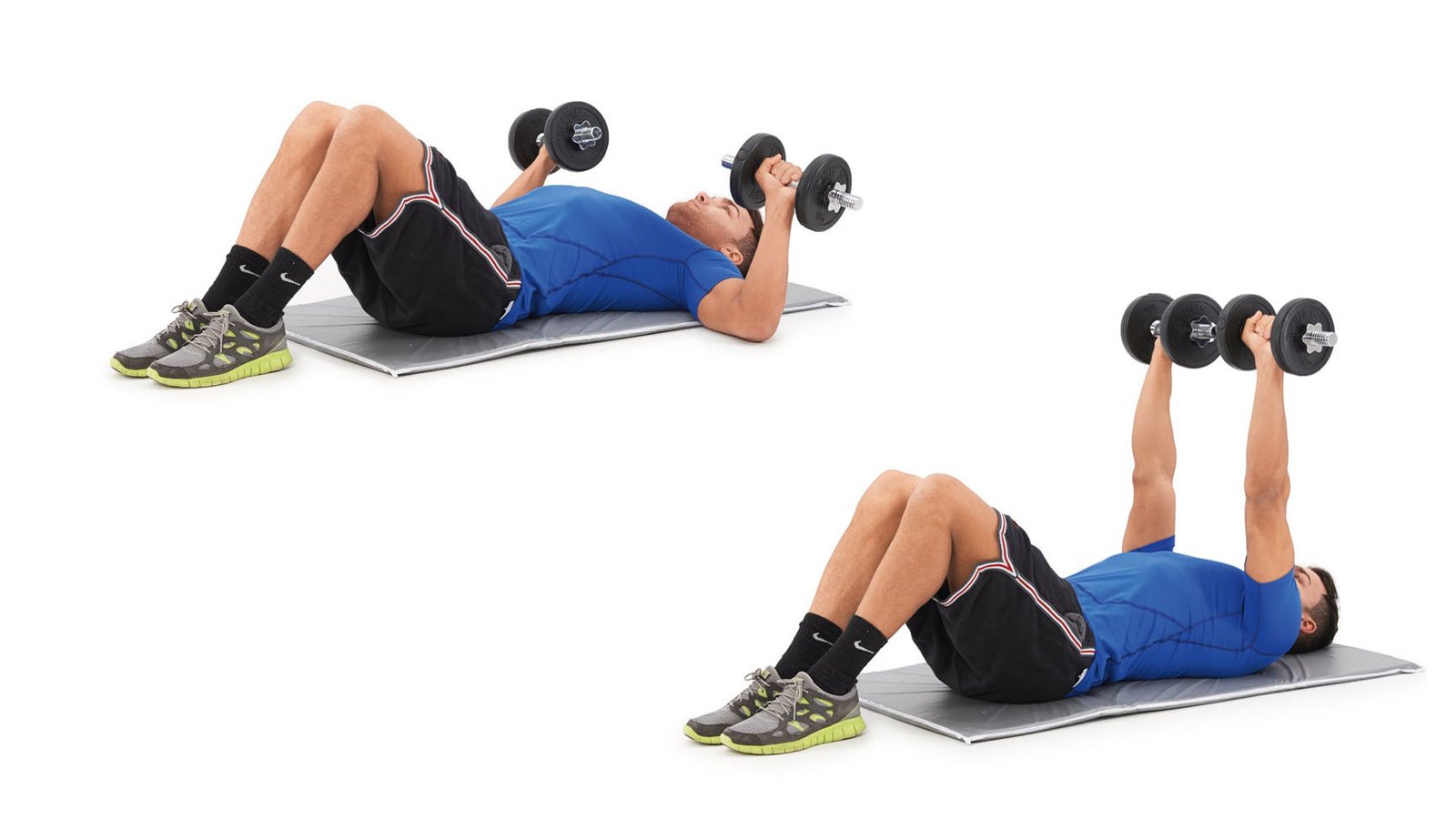
Begin with the dumbbells balanced above your shoulders, then lower them smoothly. Keep your forearms approximately upright as your upper arms approach the floor. The aim is a controlled contact through the upper arms, rather than driving the points of your elbows down or using the floor as a springboard. Your hands should remain in charge of the weights throughout.
Pause briefly after the upper arms meet the surface, keeping your grip and torso organized, then press upward. Choose a pause you can reproduce instead of alternating between a long stop and an immediate rebound. There is no special pause duration required for everyone. A simple one-count can make the boundary obvious while you learn, provided it does not turn into a rushed tap later.
At the top, finish with both weights stable rather than smashing them together. You do not need to reach them dramatically toward the ceiling or turn the finish into a shoulder shrug. Lower again along a path you can control. If one dumbbell drifts out while the other rises, end the set or reduce the load rather than speeding up to disguise it.
Keep breathing rather than holding a strained breath through several repetitions. Use a controlled exhale as you press and reset between reps as needed. A deliberate brace should help you stay organized, not become a reason to grind through a weight that is already escaping your control. Practice the rhythm with preparation sets.
A side-view recording can help check whether contact and hand position remain similar across repetitions. It cannot tell you how a joint feels. Change the load or movement when discomfort disrupts your technique; a shorter range is a feature of the floor press, not a promise that painful pressing will become suitable.
3. Choose a grip you can keep consistent
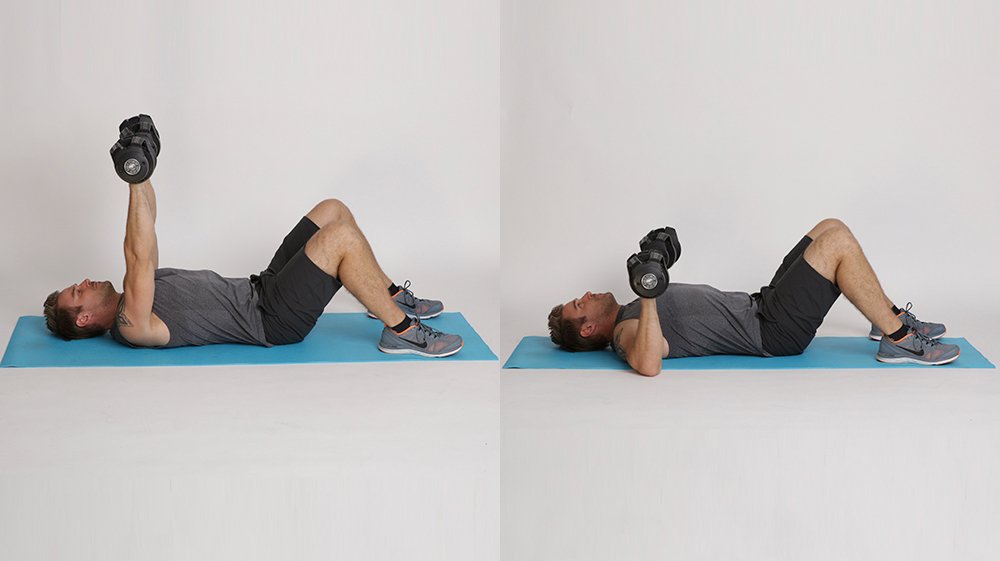
Dumbbells allow the hands to rotate independently. You might use palms generally forward, palms facing inward, or a comfortable position between those extremes. Start light and choose an orientation that lets the weights sit securely over your forearms. Avoid bending your wrists far back while the dumbbells wander toward your fingertips.
Let the upper arms travel at a manageable angle from your sides rather than forcing them into a perfectly straight line across your shoulders. Equally, squeezing the elbows tightly against your ribs is not a universal requirement. The practical question is whether your chosen grip, elbow path and floor contact work together without a sudden twist at the bottom.
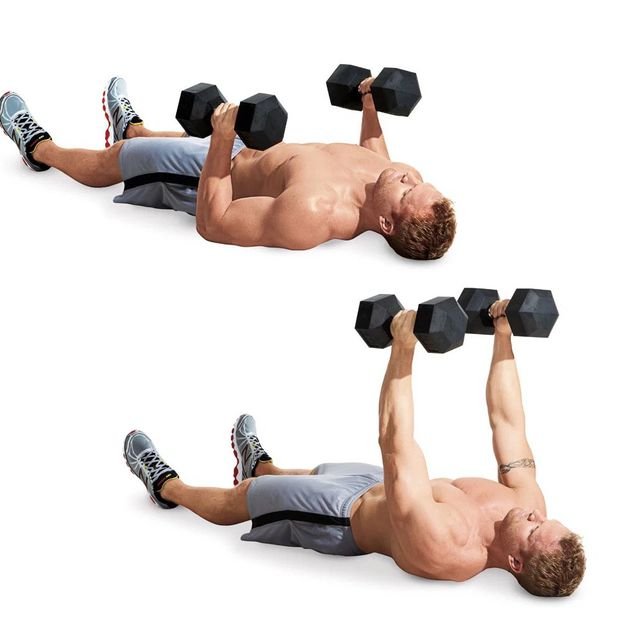
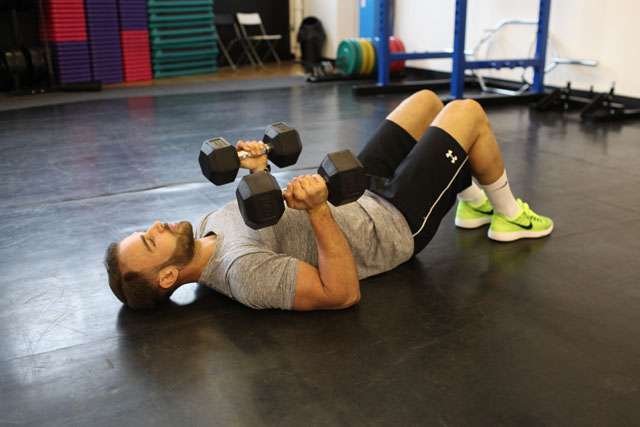
The photograph shows a floor press with the legs extended. That is a possible setup variation, while this guide’s starting example uses bent knees and planted feet. Neither picture nor cue requires you to force an exact posture. Pick a stable version, record it and keep it consistent when comparing sessions. Changing foot position halfway through a hard set can make the movement harder to assess.
If a palms-in grip feels more controllable, log it as part of the exercise instead of treating it as an invisible change. It does not prove you have isolated one muscle or solved a shoulder problem. Similarly, do not compare a new grip’s load directly with an old grip’s best set until you have established a repeatable range and pause for both.

Bodybuilding Shirts & Workout Gear
Bodybuilding shirts, tanks and gym gear for lifters chasing muscle, size, symmetry and the pump.

| I Love Bench Press Pink Heart Pullover T-Shirt
For laid-back days and gym-girl humor: “I Love Bench Press Pink Heart”.

Dumbbell Meme Shirt – Essential & Gymbros Seeking T-Shirt
Make gym days more fun with “Dumbbell Gym Meme” style.

Heart And Brains Dumbbell Meme : The Ultimate T-Shirt
Make gym days more fun with “Heart and Brains Dumbbell Gym Meme” style.


Chest Day Decal Water Bottles & Equipment Meme Sticker
Bring “Chest Day” attitude to your water bottle or laptop.

Bench Press and Chill Funny Gym T
Make gym days more fun with “Bench Press and Chill” style.

Shirt: Good Argument But I Bench More Than You – T-Shirt
Make gym days more fun with “: Good Argument But I Bench More Than You” style.


Dumbbell Heartbeat Muscle Shirt Athletic Vest Fitness F Tank Top
Your gym-day look, with a playful “Dumbbell Heartbeat” twist.

Yeah Buddy Ronnie Tank
Add some lifting attitude to training with “Yeah Buddy Lightweight”.
4. Keep floor, bench and other presses separate
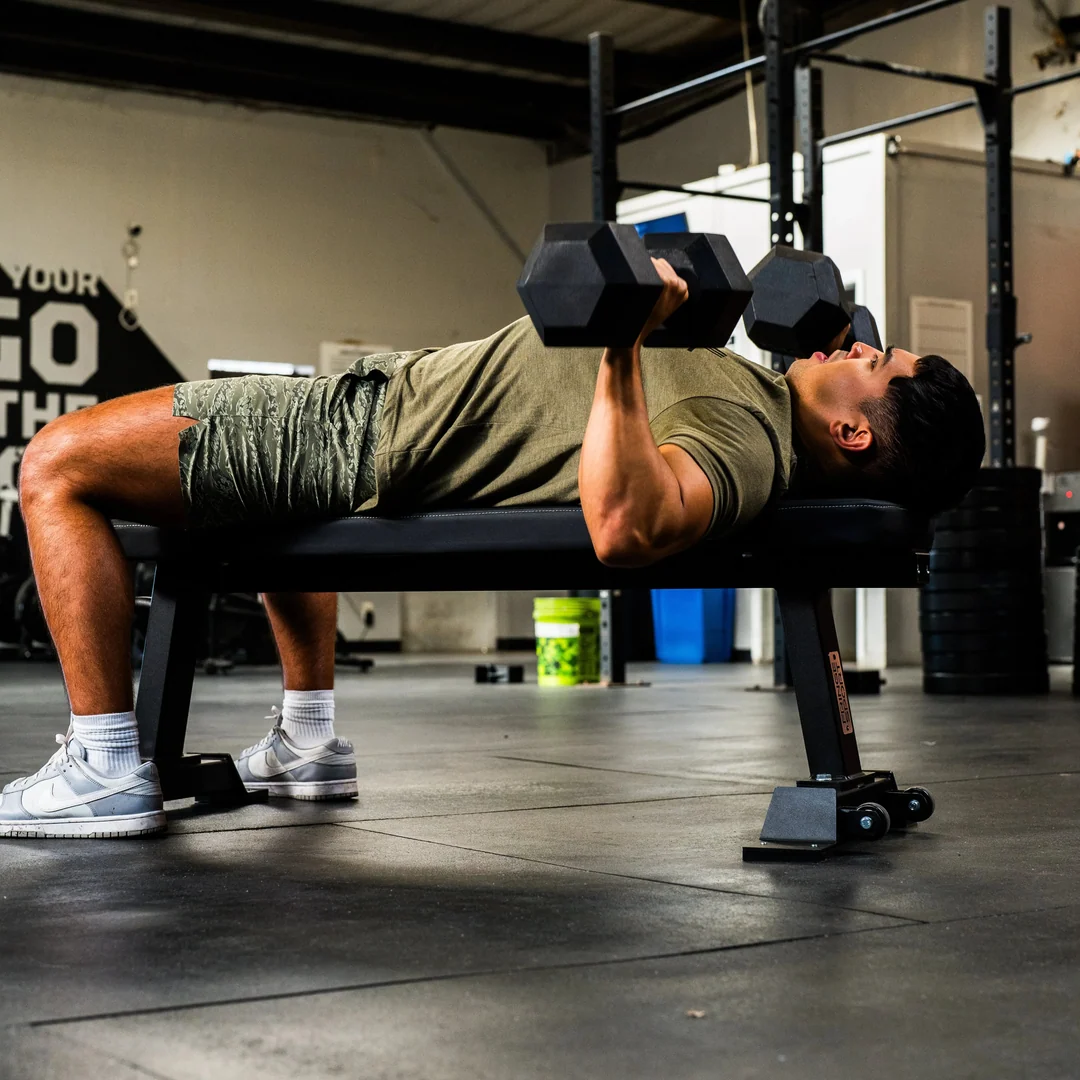
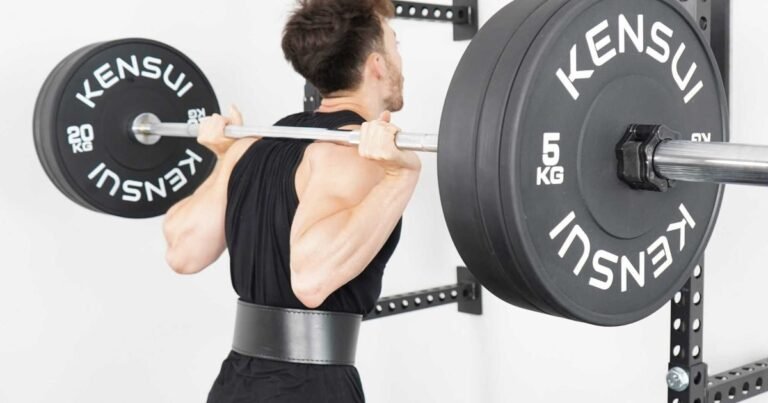
On a bench, the upper arms can descend below torso level; on the floor, contact limits that descent. The photograph here deliberately shows a bench press for comparison. More available range is a different demand, not automatic evidence that one exercise is better. Choose the variation that fits your training purpose and your ability to control it.
Keep separate logbook entries for dumbbell floor presses and dumbbell bench presses. A heavier floor-press pair does not demonstrate that your full bench-press range has improved by the same amount. Changes in stability, depth and setup can all affect the load. Treat each version’s progress as specific evidence about that version.
An adjustable or flat bench becomes relevant when you want the bench variation, rather than as a requirement for floor pressing. Check stability, dimensions and rated use before buying. For a barbell alternative, the rack, safeties, bar and collars form a separate system: confirm compatibility and arrange a safe starting and stopping position. A Smith machine also follows its own fixed path.
Cable stations offer another pressing option, with different resistance direction and setup requirements. They are not substitutes that preserve the exact dumbbell task. Decide which movement you actually intend to train before comparing equipment lists. Buying a rack or bench will not correct an uncontrolled pause, and no accessory replaces secure dumbbell assembly.
Equipment Worth Exploring
Explore equipment, accessories and gear from our carefully selected range.


FID Bench MAX
Adjustable bench offering flat, incline, and decline positions + adjustable headrest.


Multi Bench MBX-650 2.0
Adjustable multi-bench with roller adjustment, 15 backrest positions and accessory mounts.

Multi Pull Smith Rack MPHR-780
All-in-one rack with a Smith machine, functional trainer, lat pulldown and low row.

Foldable Wall Rack
Wall-mounted folding squat rack designed to save floor space between workouts.


5. Progress the same repetition, not a changing test
For a practical starting example, you could perform two or three working sets of eight to twelve controlled repetitions after lighter preparation sets. This is an adjustable example, not a proven optimum. Select a load that leaves a few manageable repetitions available and lets you finish safely. Rest long enough that the next set begins with similar control.
Record the dumbbell weight per hand, repetitions, sets, grip, surface and pause. Note whether assistance was needed to get into position. If the final reps become quick floor taps or your wrists lose their position, that is useful information about the set, even when you technically moved the dumbbells upward.
For example, an entry might read three sets of ten, ten and nine with the same pair, planted feet and a brief pause. Adding a clean tenth repetition to the last set is a useful next step. Achieving it by lifting the elbows off the floor early changes what the entry means.
One simple progression is to add repetitions within your chosen range before taking the smallest sensible load increase. When the new pair reduces your repetitions, rebuild them with the same contact and pause. Large jumps between available dumbbells may justify staying at the current load longer rather than forcing a heavier pair you cannot set up.
If one side consistently finishes earlier, do not keep extending that arm while the other struggles through extra repetitions. Stop at the limit of the side you can still control. Persistent asymmetry deserves attention to setup and load before it becomes a reason to add more volume.
Consider the rest of your pressing session too. Bench work, dips and overhead presses can leave your floor press feeling different depending on order and fatigue. Keep the order steady while assessing progress, or label the change. The clearest improvement is more controlled work under comparable conditions, followed by a finish that remains as deliberate as the first repetition.