Advertising disclosure: This page includes affiliate product links that may earn us a commission, as well as products from our own store.
Dumbbell Clean and Press: Learn the Pull, Secure the Rack and Own the Press
The dumbbell clean and press joins two jobs: getting the weights to your shoulders and pressing them overhead. Both matter. A strong press does not compensate for an uncontrolled catch, and a fast clean does not make an unstable overhead position acceptable. Learn the transitions before treating the movement as a conditioning challenge, then keep the version you choose consistent enough to measure.
Choose your starting position before choosing a heavier pair
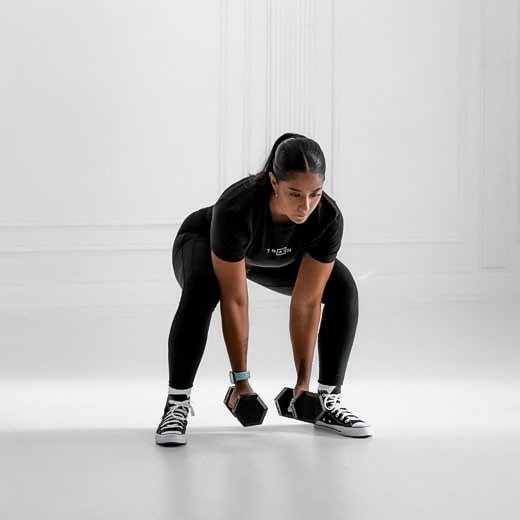
A floor clean and a hang clean begin at different heights. In the floor version, the weights start beside your feet. In the hang version, you first stand with them, then move into a shallow hip hinge to begin the pull above the floor. Neither label tells you how deep the receiving squat will be. Write down the start and catch you intend to use rather than treating every route to the shoulders as interchangeable.
Begin with a pair you can handle comfortably through each component. Check overhead clearance, the space beside your legs and the area where you will return the weights. Your normal training shoes should feel stable on the surface. A mat that slides or a cluttered space adds a problem before the first repetition. Do not assume that a crowded dumbbell aisle is a suitable place for a movement with a fast transition.
For a hang start, stand tall, take a secure grip and send your hips back while allowing the knees to soften. Keep the weights close enough that you do not have to swing them around your body. For a floor start, establish a position you can hold before lifting. If reaching down changes your posture substantially, use a manageable hang version while you learn the sequence rather than forcing the floor setup.
Equipment dimensions can affect the experience. Long adjustable dumbbells may feel different beside the thighs and at shoulder level from compact fixed heads. Check the locking mechanism according to the maker’s instructions before any dynamic work. Do not drop an adjustable model unless its manufacturer explicitly allows it. Buying a heavier pair does not solve an awkward catch.
Make the clean a coordinated pull rather than a swinging curl
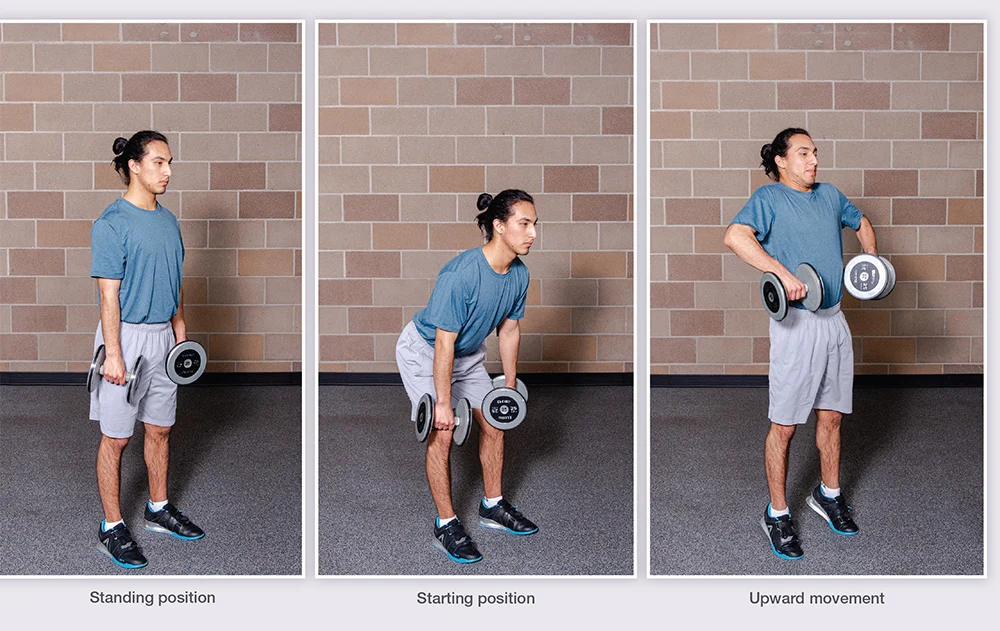
The clean uses lower-body extension to accelerate the dumbbells, followed by a quick transition underneath them. Starting with long arms leaves room for that sequence. Bending the elbows immediately and dragging the weights upward can turn the movement into an awkward curl with a large body swing. Practice with a light enough pair that you can notice the difference between initiating the pull and receiving the load.
Think about the route, not just the destination. A weight that travels far out in front has to come back toward you. A close, controlled path is easier to receive than an exaggerated loop. From the hang, rehearse the hinge, stand with intent and let the elbows move into the receiving position as the dumbbells rise. You do not need to chase a dramatic jump or throw the weights to prove that the movement is explosive.
A useful practice format is a single clean followed by a deliberate pause. Ask whether both dumbbells arrived together and whether you can stand without stepping to recover your balance. Reset before the next attempt. This is a coaching exercise, not a special scientific protocol. Its value is that a poor transition is easy to identify instead of being hidden inside a long string of repetitions.
Keep the floor pull and hang pull distinct in your notes. For example, “three clean singles from the hang, then separate pressing practice” describes a session much better than “clean and press, light.” If you repeatedly have to swing harder, curl one side first or change your stance unexpectedly, reduce the demand and review the sequence with a qualified coach before adding load.
The rack is a position to control, not a collision to tolerate
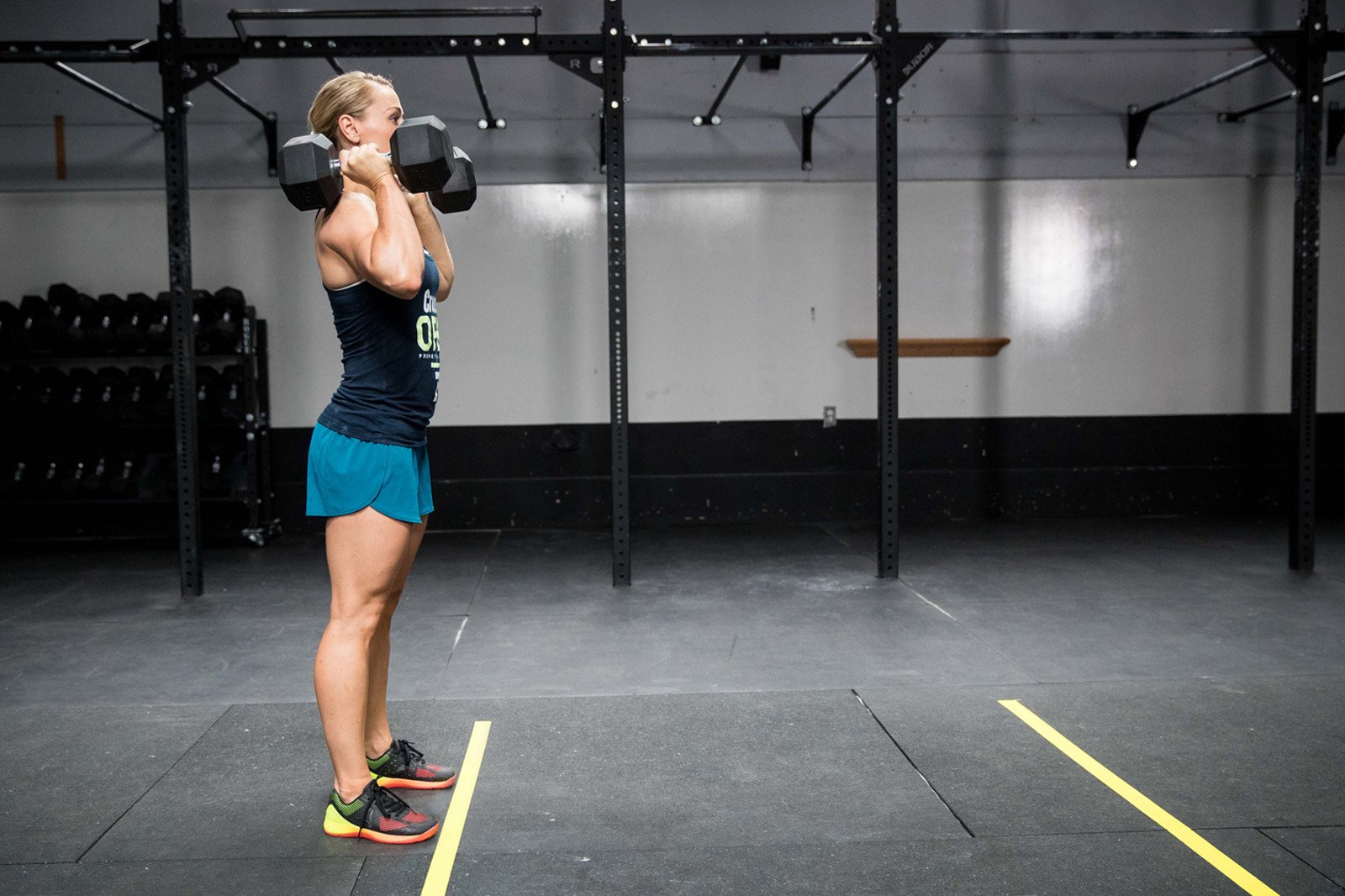
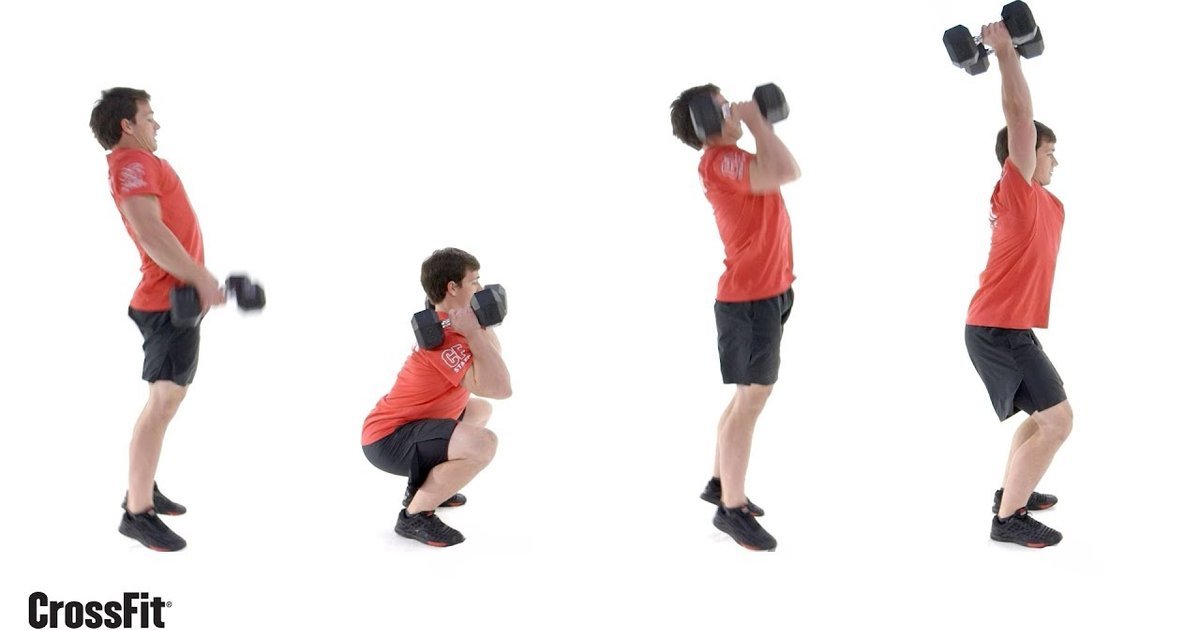
Once the dumbbells reach shoulder level, receive them with control and finish standing. A power clean uses a partial squat to catch; a full squat clean receives the weights deeper. Do not add a deep squat simply because a demonstration shows one, and do not call an accidental collapse a planned variation. The chosen version should match your ability and the purpose of the session.
The pause between clean and press is a useful checkpoint. Can you breathe, organize your stance and hold the dumbbells without bouncing them against yourself? Is one wrist folding back while the other stays supported? Are you already leaning backward before the press begins? These observations tell you more about the usable load than the largest number you have previously pressed from a convenient rack.
Keep your hands closed around the handles. Position the dumbbells so that the wrists and forearms support them without an exaggerated bend, and find a comfortable relationship between your elbows and torso. Dumbbell shape, arm length and available shoulder movement mean that one photograph is not a universal pose to copy exactly. The goal is a stable transition that lets you begin the next phase deliberately.
A helpful comparison is a clean without a press against a clean with a press. If the clean looks organized until you anticipate going overhead, separate the tasks again. Perform a light clean, settle, then lower. Practice pressing independently with a manageable setup. Combining skills is useful once each is available; it is not a reason to accept a rough catch on every repetition.

Equipment Worth Exploring
Explore equipment, accessories and gear from our carefully selected range.


Rubber Hex Dumbbells
Rubber-coated hex dumbbell pairs with a stable shape for home and commercial strength training.


Cast Iron Kettlebells
Textured cast-iron kettlebells for swings, squats, carries, and full-body training.


FID Bench MAX
Adjustable bench offering flat, incline, and decline positions + adjustable headrest.

Decide whether the overhead phase is a strict press or a push press
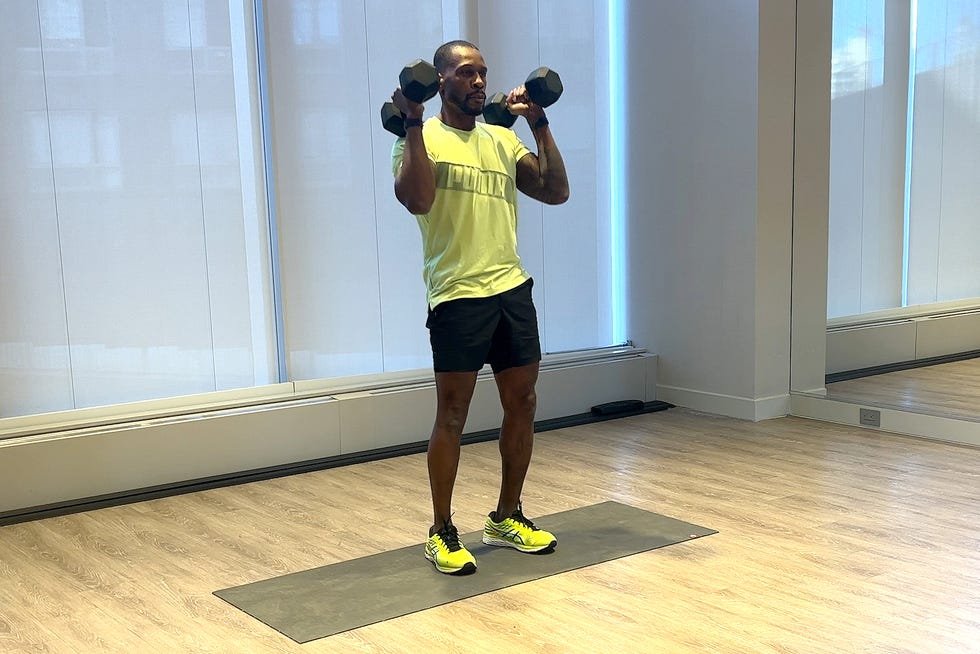
In a strict press, you press from the shoulders without a fresh knee dip to help launch the weights. A push press deliberately adds a shallow dip and leg drive. Both are recognizable exercises, but they answer different training questions. A set that begins strictly and gradually turns into a push press is a changing task unless you explicitly planned that transition.
Before pressing, stand with a firm base and brace your torso. Move the dumbbells overhead along a path you can control without a large backward lean. Lower them to shoulder level deliberately. If the press requires you to chase the weights with your ribs or shuffle your feet, the combination is asking more than you can currently organize. Stop the set and reassess rather than making the final position a guessing game.
For a push press, learn the dip-and-drive as its own movement. Keep the dip controlled and the torso organized, then use the legs to contribute to the upward movement. Do not confuse that with a jerk, which includes another receiving action under the weights. Precise names help you compare sessions and choose appropriate practice; they are not a competition over which variation is more legitimate.
Lowering deserves the same planning as lifting. Return the weights to the shoulders before guiding them toward the hang or floor. Avoid suddenly dropping them past your face or trying to catch a slipping handle. If your equipment or space does not permit a safe return, choose another setup. Pain, loss of grip or inability to control the overhead position is a reason to stop, not a technique cue to work around.
Build a progression around clean repetitions, not a complicated circuit
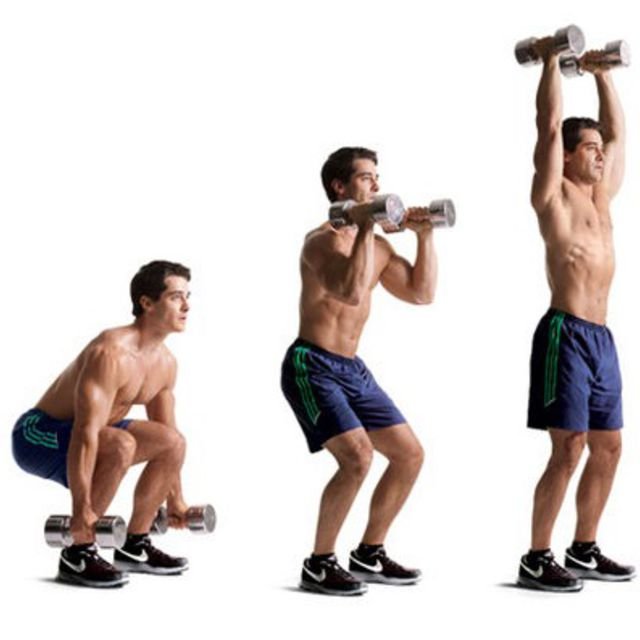
Start by deciding why the movement is in your program. Learning the sequence, practicing a crisp clean and completing a conditioning interval are different aims. A beginner does not need a demanding circuit to get useful practice. Use short sets with enough recovery to keep the components recognizable, and finish before fatigue changes the technique you are trying to learn.
Here is an illustrative four-session learning sequence, rather than a promise of adaptation. In the first session, practice light hang cleans and separate presses. In the second, join them with a clear pause at the shoulders. In the third, repeat the same version and record whether the catches and overhead finishes remained consistent. In the fourth, decide whether to retain the load, add a little work or use the next manageable increase. These sessions need not occur on consecutive days.
Change one meaningful variable at a time. Moving from two to three good repetitions with the same pair is already a change; adding weight, removing the pause and shortening rest simultaneously makes progress hard to interpret. A simple log can record start height, receiving depth, strict or push press, load per dumbbell, sets, repetitions and the reason you stopped. Note an uneven catch rather than counting it as a perfect rep.
Use alternatives to solve specific learning problems. A seated dumbbell press on a stable bench can separate pressing from the standing transition, though it is not the same whole-body exercise. Kettlebell cleans involve a different rack and turnover and deserve their own instruction; they are not an automatic replacement using identical cues. With loadable dumbbells, verify plate and collar compatibility instead of assuming every accessory fits every handle.
Keep the success criterion simple: a repeatable start, an organized clean, a rack you can control and an overhead finish that matches your chosen press. When all four remain clear, the exercise becomes easier to program. When one disappears, adjusting the session is more productive than forcing the rest of the set.

Funny Gym Shirts & Workout Gear
Funny gym shirts, tanks, hoodies and workout gear for lifters who like training hard.

Dumbbell Meme Shirt – Essential & Gymbros Seeking T-Shirt
Make gym days more fun with “Dumbbell Gym Meme” style.


Shoulder Press Dost Thou Even Press Medieval Knight Cre T-Shirt
Show some gym-day personality with “Shoulder Press”.

LIFT Shirt Meme – Ultimate & Gymbros Seeking Gains T-Shirt
Show some lifting attitude with a playful “LIFT Funny Gym Shirt Meme” tee.

Dumbbell Heartbeat Hooded Pullover Fitness Fans Hoodie
Stay casual and show some bodybuilding attitude with “Dumbbell Heartbeat”.

Be Happy Lift Heavy Happy Weights Smiley Face Weight Pl Tank Top
Bring “Be Happy Lift” humor to your next lifting session.

Lifting Is My Therapy – Lifting Bodybuilding Powerlifti Sticker
Bring “Lifting Is My Therapy” attitude to your water bottle or laptop.

Lifting Is In My DNA Shirt – & Gains T-Shirt
Make gym days more fun with “Lifting Is In My DNA” style.

Lift Heavy Sh*T – Essential & Gymbros T-Shirt
Show some powerlifting attitude with a playful “Lift Heavy Sh*t” tee.

Meme – You May Delay Time Will Not Next Cult Brand T-Shirt
Heavy lifts, good laughs, and a little “You May Delay Time Will Not” energy.