Advertising disclosure: This page includes affiliate product links that may earn us a commission, as well as products from our own store.
There is a difference between building powerful calves over months and making your legs feel unusually springy for the next few minutes. A heavy strength session might achieve the first while doing exactly the opposite of the second. That distinction matters if you sprint, jump, play court sports or simply want to combine lifting with athletic training.
A 2026 experiment involving 37 competitive track-and-field athletes looked at what happens when calf raises on a flywheel machine are followed by repeated jumps. Its useful lesson is not that you need an exotic machine to become explosive. It is that the relationship between a preparation exercise and the performance that follows is rarely as simple as adding more resistance.
What the 37-athlete experiment actually tested
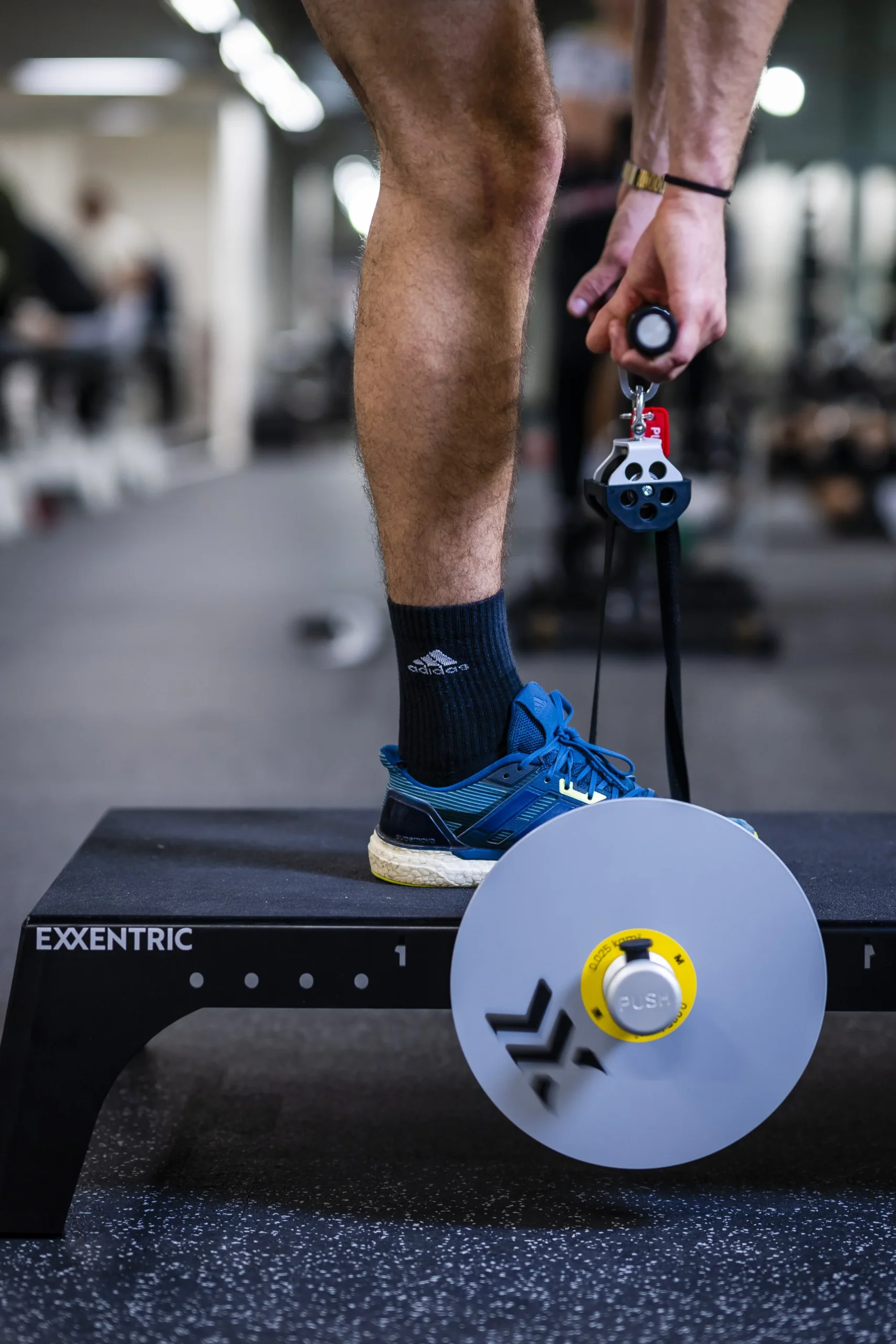
Each athlete completed three sessions with different flywheel inertia settings: 0.0281, 0.0711 and 0.1011 kg m². The calf-raise prescription was three sets of eight repetitions. Sessions were separated by at least 48 hours, and the athletes performed a repeated-jump assessment before and four minutes after the calf raises. The crossover design meant that the same men experienced the different conditions, rather than three unrelated groups being compared.
In a flywheel exercise you accelerate a rotating mass, then absorb its returning energy as the strap rewinds. This is different from selecting a fixed number of kilograms on a weight stack. Inertia describes the resistance to changes in rotational motion, and the force you experience depends partly on how aggressively you accelerate and decelerate the wheel. Two people using an identical disk can therefore have quite different training experiences.
That is particularly relevant at the ankle. A calf raise covers a fairly small distance, and it is tempting to turn the last portion of the movement into a bouncing contest. For strength work, aim to control the range you actually intend to train. For a power-oriented preparation exercise, the aim changes: you want purposeful acceleration without losing your position or turning the exercise into a maximal fatigue test.
The important thing about this study is its timescale. It asked whether a specific exercise could change a subsequent jumping test. It did not investigate a whole season of training, Achilles tendon adaptation or whether the athletes would run a faster race.
The middle inertia produced the clearest response
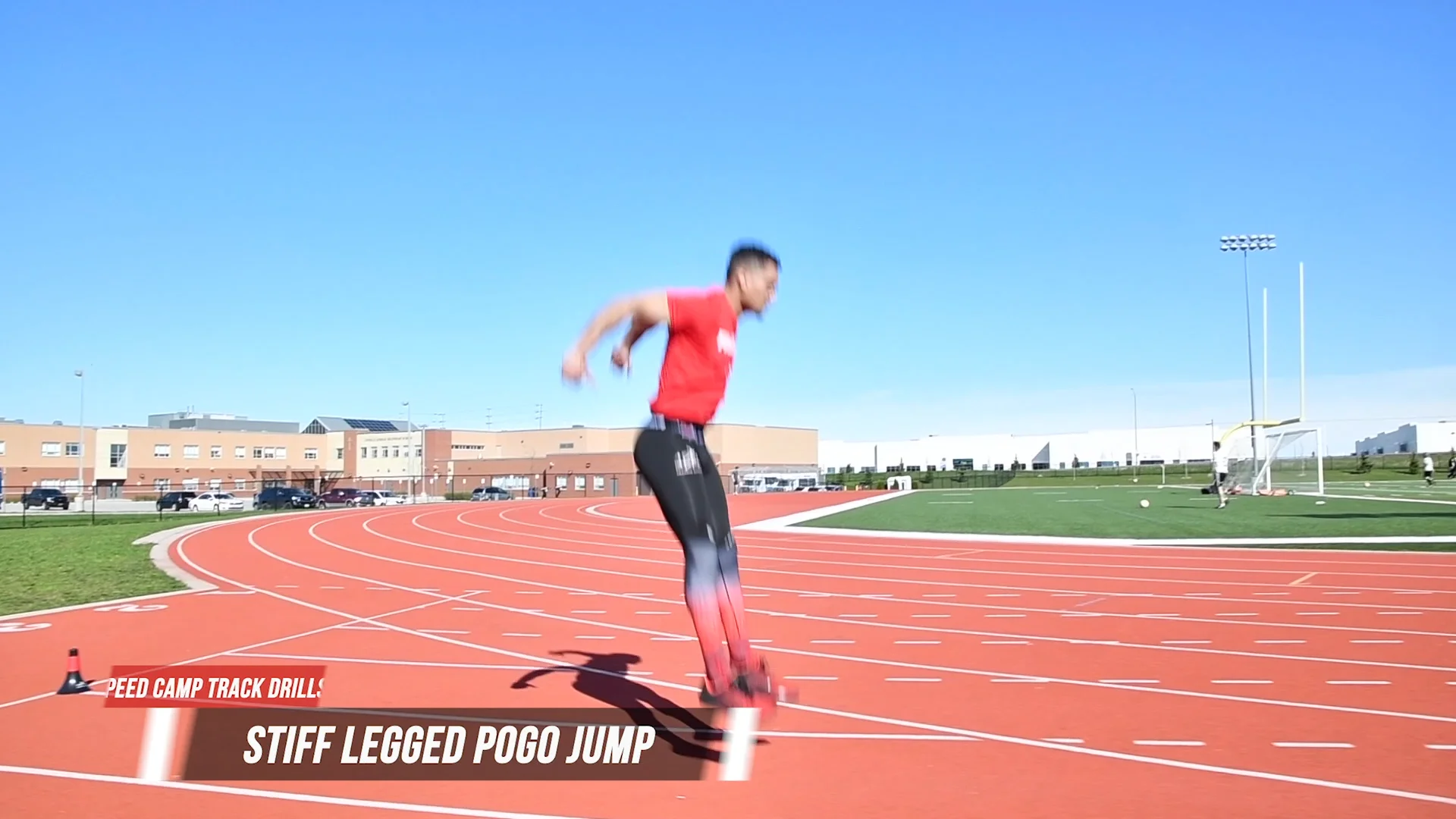
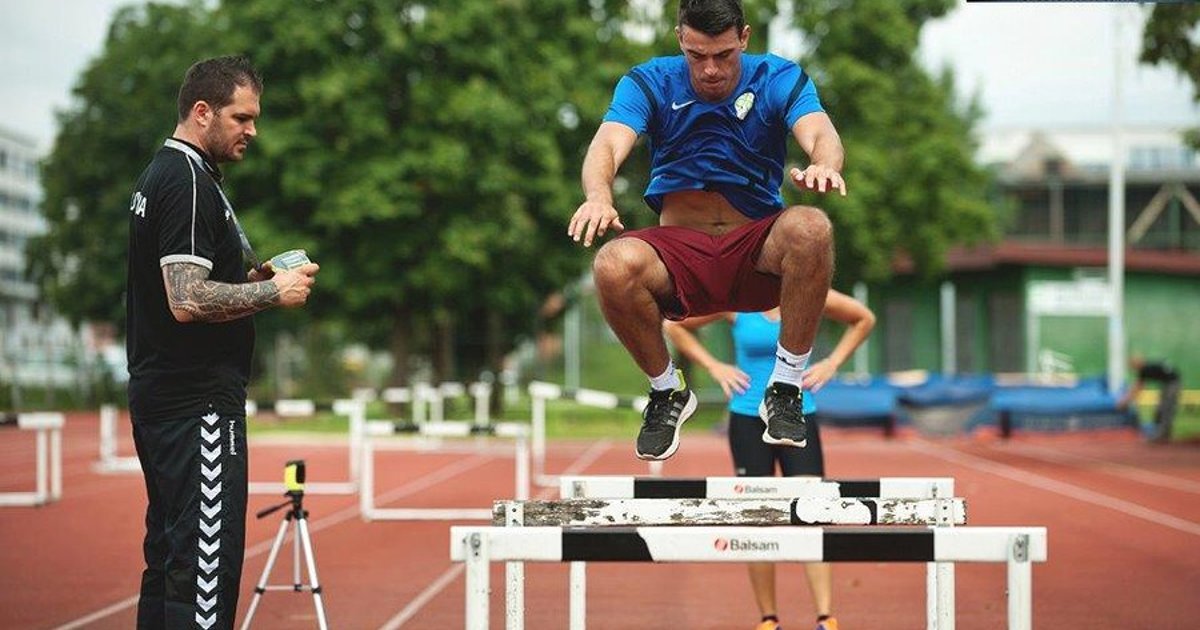
The moderate-inertia condition produced an interesting combination: average jump height rose from 36.08 to 37.63 cm, ground contact time fell from 170.04 to 159.65 milliseconds and the reactive strength index rose from 2.142 to 2.378. The lighter condition also showed improvements, while the highest inertia did not produce a statistically clear improvement in the same way.
Reactive strength is not simply the ability to jump high once. It describes how effectively you can produce another effort after touching down. A person could jump impressively but take a long time to reverse direction. Another might get off the floor quickly but barely leave it. A good repeated jump balances the two demands.
One way to understand the index is to divide jump height in metres by ground contact time in seconds. A 35 cm jump with a 180 ms contact gives approximately 1.94. If you maintain that height but reduce contact time to 160 ms, the value becomes approximately 2.19. That example illustrates the arithmetic, not a target that every athlete should chase. Different measurement systems and jump protocols can produce different scores.
For your own training, resist the urge to compare a slow countermovement jump with a fast rebound jump as though they were the same test. Pick a movement, choose a consistent landing surface and use the same measurement method. Even an ordinary phone video can reveal useful changes in landing rhythm, although it is not equivalent to a laboratory instrument.
Remember that the numbers above are group averages. A favorable mean response does not promise that every participant improved, and one excellent session is not proof that a particular exercise reliably makes you more explosive.
Why more resistance can mean less immediate explosiveness
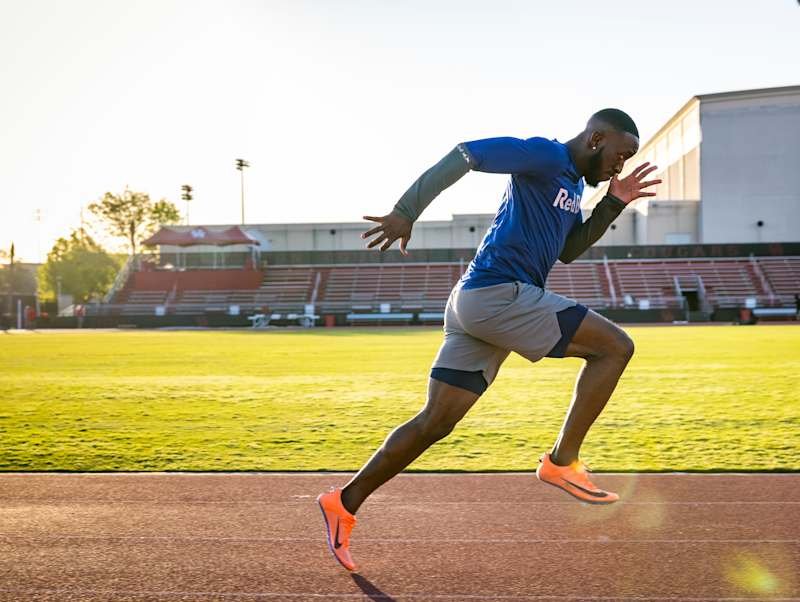
A preparation exercise can create two competing effects. It may temporarily improve the ability to produce force, but it may also leave the muscles tired. What matters to your next jump is the balance at the moment you perform it. The point at which that balance is favorable depends on the movement, the athlete and the amount of recovery.
Imagine two sessions before a sprint practice. In the first, you do a few purposeful calf raises and feel alert, warm and coordinated. In the second, you keep adding repetitions until the calves are burning and your feet are shaking. The second session might be a demanding calf workout, but it is unlikely to be the best preparation for high-quality sprinting immediately afterward.
Research on heavy squat preparation and subsequent jumps illustrates why timing is important: very short recovery intervals can be unfavorable, while several minutes of recovery can be more useful in some protocols. That does not establish a universally ideal waiting period. Nor does an improvement following calf raises establish that the same strategy improves acceleration, maximum sprint speed or sports performance.
The 2026 crossover experiment is especially interesting because the highest inertia was not the clear winner. The temptation with strength equipment is to equate the biggest available setting with the greatest benefit. That is reasonable only when the outcome you are trying to improve actually rewards that setting. A jump-preparation exercise should be judged by the jumps, not by how impressive the resistance looks.
There is also no reason to assume that flywheel resistance is inherently superior for building muscle. Broader comparisons of accentuated eccentric loading and conventional resistance work do not establish a consistent long-term advantage across strength, muscle size and jump performance. The device is a tool, not a shortcut past sensible programming.
Build your calves without confusing growth with jump readiness
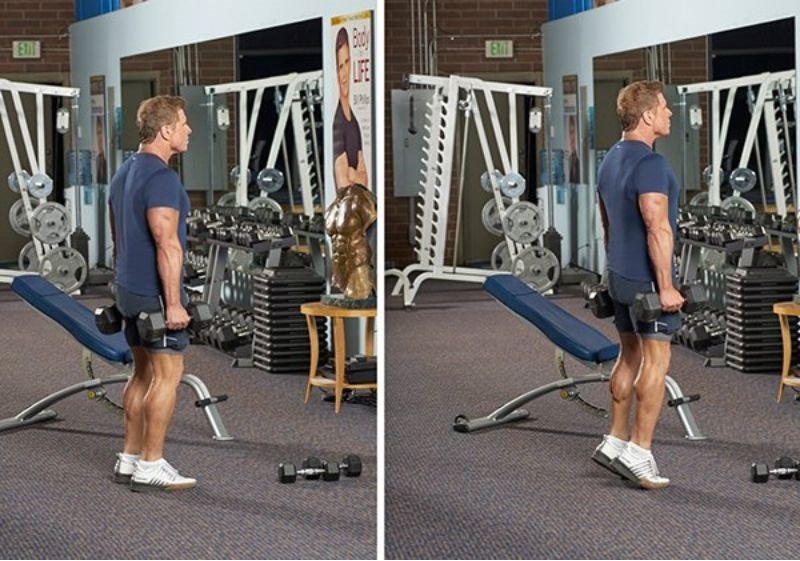
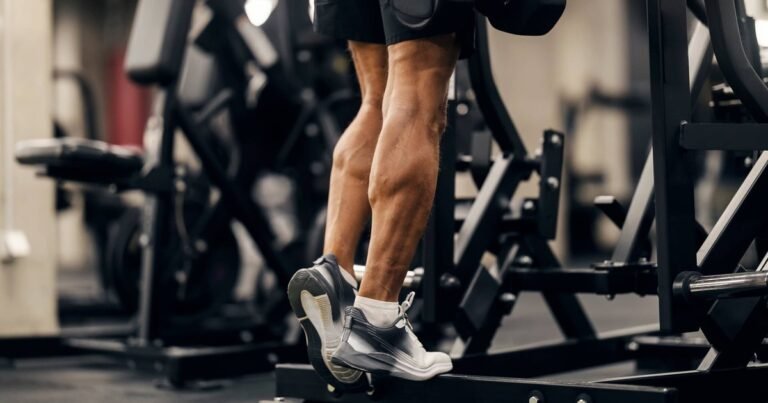
If calf development is your priority, treat it like any other muscle-building goal. Start with a repeatable exercise and choose loads you can progress without shortening the movement every time you add resistance. A stable standing calf raise with a dumbbell, a machine or an appropriate barbell setup can be enough. Supported single-leg raises let you work with relatively modest external loads and can reduce the amount of equipment needed.
A seated variation has a different knee position. In a 12-week comparison of standing and seated calf raises, standing training produced greater growth in the gastrocnemius, while the soleus response was more similar between conditions. That is a good reason to include straight-knee work if you want visible calf development, rather than assuming a bent-knee exercise automatically replaces it. It is not a reason to discard seated raises if they are comfortable or valuable in your program.
For an ordinary lifting week, you could use two calf sessions. On one day, do two or three sets of controlled standing raises after the main lower-body lifts. On another, use a supported or seated version, with enough rest to keep the repetitions consistent. Start conservatively, particularly if you have not been training your calves regularly. Increase load or repetitions when the same range of motion becomes easier.
If you also want to jump, place genuinely explosive work early in the session, while your landing and takeoff mechanics are still sharp. Low-volume rope skipping or low-amplitude rebounds can provide useful coordination practice for people who already tolerate impact, but they are not direct substitutes for the flywheel protocol. Sled work can train general lower-body conditioning; do not treat it as a proven way of reproducing this specific jump response.
Keep your muscle-building and jump-preparation objectives separate. A difficult calf workout is not a failed workout merely because you jump lower immediately afterward. And a preparation routine that improves a jump score does not necessarily provide enough stimulus to build bigger calves.

Equipment Worth Exploring
Explore equipment, accessories and gear from our carefully selected range.

Rubber Hex Dumbbells
Rubber-coated hex dumbbell pairs with a stable shape for home and commercial strength training.


Cast Iron Kettlebells
Textured cast-iron kettlebells for swings, squats, carries, and full-body training.


Pro Sled System
Heavy-duty push-pull training sled for loaded conditioning, speed, and strength work.
A four-week way to test the effect in your own training
Experienced lifters and athletes who already tolerate jumping can run a small training experiment without turning every session into a laboratory. If you have access to a flywheel machine and know how to use it safely, begin with familiar, conservative resistance. The study’s numerical inertia values are machine-specific reference points, not instructions to match a plate setting on unrelated equipment.
Week 1: Establish a baseline. On two separate days, use your normal warm-up, then record a small number of consistent jumps or rebounds. Keep the surface, footwear, technique and recovery interval constant. Do not add a new preparation exercise yet. This gives you some idea of normal day-to-day variation.
Week 2: Introduce a modest calf-raise preparation exercise on one day while keeping the other day similar to your baseline. Use repetitions that feel crisp, rather than working to failure. Recover for several minutes before repeating the jump assessment. If the jumps deteriorate or your calves feel unusually tired, record that too.
Week 3: Repeat the comparison. Change only one variable, such as the resistance or rest interval, if the previous week suggested a useful adjustment. Avoid simultaneously changing the exercise, the number of repetitions and the jump test. Otherwise, you will have little idea what caused the difference.
Week 4: Review the pattern rather than celebrating the single best score. If a short preparation reliably improves your test without disrupting the rest of training, it may be worth keeping. If the effect is inconsistent, your normal warm-up may be the better choice. Do not force a positive result simply because a study found one.
Keep the volume small and stop if you develop Achilles pain, unusual discomfort or deteriorating landing control. People returning from injury or unfamiliar with impact training should establish appropriate tolerance before experimenting with repeated jumps. If your real goal is a faster sprint, ultimately judge the program by sprint performance over time, not a jump index alone.
The practical conclusion is straightforward: the best resistance for a preparation exercise is not necessarily the heaviest resistance you can move. Choose the dose that leaves you better prepared for the task ahead, and save the exhausting work for sessions designed to build capacity.

Leg Day Shirts & Workout Gear
Leg-day gym shirts and workout gear for lifters who never skip squats, lunges and lower-body punishment.

Shirt Never Skip Leg Day NSLD Meme – Chicken Legs & T-Shirt
Show some leg-day attitude with a playful “Never Skip Leg Day NSLD Meme” tee.

My Leg Hurts Leg Day , Meme Lovers & Bros Casual T-Shirt
Bring “My Leg Hurts” humor to your next gym day.


Anti Leg Day Leg Day Club Meme Sweater T-Shirt
Show some gym-day personality with “Anti Leg Day Leg Day Club”.

Leg Day Is Calling You Squats & Deadlifts Meme Vest Tank Top
Your gym-day look, with a playful “Leg Day Is Calling You” twist.

Leg Day No Thanks Skip Leg Day Meme Decal Water Sticker
Give your everyday gear a playful “Leg Day No Thanks” twist.

Negative Leg Day Review 1 Star Not Recommended Tank Top
Train hard, laugh a little, and rep “Negative Leg Day Review”.

Legday Gains Squats & Deadlifts , Top & Bros T-Shirt
Bring “Legday Gains” humor to your next gym day.

Legendary Leg Day – Squat Meme Hooded Pullover Hoodie
Keep it laid-back with a little “Legendary Leg Day” attitude.

Everyday Is Leg Day Octopus Meme & Top T-Shirt
Show some leg-day attitude with a playful “Everyday Is Leg Day Funny Octopus” tee.