Advertising disclosure: This page includes affiliate product links that may earn us a commission, as well as products from our own store.
Dumbbell Romanian Deadlift: Find Your Hinge, Depth and Working Weight
A dumbbell Romanian deadlift is not a contest to reach the floor. The exercise starts upright, loads the hip hinge and reverses when you reach a position you can control. Your hamstrings and glutes help move the hips, while your trunk and grip help organize the load. The useful challenge is keeping those jobs consistent as the set gets harder.
Two lifters can finish at different heights without either needing to chase the other’s dumbbell position. Limb lengths, knee bend, equipment size and control all affect what the repetition looks like. Build a clear movement first, then use it to judge progress. This guide separates the hinge, the stopping point, grip limits and exercise choices before putting them into an adjustable training example.
1. Start with a hinge, not a moving squat
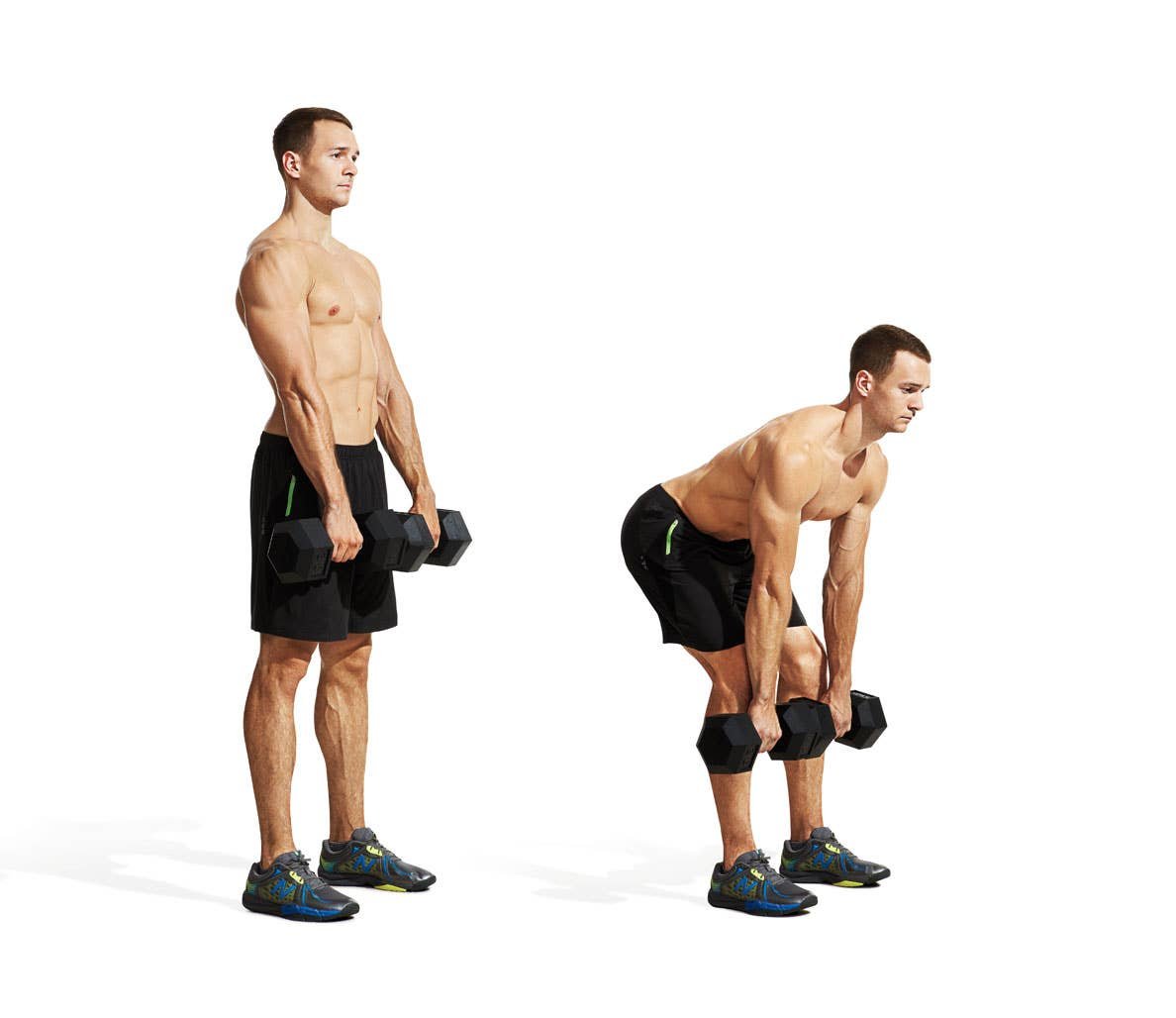
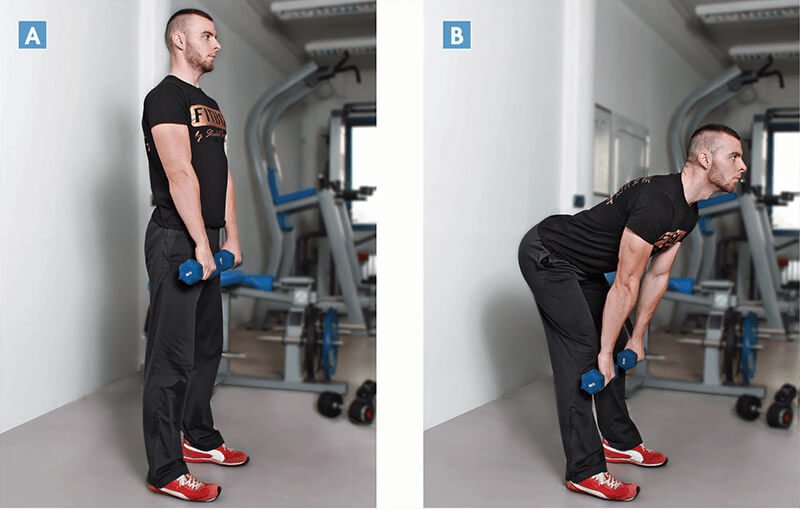
Stand with your feet roughly hip-width apart and a dumbbell in each hand. Use a position that gives the weights room to pass your legs. Keep a small bend in your knees rather than locking them straight. Before lowering, settle the weights, brace your trunk and establish balanced pressure through your feet.
Move your hips backward as your torso inclines forward. The knees can remain softly bent without continuing to travel into a deep squat. Think about sending the hips away from the dumbbells rather than dropping your chest toward the floor. Your arms hold the load; they do not need to row it upward or reach it deliberately forward.
Practice several unloaded repetitions before adding a light pair. You can stand a short distance in front of a wall and reach your hips toward it, without using the wall to catch a fall. If you mainly bend through the knees or curl your torso down, reduce the task and rehearse the movement slowly.
Choose dumbbells you can also pick up and put down deliberately. The first pickup and final return are separate from the repeated hinge; use a controlled setup that suits the available equipment and your ability. Fixed hex dumbbells, adjustable pairs and plate-loaded handles have different dimensions and loading systems. Check locks, compatible plates and the manufacturer’s limits before a working set.

Equipment Worth Exploring
Explore equipment, accessories and gear from our carefully selected range.


Rubber Hex Dumbbells
Rubber-coated hex dumbbell pairs with a stable shape for home and commercial strength training.


Cast Iron Kettlebells
Textured cast-iron kettlebells for swings, squats, carries, and full-body training.


2. Keep the load close as your hips travel back
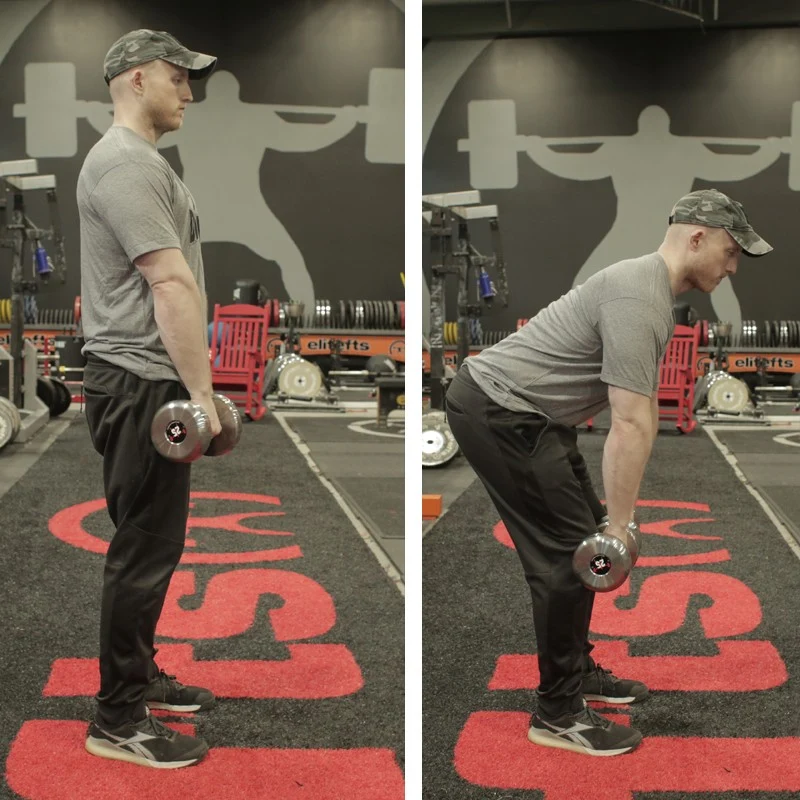
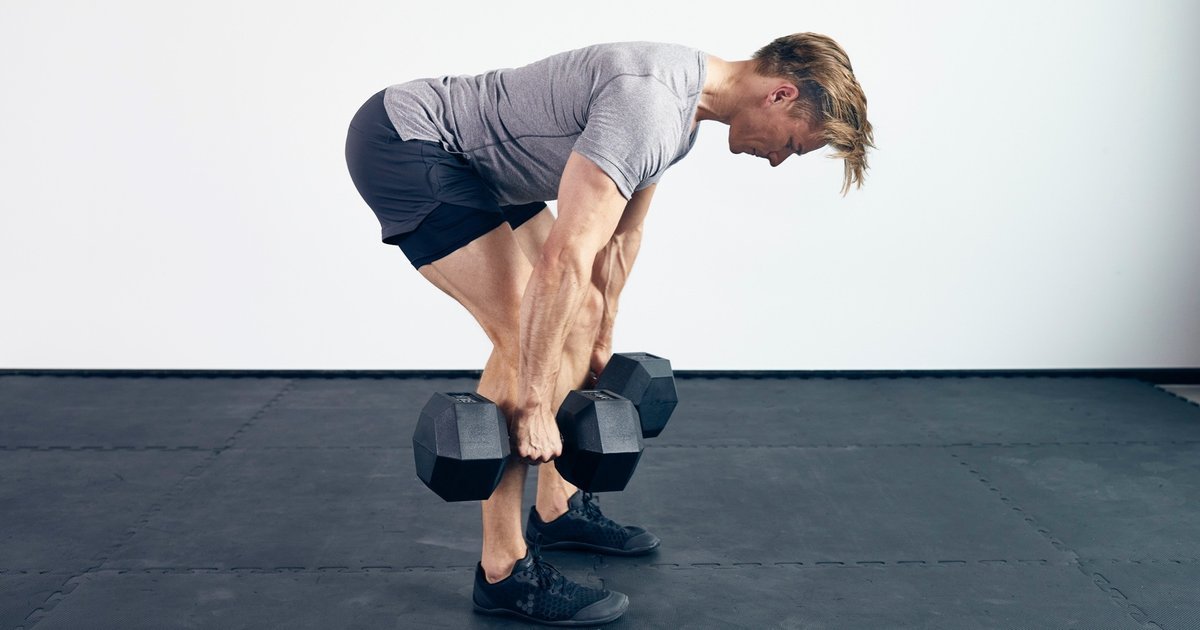
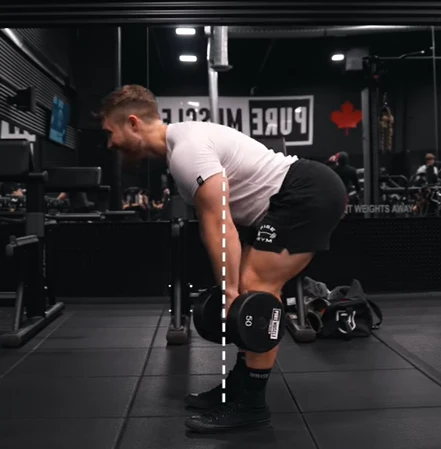
Let the dumbbells travel near your thighs and lower legs. They do not have to scrape your skin, but allowing them to swing far forward changes the demand on your back and balance. Start with an orientation that gives your knees clearance, then keep the hand position predictable through the repetition.
Maintain an organized torso while the hips move. A neutral spine is a practical position to control, not a demand to exaggerate an arch or freeze every part of your body. Avoid finishing each descent by abruptly rounding farther just to make the dumbbells lower. If the load pulls you out of position, reduce it or shorten the range.
Your head can follow the angle of your torso rather than staying tilted up at a mirror. A side-view recording is often more useful for reviewing the hinge afterward than trying to watch yourself while moving. Place the camera far enough away to include your feet, hips and shoulders, and compare early and late repetitions.
If your toes lift or your heels lose contact, revisit the stance and how far you send the hips backward. You should not need to fall toward either edge of the foot to create a bigger hinge. Slow the repetition and reduce the load until the weight stays balanced over a base you can control.
On the return, bring the hips forward as you stand. Finish tall without leaning backward to make the repetition look bigger. Keep the dumbbells stable beside or slightly in front of the thighs, take the next breath you need and reset. Rushing straight into another descent can hide a loss of balance that a brief organized transition would reveal.
3. Let controlled depth set the bottom position
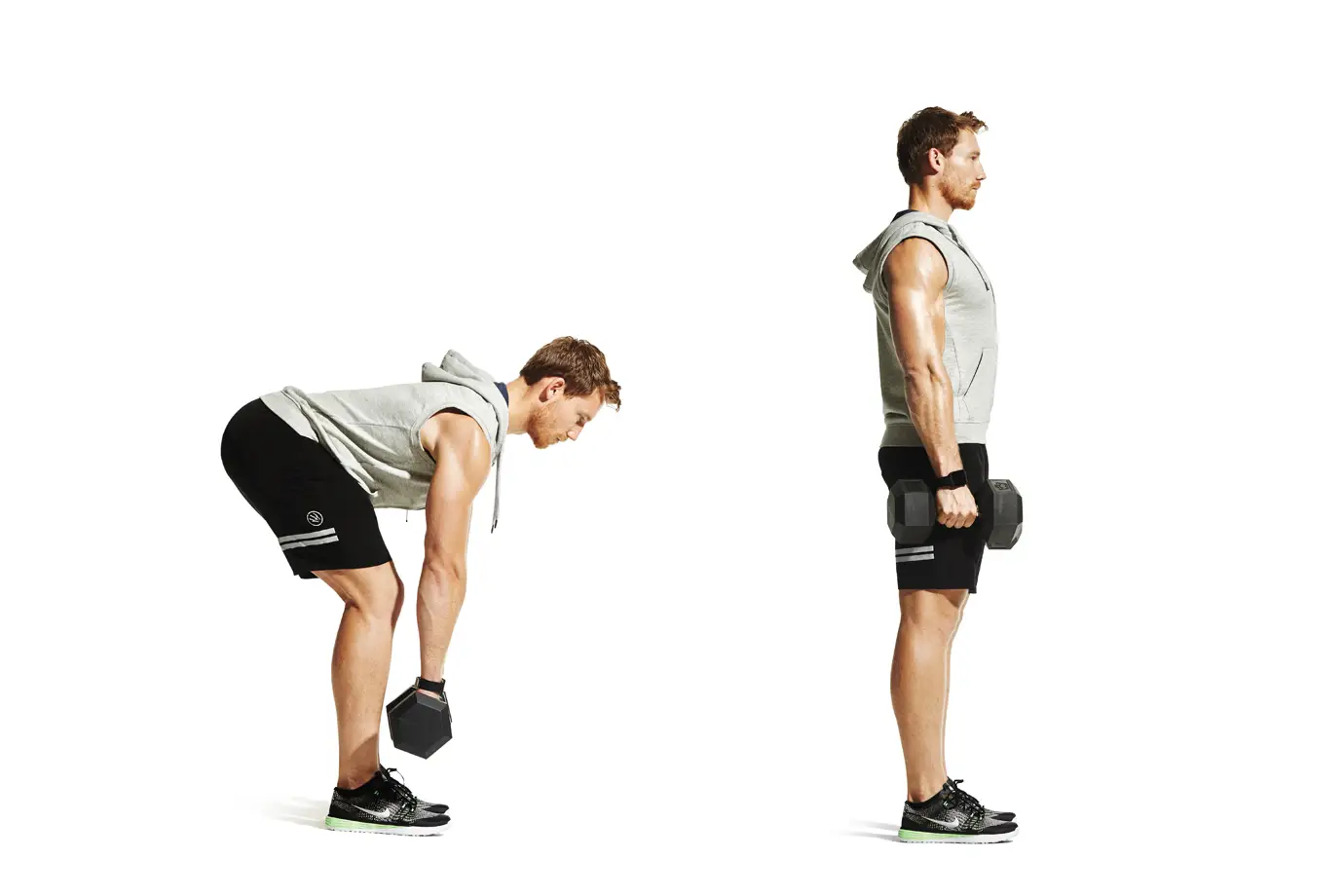
Lower until you reach the end of the hip motion you can manage while keeping the planned knee bend and trunk position. You may feel tension through the back of your thighs as the hips move back. That sensation helps guide the movement, but the strongest possible stretch is not a score you need to beat.
For some lifters, the dumbbells will stop below the knees; others may reach farther down the shins. Those are descriptions, not mandatory targets. Stop sooner if reaching farther requires a new movement through the lower back or a deeper knee bend. Pain is a reason to stop and reassess, not evidence that the exercise is working better.
Dumbbell size can interfere with comparisons. A large adjustable housing may touch the ground before a smaller fixed dumbbell at the same nominal weight. Touching down does not automatically make a better repetition. Choose a controllable range and note the implement rather than turning every set into a floor-reach challenge.
Keep your feet on a stable surface while learning. Standing on loose plates to gain extra depth introduces another variable before you know whether more range is useful. If you later change range deliberately, treat it as a new progression to establish with lighter loading, not as proof that last week’s heavier set was suddenly inadequate.

Bodybuilding Shirts & Workout Gear
Bodybuilding shirts, tanks and gym gear for lifters chasing muscle, size, symmetry and the pump.

I Love Deadlifts | Valentine's Workout Sweater With Hea T-Shirt
For laid-back days and deadlift humor: “I Love Deadlifts”.

I Look Better Bent Over Squats Deadlifts & Booty Hoodie
Keep it laid-back with a little “I Look Better Bent Over” attitude.

Shirt – Deadlift – Meme Gains & Bros T-Shirt
Heavy lifts, good laughs, and a little “Deadlift” energy.

Deadlift And Chill – & Top T-Shirt
Heavy lifts, good laughs, and a little “Deadlift and Chill” energy.

Deadlifts & Gains Meme – Essential T-Shirt
Heavy lifts, good laughs, and a little “Deadlifts & Gains” energy.

Leg Day Squats Deadlifts Decal Meme Vinyl Sticker
Give your everyday gear a playful “Leg Day” twist.


OnlyGains Only Gains Meme – Booty & Leg Day Squats, T-Shirt
Show some leg-day attitude with a playful “OnlyGains Only Gains” tee.

Deadlift Frozen Skull Muscle Shirt for Powerlifters, Ha Tank Top
Train hard, laugh a little, and rep “Deadlift”.

Meme Pink Dumbbells Top & Gymbros T-Shirt
Rep “Pink Dumbbells” humor in and out of the gym.
4. Separate grip limits from exercise alternatives
A set can end because your hands cannot hold the dumbbells even when the hinge still feels manageable. Notice whether the handles are rolling into your fingertips, one hand opens earlier or your shoulders start shifting to rescue the grip. End the set under control rather than letting a slipping dumbbell determine the finish.
Lifting straps are an optional tool when grip is limiting the intended posterior-chain work. Learn the wrap with light weights and keep release and setup manageable. Record when you use them so strapped and unstrapped sets are not silently mixed. If grip development matters too, train it deliberately elsewhere rather than assuming every heavier strapped hinge improves it equally.
A barbell RDL uses the same broad hip-hinge idea with a different implement. It can suit heavier loading, but bar clearance, plates, collars and the rack setup become part of the task. A trap-bar deadlift is another variation with different geometry and often more knee involvement; do not compare its load directly with your dumbbell RDL.
Hamstring curls, Nordic variations and back-extension equipment also provide different training tasks. Knee-flexion work can complement a hinge rather than replace it repetition for repetition. Cable hinges change the direction of resistance again. Choose alternatives for a reason, keep their records separate and check equipment compatibility instead of expecting one accessory to solve every training limit.
Equipment Worth Exploring
Explore equipment, accessories and gear from our carefully selected range.


Competition Plates
Competition-style bumper plates for Olympic lifts and loaded strength training.

Grip Plates
Rubber-coated weight plates with handholds for loading barbells and machines.

Speed Collar
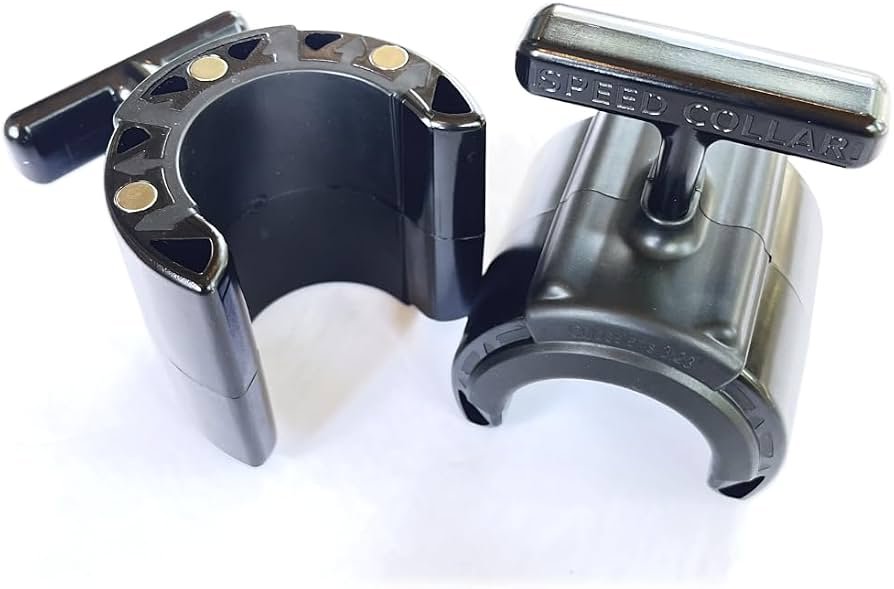
Quick-release collars designed to secure weight plates on standard two-inch Olympic bars.
Keppi Open Collars
C-shaped magnetic Olympic barbell collars with a quick-lock mechanism and grippy lining.


5. Add work while keeping the hinge recognizable
As an adjustable example, begin with two or three working sets of eight to twelve repetitions after lighter preparation. Choose a pair that leaves a few controlled repetitions available and allows the same stopping point across the set. These numbers are a starting example, not a universal prescription or a promise of a particular growth result.
Use enough rest to begin the next set with similar balance and grip control. Record weight per hand, repetitions, sets, straps, range and where the exercise sits in the session. A hinge after heavy squats may feel different from one performed first. The order is useful context when a familiar pair suddenly seems much harder.
During preparation, compare the path of both dumbbells. If one moves farther forward, first check that you are holding the handles similarly and standing evenly. Do not use a heavier working set as the diagnostic test. A lighter rehearsal lets you see whether the difference persists without the same fatigue or urgency.
A simple progression is to build repetitions within your chosen range, then make a small sensible increase in load. With a new pair, accept fewer repetitions while retaining the same hinge. Avoid adding weight and extra depth simultaneously if your goal is to identify what improved; changing both makes the log harder to interpret.
For instance, three sets of ten with consistent knee bend tell a different story from ten repetitions that become progressively deeper squats. If grip fails at seven on the last set, record seven rather than chasing ten with a changed movement. The log should describe the session you completed, including its limit, rather than the session you hoped to perform.
Review soreness alongside performance and the rest of the week’s leg training. More soreness does not prove a better stimulus, and a difficult session does not require adding more work immediately. Keep a manageable starting dose, observe recovery and adjust one variable at a time. Progress should leave the setup, hinge and final return as recognizable as the first repetition.