Why the sled belongs in a strength athlete’s conditioning plan
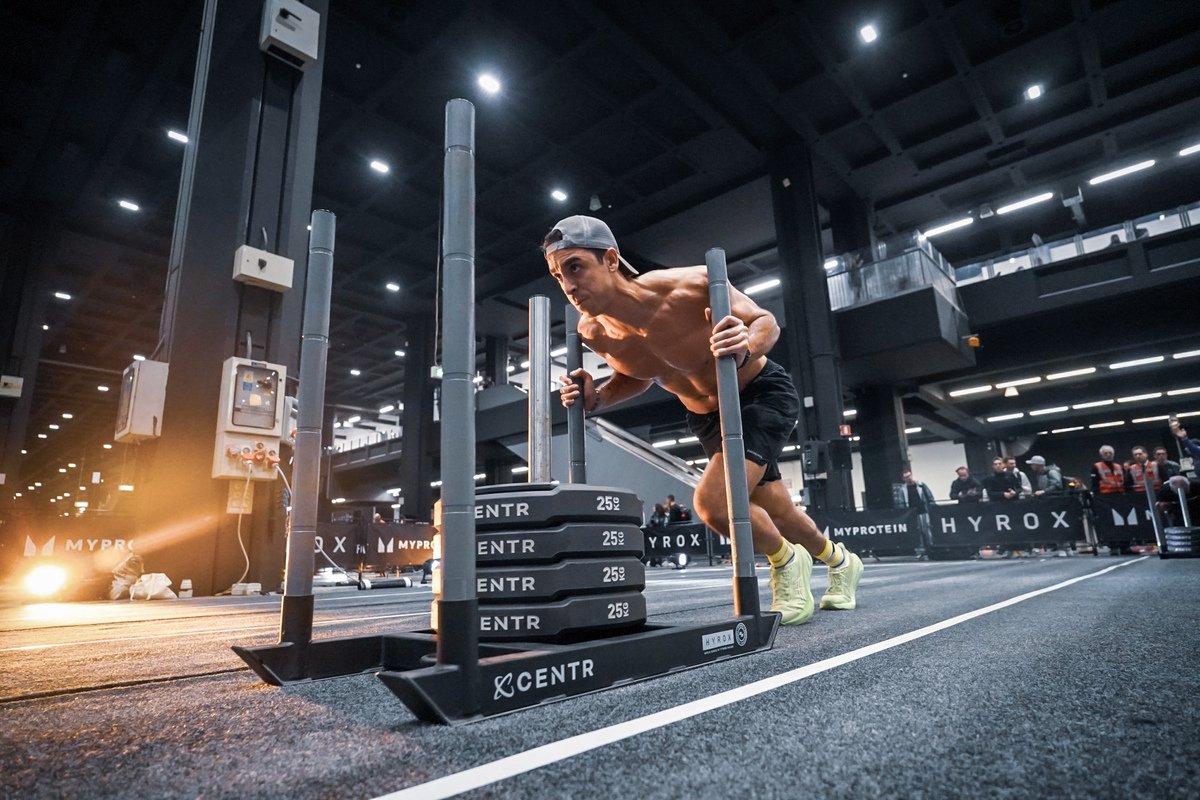
A loaded sled looks simple: put weight on it and move it. In practice, it can be one of the most demanding tools in a hybrid athlete’s training week. The legs have to create horizontal force, the trunk must stay rigid, and the lungs have to keep up. Unlike a conventional squat or deadlift, the effort is mostly concentric: every step is another drive against resistance rather than a controlled lowering phase followed by a lift.
That makes the sled useful for several different goals, but those goals should not be confused. A very heavy push over ten meters is a force-focused effort. A lighter, faster push can train acceleration mechanics. Repeated moderate pushes with short rest periods become conditioning. A race-weight push after running is a different test again, because breathing, pacing, grip and the friction of the track all affect the result.
For a lifter who wants better conditioning without turning every workout into a long run, the sled is a practical addition. It can also complement a HYROX build, where pushing and pulling appear early in the race after the legs have already covered several kilometers. The trick is to choose the load and distance for the adaptation you actually want, not simply chase the largest stack of plates.
Sled push versus sled pull: the mechanics are not interchangeable
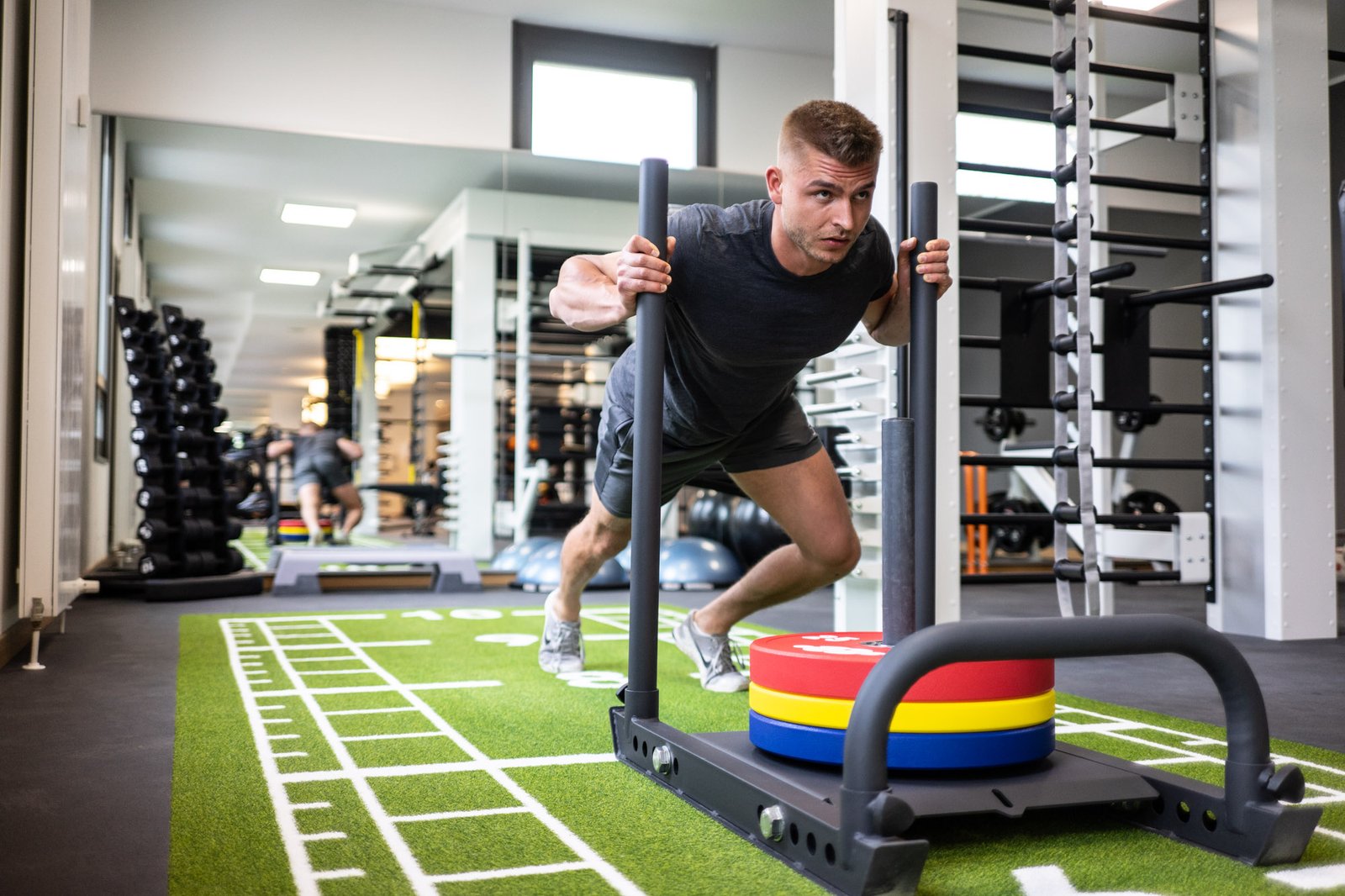
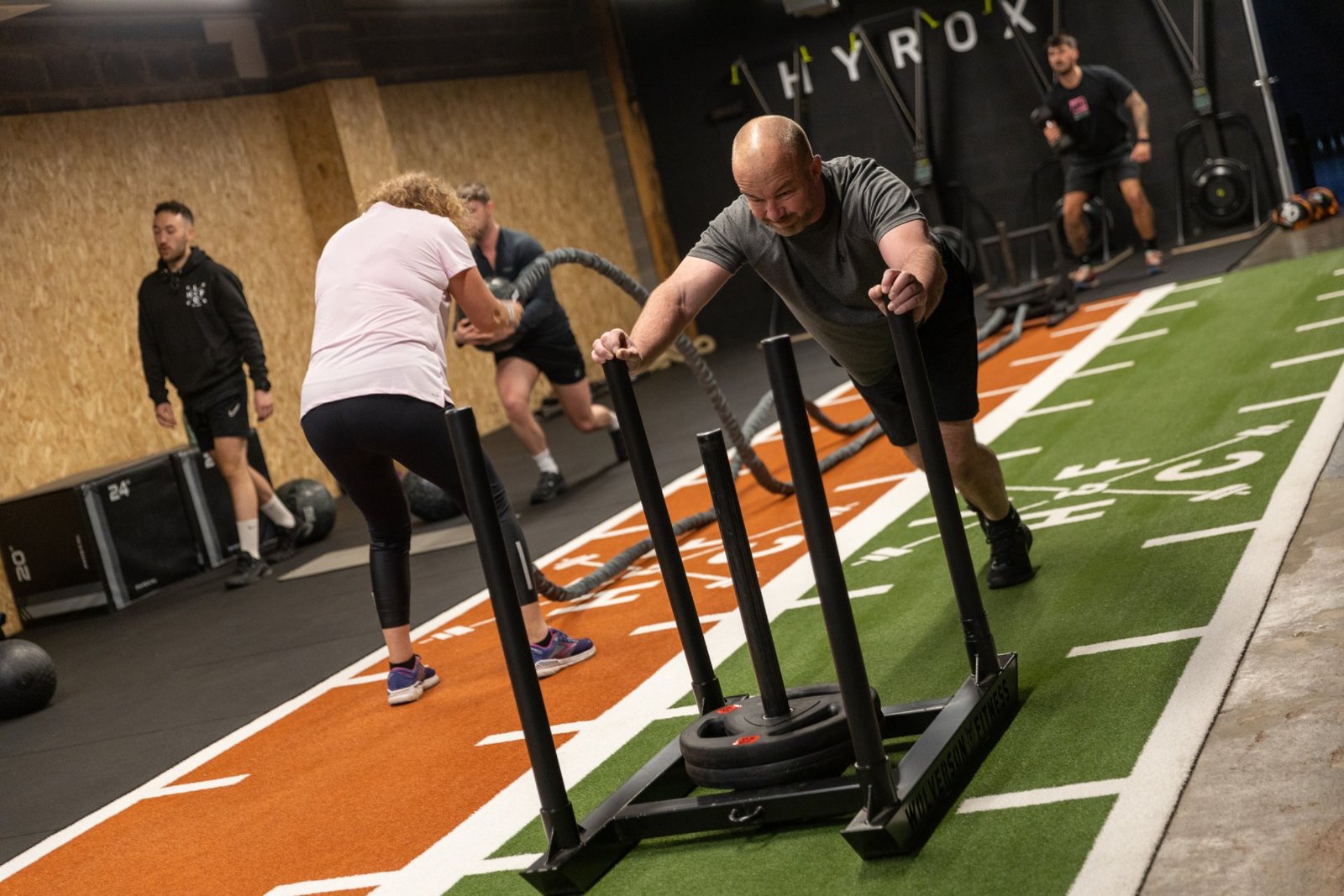
In a sled push, the athlete braces against vertical handles and drives through the floor while the arms transfer force into the implement. A forward lean is normal, but folding at the waist until the lower back rounds is not a shortcut. Keep the torso firm, drive the knee forward, and use short, powerful steps when the load is heavy. The feet should continue moving rather than pausing between each shove.
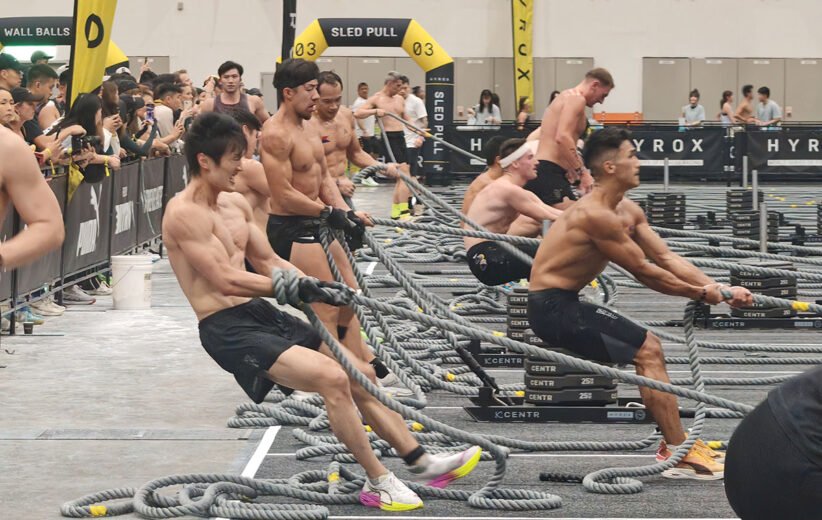
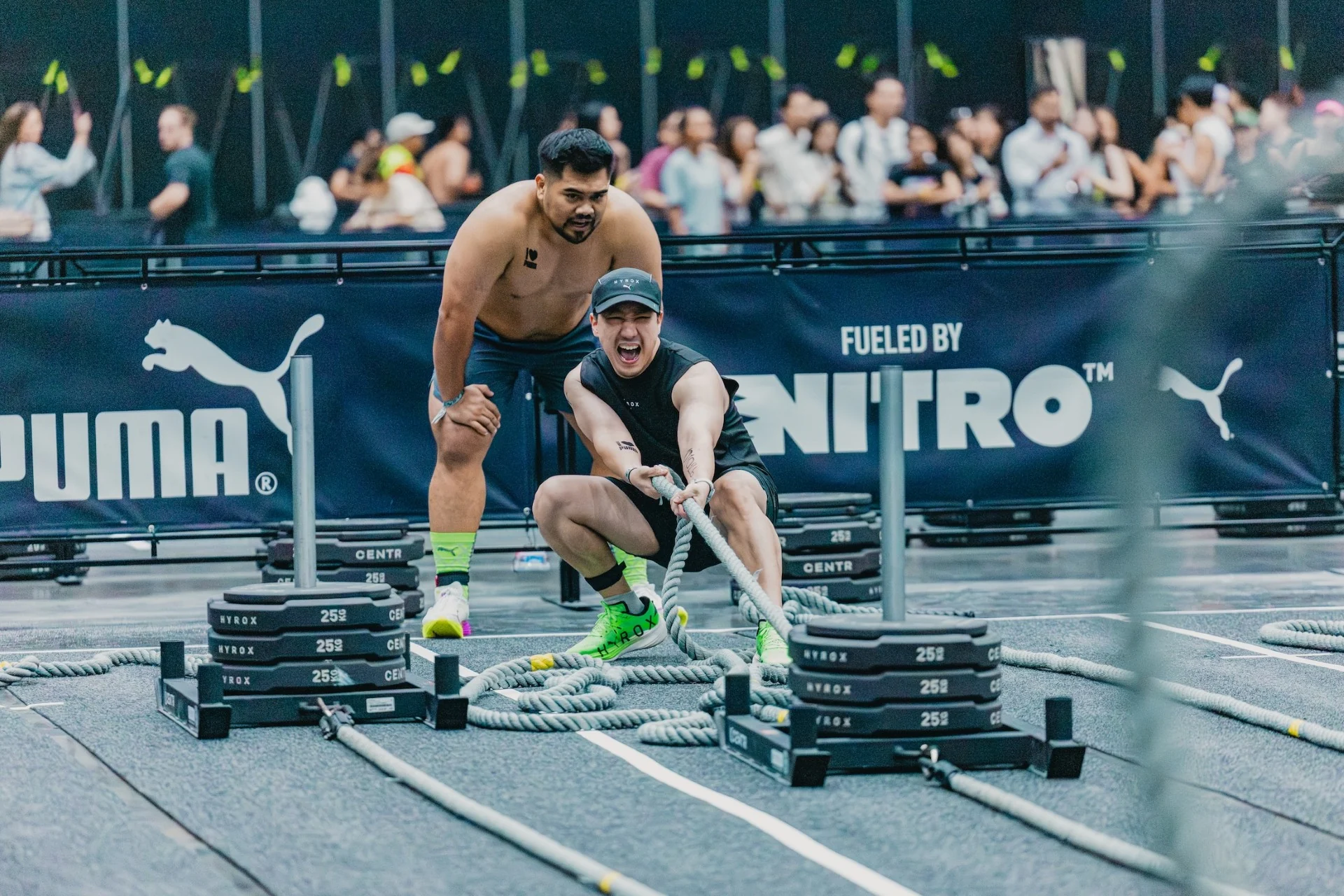
The HYROX-style sled pull uses a long rope. The athlete remains in the working box and pulls the sled toward them, often using a staggered stance and a coordinated hand-over-hand rhythm. A pull that starts with the arms alone wastes the stronger contribution of the legs and hips. Set the feet, shift body weight backward under control, pull the rope to the hip area, then recover the hands without losing rope tension.
The two exercises overlap in their demand for whole-body tension, but their limiting factors differ. Pushing often exposes poor leg drive or unsuitable footwear. Pulling can expose grip endurance, rope management, inefficient footwork and an inability to brace while repeatedly changing hand position. A strong squat does not automatically produce a fast pull, and a fast pull does not prove superior sprint acceleration.
Train both if your goal is a complete hybrid race. If you only have room for one home-gym variation, a push sled or wheelbarrow-style sled is still useful, while cable or rope resistance can help rehearse the pull pattern without pretending to reproduce the exact competition friction.

Equipment Worth Exploring
Explore equipment, accessories and gear from our carefully selected range.

GymPin Starting Blocks
Portable high-density foam blocks for adjusting machine starting positions and range of motion.



Squat Harness
Wearable harness for hands-free cable squats, sled work, and lower-body training.


What resisted-sled research really tells us about speed
The best evidence for sled training comes largely from sprint and field-sport settings rather than from recreational bodybuilding. In one eight-week comparison involving 50 high-school athletes, groups training with resisted sled pushes improved short sprint splits, while the unresisted group did not show the same significant improvement. Heavy resistance produced particularly promising results in the earliest acceleration phase. That is interesting, but it is not proof that every adult lifter should load a sled as heavily as possible.
Another six-week experiment in sprinters compared a more demanding velocity-based sled load, a lighter load based on body mass, and ordinary sprinting. The heavier velocity-based approach improved acceleration across measured intervals. The training still involved repeated short sprints, not slow grinding pushes to exhaustion. Those are different stimuli, and transferring findings from competitive sprinters to HYROX race pacing requires judgment.
The useful lesson is that the weight on the sled is only part of the prescription. How much the sled slows you down, how far you travel, the rest interval and your technique all matter. A push that turns a quick drive into a crawl may build tolerance for heavy horizontal force, but it is not automatically the best speed workout.
For most gym athletes, a sensible combination is one lower-volume strength-oriented session and one faster or race-specific session per week. Record your distance and time so you can distinguish genuine improvement from simply using a lighter sled or a more forgiving floor.

Functional Fitness Shirts & Workout Gear
Functional-fitness shirts, tanks and workout gear for athletes who train strength, conditioning and everything in between.


Hybrid Athlete Strength Tee
Show some lifting attitude with a playful “Hybrid Athlete” tee.

Hybrid Athlete – Built Different Gym Pullover for HYROX Hoodie
Show off your lifting humor in a laid-back “Hybrid Athlete” hoodie.


Anti HYROX HYROX Club Meme Shirt Gymbro T-Shirt
Make gym days more fun with “Anti HYROX HYROX Club” style.


Burpees Bad Breaking Bad Shirt – Meme & Cardio Haters T-Shirt
Show some cardio attitude with a playful “Burpees Bad Breaking Bad” tee.

Battle Ropes Wonder Woman Sticker
Put “Wonder Woman Battle Ropes” gym humor on your laptop, bottle, or gym gear.

HYROX 2026/27 sled loads, distances and the friction trap
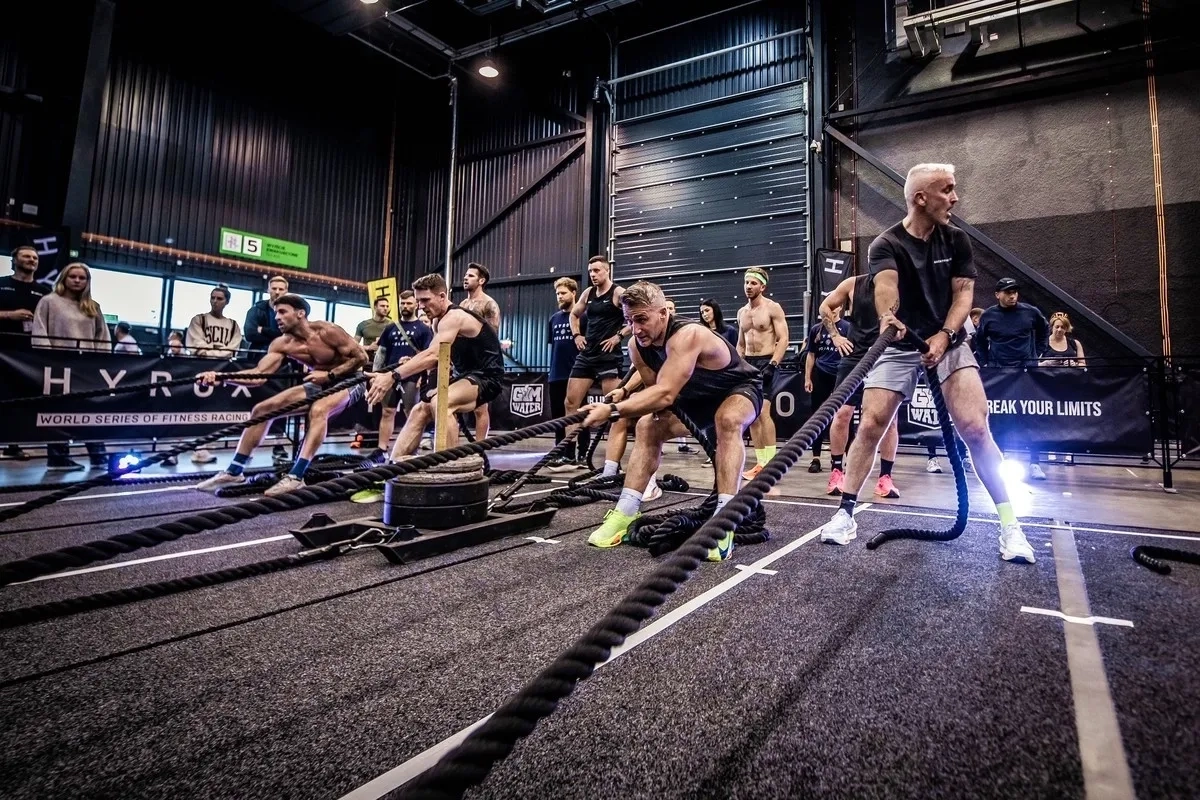
For the 2026/27 HYROX singles format, both the sled push and sled pull cover 50 meters, divided into four 12.5-meter lengths. In Men’s Open, the prescribed push is 152 kg including the sled, while the pull is 103 kg including the sled. In Men’s Pro, those figures rise to 202 kg and 153 kg respectively. These are total equipment masses, not instructions to add that much weight in plates on top of an empty sled.
Push and pull stations come after the second and third one-kilometer runs respectively. That placement matters: the athlete has already started accumulating running fatigue, yet still has five more runs and several stations to complete. An all-out sled effort that leaves you unable to settle back into running can be more expensive than a slightly slower, steadier station.
There is a major catch when replicating those loads at home. A sled that weighs 152 kg on smooth turf can feel dramatically different from one at the same mass on carpet, rubber, concrete or another turf. Friction depends on the sled base, surface and speed, so nominal kilograms alone cannot standardize the resistance. Do not assume your training sled matches race difficulty just because the plates add up.
Practice completing the entire sled past the lane marker before changing direction, and practice rope management without wandering out of the designated area. For race preparation, read the current event-specific instructions rather than rely on an old social-media chart. Use the published load as a starting reference and your actual split times as the performance measure.
Better technique: faster feet, stronger brace and smarter grip
Start every push by checking the lane. Wear shoes that grip the surface, place the hands comfortably on the uprights, brace the abdomen, and establish forward pressure before accelerating. The first steps are often the hardest. Once the sled moves, keep the rhythm rather than trying to take enormous strides. Shorter, continuous steps generally make it easier to maintain pressure against a heavy sled.
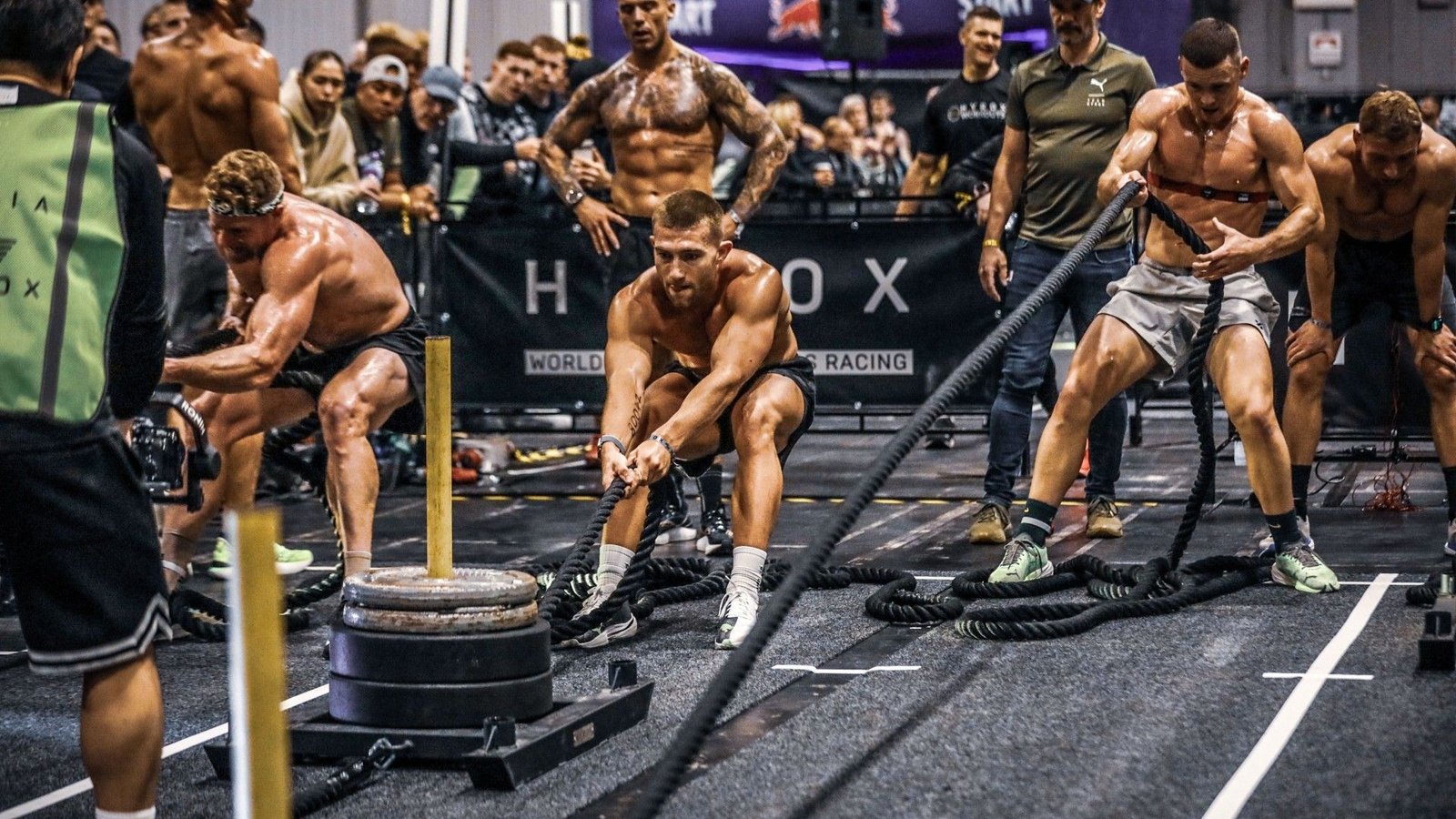
On a pull, arrange the rope so it does not tangle under your shoes. Use a stable staggered or square stance depending on the working space, keep the torso engaged, and draw the rope back with coordinated leg and arm action. Pull smoothly enough that the sled keeps moving. If you must reset your grip, make that reset deliberate instead of letting a loop of rope slip through your hands.
Technique should be judged by repeatability. If the first lane is clean but the third becomes a sequence of uncontrolled yanks and awkward foot placements, reduce the load or increase rest during practice. An efficient athlete can keep the same basic movement pattern while breathing hard. That skill is more valuable than one impressive maximal push filmed with fresh legs.
For a compact home gym, pair the sled work with simple assistance: loaded carries for trunk and grip, split squats for unilateral leg strength, calf work for ankle stiffness, and a row or cable pull for upper-back endurance. These exercises support the movement but do not replace actual practice with the sled or rope when a race is the goal.
Equipment Worth Exploring
Explore equipment, accessories and gear from our carefully selected range.


Leather Lifting Straps
Padded leather straps support grip during heavy rows, deadlifts and pulling exercises.


A six-week sled plan for lifters and HYROX beginners
Use two sled sessions per week, separated by at least 48 hours when possible. Keep your normal lifting schedule, but avoid stacking the heaviest sled session directly after a maximal squat or deadlift day. Warm up with five minutes of easy movement, two progressively harder practice lengths, and several controlled accelerations before the work sets.
Weeks 1-2: establish control. Session A is six 10-meter pushes at a moderately heavy load, resting 90-150 seconds between efforts. Session B is four 12.5-meter pushes plus four rope pulls at a load that allows smooth, uninterrupted movement. Rest until breathing is under control. Record every split and whether the final repetition looks like the first.
Weeks 3-4: build capacity. In Session A, progress to eight 10-meter pushes or make a small load increase if all six original efforts were consistent. In Session B, perform two 25-meter push segments and two 25-meter pull segments, keeping the rope organized. Add a short, easy run before one of the segments if your goal is HYROX, but avoid turning every repetition into a maximal race simulation.
Week 5: rehearse the demand. Complete a controlled 50-meter push and 50-meter pull on separate efforts, with enough rest to preserve technique. For race-specific work, place a one-kilometer run before each station simulation and observe how much your splits change. If your training surface is unlike competition flooring, prioritize consistency and pacing rather than matching the official plate load exactly.
Week 6: consolidate. Reduce total sled volume by roughly one-third to one-half. Keep a few brisk, clean lengths to maintain confidence, then assess a repeatable benchmark on the same surface. If racing soon, arrive with fresh legs rather than trying to set a gym personal record in the final days. A beginner can scale every distance and load down while preserving this structure.
Cardio Shirts & Workout Gear
Cardio and conditioning gym gear for runners, endurance athletes and anyone who earns the sweat.

Jump Rope Cardio Tee
Rep “Jump Rope Cardio Van Halen Rock Music” humor in and out of the gym.


Dost Thou Even Pedal Tee
Make gym days more fun with “Dost Thou Even Pedal Medieval Air Bike” style.

Shirt – Don'T Quit Do It – Meme & Gains T-Shirt
Show some lifting attitude with a playful “Don't Quit Do It” tee.

Everything Hurts And I'M Tired Motivation Jumper T-Shirt
Add a playful “Everything Hurts And I'm Tired” touch to your casual rotation.

Cardio Is Calling You , Meme Top Answer Or Decline? T-Shirt
Make gym days more fun with “Cardio Is Calling You” style.

Shirt – Cardio Is Hardio – & Gymbros T-Shirt
Show some cardio attitude with a playful “Cardio is Hardio” tee.

Anti Running Club Tee
Heavy lifts, good laughs, and a little “Anti Running Running Club” energy.

Cardio Sucks Shirt Meme & Gymbros Top T-Shirt
Make gym days more fun with “Cardio Sucks” style.

Negative Cardio Review Cardio Sucks Running , Meme T-Shirt
Heavy lifts, good laughs, and a little “Negative Cardio Review” energy.
Track the right numbers and avoid the usual sled mistakes
For each session, log the sled’s total mass, the surface, the distance, the number of lengths, rest time and individual split times. If you switch facilities, treat the new surface as a new benchmark. A faster 12.5-meter push at the same load and on the same turf is meaningful. A faster push on a different floor may simply reflect less friction.
Watch for three common errors. First, adding plates while movement quality deteriorates can make a workout look more impressive without improving race performance. Second, treating every session as a conditioning test leaves little room to develop force and technique. Third, neglecting the run-to-station transition means you may be strong on the sled yet unable to regain your running rhythm afterward.
A useful checkpoint is to compare your first and last length. If the last is dramatically slower, decide whether the session was meant to develop sustained race pacing or maximal force. For pacing, reduce the load or add recovery until the split drop is manageable. For strength, keep efforts short and allow more rest. Grip fatigue on the pull can be trained separately, but it should not become an excuse to abandon efficient footwork.
The bottom line: the sled is not magic, and heavier is not always better. Push for horizontal leg drive, pull for coordinated rope and whole-body work, and progress each with the same care you give your main lifts. That combination makes a more capable hybrid athlete without sacrificing the strength work that brought you into the gym.