Advertising disclosure: This page includes affiliate links that may earn us a commission at no additional cost to you.
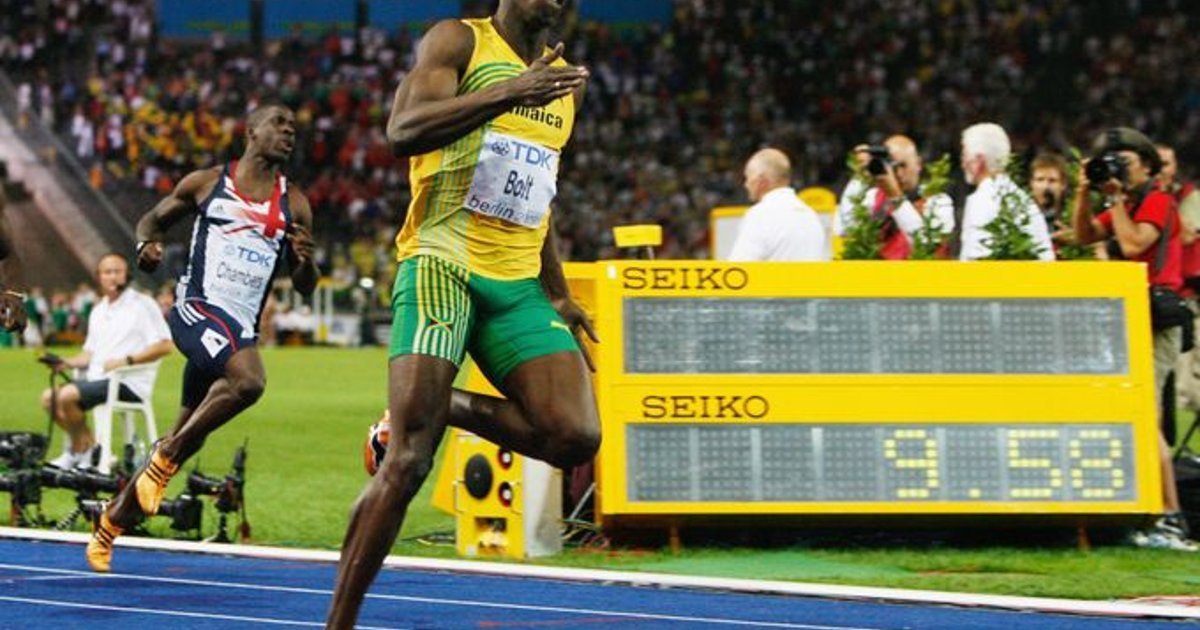
Usain Bolt’s Berlin performances are easy to remember: 9.58 seconds for 100 metres and 19.19 for 200. Understanding what those times measure is more useful than turning either into a headline about how fast a human can move. A race result, an average speed and a peak speed describe different things.
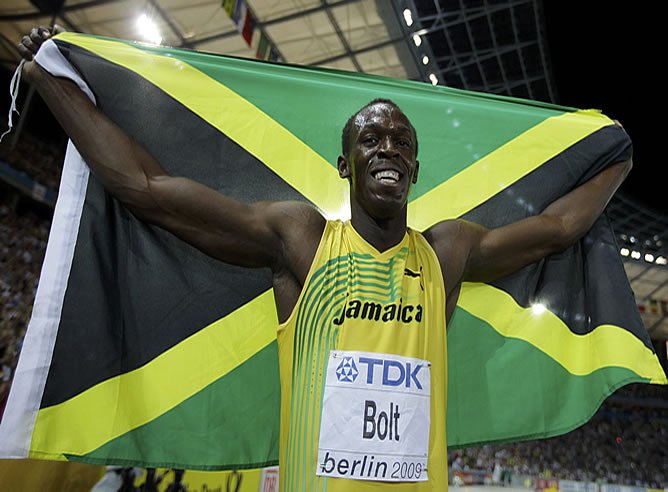
The two performances also happened in separate races, four days apart. Bolt won the 100-metre final on 16 August 2009 and the 200-metre final on 20 August, both at Berlin’s Olympiastadion. This is a look back at those results and the arithmetic behind them, rather than a claim about a new record or a reconstruction of his training programme.
Two finals, two distances and more than one number
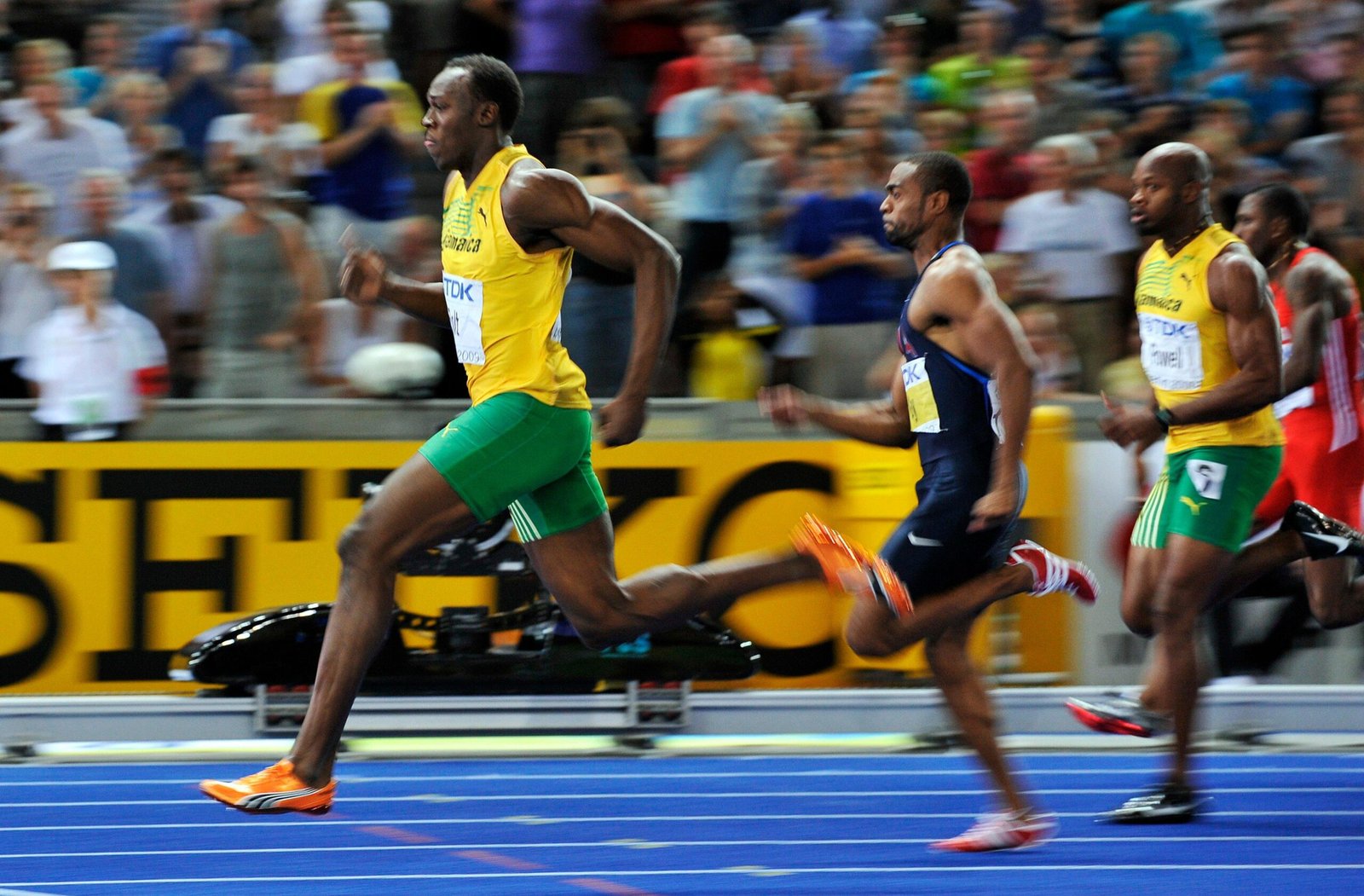
The 100-metre final ended with Bolt first in 9.58 seconds, Tyson Gay second in 9.71 and Asafa Powell third in 9.84. The recorded wind was +0.9 metres per second. Four days later, Bolt won the 200 in 19.19, ahead of Alonso Edward’s 19.81 and Wallace Spearmon’s 19.85, with a recorded wind of −0.3 metres per second.
Those details give the performances a setting. They were championship finals against other athletes, with recorded conditions and official results. Bolt’s winning margin was 0.13 seconds in the shorter race and 0.62 in the longer one. The subtraction is straightforward; deciding what a margin says about the whole race requires more information.
For example, a finishing margin does not tell you when a lead opened or identify the fastest part of the winner’s run. It is possible to know the final result precisely while still needing separate evidence for a claim about acceleration or maximum velocity. A familiar video clip should not make those distinctions disappear.
Keeping the conditions alongside the number matters beyond sprinting. MMP’s account of Kipchoge’s Vienna run and its record distinction examines another famous performance where understanding the setup makes the result more specific. Different events demand different comparisons, even when both produce a memorable stopwatch number.
Why 37.58 kilometres per hour is an average
Divide 100 metres by 9.58 seconds and the result is approximately 10.44 metres per second. Multiply by 3.6 to convert that value into kilometres per hour: about 37.58 km/h. This is the average speed calculated from the full race distance and official time.
It is not a measurement of Bolt’s fastest instant. The calculation combines the beginning of the race with everything that follows. It does not show a separate speed for leaving the blocks, accelerating, reaching maximum velocity or approaching the finish. One average can describe the outcome without describing that changing speed profile.
A simple hypothetical example makes the distinction clearer. An athlete covering a short middle segment of a run may be moving faster than their average across the full distance. Measuring that segment asks a different question from timing the entire run from its start. The segment result cannot simply be substituted for the race result.
This is also why a photograph of a sprinter in full stride cannot establish peak speed. It shows a position at one moment, not distance travelled over a measured interval. To assess a peak-speed claim, ask how it was measured and over what interval. A precise-looking decimal is only useful when the quantity and measurement method are clear.
The 200-metre result is not two copied 100-metre runs
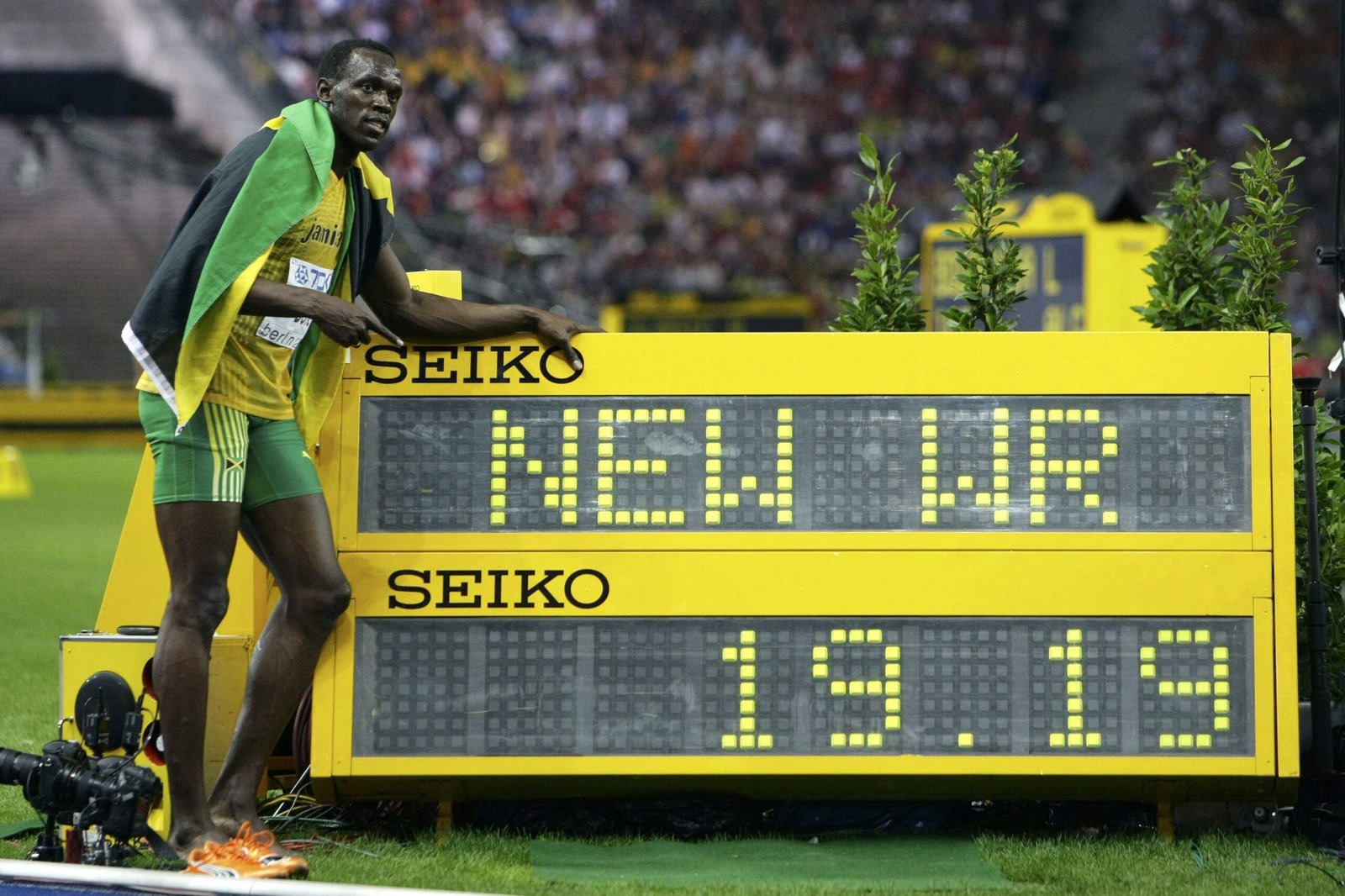
Doubling 9.58 gives 19.16 seconds. Bolt’s Berlin 200-metre time was 19.19, only 0.03 seconds longer than that arithmetic total. It is an interesting comparison, but it does not mean that he ran two consecutive 9.58-second halves.
The 200 is one continuous race, with one start and a bend as well as a straight. Two separate 100-metre races would each include their own start. Simply doubling a finishing time cannot reproduce the demands of the longer event, or reveal how the athlete distributed speed within it.
The full-distance average for 200 metres in 19.19 seconds is approximately 10.42 metres per second, or 37.52 km/h. That is close to the 100-metre average, but equal-looking averages do not imply identical movement patterns. Nor should a 200-metre average be used as a promise about a longer distance.
If you want to compare the races, start with an honest label: these are calculations from their total distances and finishing times. A statement about the first or second 100 metres would require actual split evidence. Without that evidence, leave the halves unassigned rather than inventing an attractive explanation for the overall time.

Cardio Shirts & Workout Gear
Cardio and conditioning gym gear for runners, endurance athletes and anyone who earns the sweat.

Running Dost Thou Even Trot Medieval Treadmill Pullover Hoodie
Show off your medieval humor in a laid-back “Running” hoodie.

Anti Running Club Tee
Heavy lifts, good laughs, and a little “Anti Running Running Club” energy.

Shirt – Sometimes Motivation Finds You – , Swimming T-Shirt
Bring “Sometimes Motivation Finds You” humor to your next gym day.

Cardio Is Calling Decline Decal Water Bottles Meme Sticker
A fun “Cardio Is Calling” touch for bottles, laptops, and lockers.

Cardio Is Hardio – Workout Meme Vest Muscle Shirt For S Tank Top
Add some cardio attitude to training with “Cardio Is Hardio”.


Death By Cardio Shirt Meme & Top T-Shirt
Bring “Death By Cardio” humor to your next gym day.

Cardio Sucks Negative Review 1 Star Hooded Hoodie
Show off your cardio humor in a laid-back “Cardio Sucks” hoodie.

Don't Quit Do It – Motivational Workout Hooded Pullover Hoodie
Show off your cardio humor in a laid-back “Don't Quit Do It” hoodie.

Everything Hurts And I'M Tired Motivation Vest Tank Top
Your gym-day look, with a playful “Everything Hurts And I'm Tired” twist.
Reaction time belongs beside the result
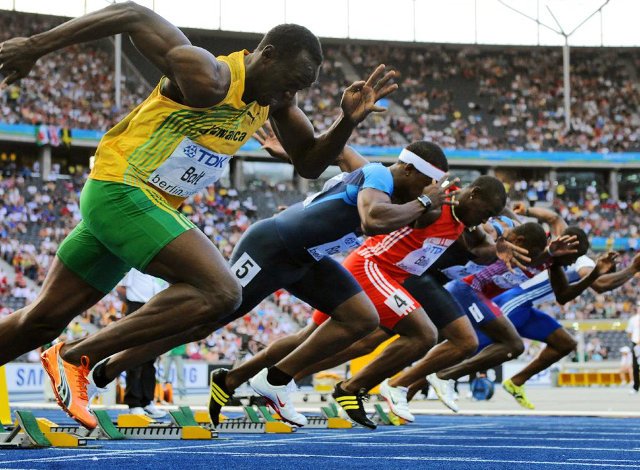
The official 100-metre result lists Bolt’s reaction time as 0.146 seconds; the 200-metre result lists 0.133. Those are separately recorded details of the starts. They should not be confused with his total race times or treated as a complete explanation of the finishing results.
Subtracting reaction time from an official result creates a different calculation. It does not create a replacement official performance. If someone makes that adjustment for a particular analysis, the changed definition needs to be stated clearly and applied consistently to any comparison.
The same principle applies when comparing your own attempts. A run timed from an external signal and one timed from your first movement do not necessarily have the same starting point. A standing start and a flying start are different tasks. If the definition changes, an improved number may reflect the measurement change rather than improved performance.
Before interpreting small differences, write down how the attempt starts, how the distance is established and how the finish is timed. Consistent measurement will not make an ordinary training session equivalent to a championship final. It will make your own records more useful and reduce the temptation to attach a grand explanation to a tiny difference.
Borrow the habit of asking a better question
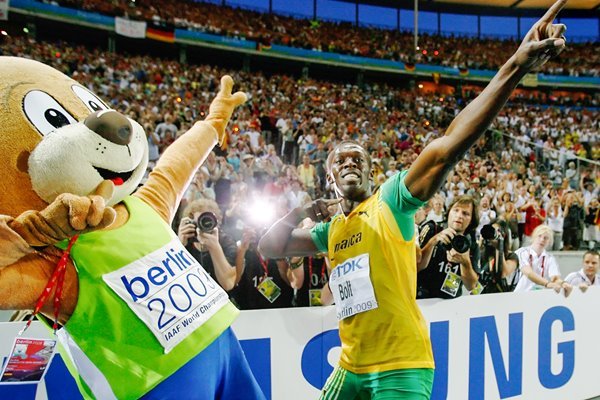
Bolt’s achievements can inspire training without supplying a ready-made programme. A pair of race results does not reveal his weekly lifting volume, recovery schedule or exact sprint sessions. It also cannot establish that copying one visible exercise will reproduce his performance.
Choose a question that matches your goal. Are you trying to measure a full-distance result, a short acceleration task or a controlled repeated effort? Those tasks may all involve running, but one number should not be expected to describe every ability. Keep the task consistent when you repeat it.
Be equally careful when borrowing conclusions from strength training. MMP’s discussion of calf strength and sprint or jump performance explores why a gym measure and a sporting outcome need to be distinguished. A useful training exercise is not automatically a direct measurement of racing speed.
The Berlin double remains remarkable when described precisely: two championship finals, two exceptional times and results that reward closer examination. You do not need an invented peak-speed figure or an imaginary Bolt workout to appreciate them. Keep the distance, timing definition and conditions together, and the numbers become more informative than a slogan about running fast.