Advertising disclosure: This page includes affiliate product links that may earn us a commission, as well as products from our own store.
A three-minute exercise break sounds easy to fit around work. Asking someone to repeat it sixteen times is a different proposition. The useful question is not simply whether a short bout of movement can be performed beside a desk. It is whether the plan survives meetings, deadlines, shared space and the ordinary unpredictability of a working day.
A small workplace trial offers a practical lesson about that gap. For lifters who spend most of the day sitting, the takeaway is to build a manageable movement habit while keeping proper training in the week. A desk break can have a clear purpose without becoming another workout you feel guilty about missing.
What the workplace trial actually tested
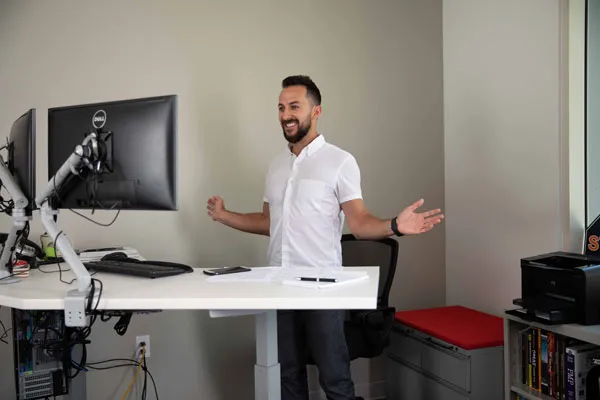
A trial published in 2024 involved twenty-nine people and compared a sitting-control condition with a workweek containing three-minute bodyweight resistance breaks. The requested frequency rose from four daily breaks on the first two days to eight on the next two, then sixteen on the final day.
Average completion was 3.2, 6.2 and 9.2 breaks per day at those respective targets. Acceptability fell from 88% for four breaks to 40% for eight and 9% for sixteen. More prescribed opportunities did produce more completed bouts, but the most frequent schedule was poorly accepted.
This was a small, short investigation of a workplace strategy, not proof of muscle growth, fat loss or a universally optimal break schedule. The escalating frequencies also occurred on different days. It cannot cleanly separate frequency from every other influence on the week.
For your own planning, distinguish a target you admire from a routine you can repeat. A demanding schedule may look impressive in a calendar while being a poor match for the job you actually do.
Count completed movement, not dismissed reminders
A reminder is only a prompt. It is not a completed set, a change of posture or time spent moving. If your phone interrupts every focused work block and you repeatedly silence it, adding more alerts may increase annoyance without solving the underlying scheduling problem.
Start by identifying a few genuine openings: finishing a task, returning from the kitchen, ending a call or reaching a normal break. These are practical examples rather than a validated prescription. Choose opportunities you can usually recognize without constantly checking a timer. A person with back-to-back appointments may need a different arrangement from someone working independently.
Keep the first record simple. Note the opportunities you planned, the ones you used and why others were missed. If a client meeting ran late, write that down. If you forgot despite having time, the cue may need improvement. If you avoided the movement because the area felt awkward or unsafe, scheduling alone is not the solution.
For example, imagine planning three movement opportunities and completing all three on most days. That gives you a stable routine to evaluate. Planning ten and completing three produces the same number of completed opportunities, but a much less useful sense of success. These are hypothetical examples of habit design, not results from the trial.
Review the pattern after a normal working week. Keep what fits, adjust what repeatedly clashes with work, and resist the urge to punish missed breaks with one exhausting session at the end of the day.
Choose movements that suit the actual workspace
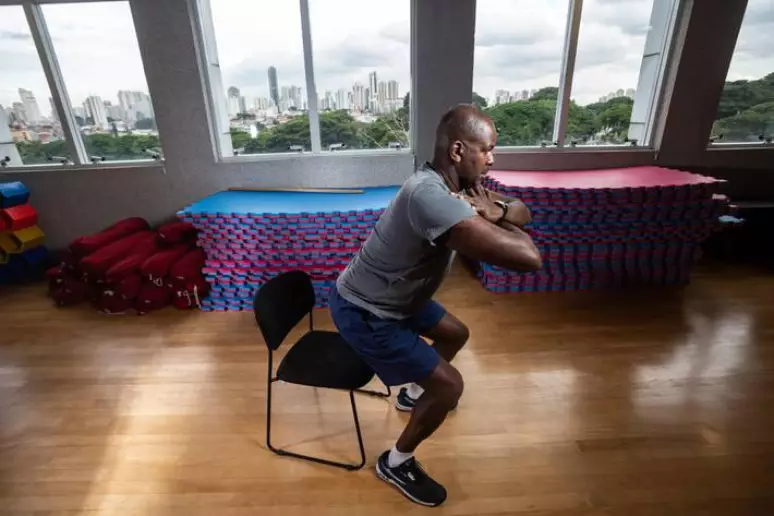
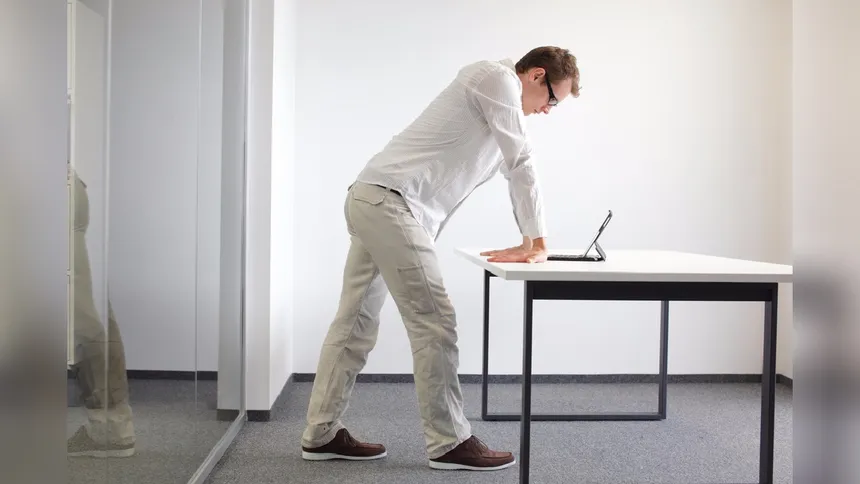
Bodyweight movements remove the need to carry equipment into the office. A comfortable sit-to-stand, a supported calf raise or an appropriately scaled wall push-up can be possible options for someone able to perform them safely. Choose familiar movements and a range you control. The aim is to interrupt sitting, not discover your hardest exercise variation between emails.
For a sit-to-stand, use a stable, non-wheeled chair on a surface where it will not slide. Place your feet securely, rise under control and sit down deliberately. Do not turn a rolling office chair into an exercise platform. A sturdy wall is often a simpler support than a desk whose stability or load capacity you do not know.
Start gently rather than taking every bout to failure. Work clothing, footwear, floor space and nearby colleagues all matter. Stop if you feel pain or become unwell. If an injury or health condition makes a movement uncertain, get appropriate advice about a suitable alternative instead of forcing the example.
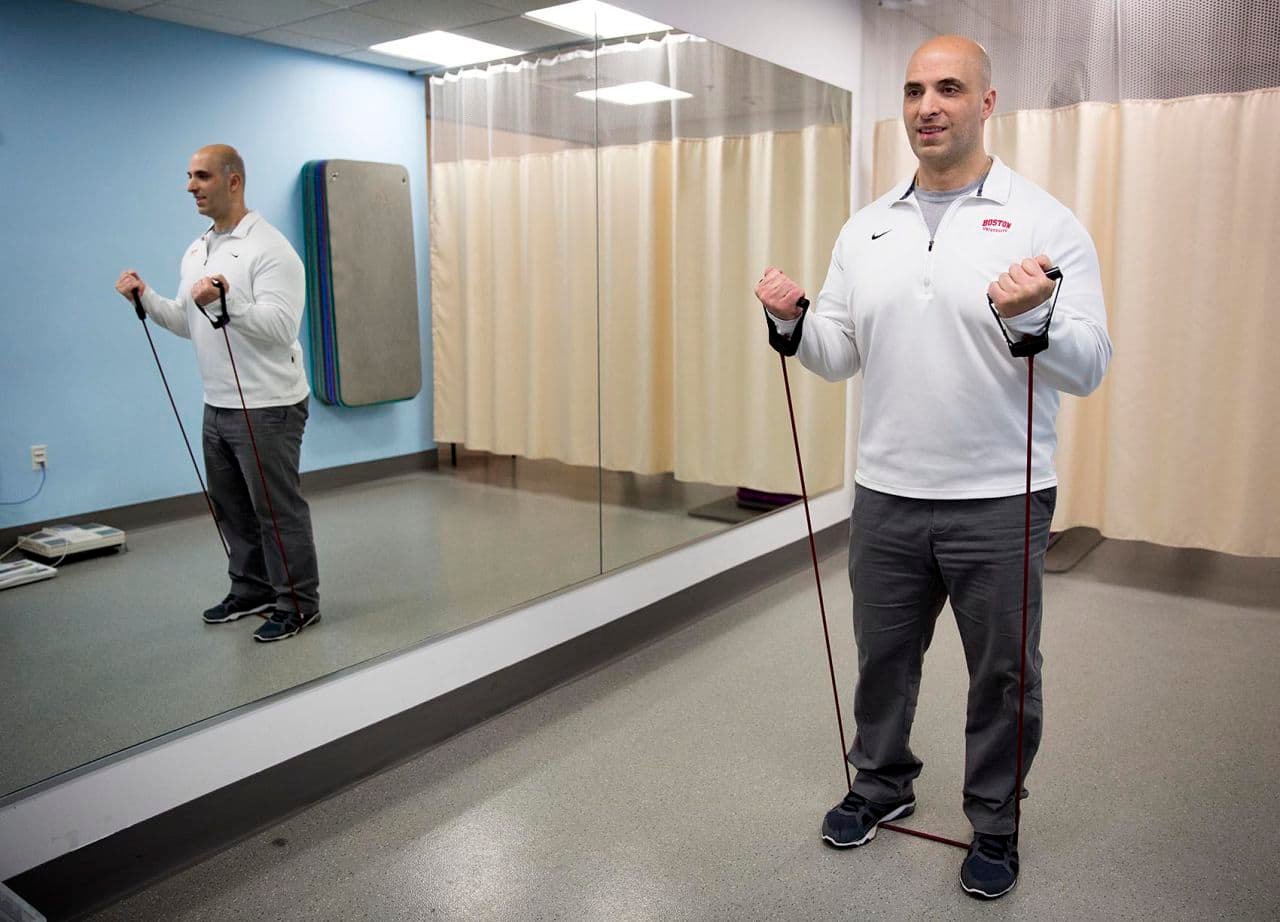
A resistance band can be convenient where there is room, but inspect it and use it as intended. Avoid improvising an anchor on office furniture. Likewise, leave dumbbells out of walkways and do not let optional equipment become the reason a simple movement break never happens.
Walking or standing to complete an ordinary task can also be a practical way to change a long seated spell. That is a different activity from a resistance circuit; record it honestly rather than treating every change of position as an equivalent strength stimulus.
Keep your proper strength training in the week
Brief movement breaks and progressive resistance training solve different planning problems. One interrupts a long period at the desk. The other deliberately develops strength or muscle through suitable exercises, effort, workload and progression. Completing a few comfortable chair rises does not establish that you have replaced your usual lower-body training.
General adult activity guidance includes muscle-strengthening work on at least two days each week, alongside aerobic activity. It also allows activity to be accumulated in smaller chunks. That flexibility should make participation easier; it does not mean that any collection of easy movements automatically meets every training goal.
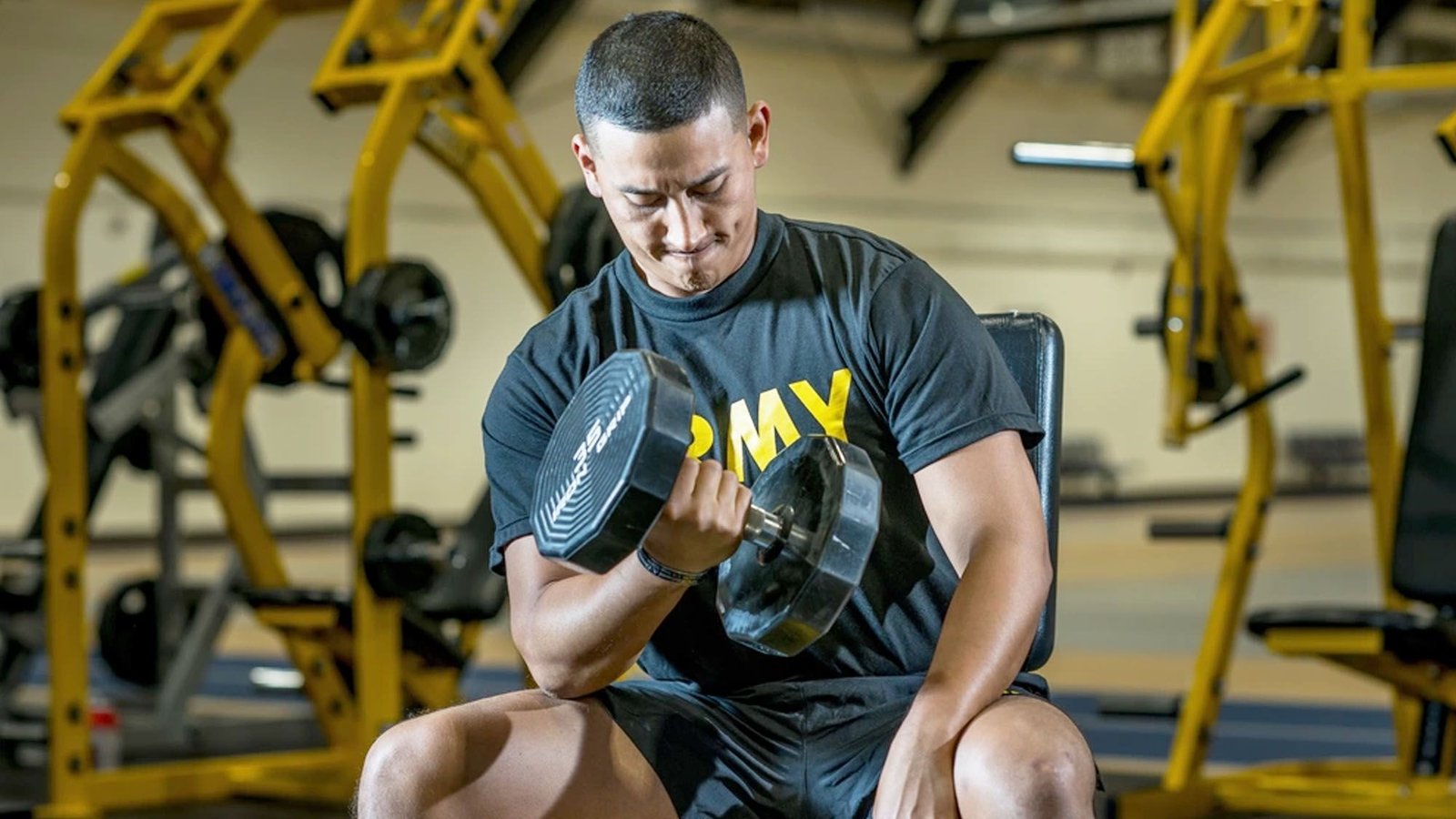
For your main resistance sessions, keep a program you can follow and adjust to your experience. Dumbbells, kettlebells, a suitable bench, or a bar and plates can all be tools for that separate work. You do not need to buy a special desk-workout setup before returning to the routine you already understand.
Watch how the two habits interact. A movement break should not routinely leave you too fatigued to train later or too distracted to work. If you already lift hard, choose easy, controlled bouts rather than inserting extra demanding sets throughout the day without accounting for them.
There is room for a short resistance session when time is limited, but label its purpose clearly. A planned workout with challenging sets is different from a low-demand break. Clear labels help you decide what to progress and what simply needs to remain convenient.

Equipment Worth Exploring
Explore equipment, accessories and gear from our carefully selected range.


Rubber Hex Dumbbells
Rubber-coated hex dumbbell pairs with a stable shape for home and commercial strength training.


Cast Iron Kettlebells
Textured cast-iron kettlebells for swings, squats, carries, and full-body training.



FID Bench MAX
Adjustable bench offering flat, incline, and decline positions + adjustable headrest.


Make the habit easy to maintain and honest to assess
Set up the environment before demanding more discipline. Identify a safe place to move, agree on appropriate breaks where necessary and keep equipment optional. In a shared office, consider whether a corridor, spare room or normal walking route is a more considerate option than exercising beside a colleague’s chair.
Use the log to answer a practical question: what prevented the break? Forgetting, workload, embarrassment, discomfort and lack of space need different solutions. A more aggressive notification cannot create floor space. A new band cannot shorten a meeting. Change the obstacle you actually observed.
One way to organize the experiment is to write a primary option and a fallback beside each opportunity. At home, the primary option might be a familiar bodyweight movement in a clear space; during an office day, the fallback might be a short walk at a permitted break. Neither needs to imitate the other. Mark what you actually did, and keep the total demands modest enough to assess. This is an organizational example, not the research protocol or a claim that the alternatives have identical effects.
Judge the first stage by consistency and tolerability. You might notice that a short change of activity feels welcome, but that personal impression is not proof that your productivity, blood pressure or long-term health has improved. Keep a useful experience without attaching a measurement you did not make.
A separate small four-hour experiment in fourteen adults found no overall statistically significant differences in discomfort, fatigue or sleepiness between conditions, although mental fatigue favored the exercise-break condition at hour four. That limited result is a reason to avoid sweeping promises about an afternoon energy cure.
Progress can mean making the routine easier to follow, not endlessly increasing the number of interruptions. Once the basics fit your week, decide whether another opportunity would add value or simply compete with work and recovery. Keep your coffee break, movement break and proper workout distinct enough that you know which habit you are actually improving.
The goal is a working day with more manageable opportunities to move. Build that around real constraints, preserve the training that supports your goals, and give yourself a routine that can survive an ordinary busy Tuesday.

Bodybuilding Shirts & Workout Gear
Bodybuilding shirts, tanks and gym gear for lifters chasing muscle, size, symmetry and the pump.

T-Rex Hates Push Ups Hooded for Calisthenics Workout Fa Hoodie
Keep it laid-back with a little “T-Rex Hates Push Ups” attitude.

Consistency Is Key Stoic Greek God Marble Sculpture T-Shirt
Make gym days more fun with “Consistency is Key Stoic Greek God Marble” style.

Don't Quit Do It – Motivational Jumper Pullover For Wor T-Shirt
Show some gym-day personality with “Don't Quit Do It”.

Coffee and Weights for Coffee Lovers, Lifters and Bodyb T-Shirt
Make gym days more fun with “Coffee and Weights” style.

Lift Eat Repeat & Weightlifting Meme Vest Tank Top
Add some lifting attitude to training with “Lift Eat Repeat”.

Everything Hurts And I'M Tired Duck Meme Lifting Hoodie
Stay casual and show some bodybuilding attitude with “Everything Hurts And I'm Tired”.

Rest Day Sloth – Essential T-Shirt
Show some bodybuilding attitude with a playful “Rest Day Sloth” tee.

Quadzilla Massive Quads Sweater Leg Day Squatting T-Shirt
Keep things casual with a little “Quadzilla” attitude.

Gym Dost Thou Even Curl Medieval Knight Bicep Decal & B Sticker
Give your everyday gear a playful “Dost Thou Even Curl Medieval Knight Bicep” twist.

Repetition Stoic Shirt: Meme Sigma & Greek God Pump T-Shirt
Show some lifting attitude with a playful “Repetition Stoic” tee.