Advertising disclosure: This page includes affiliate product links that may earn us a commission, as well as products from our own store.
The Rogue Monster Rhino lets you train hard squats with the load attached at the hips rather than supported on the shoulders. It also demands a real installation commitment: a heavy freestanding tower, permanent anchoring, a raised platform and room for plates. Here is what the machine actually offers, where the evidence supports belt squats, and how to use it in a six-week lower-body program without inventing a hands-on test.
The stand-alone Rhino is a dedicated leg-training station
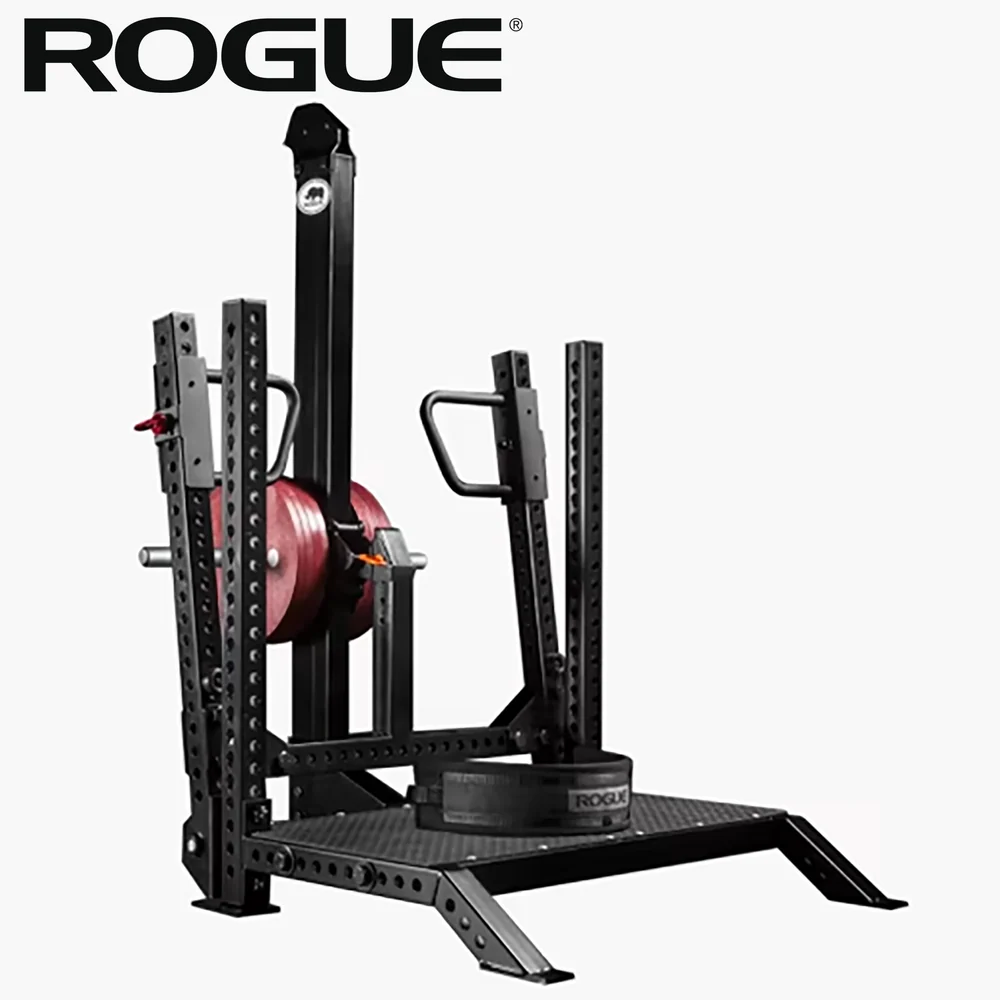
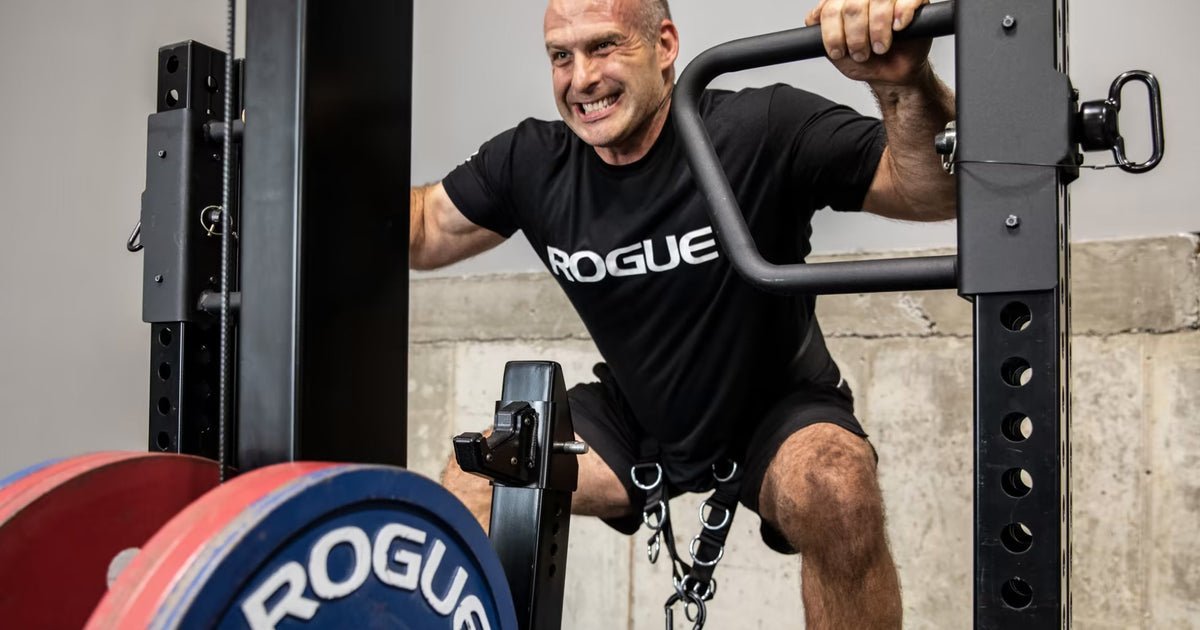
The Monster Rhino is not a plate-loaded hack squat and it is not a traditional weight-stack machine. It is a belt squat: plates sit on a moving trolley, a cable connects that trolley to a belt around the lifter’s hips, and the user stands on a raised platform to perform squats with the main external load applied below the torso. Rogue’s stand-alone model combines the platform, tower, weight posts and supports in one independent frame. It does not need an existing rack to function, although that does not mean it is a portable or freestanding-without-anchors solution.
The key training distinction is where the force enters the body. A barbell back squat asks the upper back, arms and trunk to support a bar on the shoulders. On the Rhino, the belt connects load to the hips while the hands can hold adjustable supports for balance. You still have to control your knees, hips and trunk, and leg fatigue can be substantial. It simply changes the loading arrangement. For lifters limited by shoulder comfort or who want more lower-body volume after barbell work, that difference can be useful.
The Rhino’s purpose-built trolley also changes the feel relative to hanging plates from a dip belt between raised boxes. A guided carriage manages the plates and cable travel, while the platform offers a stable stance area. That is a practical convenience rather than a promise of more muscle growth. A properly executed squat, leg press or split squat can still provide an effective leg stimulus when effort, range and progression are matched.
Measure the full installation, not just the platform
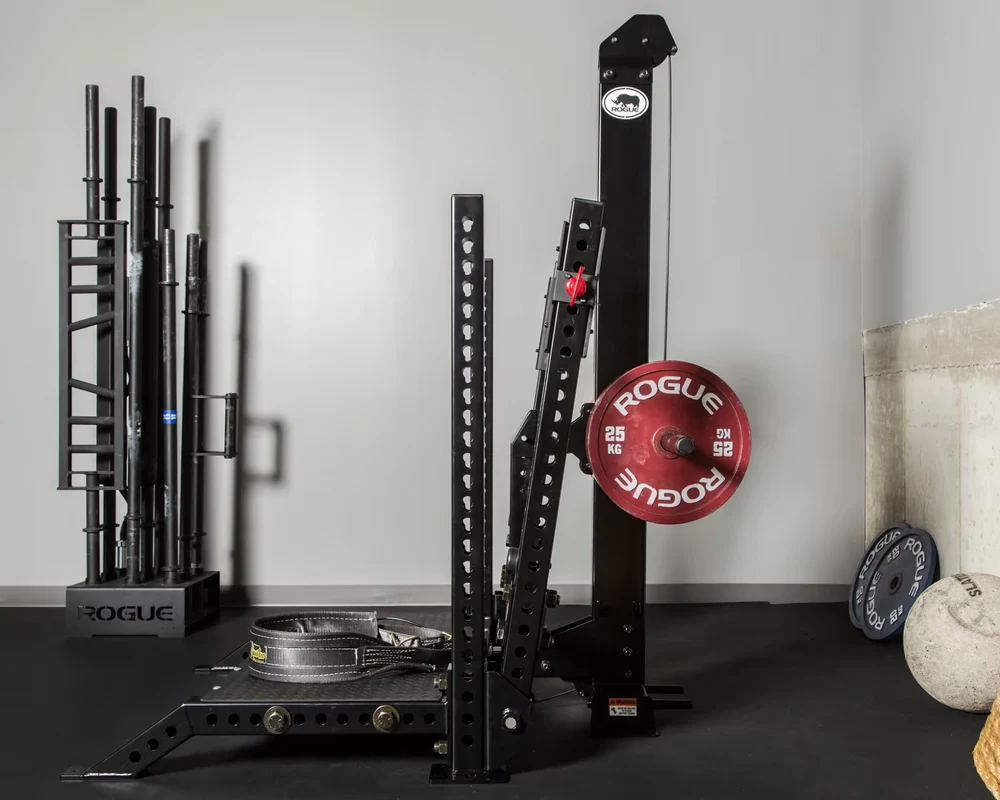
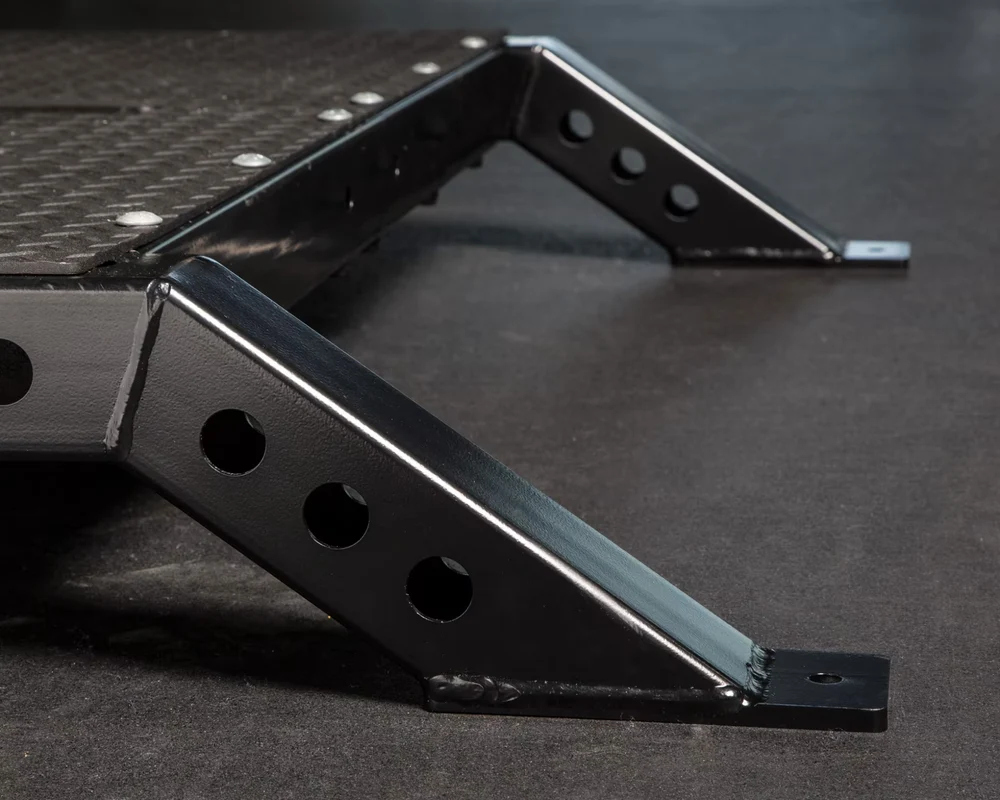
The stand-alone machine measures approximately 53 inches by 60.5 inches across its listed footprint, with the top of the tower about 78.5 inches from the floor. Its diamond-tread working platform is roughly 26 inches deep and 48.5 inches wide, sitting 7 inches above the ground. The full unit weighs about 530 pounds before the training plates are added. That is substantial equipment, especially when moving a shipment through a doorway, along stairs or across finished flooring.
Rogue specifies freight delivery, assembly and floor anchoring before use. Treat that anchoring requirement as essential. A heavy frame alone does not establish a safe installation, and a rubber mat is not a substitute for the manufacturer’s mounting instructions. Check the underlying surface, anchor suitability and any lease or building restrictions before ordering. An installer should account for the loaded machine and movement of the user, not just the static metal footprint.
Allow room around the plate-loading sleeves, too. Each of the Rhino’s two weight posts offers roughly 15.75 inches of plate-loading length. A machine squeezed directly against a wall may technically fit on paper yet leave too little space to handle 45-pound plates or walk around the tower. Plan an unobstructed loading path, room to step on and off the raised platform, and clearance above a tall lifter’s head. The correct floor plan includes access and traffic space, not merely a rectangle drawn around the feet.
Because the platform is 7 inches high, an overhead clearance measurement taken only from the room’s floor will mislead taller users. Stand on a 7-inch step, extend into a normal upright position and check ceiling obstacles such as ducting, lighting and pull-up bars. That simple mock-up is more useful than assuming a room with an eight-foot ceiling automatically works for everybody.

Equipment Worth Exploring
Explore equipment, accessories and gear from our carefully selected range.

Belt Squat Collar
Heavy-duty collar adapter for compatible belt-squat and landmine bar setups.

Squat Harness
Wearable harness for hands-free cable squats, sled work, and lower-body training.

GymPin Squat Wedges
Non-slip 15-degree squat wedges help elevate the heels for deeper quad-focused squats.

Studio V-Squat
Plate-loaded V-squat machine for supported lower-body strength training.

Studio Glute Drive
Plate-loaded hip-thrust machine with supported back pad and adjustable foot platform.

Standing Abductor
Plate-loaded standing hip abductor for targeted outer-glute and hip-stability training.


Cable trolley, load horns and the Rhino Horn mechanism
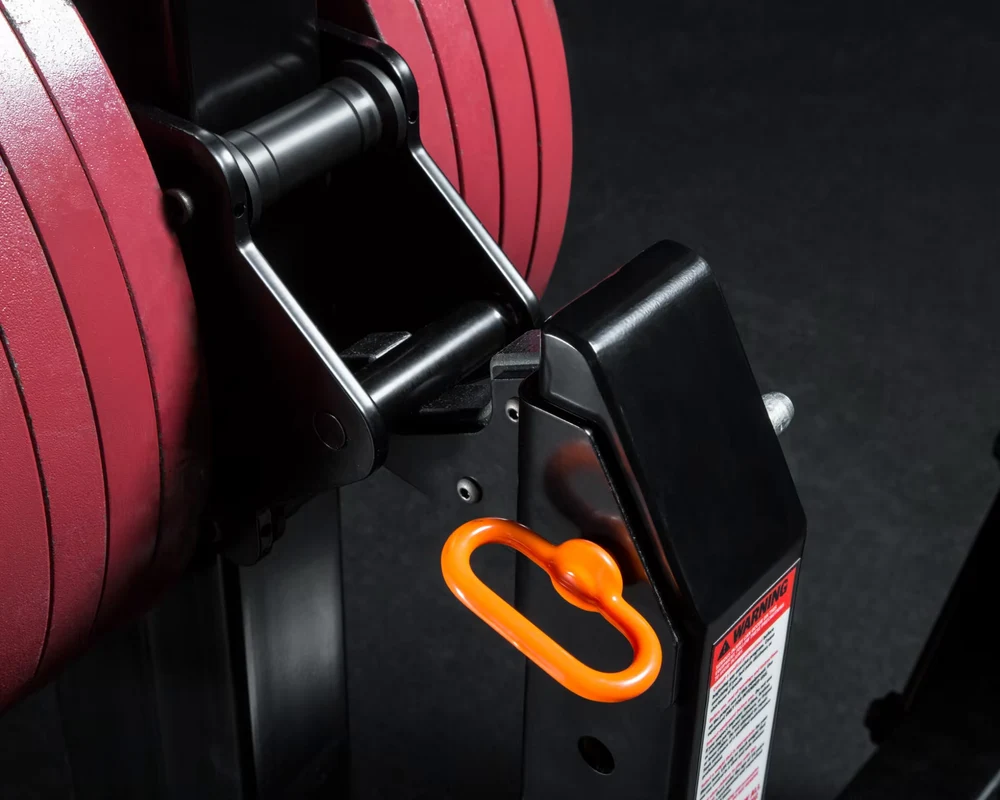
Instead of pulling a loose weight plate from directly beneath the hips, the Rhino routes the belt’s force through a braided cable to a trolley that rides vertically on a separate steel tower. The trolley’s unloaded weight is listed at about 27.5 pounds, with a small manufacturing tolerance. There are two Olympic plate posts on the moving carriage, so the easiest way to change resistance is to load them evenly on both sides. The plates are not included in the machine’s basic structural weight.
The trolley uses rolling components to move along its guide, while a thick UHMW plastic support called the Rhino Horn parks the load between sets. The horn is adjustable to help accommodate different user start heights. Beginning a rep is not the same as unracking a bar: the lifter steps onto the platform in the belt, connects to the cable, stands into the start position, and moves the handles to release the suspended trolley. At the end of the set, the handles are returned toward the tower so the carriage can settle back onto its support.
Learn that release-and-rack sequence with an empty or very lightly loaded trolley before attempting challenging sets. Verify that the belt connector is secure, that nothing rubs abnormally and that the trolley settles predictably on its designated support. Do not rely on someone else’s memory of how the mechanism works. A belt squat station is still loaded gym equipment with moving parts, pinch points and a real risk of being caught off balance.
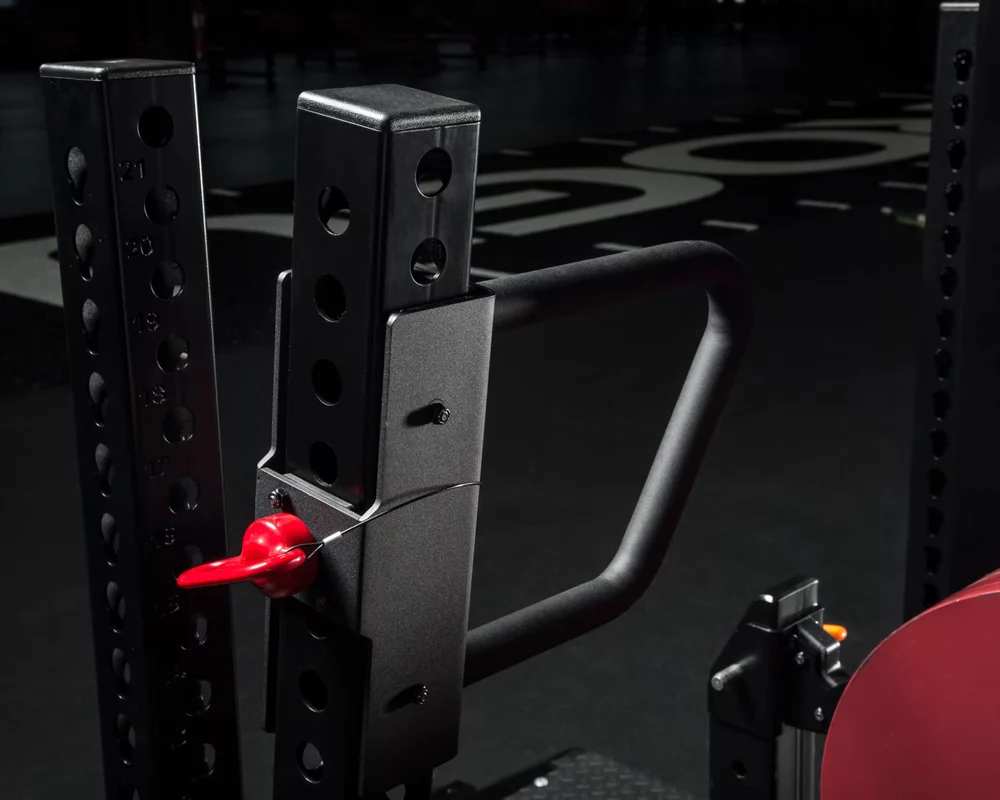
The frame also includes welded band pegs for optional accommodating resistance. Bands can change the load profile through the rep, but they complicate both the resistance estimate and the setup. Standard plates and consistent range of motion are more than sufficient for the initial training block. Add bands only after you can reproduce the same clean start, depth and finish across multiple workouts.

Leg Day Shirts & Workout Gear
Leg-day gym shirts and workout gear for lifters who never skip squats, lunges and lower-body punishment.

Train Legs Uncle Sam Tee
Bring “I Want You To Train Legs Uncle Sam Meme” humor to your next gym day.

Legendary Leg Day – Squat Meme Vest Muscle Shirt For At Tank Top
Add some leg-day attitude to training with “Legendary Leg Day”.

Leg Day / Metallica
Add a playful “Leg Day The Day That Never Comes Metallica” touch to your casual rotation.

Heavy Metal Skeleton Squat for Powerlifters, Bodybuilde Hoodie
Show off your metalhead humor in a laid-back “Heavy Metal Skeleton Squat” hoodie.

Deadlift Snake Skull – Hardcore Powerlifting Gym Decal Sticker
Give your everyday gear a playful “Deadlift Snake Skull” twist.

Deadlift Flaming Skull Graphic , Hardcore Workout Pullo Hoodie
Keep it laid-back with a little “Deadlift” attitude.

Deadlift PR or Die Skull Graphic for Bodybuilders, Hard Tank Top
Show some personality between sets with “Deadlift”.


Fit the belt and build a repeatable squat
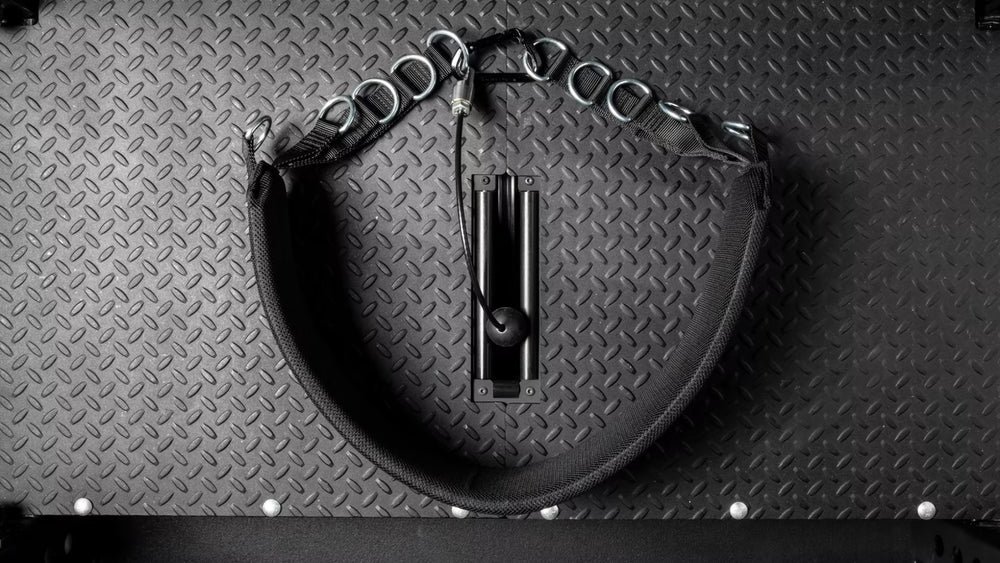
The included padded Rogue Multi Belt offers six adjustment settings over a stated 41-to-61-inch range. That is a product adjustment measurement, not a guarantee that every waist size or hip shape will be comfortable. Belt position, hanging length and the connection point determine where the force is applied. Start with the manufacturer’s fitting instructions, wear the belt snugly enough to prevent sliding, and keep the load connection centered rather than letting it twist across one hip.
Choose a stance that lets your heels stay planted while the knees travel naturally over the feet. A slightly wider or narrower foot placement can be appropriate depending on hip structure, the user’s proportions and the desired emphasis. Grip the handles lightly at a height that helps balance rather than aggressively pulling yourself through a shortened rep. Once the carriage is released, descend under control, allow knees and hips to bend together, and rise by pressing through the full foot.
Depth should be deep enough to load the intended muscles, yet reproducible without losing foot contact, forcing the pelvis into painful positions or contacting the hardware. Many lifters can achieve generous knee flexion on a belt squat, but there is no universal rule that everyone must hit the same depth. Film a set from the side occasionally. Watch whether the knees track consistently, the torso stays controlled and the belt does not pull the pelvis abruptly forward at the bottom.
For the first two sessions, keep two or three reps in reserve and use enough rest that the next set looks comparable. If the first rep is a smooth, deep squat but the last rep becomes a tiny knee dip, the load is not the only thing progressing. You need a consistent standard for comparing weeks. If discomfort occurs, reduce the load or range, change the belt position or choose another exercise rather than treating pain as evidence that the machine is working.
How it compares with a barbell squat in the evidence
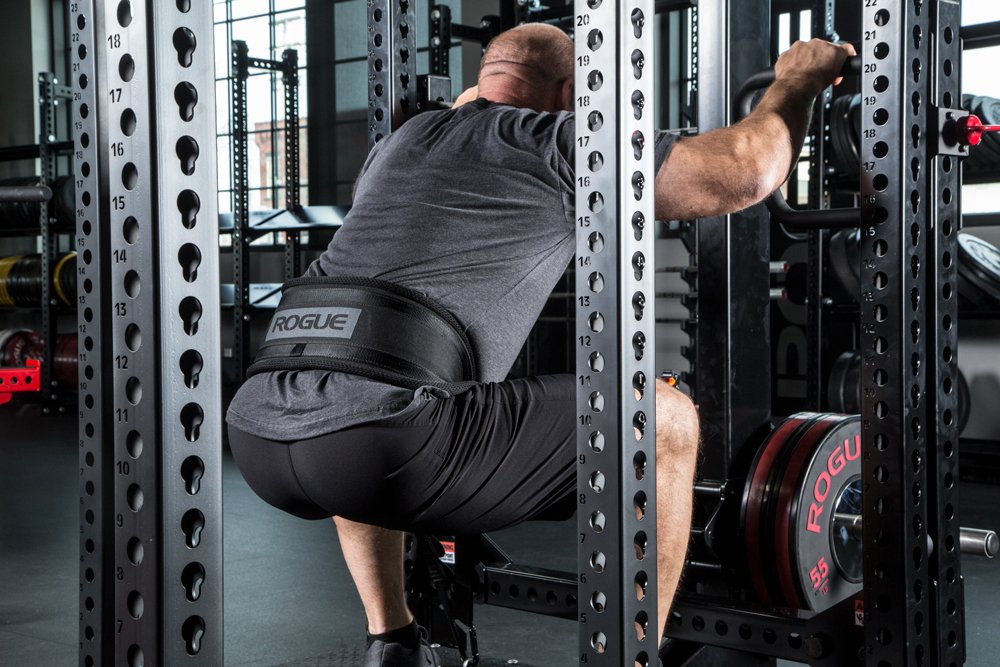
Belt squats can give the legs a demanding training stimulus while reducing the need to support a bar over the upper body. But reduced shoulder loading is not equivalent to zero spinal force, and it does not mean every lifter with back symptoms will tolerate the movement. The hip belt, posture and chosen range still create forces through the pelvis and trunk. Individual comfort, medical constraints and technique matter.
In one laboratory comparison involving 31 participants, machine belt squats and back squats were tested at challenging five-repetition loads. The researchers observed differences in gluteus maximus muscle activation, with some measures lower in belt squats. That finding is important precisely because it tempers an overly simple claim that every version of a squat activates every muscle equally. Electrical activity during a test is also not a direct measure of long-term hypertrophy.
Other controlled comparisons have examined quadriceps and spinal muscle activity in belt-squat and back-squat conditions. The general pattern makes belt squats a plausible tool for targeting the lower body with less upper-body load-bearing demand, but individual machine geometry and methods differ. A guided Rhino cable trolley is not identical to every belt-squat machine used in laboratory work. We should not turn an experiment on one apparatus into a precisely measured promise about this model.
The practical programming conclusion is modest: use belt squats when they let you accumulate productive knee-dominant sets with good technique and manageable fatigue. Keep traditional squats if barbell-specific strength is your goal, because skill and tolerance for a bar on the back are specific adaptations. For a bodybuilder, there is less need to declare an absolute winner. Both can be tools, with the decision driven by the rest of the week’s work, recovery and the muscles you are trying to challenge.
Equipment Worth Exploring
Explore equipment, accessories and gear from our carefully selected range.

Grip Plates
Rubber-coated weight plates with handholds for loading barbells and machines.

Competition Plates
Competition-style bumper plates for Olympic lifts and loaded strength training.


Open Hex Bar
Open-frame trap bar with multiple handles for deadlifts, carries, and lower-body training.


Cast Iron Kettlebells
Textured cast-iron kettlebells for swings, squats, carries, and full-body training.


Rubber Hex Dumbbells
Rubber-coated hex dumbbell pairs with a stable shape for home and commercial strength training.
Where the Rhino belongs in a leg program
The most straightforward use is as a primary knee-dominant lift on a day when barbell squats are not the priority. After an ordinary warm-up, perform three or four work sets of six to twelve controlled reps, leaving one to three good reps in reserve. Pair those sets with a hamstring movement such as a Romanian deadlift or leg curl, because the belt squat alone does not replace all of the posterior-chain work in a complete routine. Calf raises and single-leg work can fill out the day.
A second use is as a secondary volume exercise after heavy back squats. When squats already require significant spinal bracing and upper-body support, adding two or three controlled belt-squat sets can create more local quadriceps work without simply adding another loaded barbell session. The tradeoff is that the quadriceps can still become exhausted and sore; moving the weight to a belt is not an automatic recovery shortcut. Monitor subsequent leg performance as closely as you monitor back comfort.
Third, the Rhino can accommodate lighter, higher-rep technique work. For example, ten to fifteen repetitions with a deliberate eccentric phase and consistent depth can expose small balance and stance issues. But do not let a pump become the only measure of quality. If your range collapses, the belt chafes or the feet shift, reduce resistance and reset. Keep the same foot placement markers when you want a reliable comparison between sets.
The machine does have obvious limitations. It cannot teach a competitive back-squat unrack, and it occupies significant permanent floor space. A simpler squat variation, leg press, hack squat or dumbbell split squat may provide all the leg work a lifter needs for a fraction of the room and expense. Purchase a dedicated Rhino when the specific belt-squat pattern will earn frequent use, not merely because the rack looks impressive.
Powerlifting Shirts & Lifting Gear
Powerlifting shirts and gym gear for squat, bench and deadlift lifters who live for heavy numbers.

Gymhead Skull Plate – , Meme Shirt Bros & T-Shirt
Make gym days more fun with “Gymhead Skull Plate” style.


Lift King Gym Lion Tee
Show some powerlifting attitude with a playful “Lift King Gym Lion” tee.


Rat | Ratatouille Meme Workout Sweater | Cheese Barbell T-Shirt
Keep things casual with a little “Gym Rat” attitude.

Kanye Lifting | Rap Music Parody Crewneck for Gym Bros T-Shirt
Keep things casual with a little “Kanye Lifting” attitude.

Powerslave to the Gym Hoodie
Stay casual and show some metalhead attitude with “Powerslave to the”.

Trooper Eddie Heavy Metal Rock Music Workout for Liftin Tank Top
Your gym-day look, with a playful “Gym Trooper Eddie Heavy Metal Rock Music” twist.

Gym Nothing Else Matters Metallica — Rock Music Bodybui Sticker
Bring “Gym Nothing Else Matters Metallica” attitude to your water bottle or laptop.

Gold Skull Uplift Iron Club Lifters Gym Wear Powerlifti T-Shirt
Show some powerlifting attitude with a playful “Gold Skull” tee.
A six-week, two-day progression and the buying decision
This example is a practical template, not a protocol claimed to have been tested on the Rhino. Begin with a conservative load that allows repeatable depth, a secure belt fit and smooth trolley release. Day A is the heavier strength-hypertrophy session; Day B uses lighter, more controlled volume. Separate them by at least one full recovery day, and keep other demanding leg training in the plan rather than pretending it disappears.
Weeks 1–2: On Day A, complete three sets of eight reps at approximately three reps in reserve, resting two to three minutes. On Day B, perform two sets of twelve at three reps in reserve, with a two-second controlled descent. Take notes on belt setting, stance, plate load, depth and discomfort. If technique varies widely, the priority is skill, not weight.
Weeks 3–4: Move Day A to four sets of six to eight and Day B to three sets of ten to twelve. Add a small amount of weight only when every set reaches the upper rep target at the intended effort with clean depth. Small progressive jumps are preferable to turning a controlled cable squat into a short-range partial. Maintain a consistent tempo and allow a third minute of rest if breathing or leg fatigue is ruining later reps.
Week 5: Maintain the same set counts while working slightly closer to failure, approximately one or two reps in reserve on the last set. Keep at least one technically clean rep in the tank; there is no need to perform maximal attempts on the moving trolley. Add posterior-chain work and calves if recovery allows, not because the Rhino itself requires a longer workout.
Week 6: Compare your first-week working load against today’s performance at the same depth, belt setting and effort. If fatigue has accumulated, cut total sets roughly in half for a lighter consolidation week; if training is going well, repeat Week 5 and establish a new conservative baseline for the next block. Either way, progress is judged by repeatable reps and a tolerable recovery cost, not the biggest number of plates that fit on the horns.
For a serious home or commercial gym, the Rhino’s strong case is that it creates a stable, repeatable, cable-guided belt squat station independent of a rack. Its weak case is the same permanence: around 530 pounds of machine, floor anchoring, freight, plate access and a footprint that can crowd smaller rooms. Before buying, compare the stand-alone unit with Rogue’s rack-mounted drop-in Rhino, examine installation instructions and check whether a belt squat adds something important beyond the equipment already available. The product’s current configuration and local availability can be checked on Rogue’s official product page.
Some product links may be affiliate links, which can support Mind Muscle Perfection at no additional cost to you.