Advertising disclosure: This page includes affiliate product links that may earn us a commission, as well as products from our own store.
Hindu vs Dive-Bomber Push-Ups: The Return Path Changes the Rep
Hindu and dive-bomber push-ups can look almost identical in a photograph. Both start with the hips high, move the chest forward through a low position and finish with the chest lifted. Watch the return, however, and the distinction becomes clearer: one moves back with the arms straight, while the other bends the elbows again to retrace the low arc.
Knowing which version you intend to perform makes practice and progress easier to judge. It also stops a demanding return from disappearing unnoticed when you get tired. Choose the movement first, then record repetitions that actually match it rather than treating every swooping push-up as the same exercise.
Use the return path to identify the variation
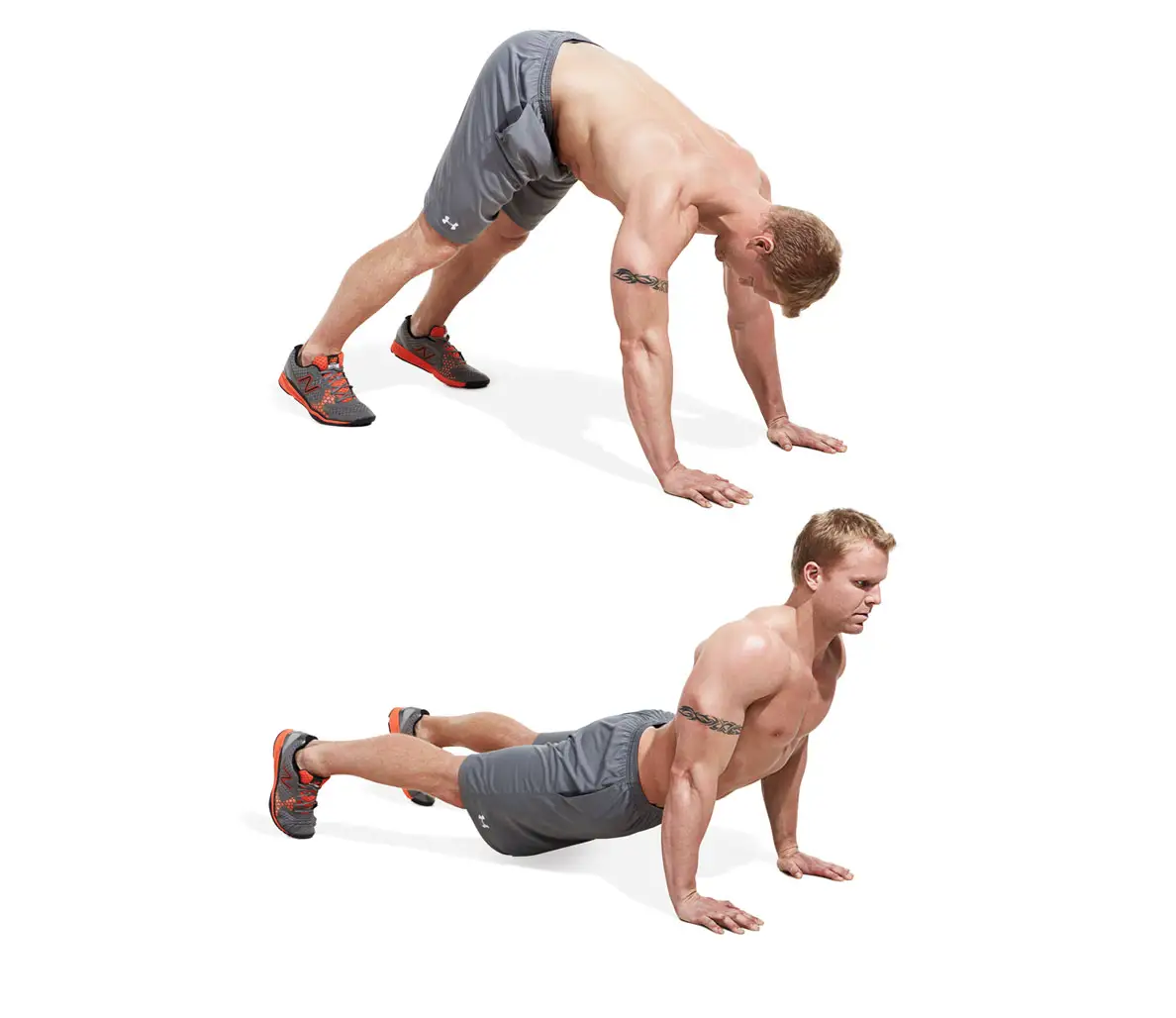
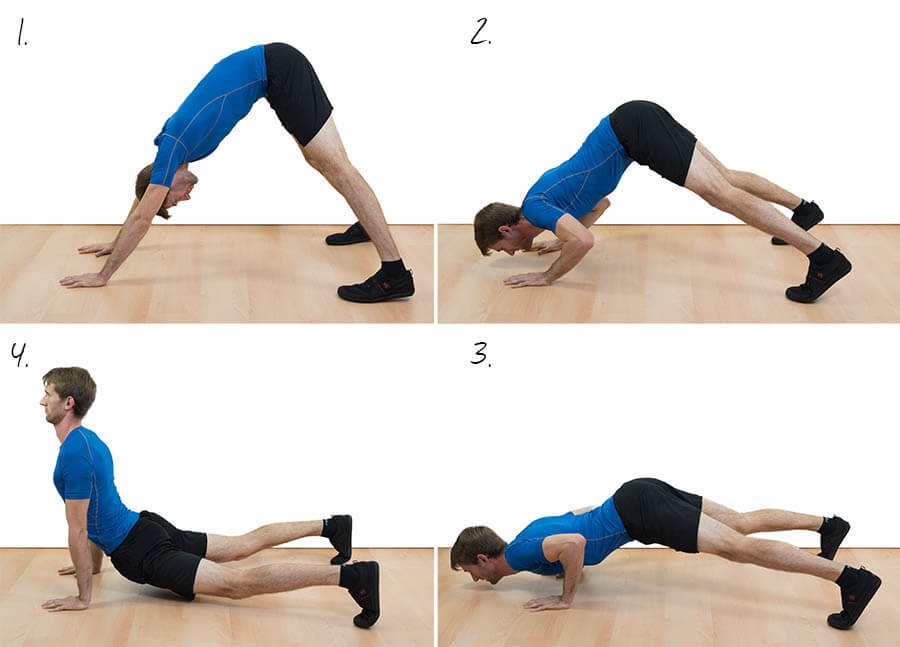
In the Hindu push-up described here, you begin in a pike position, bend the elbows as the chest travels forward and down, then extend the arms as the chest rises. To finish the repetition, send the hips back toward the pike while keeping the arms straight. There is no second low, bent-arm pass on the way back.
The dive-bomber version reverses that forward path. From the chest-up position, bend the elbows again, move the chest back through the low part of the movement and press into the pike. That extra return is the practical distinction. Names are sometimes used loosely, so describe the action rather than relying on a video title.
These versions need separate entries in your training log. Six repetitions with a straight-arm return do not represent the same task as six repetitions with another bent-arm pass. The difference does not prove one builds more muscle; it simply tells you that the repetitions involve different work.
A side-view recording should show the whole body throughout one complete cycle. Check the last repetition as well as the first. If the elbows stop bending on the return, you have changed the dive-bomber task. End the set or deliberately label the change instead of counting it as an unchanged repetition.
For consistency, count one repetition when you arrive back at the starting pike. The forward and backward bent-arm passes of a dive bomber belong to one complete cycle; they are not two repetitions. If you stop in the chest-up position, record the attempt as unfinished rather than quietly comparing it with completed cycles from an earlier session.
Set a pike position you can control
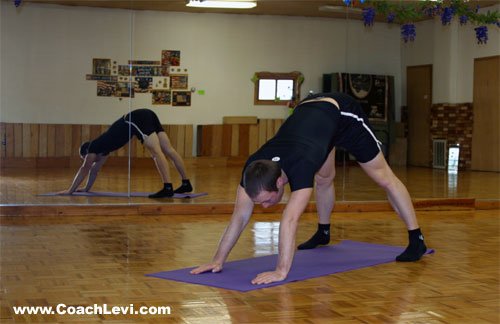
Start on a clear, non-slip surface with the hands and feet supporting you and the hips raised. Leave enough room for the chest to travel forward. There is no benefit in arranging the hands so close to the feet that the forward sweep becomes a struggle to avoid the floor.
Make the starting position comfortable and repeatable. The movement is not a test of whether your heels can stay flat or your legs can look perfectly straight in a photograph. If the position is uncomfortable, shorten the task or choose a simpler pressing exercise. Do not force a stretch while also trying to support your bodyweight.
Before the full movement, practise a small, controlled weight shift while keeping the hands secure. Notice whether the surface slides, the fingers lift or the shoulders feel uncomfortable. Fix the environment and starting arrangement before adding a bigger arc. A mat should provide grip without bunching under your hands.
Use a consistent start when comparing sessions. A much shorter hand-to-foot distance changes the task, even if you use the same exercise name. You do not need to measure every centimetre, but a reference photograph or a note about where the hands and feet sit can prevent accidental changes.
Let the chest travel without dropping into the floor
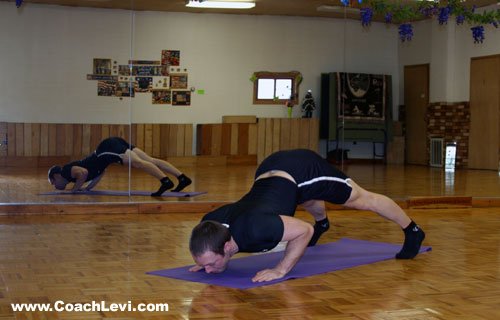
From the pike, bend the elbows and guide the chest forward and downward in a controlled sweep. Keep the head clear of the floor. Continue forward into a comfortable chest-up position as the arms straighten. The movement should remain supported rather than becoming a drop followed by an attempt to catch yourself.
Start with a shallower arc if the full path is unfamiliar. Lowering the face as close as possible to the floor is not a useful goal when you cannot control the transition. More range should come from a movement you can manage, not from letting the hips collapse or forcing the lower back into a deeper arch.
At the chest-up phase, avoid chasing height by throwing the head back. Keep the neck comfortable and do not treat maximum spinal extension as the standard for a successful repetition. Photos illustrate positions; they do not establish the exact range your body needs to use.
Pay attention to the transition rather than only its endpoints. Two impressive-looking poses joined by an uncontrolled middle are still an uncontrolled repetition. If you cannot move between them smoothly, practise less range or return to an ordinary push-up variation you can perform consistently. Stop a version that causes pain rather than trying to push through it.
Choose the return before adding equipment
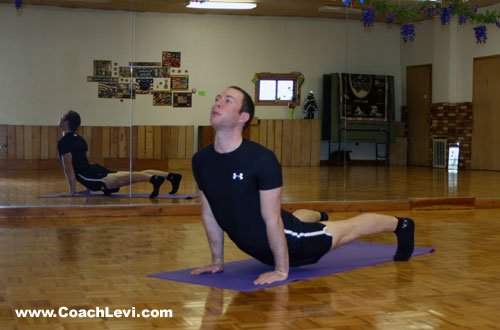
For the Hindu version, use the straight-arm route back to the pike. For a dive bomber, rehearse the second bent-arm pass with a manageable range before trying to repeat it continuously. Keep breathing as you move, and finish while you can still support and reposition yourself deliberately.
If the return gets rushed, reduce repetitions before inventing a harder progression. A pause between attempts can give you time to reset the hands and check the movement. That is preferable to continuing until the technique becomes a different exercise. The return belongs to the repetition, not to the rest period.
No equipment is required for either version. Parallettes change the hand position and floor clearance; rings add movement at the hands. Neither should be treated as an automatic upgrade for learning this swooping path. If flat-hand support is uncomfortable, stop and choose a comfortable alternative rather than assuming that a new handle makes every range suitable.
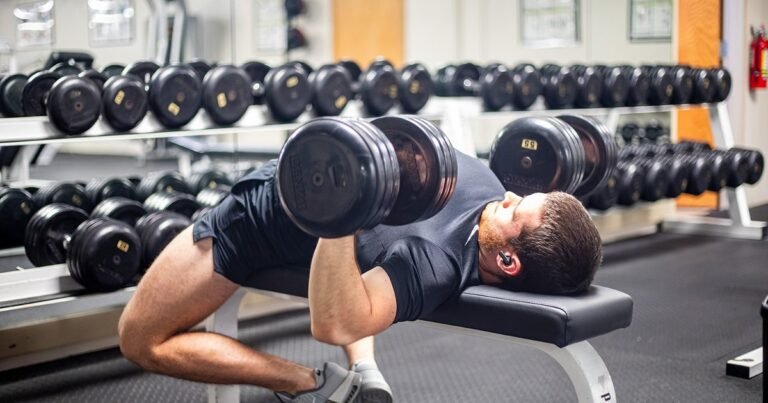
The equipment below also includes benches, dumbbells, a dip station and a chest-press option for broader pressing work. Those can support different training choices; they are not devices required to perform Hindu push-ups. Use each according to its instructions, with a stable setup and appropriate loading. A weighted vest is a later loading option for suitable exercises, not the first answer to an unfamiliar movement.

Equipment Worth Exploring
Explore equipment, accessories and gear from our carefully selected range.




FID Bench MAX
Adjustable bench offering flat, incline, and decline positions + adjustable headrest.


Rubber Hex Dumbbells
Rubber-coated hex dumbbell pairs with a stable shape for home and commercial strength training.

Power Tower
Freestanding pull-up and dip station with adjustable handles for bodyweight training.

Standing Chest Press SCP-760
Standing chest-press machine with adjustable handle positions for chest and close-grip pressing.
Give skill practice and pressing work separate jobs
Decide what the exercise is doing in your session. A few controlled attempts to learn the arc are different from a long conditioning set. If your main priority is progressively loaded chest, shoulder or triceps work, keep a dependable pressing exercise in the programme rather than assuming a more complicated bodyweight movement must replace it.
An illustrative practice entry could read: “Hindu version, shallow arc, four controlled repetitions, straight-arm return retained.” Another could read: “Dive bomber, three complete cycles, stopped before losing the reverse pass.” Those are examples of clear records, not prescribed starting numbers. Your manageable amount of practice may be smaller.
Change one important detail at a time. Add a little range, improve the smoothness of the transition or increase the number of complete repetitions. Avoid making all three changes together. If a longer set removes the very return you intended to practise, the extra count does not demonstrate progress in that task.
Use ordinary push-ups, bench pressing or another suitable press for the loading goal it serves. Keep that work distinct from learning a fluid swooping movement. This makes your programme easier to review: skill practice can improve coordination without needing to produce a new strength record every session.
Finally, compare sessions using the same definition of a repetition. Note the return path, approximate range, any pause and the reason you stopped. A modest improvement that preserves control is more informative than a large jump in repetitions produced by quietly switching variations.
Keep the place in the workout reasonably consistent too. A short practice set before demanding presses may feel very different from the same set afterwards. Record that context instead of concluding that your ability changed dramatically overnight. If learning the path is the priority, choose a point when you can concentrate on it without exhausted arms turning the return into a rushed shortcut.
The calisthenics, push-day and pressing designs below are optional merchandise for that broader training theme. They do not change the exercise or prove a training benefit. Keep the practical lesson clear: name the version by its return, learn a range you can support and count the whole repetition.

Funny Gym Shirts & Workout Gear
Funny gym shirts, tanks, hoodies and workout gear for lifters who like training hard.

T-Rex Hates Push Ups Hooded for Calisthenics Workout Fa Hoodie
Keep it laid-back with a little “T-Rex Hates Push Ups” attitude.

Funny Calisthenics Gym Crewneck Pullover Sweater for Bo T-Shirt
Add a playful “Calisthenics” touch to your casual rotation.

Funny Calisthenics Gym Muscle Shirt Athletic Vest for B Tank Top
Train hard, laugh a little, and rep “Calisthenics”.

Calisthenics Evolution Decal for Water Bottles Laptops Sticker
Put “Calisthenics Evolution” gym humor on your laptop, bottle, or gym gear.

Be Stronger Than Your Excuses Motivational Workout Pull Hoodie
Make your off-duty look more fun with “Be Stronger Than Your Excuses”.


Shirt for Chest Day | I Love Bench Press with Pink Weig T-Shirt
Show some gym-girl attitude with a playful “for Chest Day” tee.


Shoulder Press Dost Thou Even Press Medieval Knight Cre T-Shirt
Show some gym-day personality with “Shoulder Press”.