Advertising disclosure: This page includes affiliate product links that may earn us a commission, as well as products from our own store.
Cable external rotation is a small movement that becomes difficult to judge when the rest of the body takes over. Start with a suitable pulley position, light resistance and a controlled return, then decide how this accessory fits your training.
Set the cable to resist rotation, not lift your arm
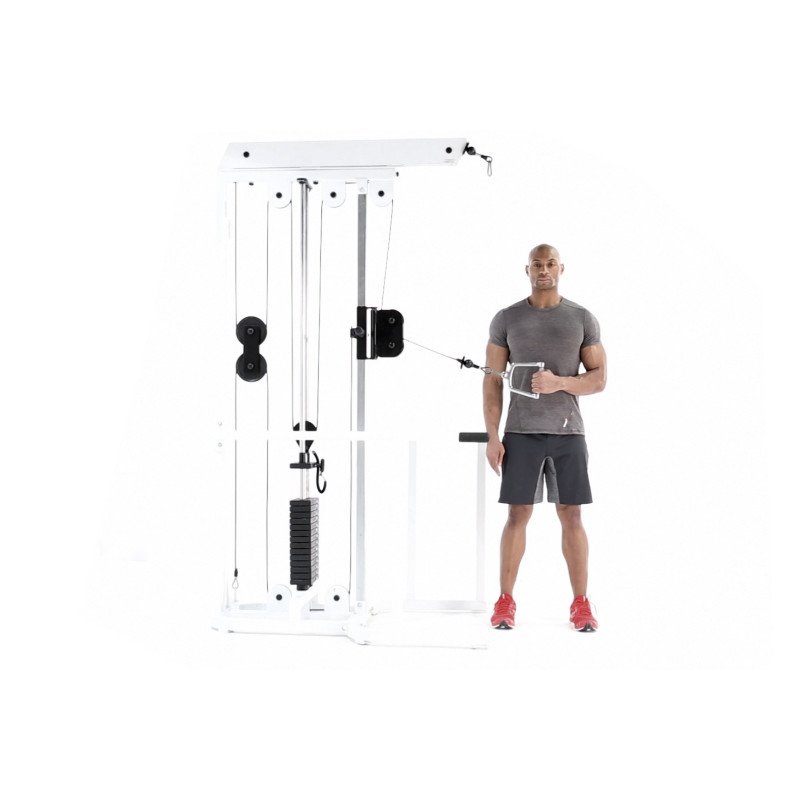
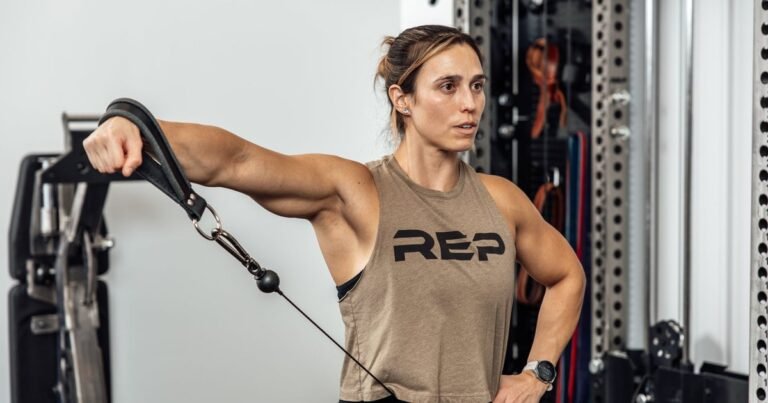
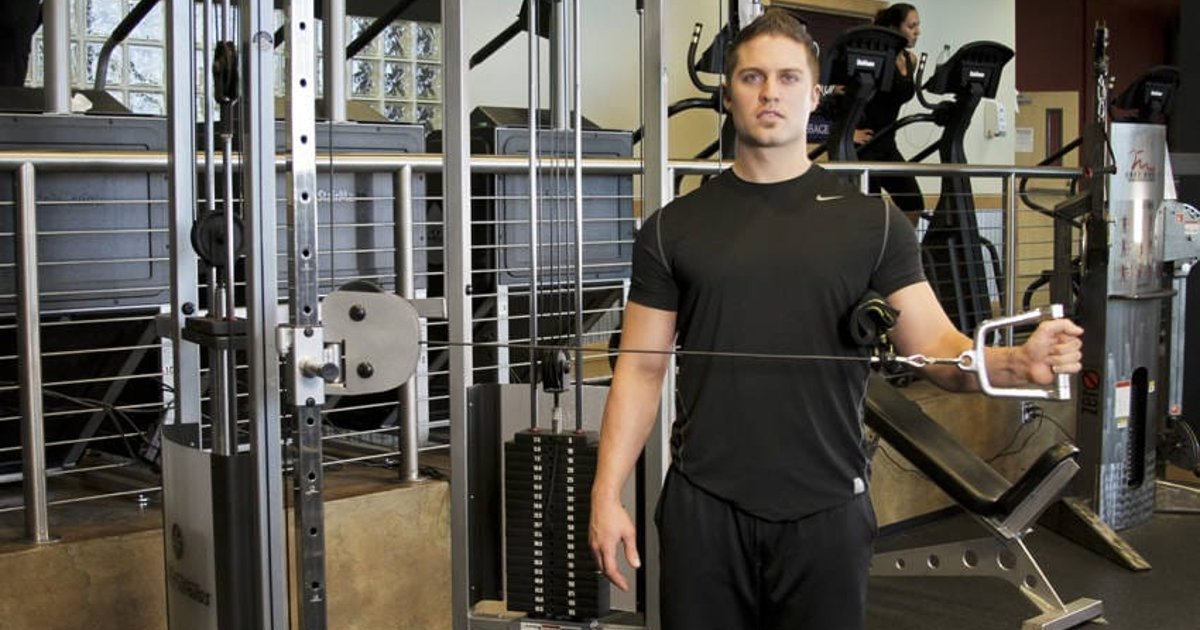
Use a single handle on an adjustable pulley. For the elbow-at-side version, begin with the cable near the height of your bent elbow. Stand sideways to the machine and hold the handle in the hand farther from the pulley. The cable crosses the front of your body. Leave enough room for the handle to move without the attachment striking the machine or the cable rubbing awkwardly against you.
Bend your working elbow to roughly a right angle and keep the upper arm near your side. Start with a light load that lets you explore the movement without twisting your torso. The weight printed on a stack is not a transferable strength score: pulley arrangements, friction and attachments can change what you feel at the hand. Judge the setup by whether you can repeat the intended movement.
The handle should not force you to bend your wrist backwards or squeeze so hard that grip becomes the main challenge. Use a comfortable grip, a steady stance and a relaxed neck. If the cable pulls your elbow upwards, downwards or away from your body, revisit the pulley height and your distance from the machine before adding weight.
Do one exploratory repetition, then stop and check the route of the cable. A useful setup allows you to begin and end each repetition in the same position. You should not need to take a step, lean sideways or reset your grip halfway through the movement. These checks make the exercise easier to assess and log.
A comfortable single handle is usually enough. Cable systems, cuffs and loading accessories vary in adjustment range and compatibility; check their instructions rather than assuming every option below suits this movement. Dumbbells and benches are alternatives for the separate side-lying version.

Equipment Worth Exploring
Explore equipment, accessories and gear from our carefully selected range.


GymPin Ergo Handles
Pair of ergonomic cable handles shaped for comfortable triceps and pulling exercises.

Angles 90 Grips
Flexible grip attachments that allow natural wrist movement during pulling exercises.
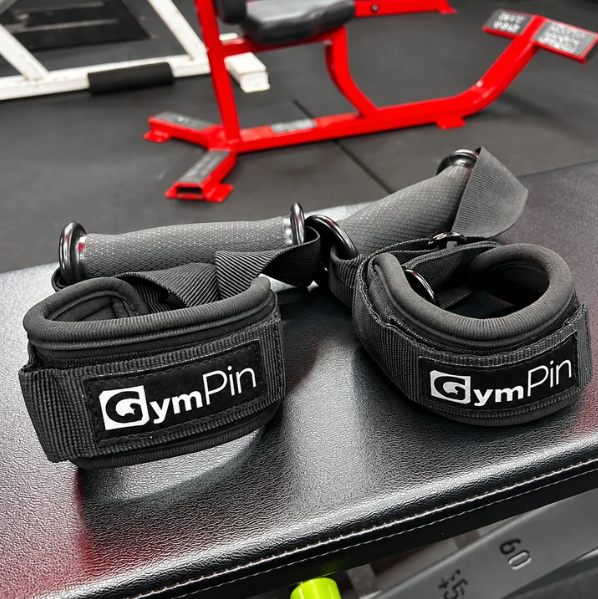
GymPin D Cuffs
Adjustable wrist cuffs with textured grips for supported cable-machine exercises.
VOLTRA
Compact digital cable trainer with smooth, adjustable resistance.

Go-Tone Pro
Portable digital cable trainer with up to 66 lb (30 kg) of adjustable resistance.

VForce Wall Trainer
Space-saving wall-mounted functional trainer with pivoting cable arms and variable resistance ratios.
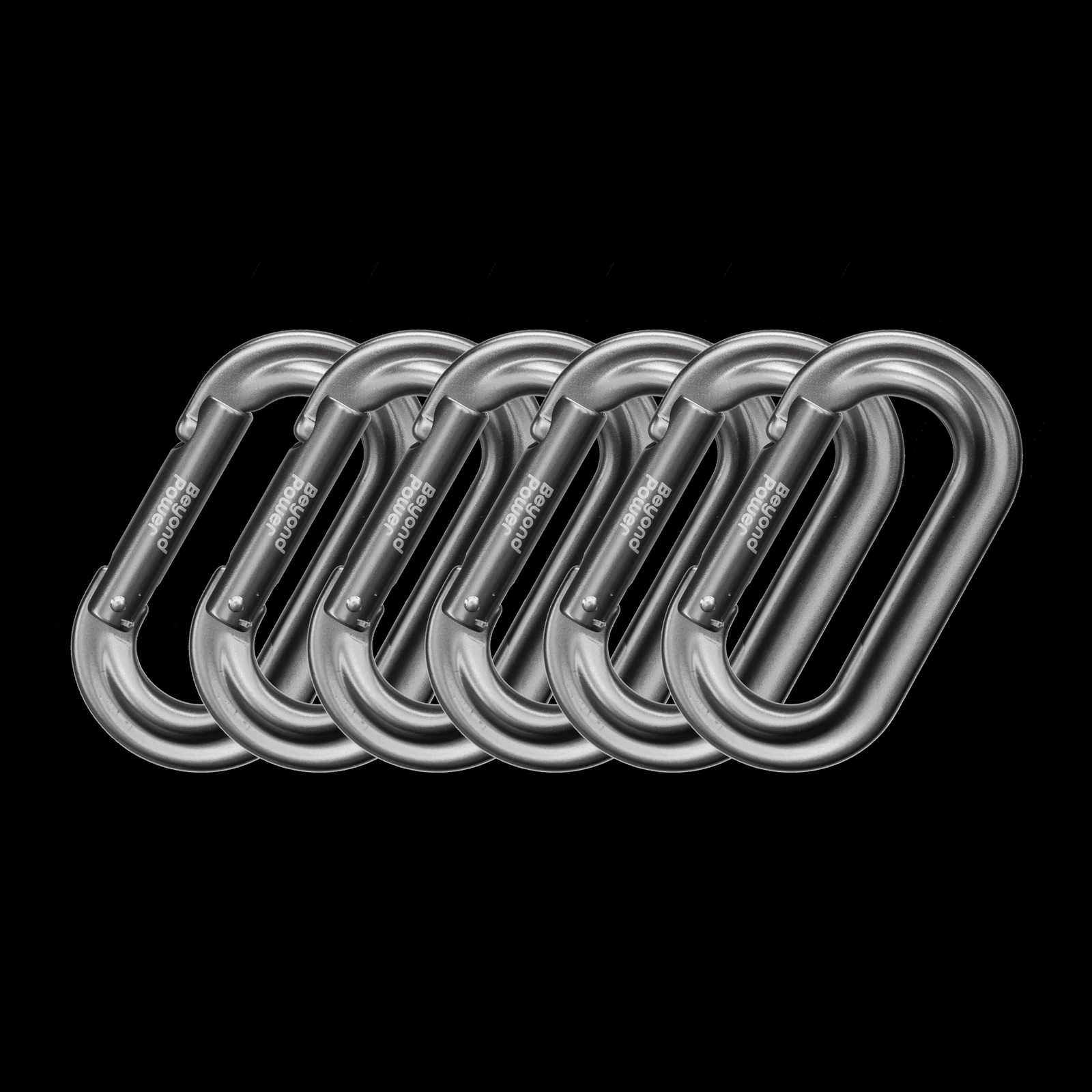
Premium Carabiner
Durable carabiner for connecting cable attachments and training accessories.

GymPin MiniPin
Compact Olympic-plate loading pin for compatible cable stacks with limited clearance.

Original GymPin
Adds Olympic plates to compatible cable-machine weight stacks for extra resistance.
Turn at the shoulder and control the return
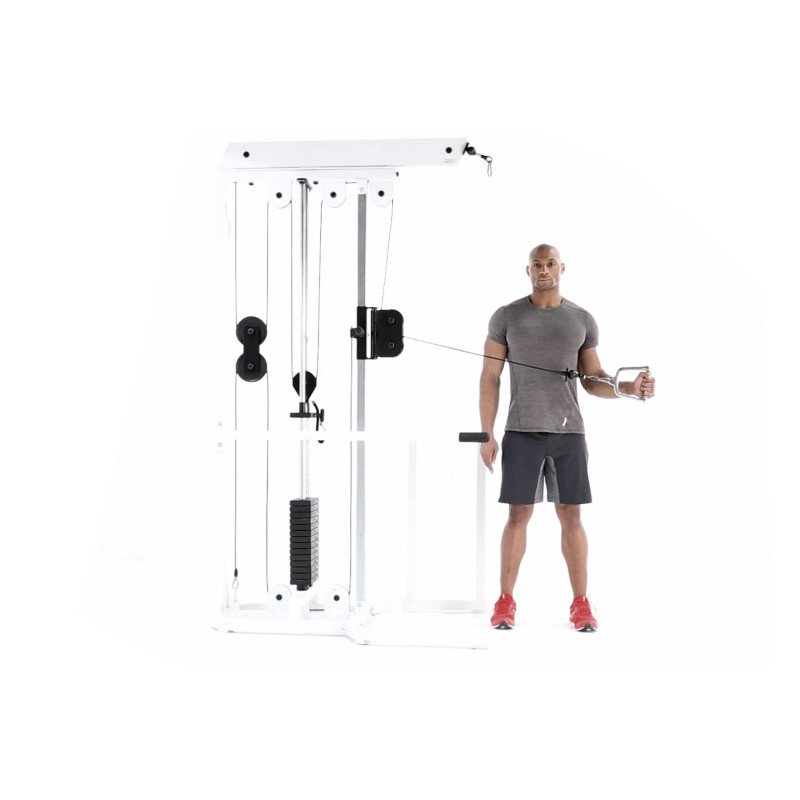
From the starting position, move the hand outward by rotating the upper arm while keeping the elbow close to your side. This is a shoulder movement with a bent elbow, not an elbow-straightening exercise. Keep the angle of the elbow approximately unchanged as the forearm travels through the arc.
The external rotators include the infraspinatus and teres minor, which are part of the rotator cuff. That does not mean this one exercise trains every shoulder function or replaces your broader upper-body programme. Think of it as a specific accessory movement. Its value depends on applying a suitable load and position rather than making the arc look as large as possible.
Finish at a comfortable position that you can reach without turning your chest towards the moving hand. Pause briefly if that helps you recognise the endpoint, then return smoothly. Do not let the stack pull you back faster than you can control. The last part of the return is still part of the repetition; dropping it changes both the effort and the starting position of the next rep.
A simple check is to watch your shirt or belt buckle while filming a light set from the front. If your whole torso swings each time the handle moves, reduce the load and try again. Video can reveal obvious movement changes, but it does not diagnose a shoulder problem or prove which individual muscle is doing the work.
Use a towel as feedback rather than a squeeze test
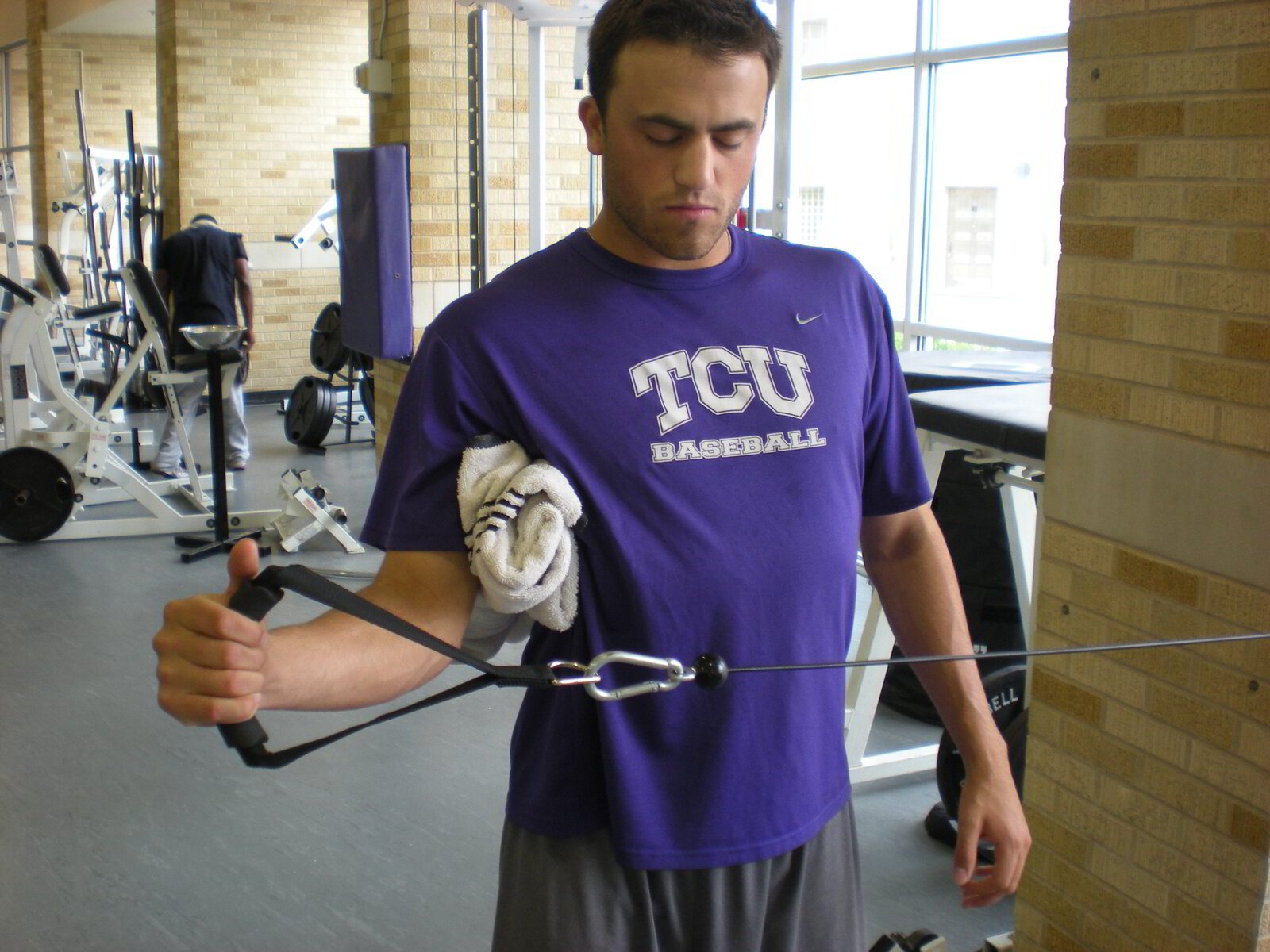
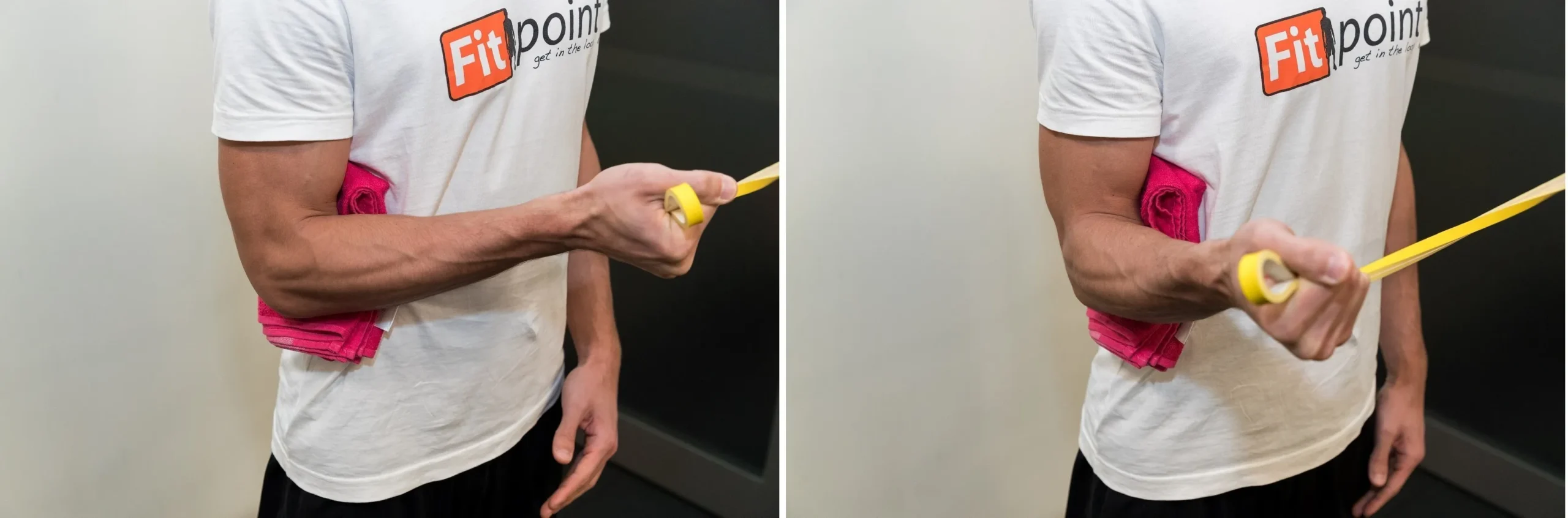
A small folded towel between the upper arm and the side can provide a useful reference point. It gives you something to notice if the elbow starts drifting away. Choose a thickness that feels comfortable rather than forcing the arm into an exaggerated position. The towel is a coaching aid, not an essential piece of equipment.
Keep gentle contact. Crushing the towel against your ribs can turn the cue into a different effort and make you tense through the shoulder or neck. The goal is to maintain a repeatable upper-arm position while the forearm moves. If you can already do that without a towel, there is no need to introduce one just to make the exercise look more technical.
Pay attention to the direction of drift. Sliding the elbow behind the body turns the repetition towards a pulling movement. Flaring it upward changes the arm position. Rolling the shoulder forward at the end changes the finish. None of those observations means your shoulder is damaged; they simply show that the repetition has stopped matching the version you intended to practise.
Change one thing when troubleshooting. Reduce the weight first if the movement becomes a struggle, then reassess the range and setup. Simultaneously changing stance, pulley height, tempo and attachment makes it difficult to tell what helped. A short, comfortable set with a clear reference point is more informative than a long set of increasingly different repetitions.
Treat a band as an alternative with its own setup
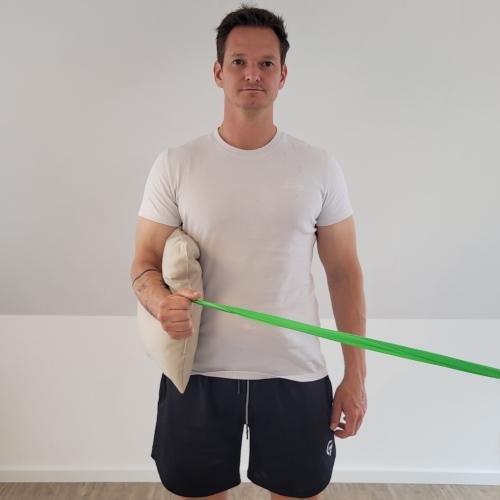
A resistance band can reproduce the basic outward-rotation task when it is anchored securely at a suitable height. Check the band and anchor before starting. Stand far enough away to have a useful amount of tension without stretching the band beyond its intended use. Keep the elbow near your side and use the same controlled outward arc.
Band tension changes as the band stretches, so the end of the movement can feel disproportionately demanding. If you can begin easily but cannot finish without twisting, move closer to the anchor or use a lighter band. Do not chase a particular colour: band colours and resistance ratings vary between products and manufacturers.
A cable and a band are not interchangeable measurements. Record which you used, the attachment or band, and enough setup detail to repeat the session. On a band, distance from the anchor matters. On a cable, the selected stack load and pulley arrangement matter. Progress on one setup does not establish an equivalent load on another.
There is also a difference between a single-arm anchored-band exercise and pulling a loop apart with both hands. Both can involve outward rotation, but the anchor, starting tension and interaction between the arms differ. Choose the version you mean to practise instead of switching between them within a set and counting the results as identical work.
Change body position when using a dumbbell
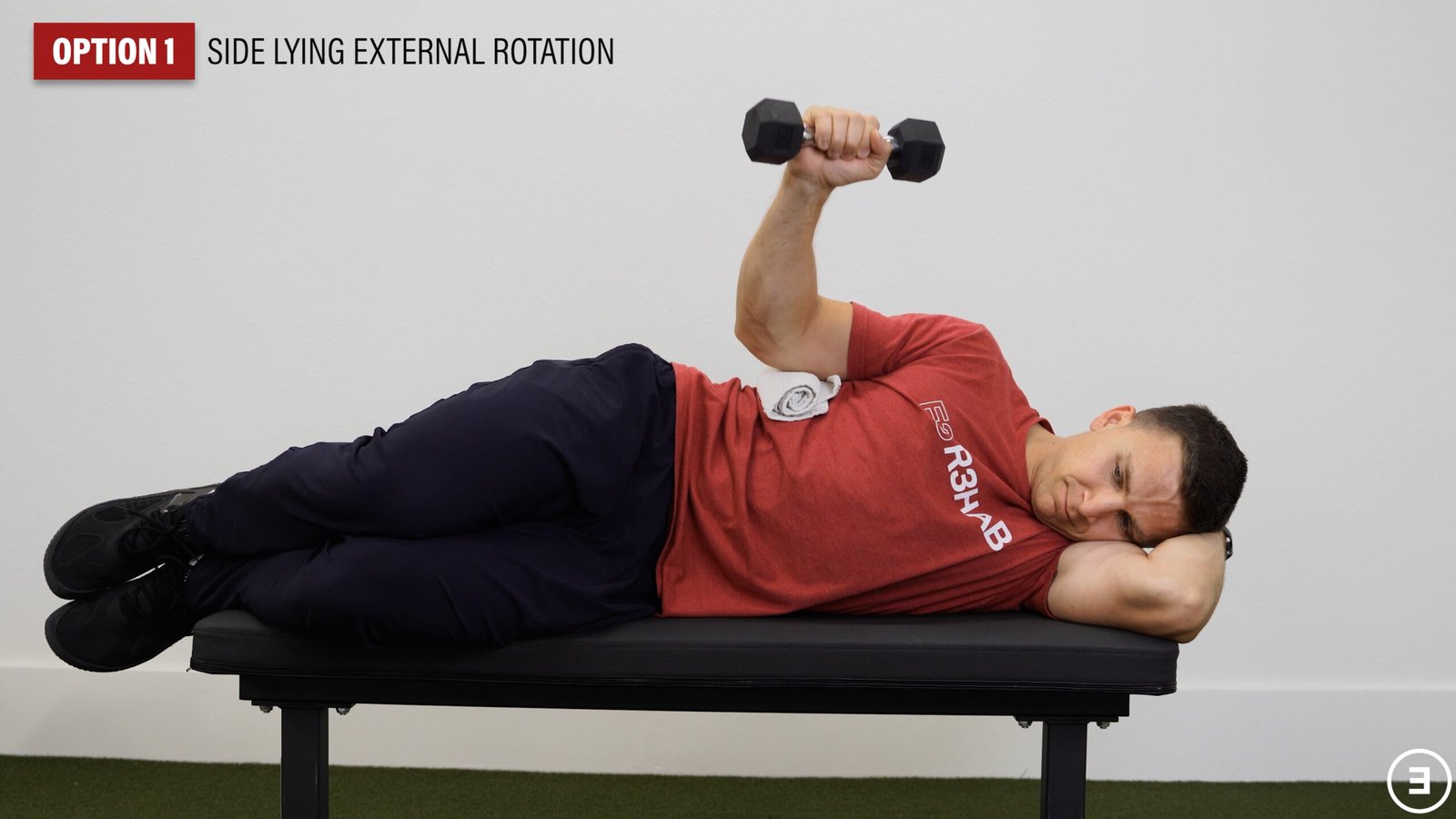
A dumbbell supplies resistance through gravity rather than through a cable pulling across your body. Simply holding it while standing and moving the forearm from side to side does not reproduce the cable exercise. The resistance direction matters as much as the name of the movement.
For a side-lying version, lie on a stable surface with the working arm uppermost. Support your head comfortably and keep the upper arm near your side, with the elbow bent. Hold a light dumbbell and rotate the forearm upwards, then lower it under control. A small towel under the upper arm can again provide a comfortable reference point.
Keep your trunk from rolling backwards to help lift the weight. End the repetition before the position changes into a different movement. You do not need to reach a dramatic overhead position. Use a light enough dumbbell that you can recognise the arc and stop it where you intend. Heavier is not automatically more useful when it removes the movement you are trying to load.
Pick one main variation for a period of consistent practice. Comparing cable, band and dumbbell options can help you find a comfortable setup, but constantly rotating between them makes progress harder to interpret. If you change variation, note that in the log and establish a new starting point rather than treating the previous weight or repetition count as a required target.
Progress the accessory without exhausting your shoulder warm-up
For a healthy lifter using external rotation as an accessory, start with a small amount of manageable work. An illustrative starting option is one or two controlled sets each side, stopping while several clean repetitions still feel available. This is an example for learning the movement, not an individual rehabilitation prescription or a requirement to reach failure.
Choose a repetition range you can perform with the same elbow position and controlled return. When that becomes repeatable, add a few repetitions before considering a small load increase. If the next stack increment is too large, keep the existing load or use a suitable lighter setup. Do not add loose weights to a machine unless its design and instructions support that arrangement.
If you include a light set before pressing or pulling, keep its purpose clear: it is preparation, not a contest to produce the biggest burn. More demanding accessory sets can be placed later in the session if that suits the programme. Record how the subsequent main work feels instead of assuming that tiring the shoulder first must improve performance.
Keep the exercise in proportion. Rows, presses and other shoulder movements still have their own roles; this small rotational task is not a substitute for all of them. Persistent pain, a recent injury, previous surgery or a sense of instability calls for individual guidance rather than pushing through a generic guide. For ordinary training, the useful progression is a repeatable position, a controlled range and an amount of work you can recover from.

Bodybuilding Shirts & Workout Gear
Bodybuilding shirts, tanks and gym gear for lifters chasing muscle, size, symmetry and the pump.

Lift Smart Brain Weight Plate Mind Muscle Connection 45 Tank Top
Add some lifting attitude to training with “Lift Smart Brain Weight Plate”.

Mind Muscle Perfection Brain and Biceps Gym for Science Sticker
Give your everyday gear a playful “Mind Muscle Perfection Brain and Biceps” twist.

Gymhead Mind Muscle Connection Sweater Meme T-Shirt
Bring “Gymhead” humor to your everyday gym style.

Voltra Cyberpunk Gym Hoodie
Show off your bodybuilding humor in a laid-back “Voltra Cyberpunk” hoodie.

Intent Stoic Bodybuilder Marble Sculpture – Meme T-Shirt
Make gym days more fun with “Intent Stoic Bodybuilder Marble Sculpture” style.

Don't Quit Do It – Motivational Jumper Pullover For Wor T-Shirt
Show some gym-day personality with “Don't Quit Do It”.

Bro – Installing Muscles Downloading Gains Meme T-Shirt
Show some lifting attitude with a playful “Gym Bro” tee.

Meme Shirt – Mode On & Motivation Top T-Shirt
Heavy lifts, good laughs, and a little “Gym Mode On Graphic” energy.

Shirt – O'Clock – Time Meme & Gains – Top T-Shirt
Show some lifting attitude with a playful “Gym O'clock” tee.

One More Rep Shirt: Motivational & T-Shirt
Make gym days more fun with “One More Rep” style.