Advertising disclosure: This page includes affiliate product links that may earn us a commission, as well as products from our own store.
A man in Kosovo held almost 374 kilograms on his lap without performing a single squat repetition. On paper, that sounds like a superhuman leg workout. In reality, Adhurim Kryeziu’s 2026 Samson’s chair record is more interesting: a highly specific isometric strength test whose number cannot be compared directly with a barbell squat. Here is what was actually achieved, what the position trains and what everyday lifters can take from it without trying to copy the stunt.
A 373.95kg wall sit is not a 374kg squat

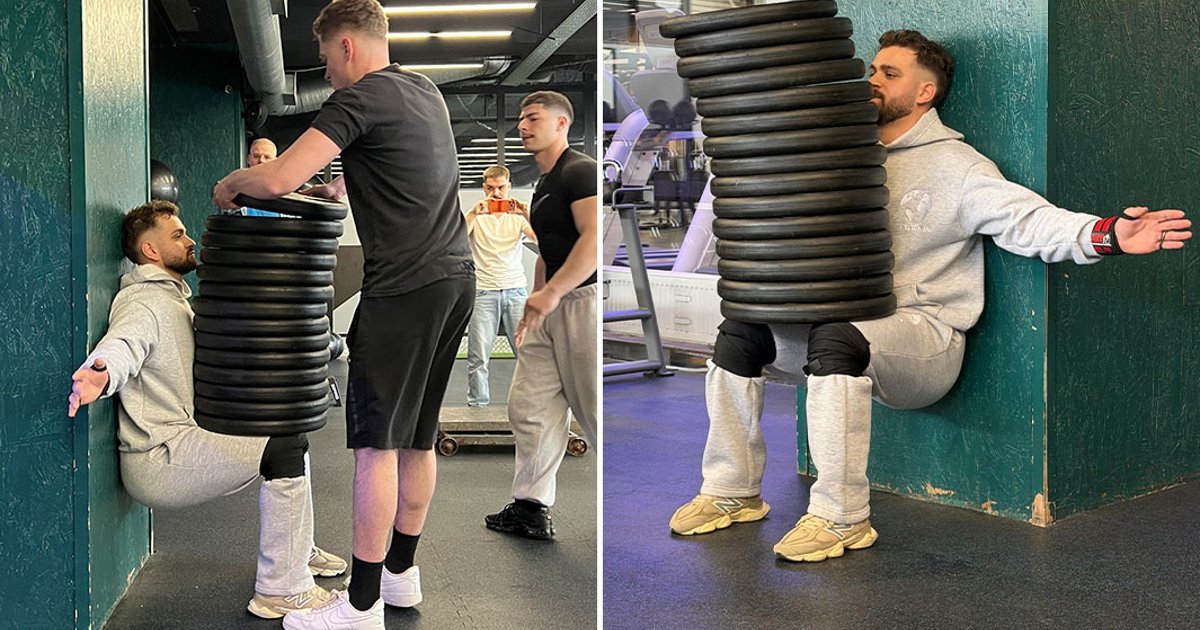
On 26 March 2026 in Prishtina, Kosovo, Adhurim Kryeziu supported 373.95 kilograms (824.41 pounds) across his lap while holding a static seated position against a wall. The feat was publicly reported on 28 September, so this is a look at a completed record, not a new November attempt. Kryeziu serves in the Kosovo Security Force and described years of strength training before specializing for this particular challenge.
The event is known as the Samson’s chair. Imagine the bottom of a wall sit: the back presses into a fixed vertical surface, the knees stay bent and the legs work without the repeated rising and lowering of a conventional squat. The enormous external stack sits across the athlete’s thighs. A wall shares the job of keeping the torso upright, while the athlete must maintain the position and resist collapse.
That distinction matters. A 373.95kg Samson’s chair does not demonstrate a 373.95kg barbell back squat, a comparable leg press or a specific one-rep maximum. The angle, support, loading point and measurement rules differ. It establishes an extraordinary feat inside one precisely defined task; treating it as an ordinary gym lift would undersell both the record and how difficult it is to compare strength feats fairly.
What actually happens when the legs stop moving
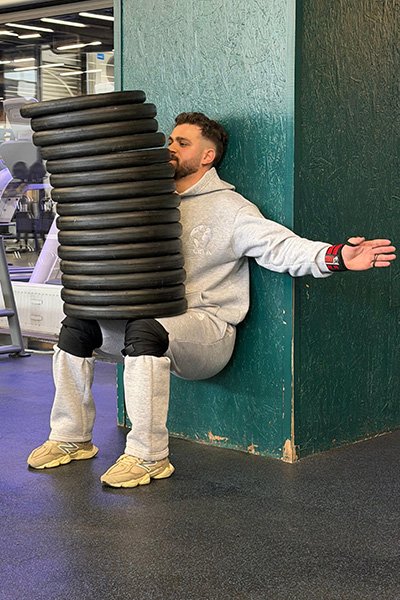
The quadriceps work hard to oppose knee flexion while the glutes and trunk help maintain the posture. The wall reduces some balance demands, but it does not switch the leg muscles off. In an isometric contraction, muscle develops force while the visible joint angle changes little. The burning sensation of a long hold is not, by itself, a measurement of force or future muscle growth.
An ordinary wall sit and Kryeziu’s heavily loaded event look related but are not interchangeable prescriptions. Adding a plate to a modest wall sit changes the muscular challenge. Stacking hundreds of kilograms against the thighs also changes contact pressure, loading procedures and the consequences if the position fails. A record setup includes the people and processes around the attempt; it should never be recreated casually between sets at a commercial gym.
The visible images of the attempt help explain the geometry. Assistants position a tall stack of plates while Kryeziu remains braced against a wall. Once the plates are in place, the observer sees a stationary person under an extraordinary load, not a bar travelling through a squat range of motion. That is precisely why the record’s name and equipment context need to stay attached to the number.

Equipment Worth Exploring
Explore equipment, accessories and gear from our carefully selected range.

GymPin Squat Wedges
Non-slip 15-degree squat wedges help elevate the heels for deeper quad-focused squats.

Leg Press/Hack Squat BPR-790
Convertible 45-degree leg press and hack squat machine with a broad footplate and band pegs.

Compact Leg Press CLP-700
Compact reverse-style leg press with a moving seat carriage and an adjustable footplate.

Leg Extension/Curl BCO-780
Leg extension and lying leg curl combo with plate loading, band pegs and a cable-loading option.



Studio V-Squat
Plate-loaded V-squat machine for supported lower-body strength training.

Studio Glute Drive
Plate-loaded hip-thrust machine with supported back pad and adjustable foot platform.

HUSLA Leg Extension Pad
Pad attachment designed to increase usable range of motion on compatible leg-extension machines.

The preparation was specialized, not an everyday leg-day template
Kryeziu reported building toward the attempt through gradual exposure to heavier loads and attention to consistent position. He also described the work of managing fatigue as the weights increased. His background in general strength training mattered, but this uncommon event demanded practice in its own right. Public accounts do not supply a verified week-by-week training plan, exact hold duration or full loading schedule; presenting one as his personal program would be invention.
Progressive preparation here has at least three dimensions: the ability to hold the chosen knee angle, tolerance for the relevant time under tension and confidence in the setup. Raising load while shortening the hold does not prove the same adaptation as making a lighter hold longer. A useful training log separates resistance, angle, duration, rest and technical quality instead of treating every wall sit as a single number.
A second error is changing the angle each time the timer starts. Moving the feet closer to the wall, raising the hips or shifting weight onto the toes can turn two apparently equal holds into different exercises. Set a reference floor mark for your feet, keep the trunk contact consistent and record the chosen depth. If a training partner watches, ask them to verify posture rather than merely counting seconds. That simple consistency is more informative than chasing a longer hold by quietly changing the rules.
One further lesson is that persistence does not erase recovery. A hard isometric finisher can make an otherwise manageable squat or lunge session feel much harder. If the main goal is progressively heavier squats, schedule high-fatigue holds after the priority lifts and monitor whether later sessions suffer. A record specialist and a recreational bodybuilder can both value consistency without copying each other’s event-specific risk.
How wall sits compare with squats and leg extensions
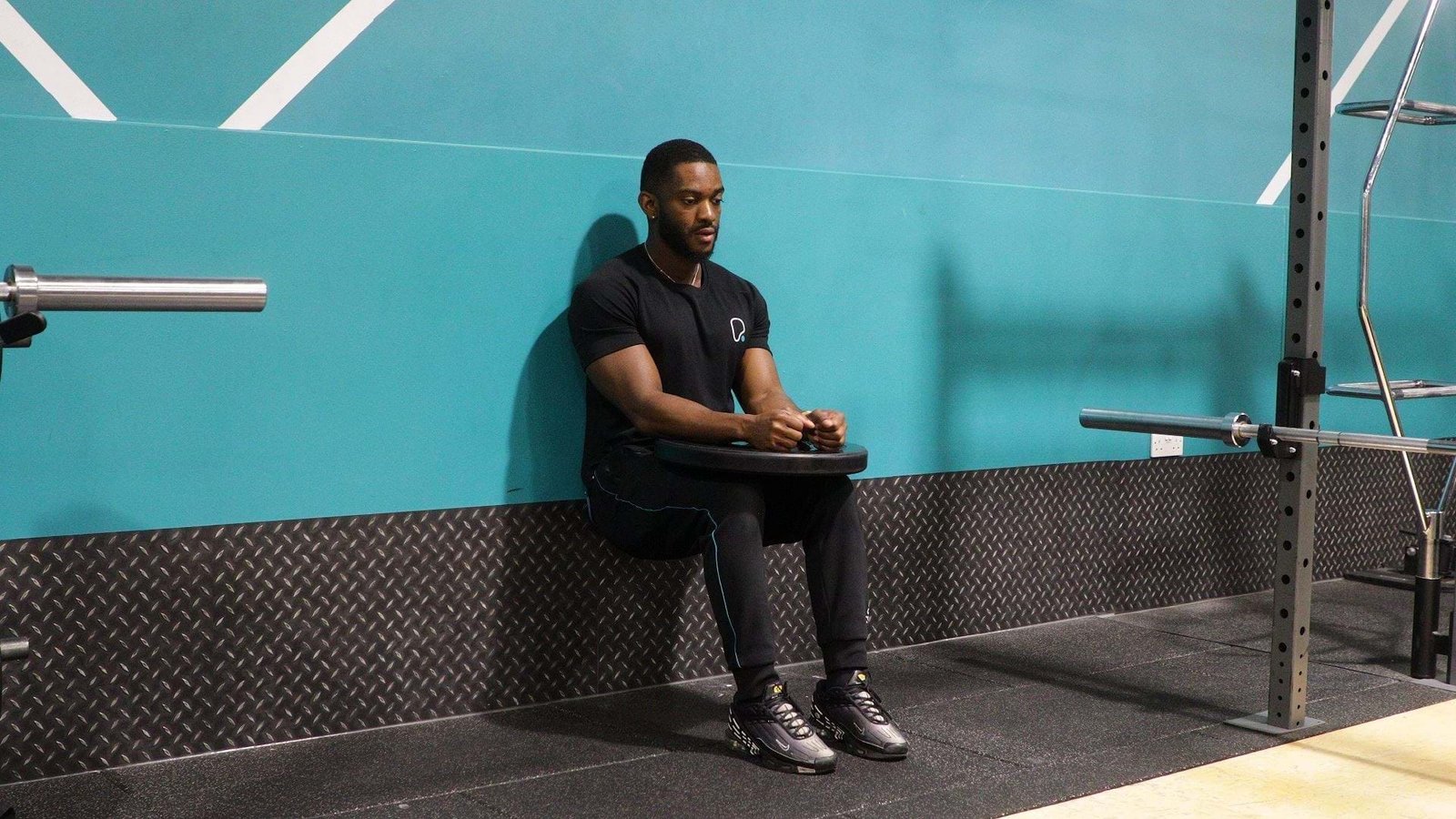
Squats involve changing knee and hip angles against resistance. Leg extensions deliberately move the knee while the torso is supported. A wall sit holds one position for time. All can challenge the quadriceps, yet their joint-angle exposures and skill demands are different. Improving a 45-second wall sit should not be advertised as guaranteed improvement in a full-range squat, and a stronger squat does not automatically make someone proficient in a loaded Samson’s chair.
Research on isometrics has interesting uses, but the claims have to match the experiments. A trial of people with knee osteoarthritis found that acute wall-squat bouts changed some measures of pain sensitivity without a demonstrated difference in reported clinical pain intensity. That is not evidence that record-level loading treats knee pain. Other studies examining brief isometric wall-squat breaks during sedentary time address vascular or blood-pressure outcomes, not elite maximal strength.
For hypertrophy and broad leg strength, complete sessions can mix controlled moving repetitions with optional static work. Keep a sensible full-range squat, split squat or leg press as a foundation if those movements fit your goals and mobility. Use wall sits to practice holding posture and to add a specific time-based challenge. The main trade-off is not which exercise looks tougher on camera, but which adaptations are actually needed and recoverable.
Equipment Worth Exploring
Explore equipment, accessories and gear from our carefully selected range.

Grip Plates
Rubber-coated weight plates with handholds for loading barbells and machines.


FID Bench MAX
Adjustable bench offering flat, incline, and decline positions + adjustable headrest.

Multi Bench MBX-650 2.0
Adjustable multi-bench with roller adjustment, 15 backrest positions and accessory mounts.


Rubber Hex Dumbbells
Rubber-coated hex dumbbell pairs with a stable shape for home and commercial strength training.

Belt Squat Collar
Heavy-duty collar adapter for compatible belt-squat and landmine bar setups.


Seated Leg Combo BCO-680
Adjustable seated leg extension and leg curl machine with band pegs for added resistance.
A practical wall-sit progression that does not mimic the stunt
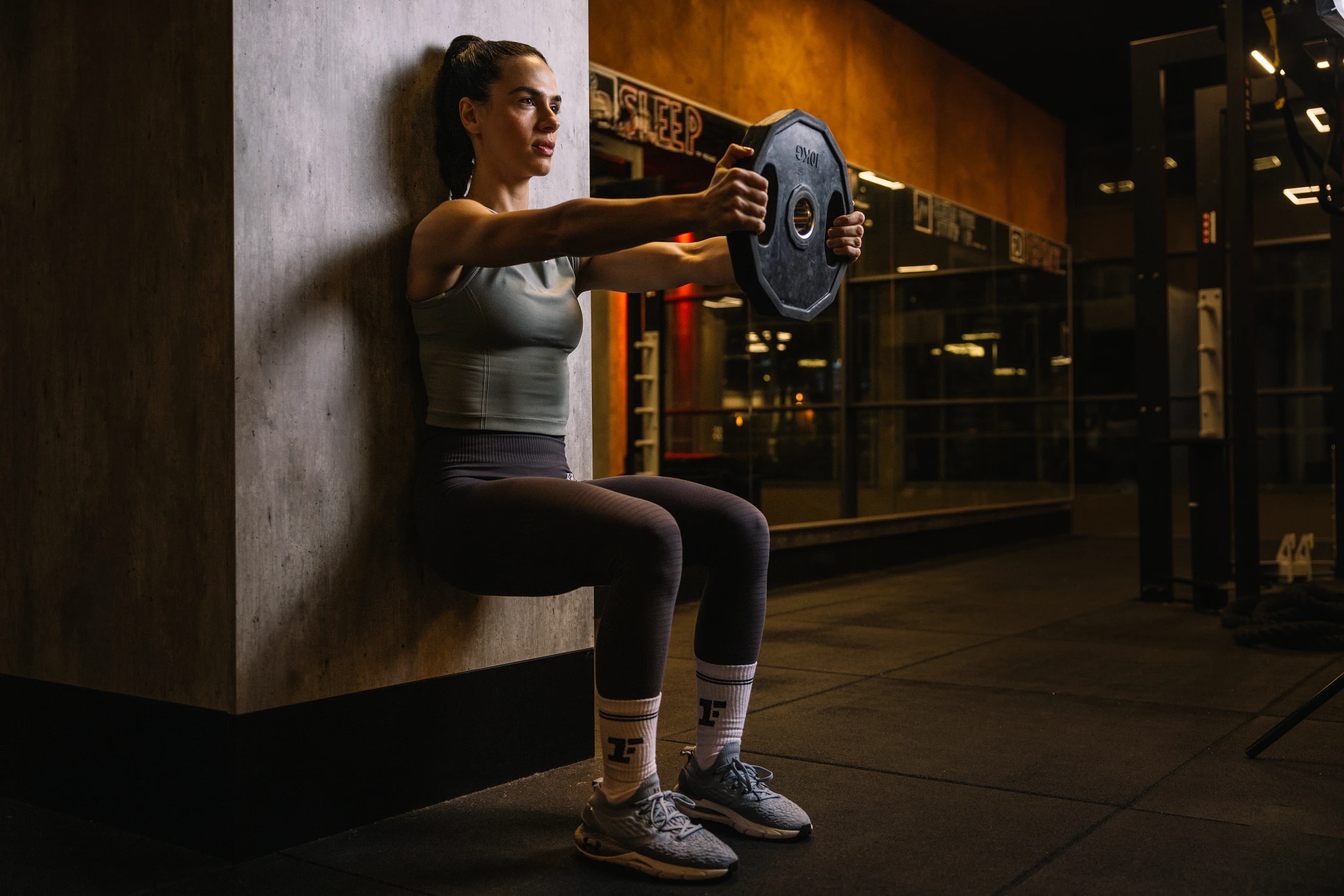
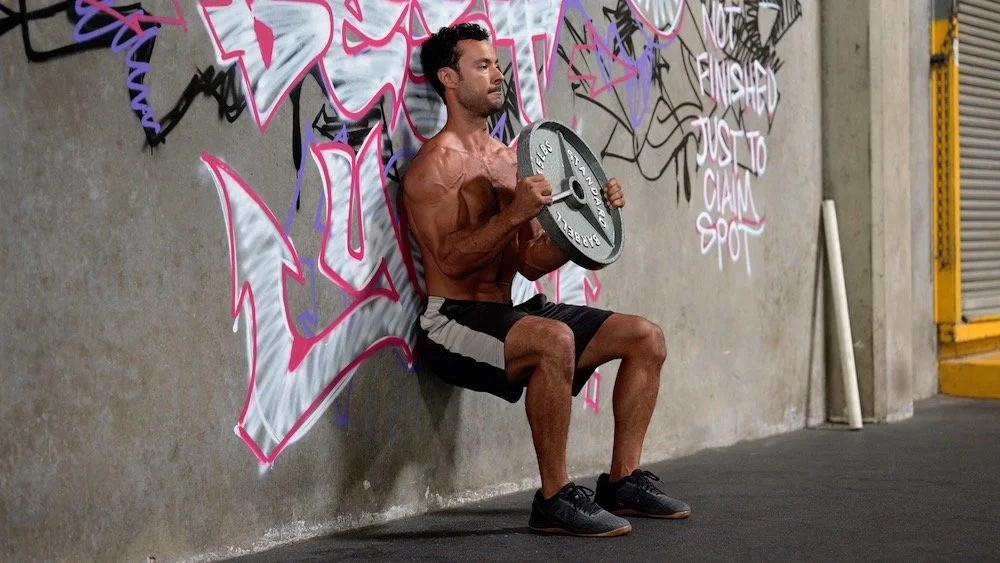
First choose a clear wall and a secure non-slip floor. Stand with your back supported, place your feet far enough forward that the knees and ankles remain comfortable, then slide into a depth you can control. Beginners can hold a shallower position; reaching an exact 90-degree knee angle is not a prerequisite for useful practice. Keep the whole foot planted and breathe rather than holding the breath for a prolonged challenge.
Try two or three sets of 15–30 seconds after normal leg training, with enough rest to repeat the same position. When that feels repeatable, progress toward 30–45 seconds before considering a small increase in challenge. This is an illustrative beginner progression, not an adaptation of Kryeziu’s reported training. The aim is a consistent standard, not a record attempt. Stop if you experience sharp pain, numbness or dizziness.
For more variety, alternate a wall sit with squats on separate sessions, or use short unloaded holds between movements only when they do not compromise the next set. A light plate held securely can be a later option for experienced exercisers, but there is no need to stack plates on the thighs. People with active knee symptoms, blood-pressure concerns or other conditions should discuss unusually demanding holds with a qualified clinician rather than assuming an exercise is therapeutic.
The real lesson from the record is measurement, not imitation

Kryeziu’s achievement is a striking example of specificity. The record recognized a particular static position, an exceptional supported load and an attempt conducted under defined conditions. It is neither proof that heavy wall sits are the best quadriceps builder nor evidence that every lifter should seek the same pain tolerance. Distinguish the accomplishment from the exercise you might use during a normal training week.
That perspective also makes ordinary progress easier to evaluate. For a strength goal, track working weights and repeatable technique. For a wall-sit goal, hold a consistent position for a measurable time. For a bodybuilding goal, observe longer-term training performance and recovery rather than ranking exercises by how dramatic a single effort looks. Consistent measurements beat heroic but incomparable gym clips.
Kryeziu has discussed interest in future heavy dumbbell walking-lunge challenges, though no specific future title should be assumed. His March record is already remarkable on its own. The practical takeaway for everyone else is straightforward: develop general strength, practice the exact test you care about, add difficulty gradually and respect the difference between a safe training drill and a specialized demonstration of extreme strength.

Leg Day Shirts & Workout Gear
Leg-day gym shirts and workout gear for lifters who never skip squats, lunges and lower-body punishment.


Squats R Us Shirt – Leg Day Gains & T-Shirt
Heavy lifts, good laughs, and a little “Squats R Us” energy.

The Quadfather Leg Day Meme Top & T-Shirt
Bring “The Quadfather” humor to your next gym day.

1 Plate Squat Club Meme – Motivational Top T-Shirt
Bring “1 Plate Squat Club” humor to your next gym day.

I Love Squats Valentine'S Day Shirt – & T-Shirt
Heavy lifts, good laughs, and a little “I Love Squats Valentine's Day” energy.

Santa Quads Funny Christmas Gym – Festive Workout Pullo T-Shirt
Bring “Santa Quads Funny Christmas” humor to your everyday gym style.

Coffee Shots & Heavy Squats for Leg Day, Lifting and Fi Tank Top
Add some leg-day attitude to training with “Coffee Shots & Heavy Squats”.

Never Skip Leg Day – NSLD Fried Chicken Meme Decal for Sticker
Bring “Never Skip Leg Day” attitude to your water bottle or laptop.


Squat Queen Gym | Funny Burger King Parody Workout Deca Sticker
Bring “Squat Queen” attitude to your water bottle or laptop.