Advertising disclosure: This page includes affiliate product links that may earn us a commission, as well as products from our own store.
A shorter workout can be a sensible goal. The difficult question is what gets shortened: waiting around, low-value work, or the training stimulus itself? Astronaut exercise makes that distinction unusually concrete. Crew time is valuable, equipment is specialised, and simply floating through a demanding working day does not replace loaded exercise.
A 2020 comparison involving nine astronauts on an experimental programme and seventeen following standard training explored a higher-intensity, lower-volume approach. It offers a useful example of training efficiency, with an equally useful warning: similar outcomes between programmes do not mean either programme prevented every decline.
What the nine-versus-seventeen comparison tested

The experimental Sprint group performed resistance exercise three days a week and aerobic exercise six days a week, alternating interval and continuous sessions. The standard group performed resistance and aerobic exercise daily. That immediately rules out one tempting headline: this was not a comparison of three total workouts a week against daily training.
The groups were small: nine participants in Sprint, seventeen in the comparison group. Before and after long-duration spaceflight, assessments covered bone mineral density, strength, agility and peak aerobic capacity. Those outcomes answer different questions. A programme could preserve one capability more successfully than another; a single overall verdict would conceal that distinction.
For a reader with a crowded calendar, the useful starting point is the question the comparison asks. Can a different distribution of demanding work conserve time while retaining useful outcomes? It is a better question than whether the shortest imaginable session can replace everything else. It also requires a definition of success before the schedule changes.
Your own definition might be completing planned lifting sessions while maintaining a particular exercise performance. That is an ordinary planning example, not a claim that a recreational lifter can reproduce an astronaut experiment. Keep the desired result specific enough that a shorter calendar entry cannot pass as progress by itself.
Less lifting frequency did not mean less effort
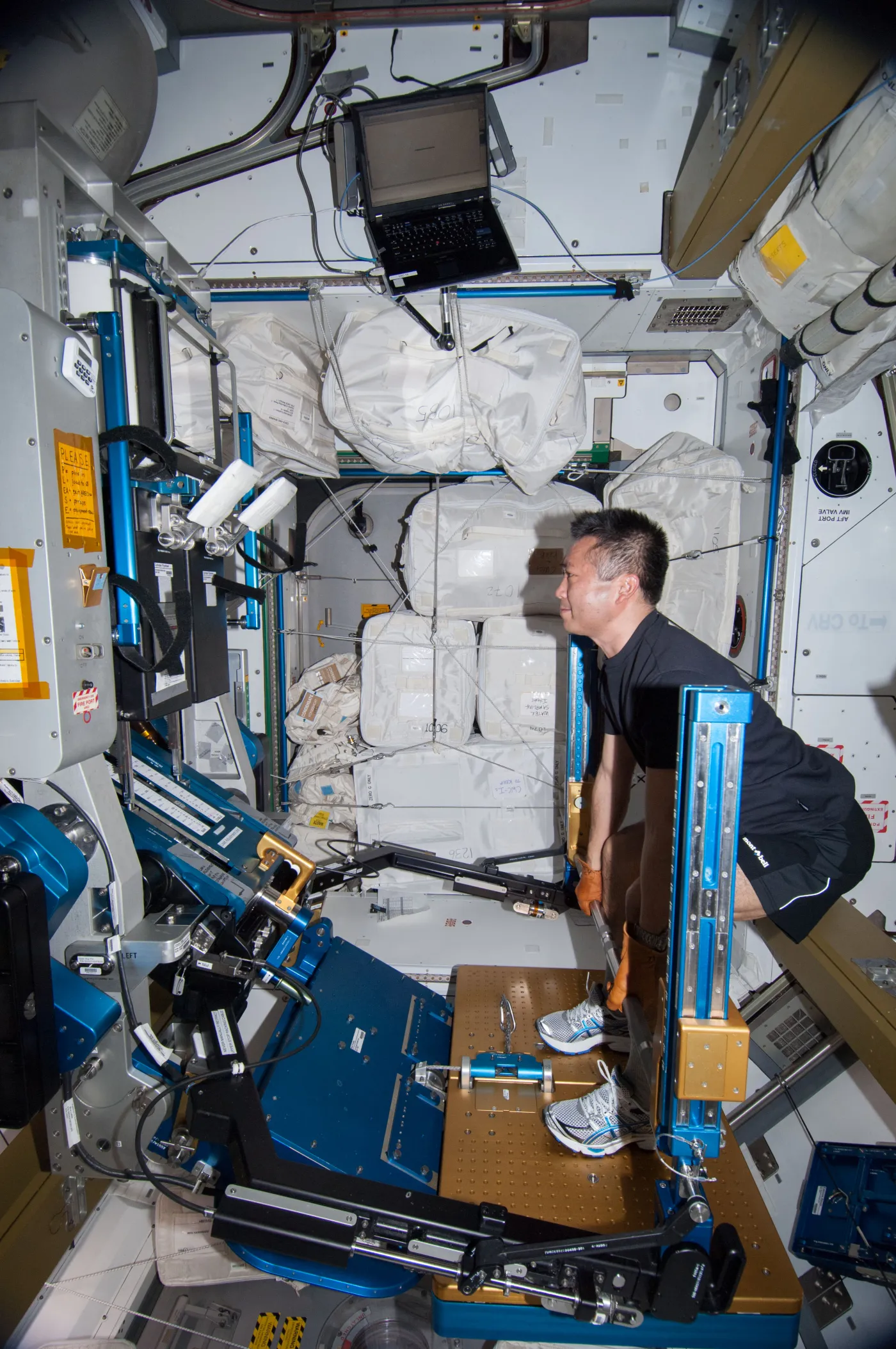
The distinction between frequency and training demand matters throughout this story. Three resistance days describe how often that part of the programme occurred. They do not establish an easy workload, permission to remove all other exercise, or a recommendation to push every set to failure.
On the space station, the Advanced Resistive Exercise Device provides resistance without relying on a conventional stack of weight plates. Its vacuum-cylinder system allows loaded movements despite the microgravity environment. Hardware, restraints and body positioning are part of the task; a photograph resembling a squat does not make its loading identical to a gym squat.
MMP’s explanation of why astronaut squat loading needs more than a machine number explores that measurement problem in more detail. Here, the important point is narrower: counting training days leaves much of the actual work undescribed.
If you want to make an existing session more efficient, first write down what fills it. Exercises, working sets, rest periods and equipment changes give you something concrete to review. Removing an unnecessary change of station is a different decision from deleting a demanding exercise. Treat the two decisions separately rather than calling both “lower volume” and assuming they have the same consequences.
Resistance work and cardio had different jobs
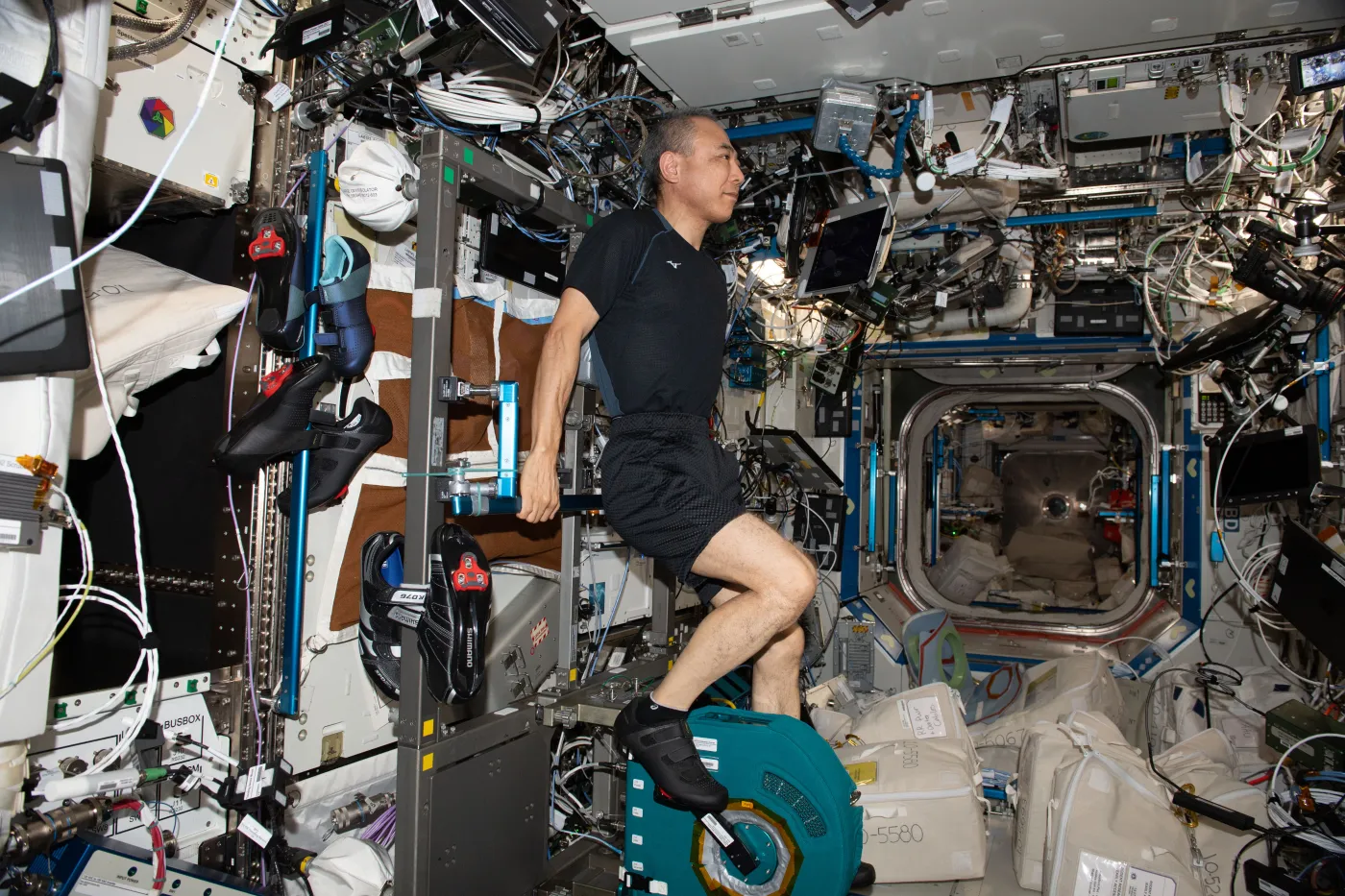
Space-station exercise uses distinct tools: a resistance device, a treadmill and a cycle ergometer. The treadmill uses a harness to apply loading; the cycle allows pedalling in an environment where a normal seated setup is unnecessary. These are solutions to specific operating conditions, rather than futuristic versions of equipment that everyone needs at home.
The Sprint schedule retained frequent aerobic work alongside the resistance sessions. Its intervals and continuous sessions were different components of the same programme. Calling the whole approach “lift three times a week” would erase much of what participants actually did.
That is a useful check on any compressed-workout claim. Ask which activity was reduced, which remained, and which outcome was measured. A change to lifting frequency does not, on its own, tell you whether endurance, agility or bone measures were retained. Likewise, a better aerobic score would not automatically establish that every aspect of strength was protected.
For your own planning, keep separate lines for lifting and conditioning rather than hiding both beneath one weekly session count. This is a way to describe your programme accurately, not a requirement to copy six aerobic days. A schedule should make its demands visible before it starts borrowing credibility from an unusual setting.

Funny Gym Shirts & Workout Gear
Funny gym shirts, tanks, hoodies and workout gear for lifters who like training hard.

Nice Try Gravity Astronaut Deadlift – , Gymbros & T-Shirt
Rep “Nice Try Gravity Astronaut Deadlift” humor in and out of the gym.

– Flex Armstrong Astronaut Moon Huge Arms Jumper T-Shirt
Show some gym-day personality with “Flex Armstrong Astronaut Moon Huge Arms”.


| Pencilneck Science-Based Lifting Hooded for Gym Bros Hoodie
Bring “Pencilneck Science-Based Lifting” gym humor to lazy days and post-workout plans.

Lift Smart Brain Weight Plate Mind Muscle Connection 45 Tank Top
Add some lifting attitude to training with “Lift Smart Brain Weight Plate”.

Off-Season Rest Day & Meme Fans Hooded Hoodie
Keep it laid-back with a little “Off-Season Rest Day” attitude.

Installing Muscles Meme – Motivation Decal Bros & Sticker
A fun “Installing Muscles” touch for bottles, laptops, and lockers.

Donut Give Up – Punny Workout Motivation Hooded Pullove Hoodie
Keep it laid-back with a little “Donut Give Up” attitude.

Don't Quit Do It – Motivational Workout Vest Muscle Shi Tank Top
Bring “Don't Quit Do It” humor to your next lifting session.

Live Love Lift Muscle Shirt Athletic Vest Gymbro Workou Tank Top
Train hard, laugh a little, and rep “Live Love Lift”.
Similar results did not mean complete protection

Overall, the two programmes did not produce appreciably different outcomes. Across participants, however, post-flight changes included a 1.7% reduction in femoral-neck bone mineral density, a 5.8% reduction in knee-extensor peak torque and a 6.1% reduction in peak aerobic capacity. Cone-agility completion time increased by 7.4%: that means slower performance.
Those are combined changes, not percentages belonging solely to the nine-person Sprint group. Some individual comparisons favoured Sprint, but the broader conclusion remains limited. Similar overall results in small groups do not prove that every outcome was identical, that one schedule was universally superior, or that either eliminated the effects of spaceflight.
The result is more interesting when those distinctions stay intact. Time conservation can matter even when protection is incomplete. Conversely, a programme that takes longer does not earn a better verdict merely because its calendar looks busier. You need the actual outcomes and the conditions in which they were measured.
This is also why a dramatic setting should not become a shortcut around scrutiny. Astronauts have specialised equipment and extensive operational support. The memorable part of the story may be training in orbit; the useful habit is checking the comparison group, the measured outcome and the remaining losses before accepting a headline about efficiency.
Use the time-efficiency lesson without copying space training
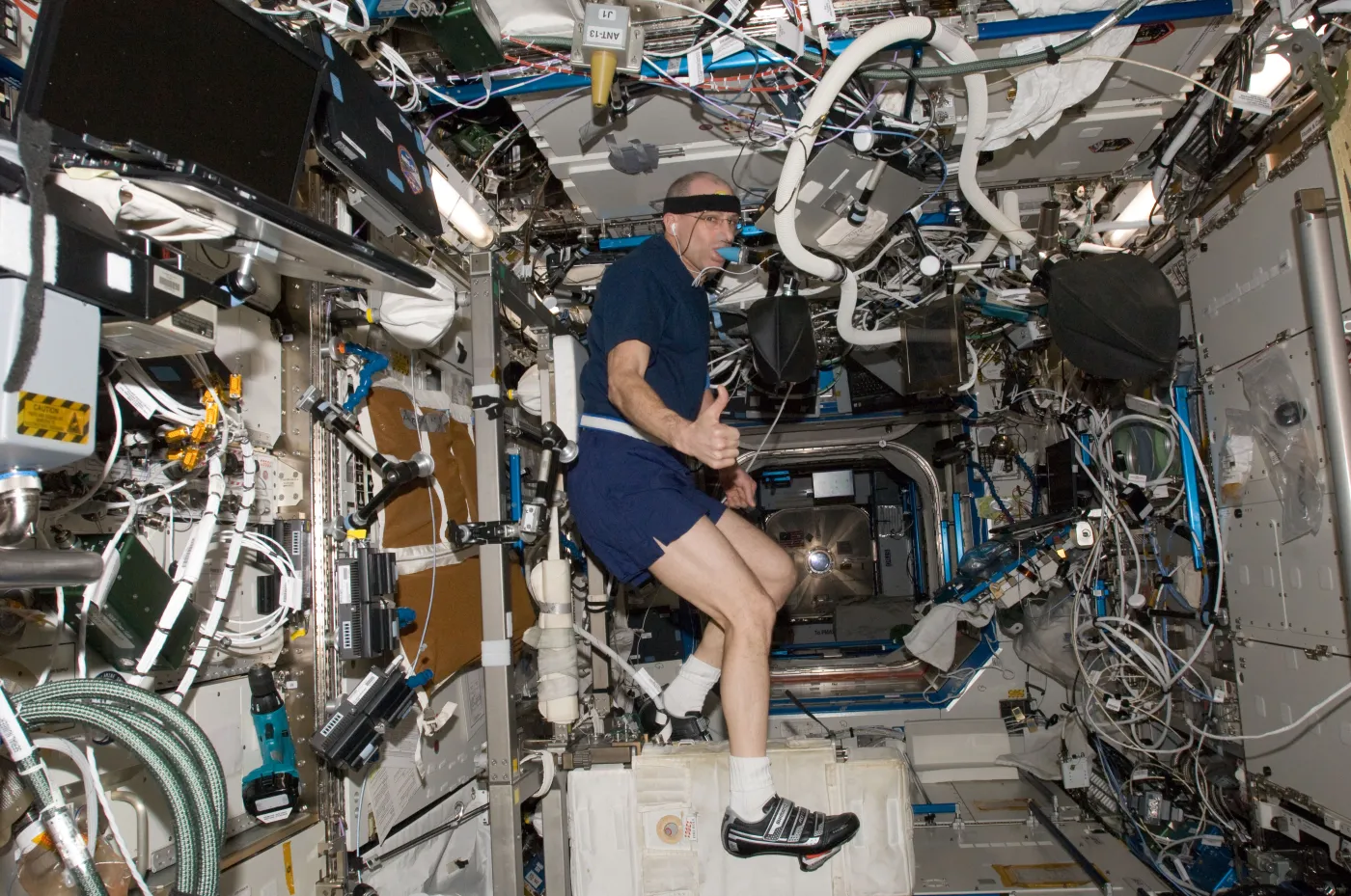
Astronaut preparation includes support before flight, during the mission and after return, involving conditioning professionals and rehabilitation specialists. Ground preparation also uses more varied equipment and activities than the three main in-orbit exercise devices. An orbiting workout is therefore one part of a much larger preparation and reconditioning process.
The transferable lesson is to make a time-saving decision reviewable. As a simple planning exercise, note how long your current sessions actually take, which planned work you complete and what performance you want to retain. Change a clearly identified part of the schedule, then review the same information again. That log will not reproduce a controlled study, but it can stop convenience from becoming your only measure of success.
Feasibility deserves its own attention. MMP’s discussion of exercise-break schedules that survive a working day looks at the gap between planned activity and activity people complete. That is a useful companion question when a programme appears manageable on paper but repeatedly disappears from your week.
Keep the ambition proportionate. This comparison does not supply an optimal three-day split for Earth, an excuse to abandon cardio, or a promise that harder sessions erase every cost of reduced training. It shows why a shorter programme deserves assessment rather than automatic dismissal—and why its benefits need to be stated alongside its limits. Save time with a clear purpose, then check what the change actually preserved.