Advertising disclosure: This page includes affiliate product links that may earn us a commission, as well as products from our own store.
Jump rope is a skill before it is a cardio test
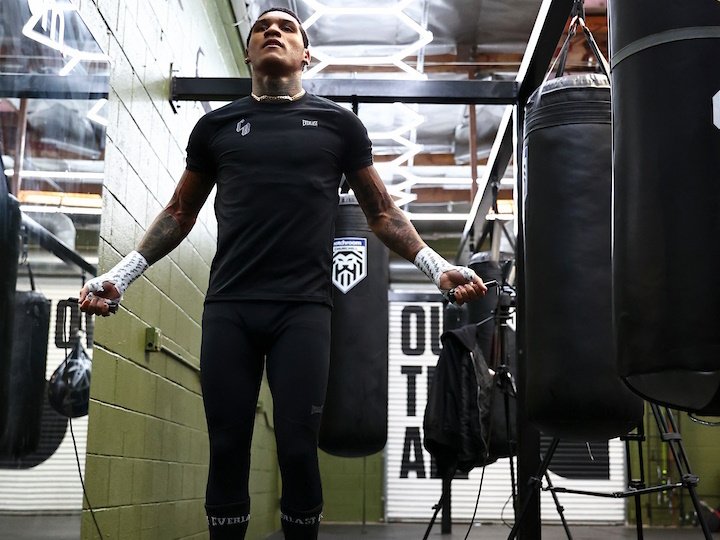
Jumping rope looks like the simplest conditioning exercise in the gym. You need a rope, a little floor space and enough clearance overhead. But someone who can squat twice their body weight may still be exhausted after a minute of skipping. That does not necessarily mean their aerobic fitness is poor. They might simply be wasting energy on excessive jump height, tense shoulders and mistimed landings.
For lifters, the attraction is a combination of portability, cardiovascular work and coordination. Unlike sitting on a stationary bike, skipping requires you to repeatedly land and rebound while controlling a moving object. That makes it useful, but it also changes how you should introduce it to a training program. Your heart may be ready for considerably more work than your calves, feet and Achilles tendons.
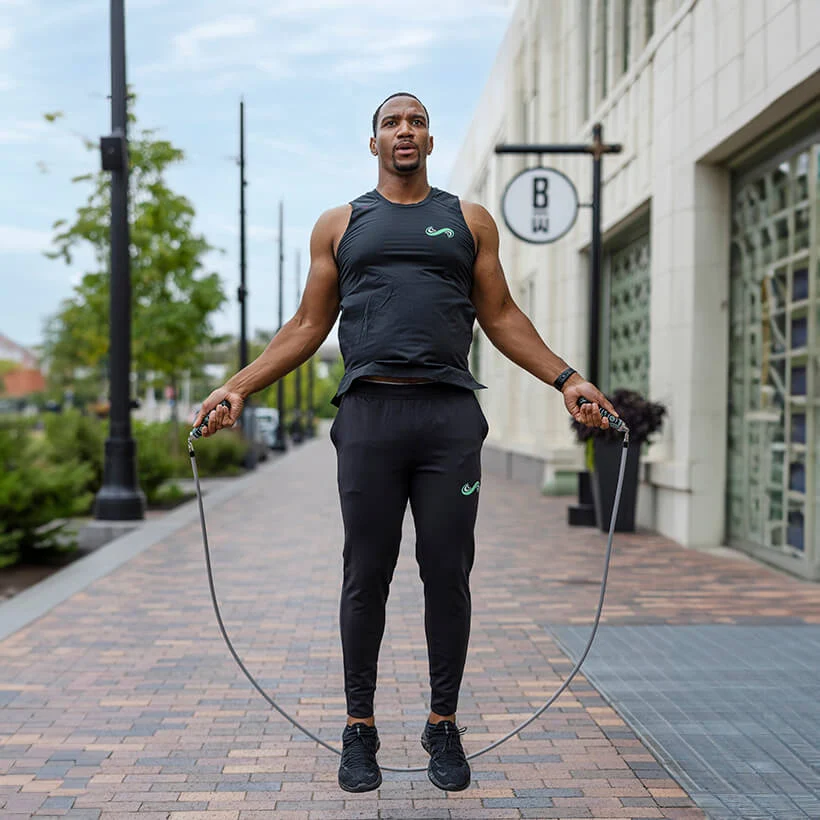
Start by separating the movement skill from the conditioning goal. Hold your elbows near your sides, keep the handles around hip height and turn the rope with small movements of your wrists. Jump only high enough to clear the cable. Land softly with your knees unlocked, and avoid forcing your heels to remain elevated throughout every session. Your feet should generally remain underneath your body rather than drifting forwards as fatigue accumulates.
Practice ten to twenty consecutive single unders without chasing speed. If you trip, reset and continue rather than jumping aggressively to compensate. Once you can complete several short sets with similar technique, you have a much better foundation for intervals. Counting clean repetitions is initially more useful than measuring how sweaty you get. A session with ten controlled bouts and plenty of recovery can be more productive than five minutes of repeated mistakes.
What rope training can and cannot build
Skipping can improve conditioning, coordination and some aspects of lower-body athletic performance. It should not, however, be sold as a shortcut to building large calves or getting lean without changing anything else in your routine. The adaptations depend on the intensity, duration, progression and population being trained.
A systematic review covering 21 studies and 1,021 participants found improvements across several fitness outcomes, including cardiorespiratory fitness, jumping and sprinting. Much of the research involved young people, and intervention periods varied from six to forty weeks. Those results make rope training a reasonable conditioning option, but they do not tell us precisely how much an experienced adult lifter will improve. The review did not establish a clear increase in lean mass or muscular endurance across the included studies.
In a separate eight-week trial involving 52 university students, a rope-training intervention added ten minutes of skipping once per week to physical education. Some measures of lower-limb isometric strength and a heart-rate-based fitness index improved. That fitness index is not a direct measurement of maximal oxygen uptake, and changes in a strength test should not be interpreted as proof of muscle growth.
Weighted ropes deserve similarly realistic expectations. A small twelve-week study in adolescent female volleyball players reported better agility results with weighted rope training than standard rope training, but did not find significant between-group differences in speed or flexibility. It would be premature to assume the same benefit for every strength athlete. Another six-week investigation in CrossFit participants found no significant changes in measured shoulder rotational torque after a weighted rope program.
Think of skipping as a complementary skill and a means of accumulating cardiovascular work. Continue using progressive resistance exercises for the muscle groups you specifically want to grow. If fat loss is the goal, the rope is one way to increase physical activity, not a guarantee of a particular calorie expenditure or change in body composition.
Choose a rope and a surface that match the job
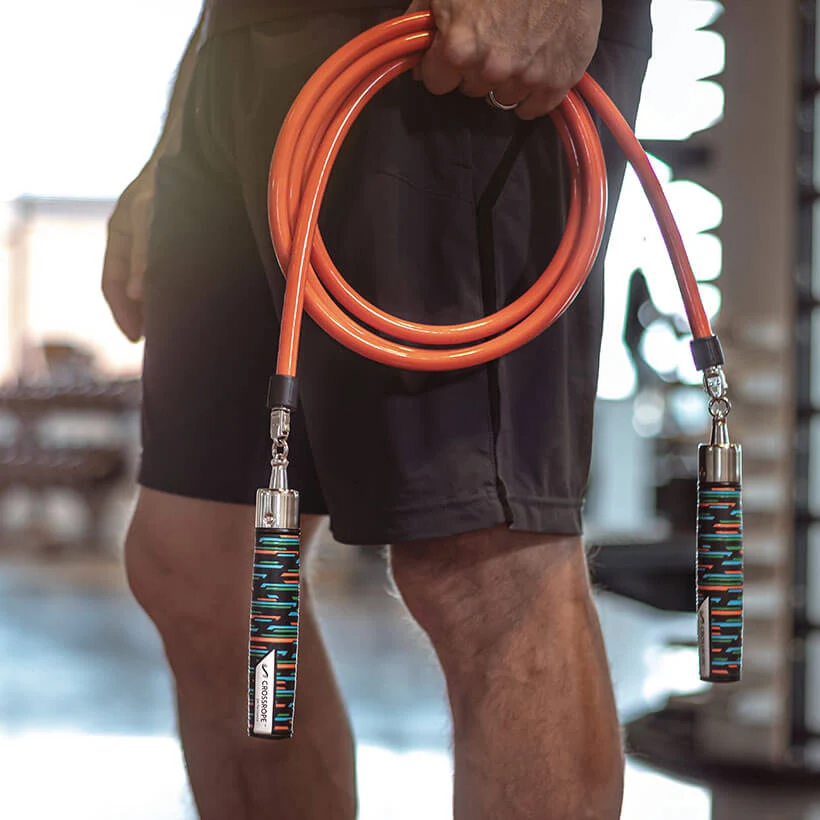
A basic adjustable rope is usually the best first purchase. A slightly more substantial cable can provide useful feedback because you can feel where it is during each revolution. Extremely light speed cables are excellent for experienced athletes who already have reliable timing, but beginners sometimes struggle to sense their position.
Weighted ropes come in different forms. Some have heavier handles, while others distribute additional mass along the cable itself. Those designs do not feel identical: cable mass changes the effort needed to accelerate and redirect the rotating rope. Start with a modest increase in load rather than immediately purchasing the heaviest option. If your wrists, elbows or shoulders become the limiting factor before you can sustain a useful conditioning effort, the equipment may be poorly matched to that particular goal.
Check length by standing on the middle of the rope and bringing both handles upwards. A common starting point is for the handles to reach roughly the lower chest to armpit region, depending on the handle design and individual technique. Fine-tune in small increments. Excess cable tends to strike the floor far ahead of you, while an overly short rope can encourage excessive jump height or awkward hand positioning.
Use a level surface that provides reliable grip and enough give for repeated landings. A suitable gym floor is preferable to rough concrete, which may also wear through the cable. Avoid thick, unstable mats that catch the rope. Check your ceiling clearance with the rope rotating slowly, and keep furniture, racks and other people outside your turning radius.
If repeated impact is not well tolerated, use a bike or rower for most of your conditioning instead. Ski trainers, climbers, treadmills and sleds also provide ways to vary your conditioning depending on available equipment and tolerance. You do not need to force skipping into every training plan simply because it requires less space than a machine. The best option is the one you can perform consistently without undermining your strength work.

Equipment Worth Exploring
Explore equipment, accessories and gear from our carefully selected range.


Four weeks of short intervals
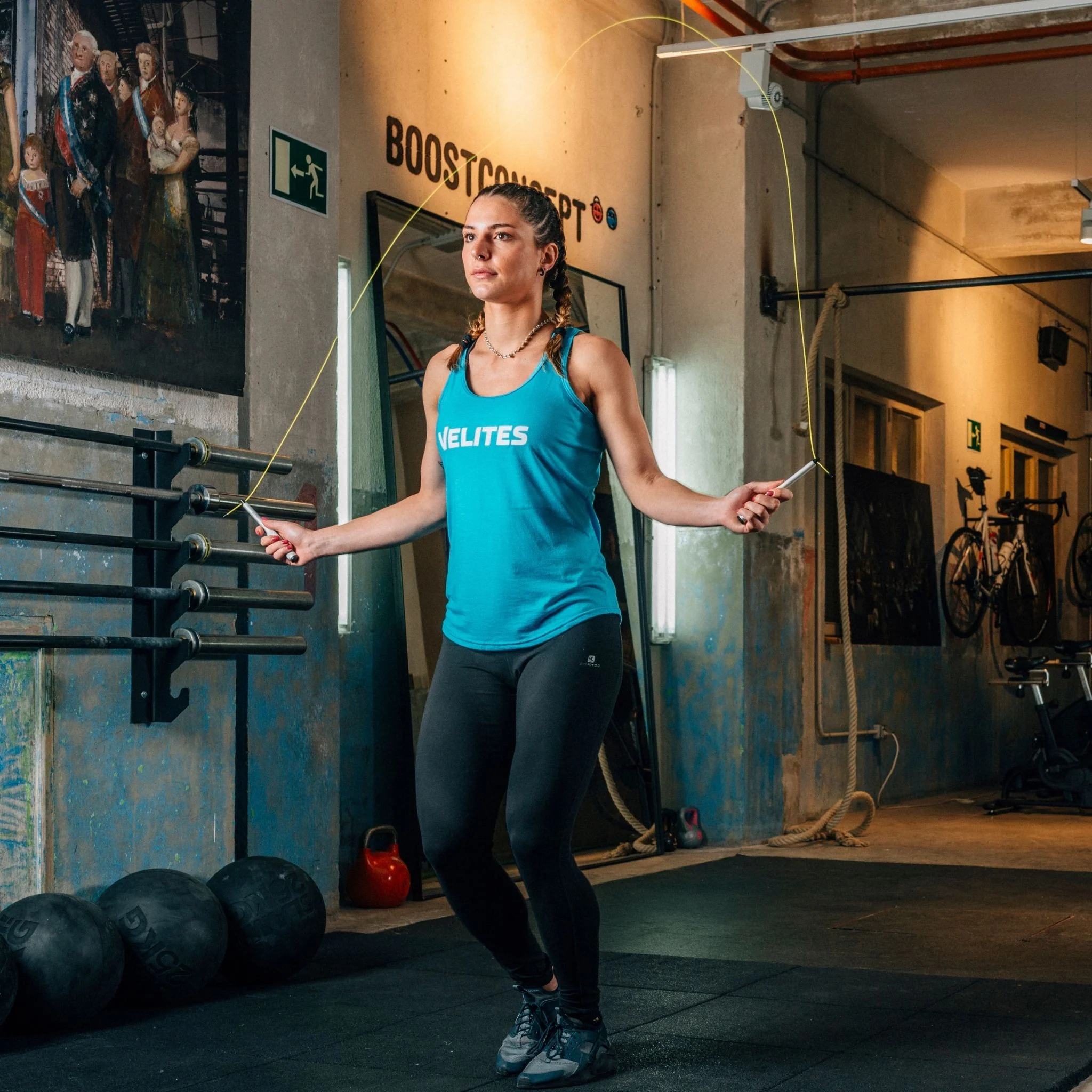
The following progression is an editorial example for a lifter who is new to skipping but already exercises regularly. Perform two sessions per week on nonconsecutive days. The goal is controlled repeatability, not maximum effort. Begin with several minutes of easy movement and a few short practice bouts before starting the timed work.
- Week 1: Six rounds of 20 seconds of skipping and 60 seconds of walking or standing recovery. Accumulate two minutes of actual rope work.
- Week 2: Eight rounds of 20 seconds and 40–60 seconds of recovery. Aim for consistent jump height and quiet landings.
- Week 3: Eight rounds of 30 seconds and 45 seconds of recovery. Accumulate four minutes of actual work.
- Week 4: Ten rounds of 30 seconds and 30–45 seconds of recovery. Accumulate five minutes of actual skipping.
Keep most intervals at a moderate perceived effort during these first weeks. If you cannot finish a round with essentially the same movement pattern as you started, slow down or shorten the next interval. When a particular week causes persistent calf soreness or interferes with your lower-body training, repeat the previous week rather than advancing according to the calendar.
Record actual skipping time, successful repetitions if convenient, perceived effort and any discomfort during the following day. Do not confuse total session duration with active work. For example, ten rounds of 30 seconds with 30 seconds of recovery occupy ten minutes, but only five of those minutes are spent skipping.
After the introductory block, increase either the active interval length or the number of rounds, not both at once. You could progress from thirty seconds to forty-five seconds per bout while keeping eight rounds and sufficient recovery. Alternatively, maintain short bouts and accumulate more of them. Faster footwork, boxer skips and double unders are optional skills, not mandatory requirements for improving conditioning.
Sharp pain, swelling, dizziness or symptoms that worsen with continued jumping are reasons to stop rather than finish the prescribed number of intervals. Persistent tendon or joint symptoms merit assessment before progressing. A low-impact conditioning alternative can keep you active while you establish what is appropriate.
Fit skipping around your lifting days

Where the rope fits in your weekly split matters as much as the interval format. If your main goal is strength or hypertrophy, perform challenging rope intervals after the priority resistance exercises or in a separate session. A few easy minutes before lifting can be a useful warm-up, provided they do not fatigue the muscles you need for the upcoming session.
For a four-day upper/lower split, try skipping after Monday’s upper-body workout and on Thursday after the second upper-body session. That gives you room to adjust around lower-body fatigue. If the Tuesday or Friday leg workout suffers, reduce the rope volume, move it further from your hardest lower-body work or substitute cycling. For a three-day full-body split, two short sessions after the lighter workouts may be a simpler arrangement.
A useful mixed-conditioning week could consist of two brief rope sessions and two longer, easier bike or walking sessions. Another option is a short circuit involving controlled kettlebell swings or sled work, separated from your rope practice until both movements are familiar. You can train cardiovascular fitness without making every session a maximal circuit.
General adult physical-activity guidance recommends at least 150 minutes of moderate-intensity aerobic activity or 75 minutes of vigorous activity per week, alongside muscle-strengthening work on at least two days. A novice skipping program contributes toward that broader goal but will not automatically fulfil it. Walking, cycling and other aerobic activities can account for the remaining work.
Judge the program after four weeks by whether you can maintain clean repetitions for longer, recover more comfortably between bouts and integrate the work without sacrificing your lifting performance. Those are more useful markers than an impressive but isolated skipping challenge. The rope should make your training more capable and flexible, not turn your recovery days into additional leg days.

Cardio Shirts & Workout Gear
Cardio and conditioning gym gear for runners, endurance athletes and anyone who earns the sweat.

Anti Jump Rope Club Shirt Cardio Meme Top & Gymbros T-Shirt
Rep “Anti Jump Rope Club” humor in and out of the gym.

Wonder Woman Jumprope Gym | Superhero Cardio Meme Worko Hoodie
Keep it laid-back with a little “Wonder Woman Jumprope” attitude.

Hero Jump Rope Cardio Speed Flash Inspired Workout Musc Tank Top
Add some cardio attitude to training with “Gym Hero Jump Rope Cardio Speed”.


Cardio Sucks Negative Review 1 Star Hooded Hoodie
Show off your cardio humor in a laid-back “Cardio Sucks” hoodie.

Cardio Is Hardio – Workout Meme Vest Muscle Shirt For S Tank Top
Add some cardio attitude to training with “Cardio Is Hardio”.

Skip Cardio Exit Cardio Meme Decal Water Bottles & Sticker
Put “Skip Cardio” gym humor on your laptop, bottle, or gym gear.

Don't Quit Do It – Motivational Workout Decal for Gym B Sticker
Give your everyday gear a playful “Don't Quit Do It” twist.


Straight Outta Shape – Out Of Shape Meme T-Shirt
Add a playful “Straight Outta Shape” touch to your casual rotation.