Advertising disclosure: This page includes affiliate product links that may earn us a commission, as well as products from our own store.
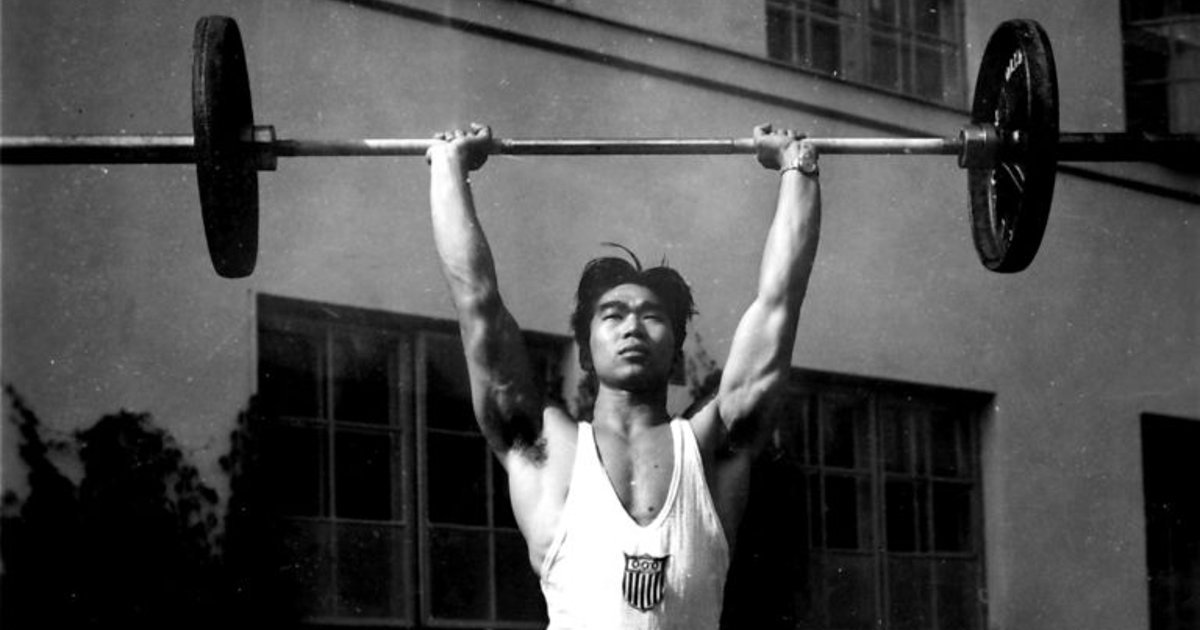
Tommy Kono’s Olympic medal record refuses to stay in one box. He won lightweight gold in Helsinki in 1952, light-heavyweight gold in Melbourne in 1956, and middleweight silver in Rome in 1960. Three medals, three bodyweight categories—and a career that also included physique competition and coaching in different settings.
That combination makes him more interesting than a vintage photograph of a muscular man beneath a barbell. His story asks useful questions about how we compare strength, what an old competition total actually measures, and how much a champion can contribute after leaving the platform. It also deserves more care than turning a remarkable life into an invented workout or a simplistic message about overcoming adversity.
Three Olympic medals in three different classes
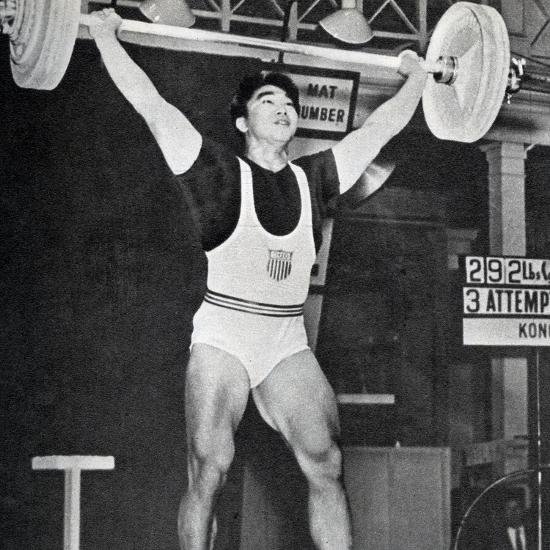
Kono’s first Olympic title came in the 67.5 kg category at Helsinki. Four years later, he won at 82.5 kg in Melbourne. His third Olympic appearance brought silver in the 75 kg class at Rome. Those numbers are category limits, not an instruction to imagine his bodyweight landing on exactly the same number at every weigh-in.
Nor should the sequence be described as a straight climb through progressively heavier divisions. The middleweight silver followed the heavier-class gold. The important historical point is his ability to remain competitive across categories and separate Olympic cycles. A medal table tells us the outcome; it does not provide the full preparation, selection decisions or daily training behind it.
That is a useful distinction for anyone comparing strength records. Before putting two performances beside each other, identify the event, bodyweight category, date and rules. A heavier total is one piece of information, while placing against a particular field is another. Neither should erase the other, and a change in category makes a simple before-and-after reading less straightforward.
Kono’s results also resist the idea that only gold belongs in a successful sporting story. Silver in a third class remained an Olympic medal. Reading it solely as the end of a winning run loses the achievement inside that result. A long career can include both a change in competitive position and an extraordinary standard of performance.
His six world championship victories came in 1953, 1954, 1955, 1957, 1958 and 1959. Calling that six consecutive calendar years would be wrong: the sequence passes through the 1956 Olympic season. It is a small wording difference with a large effect on accuracy. A useful career summary preserves the distinction between the editions an athlete won and the years printed beside them.
His competition total belonged to a three-lift sport
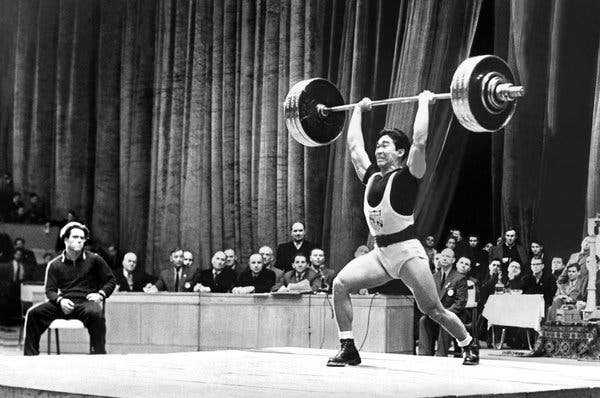
The Olympic weightlifting of Kono’s medal-winning years included the press, snatch, and clean and jerk. Modern international weightlifting uses the snatch and clean and jerk. The press was removed from international competition starting in 1973, following the decision made in 1972. That rules change matters whenever an old total appears in a modern strength discussion.
For example, his Helsinki winning total was 362.5 kg across three lifts. It would be misleading to place that figure directly against a present-day two-lift total and announce which athlete was stronger. The arithmetic is adding different events. Even before considering equipment, categories or competition conditions, the basic scoring system requires an explanation.
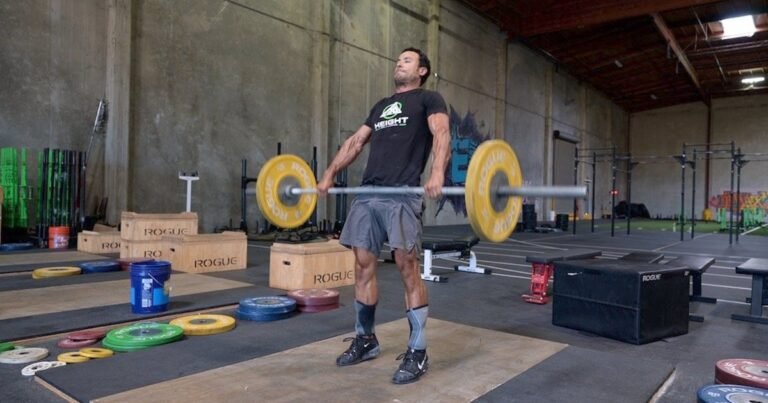
The same care applies to photographs. A still image with a bar overhead does not automatically establish which lift was performed, whether an attempt was accepted, or what the athlete eventually totalled. A dramatic position is a moment in a sequence. Use a verified result to describe an achievement, and use a photograph to show the person and setting rather than asking it to prove everything.
Our profile of Ray Ewry’s standing-jump achievements raises a related historical issue: sporting events and counting conventions change. Kono’s old totals are impressive within the competition they describe. Explaining that competition makes them more meaningful than presenting a large number without its definition.
The weightlifter also competed for his physique
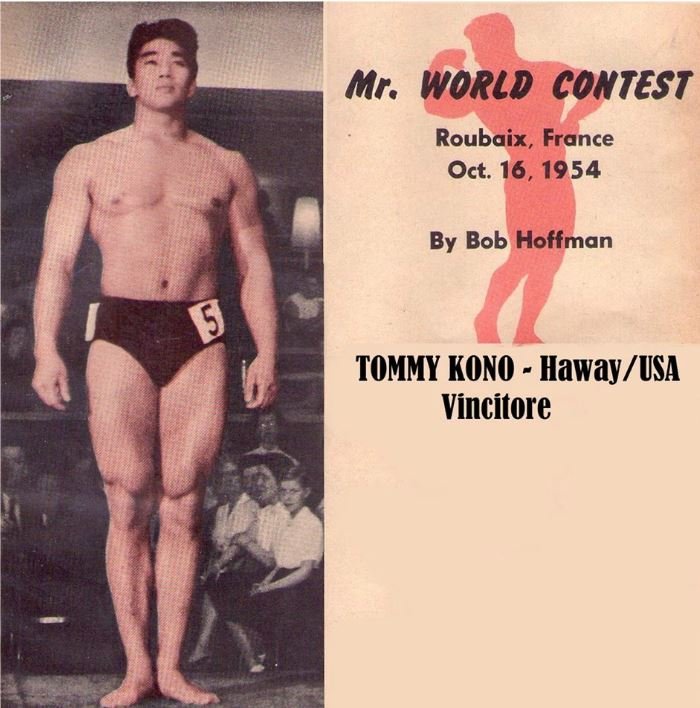
Kono also competed successfully in bodybuilding. That part of his career belongs alongside his lifting record rather than being treated as an amusing footnote. The platform and the physique stage ask different questions. One records performance in defined lifts; the other evaluates a presented physique under its contest’s judging framework.
His participation in both does not prove that every weightlifting program produces a contest-ready body, or that a particular physique guarantees an Olympic total. It shows that one athlete pursued both forms of competition. The distinction keeps admiration grounded: being accomplished in two settings is interesting precisely because their demands are not interchangeable.
For a present-day lifter, the useful reflection is about priorities. If you enjoy both strength and appearance goals, describe each separately. A training block might be judged by more reliable lifting performance, while a physique goal needs its own way of assessing change. One good barbell session cannot settle every question about appearance, and one flattering picture cannot describe a complete strength profile.
A historical physique photograph also has limits. Lighting, pose and the selected moment affect what we see. It cannot establish someone’s complete diet, training split, body-fat percentage or lifetime drug history. Kono’s documented achievements already provide plenty to discuss. There is no need to attach unsupported certainty to the parts a picture cannot answer.
Weight categories are context, not a cutting prescription
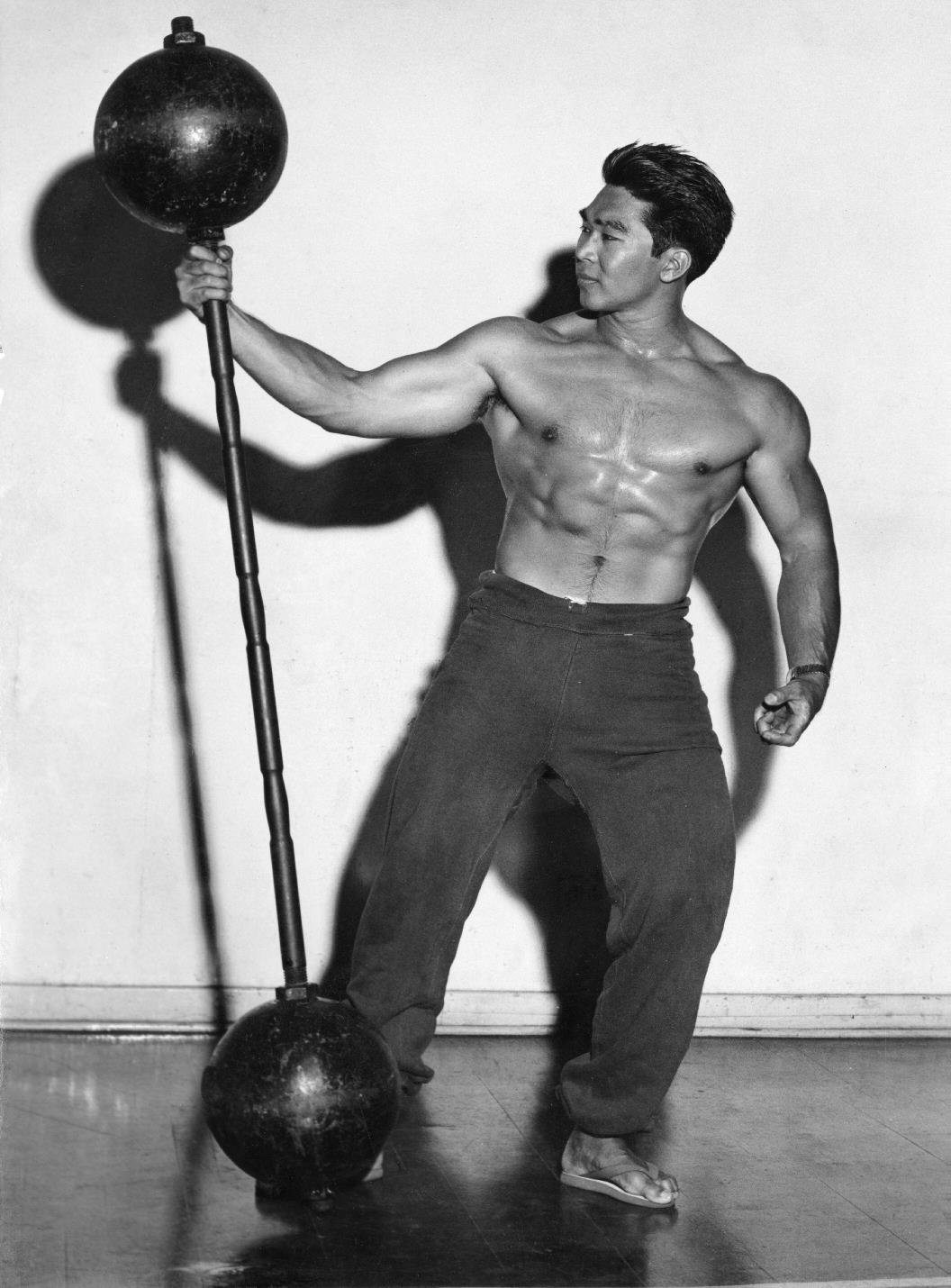
It is tempting to turn Kono’s category changes into a ready-made lesson about bulking and cutting. That would go beyond what the medal record tells us. The categories identify where he competed, but they do not give a complete timeline of how he managed bodyweight, why each decision was made, or what another athlete should imitate.
For the same reason, avoid reverse-engineering a program from a portrait with a barbell. A posed picture does not establish the implement’s exact weight, whether it was regular training equipment, or how many sets were performed. The visual can express an athlete’s connection with strength without functioning as a training log.
A better way to borrow inspiration is to make your own goals explicit. Are you pursuing a competition result, a more consistent technical performance, a physique change, or simply a sustainable relationship with barbell training? Those can overlap, but naming the main aim makes it easier to judge whether your current practice serves it. That is an editorial takeaway, not a reconstruction of Kono’s routine.
Keep comparable entries in your own log: identify the exercise, range of movement, equipment and any relevant competition standard. Record a change rather than silently treating a different variation as the same test. You can appreciate Kono’s versatility while applying a more modest principle to everyday training: progress is easier to understand when you know what you are measuring.
A career that continued through teaching
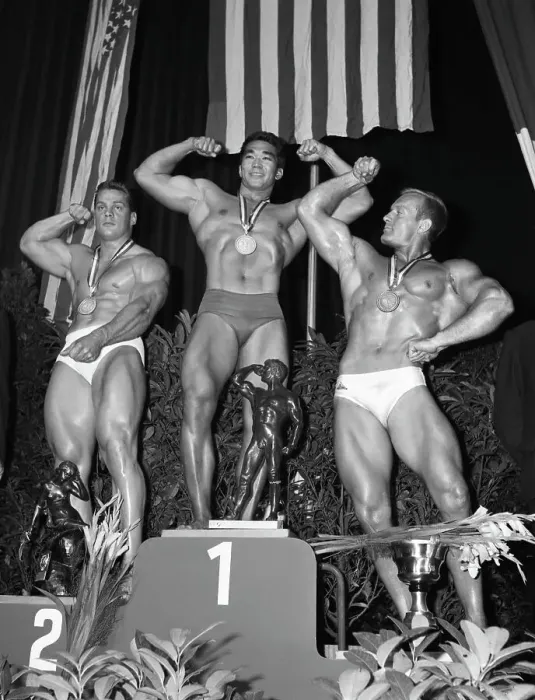
Kono’s life began far from the medal podium. Born in Sacramento in 1930, he was introduced to lifting while his family was incarcerated at Tule Lake during the Second World War. That history should be stated plainly. His later achievements do not justify the incarceration or turn it into a desirable route to athletic development.
After his competitive career, Kono coached Olympic teams for Mexico in 1968, West Germany in 1972, and the United States in 1976. That is a different kind of contribution from winning a medal himself. An athlete performs a skill; a coach must help someone else understand and develop it. The two roles can connect without being the same achievement.
He also wrote about lifting, including books on Olympic-style weightlifting, and taught through seminars. That broadens the meaning of a strength legacy. Records describe a performance at a particular time; instruction can help other people approach the sport long afterward. Neither needs to be reduced to a claim that one secret method explains an entire career.
There is another connection in Al Oerter’s career beyond his best-known Olympic victories: the most familiar results need not contain the whole sporting life. For Kono, the full picture includes lifting, physique competition and teaching. Each adds context rather than merely increasing a single headline number.
That is what makes this history useful to lifters today. You do not need an invented champion’s split to find value in it. Take the care with comparisons, the recognition that strength and physique are different goals, and the respect for learning a skill well enough to explain it. Practice, consistency, improvement and training partners can matter in an ordinary gym without pretending the next session is an Olympic final.

Funny Gym Shirts & Workout Gear
Funny gym shirts, tanks, hoodies and workout gear for lifters who like training hard.

Barbell Heartbeat Muscle Shirt Athletic Vest for Powerl Tank Top
Train hard, laugh a little, and rep “Barbell Heartbeat”.

I’m Strong Barbell Heartbeat Hooded Pullover for Streng Hoodie
Make your off-duty look more fun with “I’m Strong Barbell Heartbeat”.

Barbell Buddies for Gym Buddies, Workout Partners, and Hoodie
Keep it laid-back with a little “Barbell Buddies” attitude.

Raise The Barbell Shirt – Motivational & T-Shirt
Show some powerlifting attitude with a playful “Raise The Barbell” tee.

Vitruvian Man With A Barbell Shirt – Leonardo Da T-Shirt
Show some powerlifting attitude with a playful “Vitruvian Man With A Barbell” tee.

Barbell Crossed Weights 45LB Plate Hardcore Workout Gra T-Shirt
Show some powerlifting attitude with a playful “Classic Barbell Crossed Weights 45LB Plate” tee.

Progress Stoic Bodybuilder Greek God Marble Sculpture T-Shirt
Heavy lifts, good laughs, and a little “Progress Stoic Bodybuilder Greek God Marble” energy.

Practice Stoicism Under The Barbell: Sigma Greek God T-Shirt
Make gym days more fun with “Practice Stoicism Under the Barbell:” style.

Consistency King Tee
Make gym days more fun with “Consistency King Stoic Greek God Marble” style.

Focus Stoic Bodybuilder Greek God Marble Sculpture T-Shirt
Heavy lifts, good laughs, and a little “Focus Stoic Bodybuilder Greek God Marble” energy.