Advertising disclosure: This page includes affiliate product links that may earn us a commission, as well as products from our own store.
A body saw starts as a forearm plank but adds a deliberate glide: your feet move away from your elbows and return while your ribs, hips and pelvis stay controlled. That small change turns a familiar hold into a demanding anti-extension exercise without requiring crunches or a heavy machine. The goal is not to travel as far as possible; it is to maintain a brace while the lever gradually lengthens. Here is a practical way to set up the movement, decide when a rep is finished and progress across four weeks.
Why the body saw feels harder than an ordinary plank
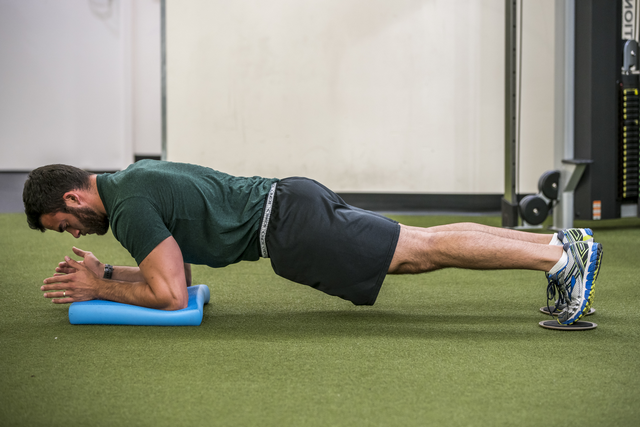
The basic forearm plank asks you to keep your spine and pelvis stable as gravity tries to pull your midsection toward the floor. In a body saw, your torso and legs slide backward relative to your planted elbows. As the shoulders move farther from the feet, the longer lever makes the anti-extension task more demanding. Your abdominal wall must resist the tendency to arch your lower back, while your glutes, quadriceps and upper body help keep one coherent shape.
That is why one precise body saw can feel harder than another 30 seconds of a motionless plank. However, feeling a strong abdominal burn does not establish that it produces more muscle growth, visible abs or better sporting performance than every other exercise. It is a progression tool: useful when you can already hold a steady plank and want to challenge it with controlled movement. Your nutrition and overall training still matter more for whether your abs are visible.
Think of the movement as an adjustable-length plank rather than a race across the floor. The travel distance is the difficulty dial. Two inches performed with quiet hips can be more productive than a foot of movement with a collapsing waist. Different coaching sources may cue the glide through the elbows or the feet; both descriptions produce the same basic relative movement, provided the whole body moves together.
Before adding the saw motion, show that you can keep your ribs down, squeeze your glutes and breathe through a regular forearm plank. If a stable 20- to 30-second hold is not yet reliable, practice that first. The body saw is an intermediate-to-advanced variation rather than a mandatory starting exercise.
Set up sliders, towels or suspension straps without losing your position
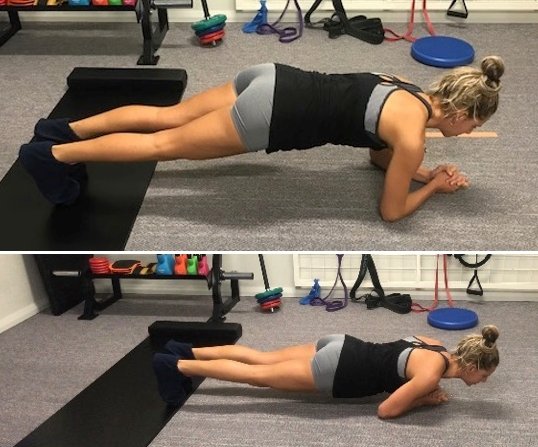
Place two sliders under your toes on a surface that actually lets them glide. Smooth floors often work with folded towels, while carpet may need purpose-made sliders or discs with a slick underside. Put a mat or other non-slip padding under your forearms. If the towel bunches, snags or causes your feet to stop suddenly, switch surfaces instead of forcing the rep. A stable friction level makes range and tempo repeatable.
Set your forearms roughly shoulder-width apart, elbows beneath or just behind the shoulders and toes together or hip-width apart. Press your forearms into the floor, pull your rib cage toward the pelvis without rounding aggressively, squeeze glutes and legs, and keep your head in line with your spine. Avoid looking forward so far that your neck becomes the leading point. Your body should resemble a long, firm plank.
Test the first two glides with almost no distance. Exhale gently as you move backward; allow a controlled inhale on the return without releasing the brace. Your pelvis should travel at the same height as your shoulders. If the shoulders become uncomfortable, narrow the range before changing equipment. You do not need a loaded vest, heavy sliders or any brand-specific tool to make the basic version challenging.
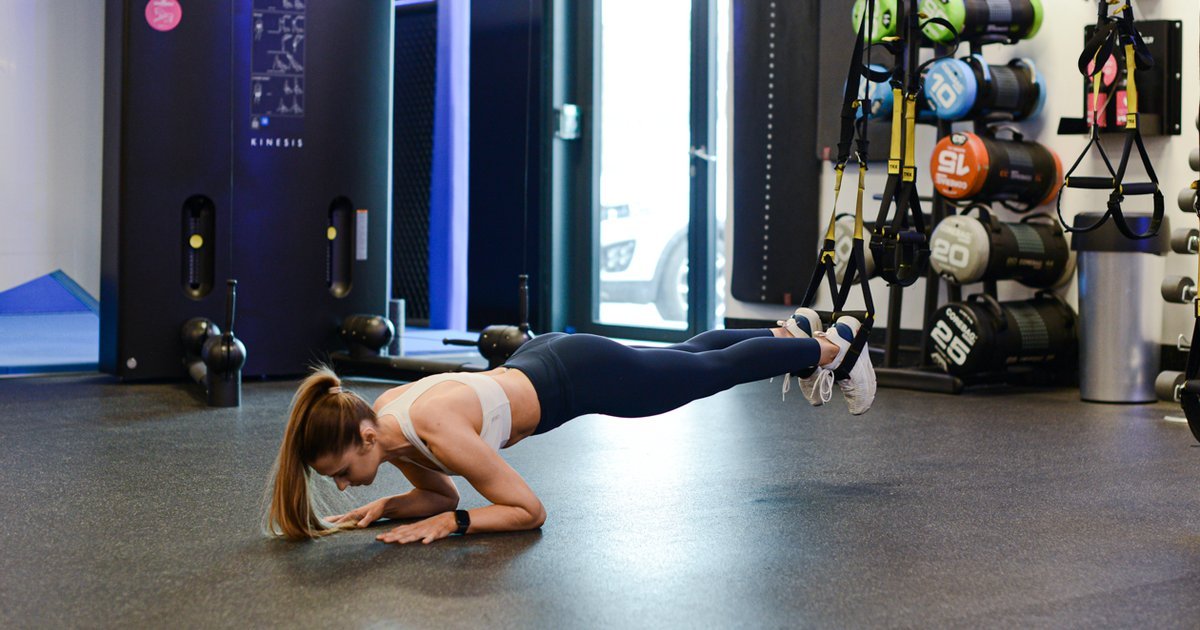
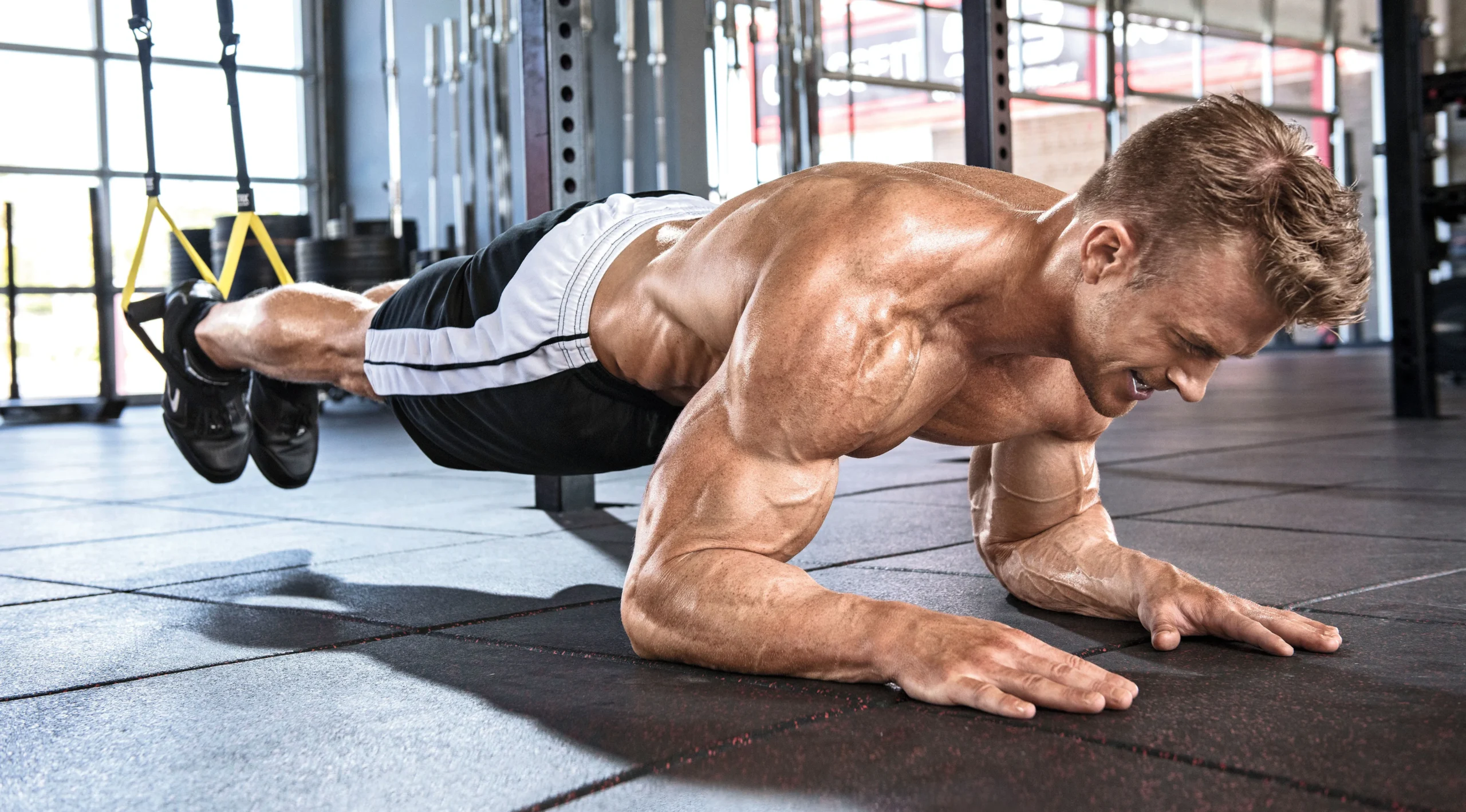
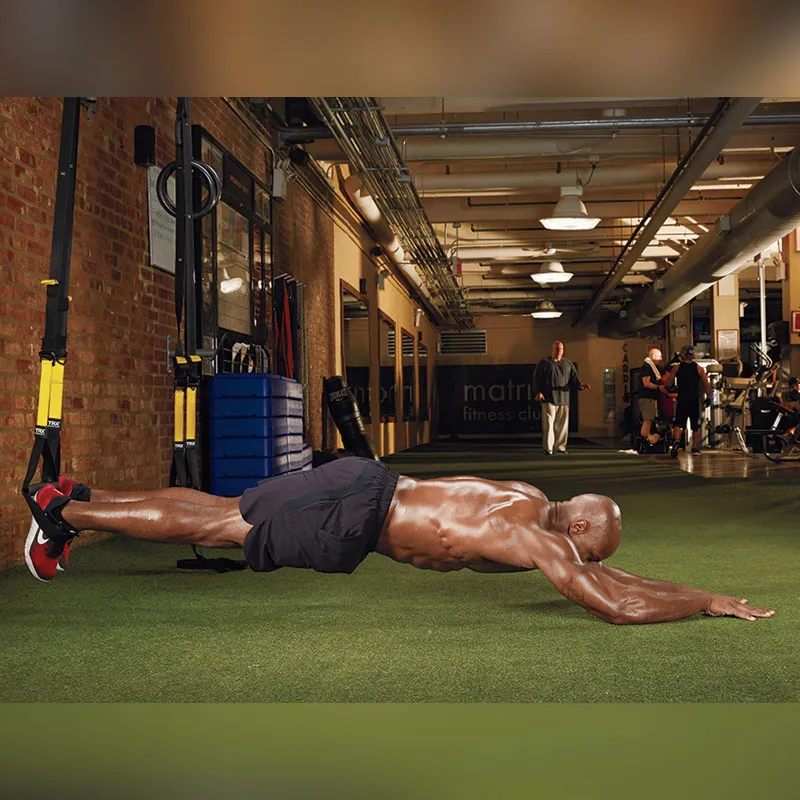
Suspension straps offer another route, but they are not identical to floor sliders. With feet supported in straps, the legs can swing and the upper body has to manage additional movement. Set the straps at a suitable low height, test the anchors and make the saw smaller than your floor version at first. A ring or suspension setup is only useful if it can securely hold your feet as intended; ordinary hand rings should not be improvised into unsafe foot cradles.
Make every rep a controlled anti-extension challenge
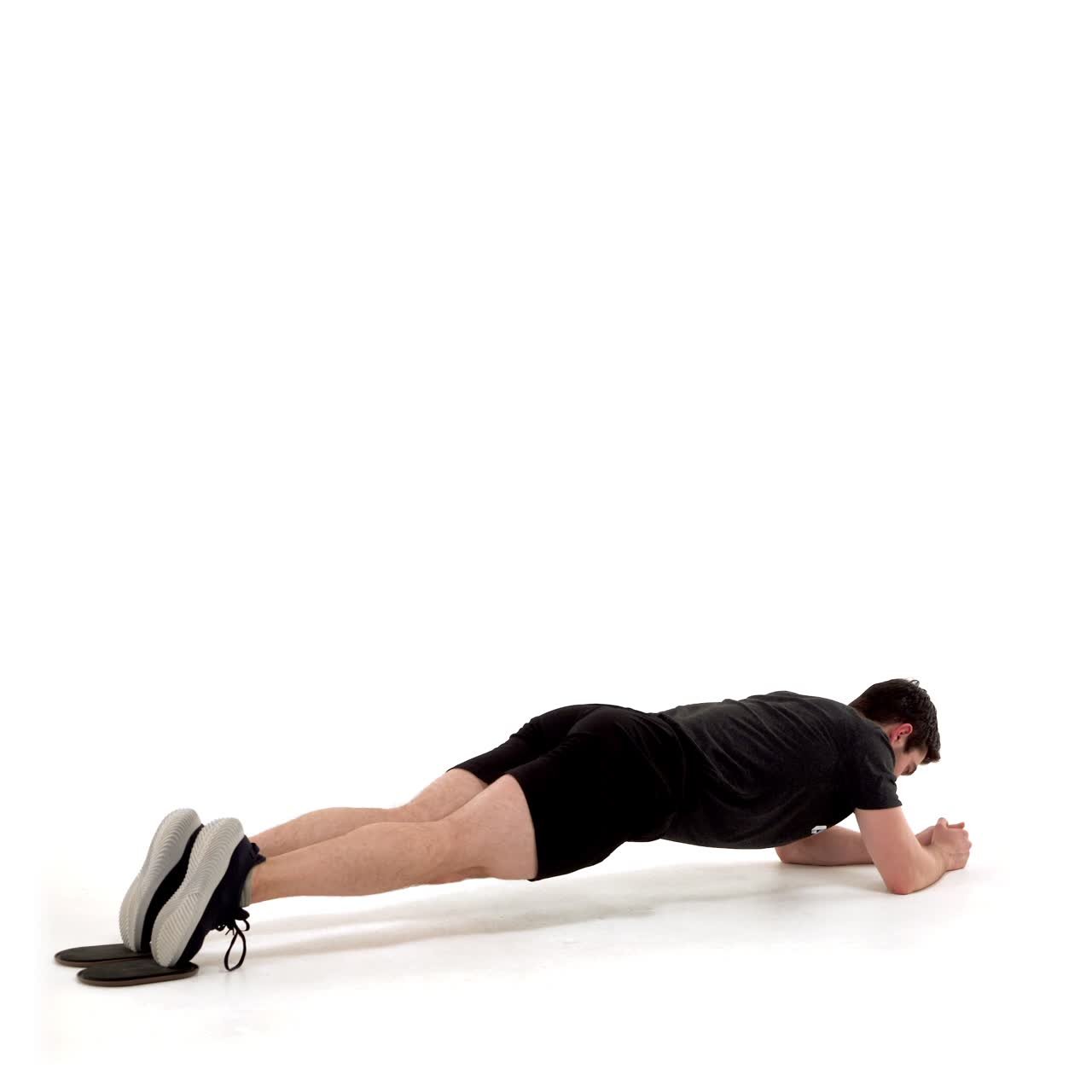
From the start position, press the forearms firmly into the floor so your entire body moves a little away from the elbows. Your toes should slide backward together. Keep knees relatively straight and do not deliberately drive the hips upward. Stop just before your lower back starts to sag or your rib cage opens. That controllable end point, not a prescribed number of centimetres, determines the useful range for each rep.
Reverse direction smoothly by pulling the body back toward the starting forearm plank. Keep the same tension on the return; do not let the feet skid forward while the hips stay behind. Count one complete backward-and-forward cycle as a repetition. If you cannot repeat the same travel distance on the next rep, reduce the range or finish the set rather than cheating the count.
Try a two-second outward glide, a brief steady moment and a two-second return. A deliberate tempo exposes wobbles without relying on an arbitrary ultra-slow duration. Count only technically clean reps. Depending on proficiency, a set may contain five to ten controlled cycles; longer is not inherently better. You can also use a 15- to 25-second set if maintaining form with a stopwatch is simpler.
A good rep feels demanding through the abdomen and around the shoulder girdle, with the hips and legs working to stabilize you. It should not be dominated by sharp shoulder pain, back pinching or uncontrolled shaking. Ordinary muscular effort is expected, but pain that changes your posture is a stop signal. A lifter with recent shoulder or back symptoms should choose an easier variation or get appropriate professional guidance.

Equipment Worth Exploring
Explore equipment, accessories and gear from our carefully selected range.


Power Tower
Freestanding pull-up and dip station with adjustable handles for bodyweight training.





Foldable Wall Rack
Wall-mounted folding squat rack designed to save floor space between workouts.
Fix the five mistakes that make the exercise less useful
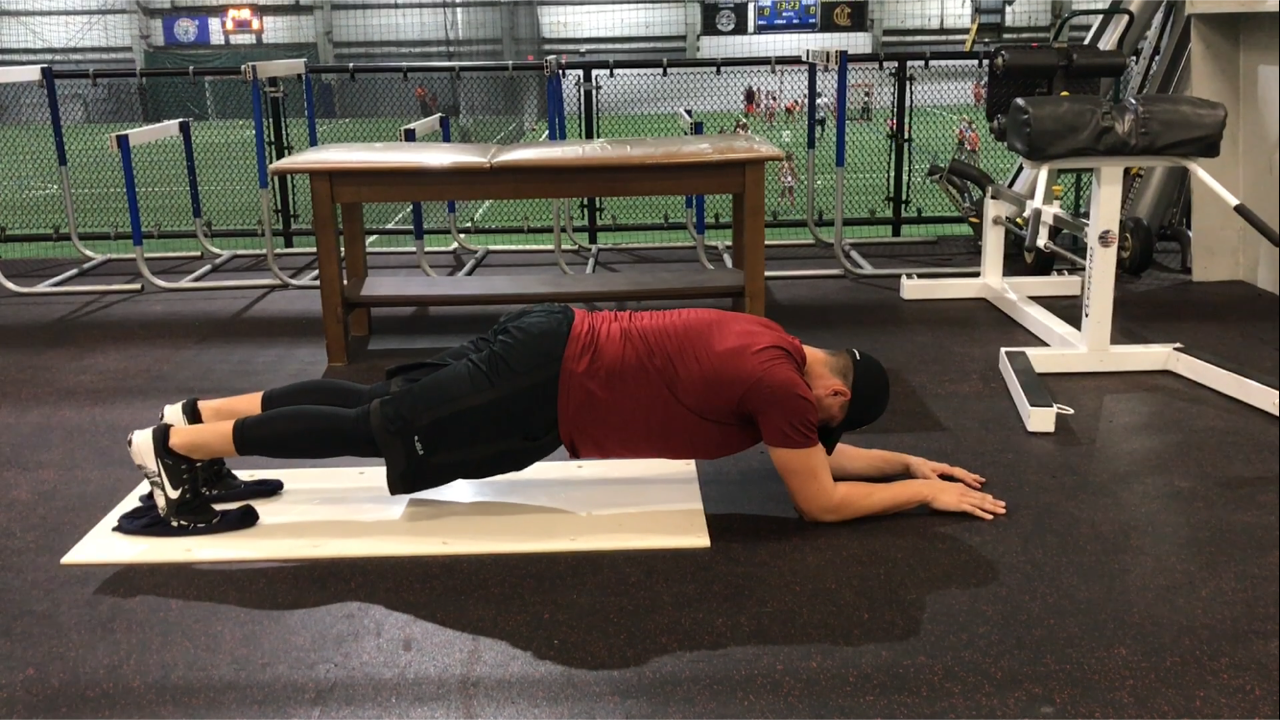
1. Letting the lower back fall into extension. This is the most important mistake. The increased lever pulls the pelvis toward the floor. Shorten the backward travel until the rib cage and hips can stay aligned, then build range over subsequent sessions. Do not confuse a long glide with a stronger brace if your abdomen is no longer controlling the spine.
2. Piking the hips to pull yourself back. If the glutes shoot skyward on every return, you are shortening the lever by folding at the waist. Maintain nearly the same hip height on the return as on the outward phase. Filming one side-on set is often more revealing than trying to judge your own body position from above.
3. Shuffling the legs independently. The body saw is not a mountain climber. Keep feet together or evenly spaced and move them in the same direction at the same time. If your feet stick, fix the slider-floor pairing rather than kicking one foot free.
4. Over-reaching through the shoulders. You do not have to slide until your elbows are far in front of your chest. Maintain active pressure into the floor and keep the neck neutral. The shoulders provide a stable base while the trunk controls the longer lever.
5. Treating fatigue as permission to lose form. Ten repetitions with the final four in an arched position are not automatically superior to six consistent ones. Stop each set with one or two clean reps still possible, especially while learning. Technique quality is a meaningful progression metric alongside distance, reps and time.
For a quick self-check, record a short side-view video and compare the start, farthest glide and return. Draw an imaginary line from shoulders through hips to heels. If that line becomes an obvious banana shape or a high tent shape, the range has exceeded your present control.
Equipment Worth Exploring
Explore equipment, accessories and gear from our carefully selected range.
VOLTRA
Compact digital cable trainer with smooth, adjustable resistance.

Go-Tone Pro
Portable digital cable trainer with up to 66 lb (30 kg) of adjustable resistance.


Cast Iron Kettlebells
Textured cast-iron kettlebells for swings, squats, carries, and full-body training.


Rubber Hex Dumbbells
Rubber-coated hex dumbbell pairs with a stable shape for home and commercial strength training.

VForce Wall Trainer
Space-saving wall-mounted functional trainer with pivoting cable arms and variable resistance ratios.

VForce 2IN1
Half rack and pivot-arm functional trainer with switchable 1:1 and 2:1 pulley ratios.
Choose a sensible regression or a harder variation
Regression one: ordinary forearm plank. Practice 3 sets of 15–30 seconds with firm glutes and steady breathing. Once this becomes routine, extend the shoulders slightly ahead of the elbows for a long-lever plank, using a modest range. Holding that position can teach the anti-extension demand without adding friction or a moving surface.
Regression two: step-back body saw. Leave the feet on the ground and walk them back a few small steps, then forward. This changes the lever without needing a sliding surface. Because the feet lift and replace, it is less smooth than the slider version, but it provides a manageable bridge and helps you rehearse the brace.
Standard progression: slider body saw. Once you have six controlled cycles without a change in hip height, increase travel slightly or add one rep per set. Modify only one variable in a workout. Increasing travel and total repetitions together makes it hard to identify which change caused form to deteriorate.
Harder progression: suspension body saw. Feet in suitable straps add instability and may demand smaller movements. Anchor and inspect the system before climbing into it. Another progression is a one-second pause at the farthest position you can own, which adds control without requiring more distance. Weighted vests are an optional advanced tool, not a beginner shortcut.
Body saws also pair well with side planks, carries and loaded resistance work because they address different demands. A sliding saw does not replace every aspect of trunk rotation, lateral flexion or hip strength. For an effective core program, select exercises for the movement qualities you actually want, rather than stacking every plank variation in one exhausting circuit.

Calisthenics Shirts & Street Workout Gear
Calisthenics and bodyweight-training gear for pull-ups, dips, handstands and street-workout athletes.

Be Stronger Than Your Excuses – Motivational T-Shirt
Rep “Be Stronger Than Your Excuses” humor in and out of the gym.


Shirt – Calisthenics Heartbeat Gymbros & Meme Lovers T-Shirt
Bring “Calisthenics Heartbeat” humor to your next gym day.


Calisthenics Evolution
Show some lifting attitude with a playful “Calisthenics Evolution” tee.


Always Pull Yourself Up Funny Gym T
Heavy lifts, good laughs, and a little “Always Pull Yourself Up” energy.

Calisthenics Lovers & – Gains & Meme Vibes T-Shirt
Heavy lifts, good laughs, and a little “for Calisthenics Lovers & Lifters” energy.

Shirt – Lord Of The Calisthenics Rings – Meme T-Shirt
Rep “Lord of the Calisthenics Rings” humor in and out of the gym.
A four-week body saw plan for stronger, repeatable reps
Week 1 — establish a consistent baseline: Twice a week, after a warm-up, do three sets of five to six short backward-and-forward cycles. Leave approximately two clean reps in reserve and rest 60–90 seconds. Note which surface and slider setup you used, because carpet and smooth flooring can make the exact same movement feel very different.
Week 2 — add clean volume: Keep the distance unchanged and aim for three sets of seven or eight reps, provided your ribs and pelvis remain aligned. If the final rep turns into a large low-back arch, repeat the previous week’s total next session. Do not progress just because a calendar says it is time.
Week 3 — expand travel modestly: Reduce back to six to eight repetitions and move one or two centimetres farther on each backward glide. Hold that end range for a moment, then return under control. Avoid deliberately chasing the longest possible slide. A video from the side is useful for comparing week 1 with week 3.
Week 4 — consolidate or introduce a harder variation: Use three sets of eight to ten reps with the best range you can own. If you consistently complete that prescription, try a brief end-range pause or a small suspension-assisted progression for the final set. If you are still fighting sagging hips, stay on the original variation and improve its quality.
On the same days you can add one complementary trunk exercise, such as a side plank or a cable Pallof press, instead of piling on redundant anti-extension drills. If you perform intense abdominal work immediately before heavy squats or deadlifts, consider whether the fatigue compromises your ability to brace for those main lifts; placing it afterward is often more practical.
Bottom line: The body saw is simple equipment, precise movement and progressively longer leverage. Keep elbows planted, move in one piece and let your ability to control the longest part of the glide determine the workload. The best improvement after four weeks is not a dramatic-looking saw; it is a repeatable rep that still looks like a strong plank.
Funny Gym Shirts & Workout Gear
Funny gym shirts, tanks, hoodies and workout gear for lifters who like training hard.

Meme I Have Abs-Olutely No Idea What I'M Doing T-Shirt
For laid-back days and bodybuilding humor: “I Have Abs-olutely No Idea What I'm Doing”.

6Pack Panther – Six Pack Abs Bros & Meme Lovers T-Shirt
Heavy lifts, good laughs, and a little “6Pack Panther” energy.

Six Pack Tacos Gym Tee
Rep “Check Out My Six Pack Tacos Gym Meme” humor in and out of the gym.


Meme Installing Muscles & Lifting Shirt Bros & T-Shirt
Bring “Installing Muscles” humor to your next gym day.

Doctor Discipline Gym Villain T
Make gym days more fun with “Doctor Discipline Gym Villain” style.

No Excuses Mermaid Motivational Vest Strong Meme Top Tank Top
Train hard, laugh a little, and rep “No Excuses Mermaid”.

Hardcore Gains Meme – – Fire Top & T-Shirt
Bring “Hardcore Gains Gym Meme” humor to your next gym day.

More Rest More Test Meme Testosterone Bro Hoodie
Keep it laid-back with a little “More Rest More Test Gym Meme Testosterone” attitude.

Consistency Is Key Stoic Greek God Marble Sculpture T-Shirt
Make gym days more fun with “Consistency is Key Stoic Greek God Marble” style.