Advertising disclosure: This page includes affiliate product links that may earn us a commission, as well as products from our own store.
A single kettlebell overhead changes an ordinary walk into a demanding test of shoulder control, trunk position and patience. The goal is not to stagger the farthest distance with the biggest bell. It is to hold an organized overhead position while your feet keep moving underneath it. Also called the waiter’s walk, the single-arm overhead carry rewards careful setup and short, repeatable efforts. Here is how to learn the position, spot the compensations that matter and build a useful training slot without turning a stability exercise into a balancing stunt.
Build the overhead position before you take a step
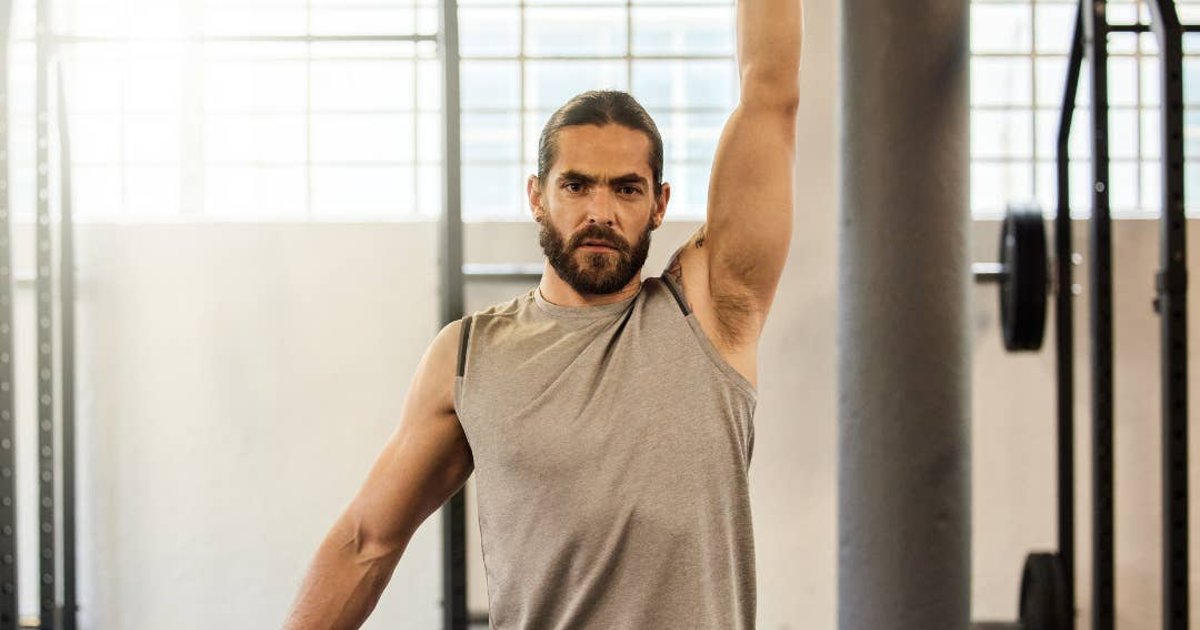
Start on an open, level strip of floor, clear of benches, other lifters and loose plates. Leave enough space to turn or stop without weaving around equipment. Choose a kettlebell you can already press smoothly through a comfortable overhead range; the carry is not the moment to discover whether you can force a new personal record overhead. Test the empty-hand pattern first: stand with feet roughly hip-width apart, reach one arm upward, breathe while keeping ribs over your pelvis, and see whether you can hold that position without pushing your chest up or leaning to one side. The overhead position should feel supported, not pinched.
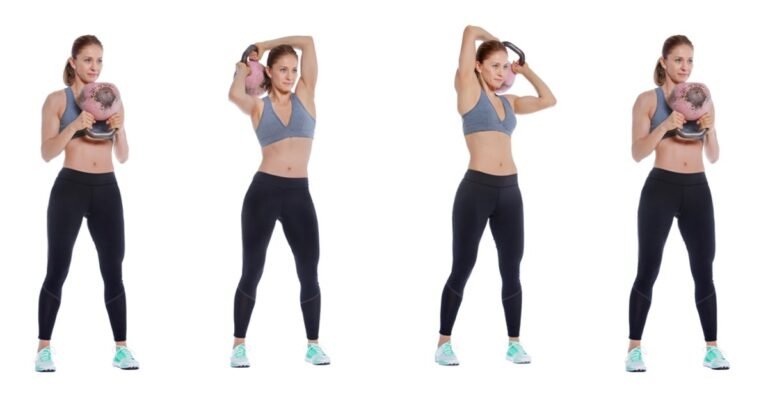
Bring the bell securely into a rack position against the outside of the forearm. A controlled clean is one option for people who already know it; otherwise use a safe two-hand assist or other setup you can manage. The wrist stays close to neutral, rather than being bent far backward under the handle. Press to a straight, actively supported arm and keep the load approximately over the shoulder and midfoot. An elbow that is locked out and comfortable provides a clearer reference than a perpetually bent arm trying to hold a wobbling bell in midair. Your upper arm will usually finish close to the ear, but proportions and shoulder mobility vary: never force a painful position simply to mimic a photograph.
Do not treat the shoulder blade as a rigid object pinned down. It must be free to rotate upward as the arm rises; tension comes from controlling the loaded position, not wrenching the shoulder away from its natural path. Keep the unloaded hand relaxed at your side or slightly out for balance. Look straight ahead, establish a steady breath, and wait until the bell stops oscillating before taking the first step. If you have to arch the low back to reach the lockout, or cannot keep the kettlebell above the shoulder while standing still, put it down and choose a lighter bell or a lower carry. That is a useful technique decision, not a failed set.
Before every work set, do a brief position checklist: clear path, secure handle, stable overhead alignment, level shoulders and a comfortable breath. It takes seconds and tells you far more than the number stamped on the kettlebell.
Walk under the bell, not away from it
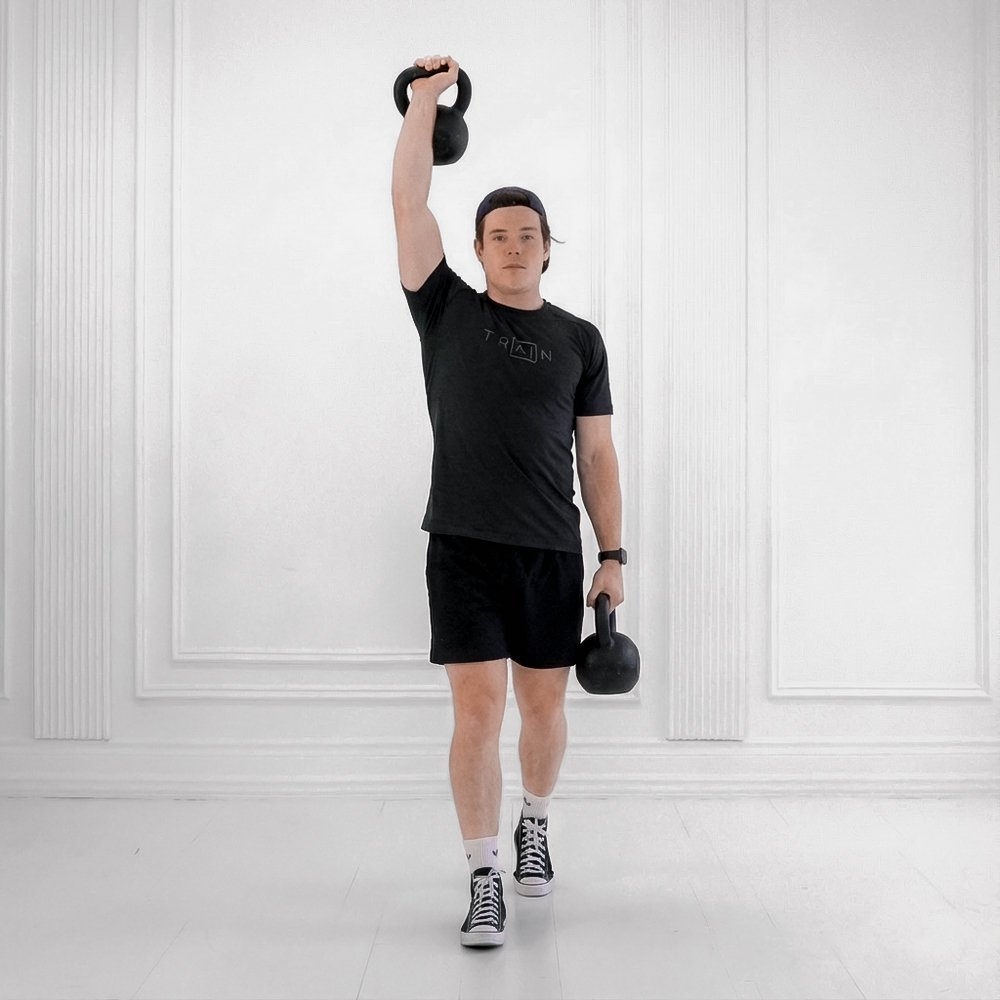
Once the overhead position feels quiet, walk with deliberate, ordinary-length steps. Plant each foot fully and avoid rushing the weight forward to make the distance end sooner. The point is to let the hips and legs alternate beneath a relatively stable upper body. Imagine balancing a full glass overhead: the hand should not trace a large side-to-side wave with every stride. Small corrections are normal, but repeated major swaying means the effort has moved beyond the control you want to practice.
A frequent compensation is drifting away from the loaded arm. If the kettlebell is in your right hand, the torso may tilt left as fatigue develops. Another is leaning backward with the ribs flared to make room for a shoulder that cannot comfortably reach overhead. Both patterns can make the bell look higher even as the whole-body position becomes less organized. A more productive cue is to keep the sternum above the pelvis, eyes forward and shoulders approximately level. Breathe in short, manageable cycles rather than holding one long breath from start to finish. If breathing changes your arm position dramatically, shorten the distance or lower the load.
Turns deserve attention. Pivoting abruptly with a weight overhead can create rotational momentum that the shoulder must catch. Walk to a marked endpoint, pause if necessary, turn in small controlled steps, and resume only while the bell remains steady. A straight out-and-back lane is easier to repeat than weaving around other people. Record a distance or time that corresponds to the quality of the set. Twenty controlled steps can be more useful than forty that end with a sideways lean and a hurried lowering of the kettlebell.
There is no universal perfect walking speed or target distance. Longer bouts increase the amount of time you must stabilize and grip the handle, but they also add fatigue. Begin with a duration that gives you a consistent setup and allows you to lower the bell deliberately. Watch for an elbow softening, a wrist collapsing, the bell migrating forward, or a torso that starts circling underneath the load. End the set when those changes become persistent, before the carry becomes an uncontrolled walk to failure. Switch hands and judge the second side by the same technical standard, not by a demand to match a number at all costs.

Equipment Worth Exploring
Explore equipment, accessories and gear from our carefully selected range.

Cast Iron Kettlebells
Textured cast-iron kettlebells for swings, squats, carries, and full-body training.




Rubber Hex Dumbbells
Rubber-coated hex dumbbell pairs with a stable shape for home and commercial strength training.


Open Hex Bar
Open-frame trap bar with multiple handles for deadlifts, carries, and lower-body training.
Build a foundation with suitcase and rack carries
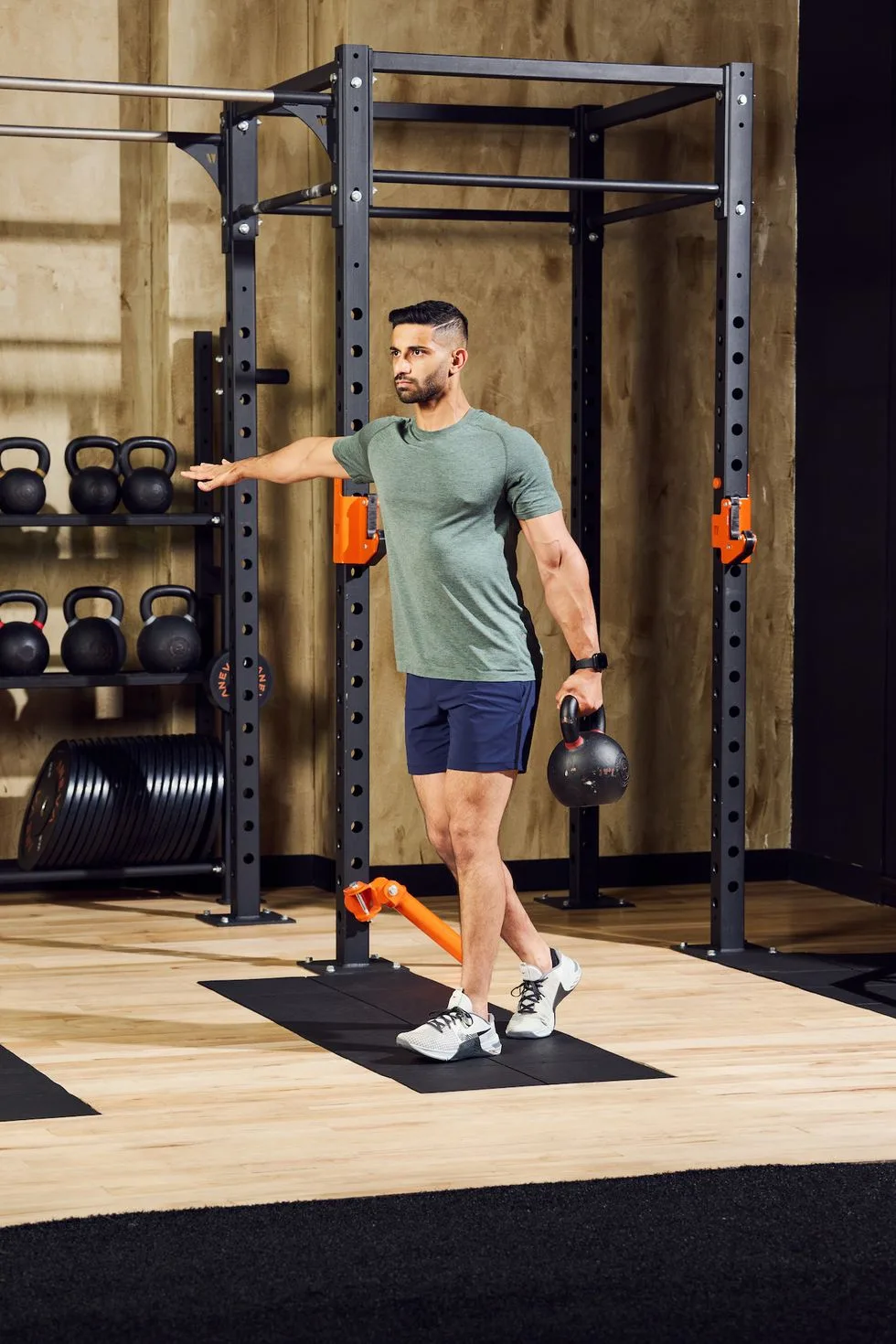
If you cannot hold a kettlebell overhead comfortably, the correct regression is not to lift it halfway and hope for the best. A suitcase carry uses one weight at your side with the arm straight. You still have to resist tipping toward the loaded hand and walk steadily, but the shoulder is no longer responsible for stabilizing a load above your head. That makes it a practical way to learn symmetrical stepping, controlled breathing and a consistent lane. The load may be heavier than for an overhead carry, but the comparison is not one-for-one: the joint positions and demands are different.
Set up a suitcase carry by lifting the bell from the floor with a comfortable hinge, standing tall and keeping it close enough to the leg that it does not swing or strike your knee. Avoid hiking one shoulder or bending sideways to counterweight the handle. Walk the same short route, return the bell to the floor under control, and repeat on the opposite side. Using a mirror briefly or recording yourself from the front can help identify a persistent torso tilt, but you should not need to stare down at your feet or the weight while moving.
The front-rack carry offers an intermediate option. Hold the kettlebell at the shoulder with the handle angled across the palm and the bell resting near the outer forearm or upper arm. Keep the elbow supported near the torso instead of letting the bell hang far in front. Compared with the suitcase position, this changes the load’s relationship to the trunk and demands that you manage the rack without flaring the ribs. It is often more accessible than overhead walking, but it is not automatically comfortable for every wrist or shoulder. Adjust the bell, shorten the bout or stay with the suitcase position as needed.
These choices are skills in their own right, not merely consolation exercises. Suitcase, rack and overhead carries all challenge you to maintain position while walking, but they do so from different load locations. A useful progression is to learn each one well enough that your route and breathing are repeatable, then add the next variation only when the relevant joints tolerate it. Heavy bilateral farmer’s walks can be excellent conditioning and grip work; they do not automatically prove that your shoulder is ready to walk with the same load overhead.
Bottoms-up carries demand a different kind of grip control
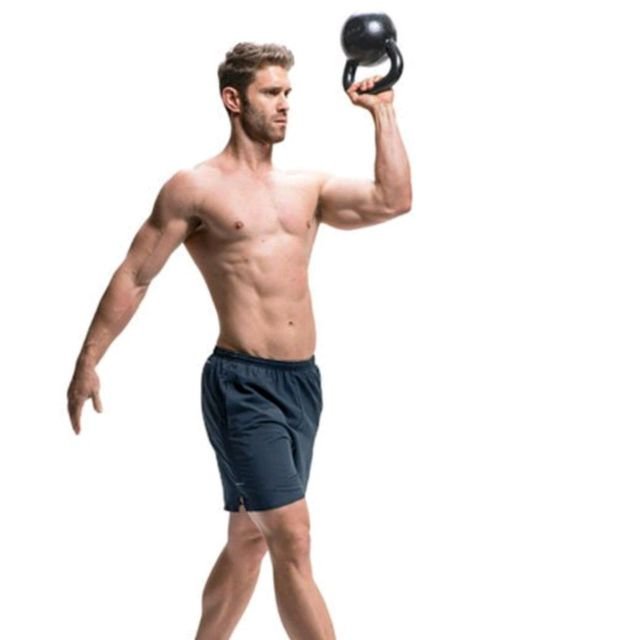
Turning the bell upside down changes how the handle behaves in the hand. Instead of having most of the kettlebell hang below your grip, the round body sits above it, creating an obvious balancing challenge. Even a modest kettlebell can suddenly feel demanding when the wrist has to keep the bell upright. The correct response is to use a lighter load and shorten the walking bout, not to squeeze so hard that you forget to breathe or let the shoulder drift into a painful position.
It helps to separate two variations often lumped together in exercise discussions. A bottoms-up rack carry holds the inverted bell near shoulder height with the elbow bent. A bottoms-up overhead carry requires pressing that unstable bell to a comfortable overhead lockout and then walking under it. The second is an advanced variation, not an automatic progression for anyone who has just mastered the basic overhead carry. The photograph in this section illustrates the shoulder-height bottoms-up position; it is not a demonstration of an overhead lockout.
For an initial bottoms-up rack attempt, test the inverted hold in place for a few controlled breaths. Keep the bell from rolling over the knuckles and avoid letting it collapse onto the forearm. If you cannot maintain control while stationary, walking adds complexity rather than productive training. Stay with ordinary rack carries or a conventional overhead load. In the advanced overhead version, the same alignment rules still matter: ribs over pelvis, arm close to the line of the shoulder and the ability to stop the set safely before grip failure.
Remember that a more unstable exercise is not necessarily a better muscle-building exercise. Instability can limit the absolute load and the total work you perform. For a person prioritizing maximal overhead pressing strength or deltoid hypertrophy, controlled presses and other straightforward resistance exercises may remain the principal work. A bottoms-up carry is better understood as a specific grip-and-position challenge that may complement a program, not replace every heavier movement.
Program short, measurable carries and progress one variable at a time
Treat overhead carries as a skill and accessory movement, especially at first. Place them after a warm-up and before exhausting shoulder work if your goal is quality control, or later as a deliberately lighter finisher if they remain stable. Begin with two or three short bouts per side, perhaps 10–20 metres or around 15–25 seconds each, using a bell that permits a quiet lockout. These are starting examples rather than validated universal prescriptions. Rest long enough to restore the grip and breathing that produced the first clean set, then repeat on the opposite hand.
A simple four-week approach makes your records meaningful. In week one, establish a comfortable load and route; write down the distance, number of bouts and the earliest point at which form deteriorates. In week two, repeat that load and aim for smoother gait, less wobble and cleaner turns rather than immediately adding volume. In week three, add a few controlled steps or a small amount of time to only those bouts that remain well positioned. In week four, choose either a modest weight increase or another carefully measured distance increase, not both at once. If the heavier bell changes your wrist, spine or shoulder position, return to the previous load. A regression is information about the current dose, not a reason to chase fatigue.
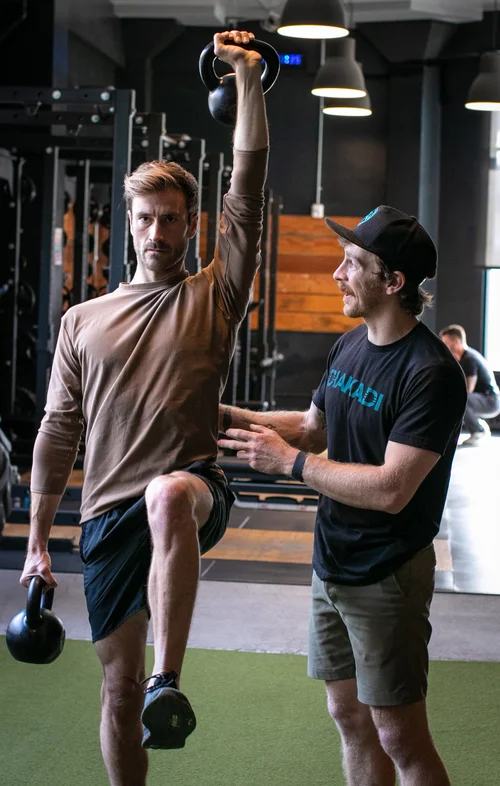
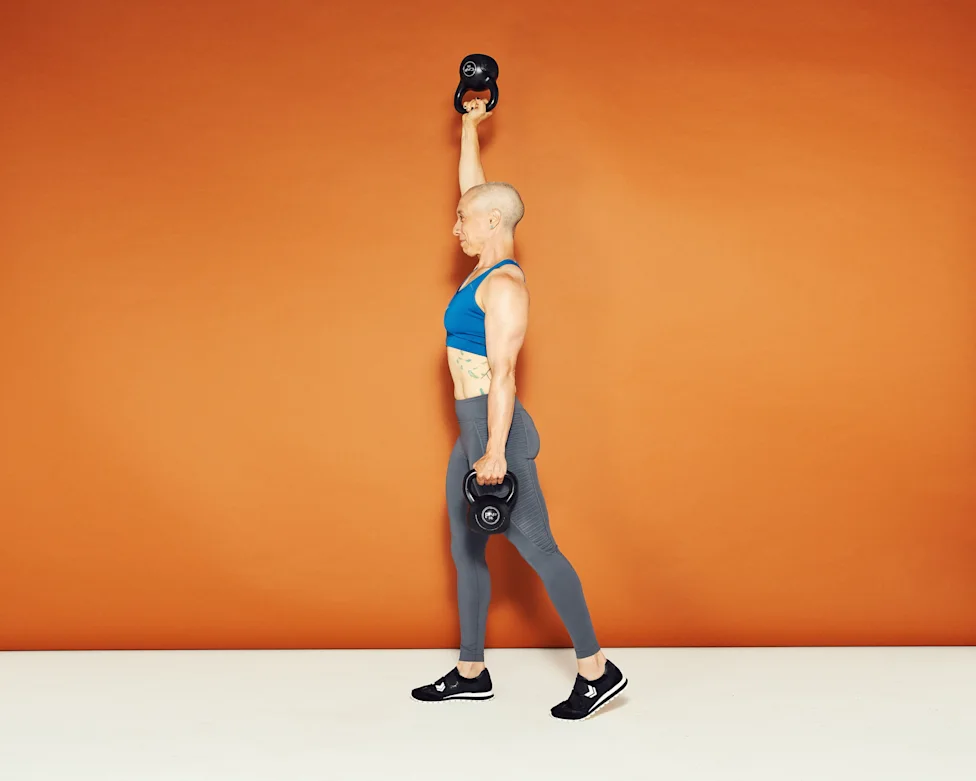
There is room for different configurations. A high-low carry places one bell overhead and another at the opposite side; it adds another load to manage, so the first attempt should be light and brief. A rack-plus-overhead carry changes the offset again. Two kettlebells overhead remove the single-sided arrangement while increasing total overhead loading. None is automatically more advanced in every respect, and none must appear in a basic training block. The person in this section’s photograph holds one bell overhead and another at her side, illustrating the high-low setup rather than a standard one-bell waiter’s walk.
Judge success by quality over repeated sessions: were both sides controlled, did you maintain an overhead position without pain, and did the distance or duration improve without changing the rules? If the shoulders already receive large doses of pressing and pulling, overhead carries may require only a small amount of extra work. They are not a cure-all for shoulder pain, a shortcut to visible abs, or a substitute for a complete strength plan. If a shoulder, wrist or neck hurts during the movement, lower the weight safely and stop; persistent pain or prior injury warrants advice from a qualified clinician.
The practical payoff is simple. Choose a clear lane, establish the overhead position you can actually own, walk under the bell with a level torso, then set it down before control unravels. If that sounds less dramatic than an all-out carry challenge, it also gives you something worth progressing: a repeatable skill with a load you can justify.

Funny Gym Shirts & Workout Gear
Funny gym shirts, tanks, hoodies and workout gear for lifters who like training hard.

Grip Training Essential Gymbro Jumper & T-Shirt
For laid-back days and lifting humor: “Grip Training Essential”.

Grip Strength Fanatic Meme Hoodie
Show off your lifting humor in a laid-back “Grip Strength Fanatic” hoodie.

Grip Day Legacy Gymbro & Decal Sticker
Give your everyday gear a playful “Grip Day Legacy” twist.


Get A Grip Grip Strength Vest Tank Top
Bring “Get a Grip” humor to your next lifting session.

Atlas Kettlebell Earth Meme Greek God Top T-Shirt
Make gym days more fun with “Atlas Kettlebell Earth Lifter” style.

Kettlebell Heart X-Ray Meme Top T-Shirt
Show some lifting attitude with a playful “Kettlebell Heart X-Ray” tee.

Gym Equation Makes Me Happy Kettlebell Meme Graphic Fit T-Shirt
Heavy lifts, good laughs, and a little “Gym Equation” energy.

Gym Is My Happy Place Happy Kettlebell Emoji Graphic Wh T-Shirt
Make gym days more fun with “Gym Is My Happy Place” style.

Happy Kettlebell Emoji Smiley Kettlebell Graphic Who Lo T-Shirt
Make gym days more fun with “Happy Kettlebell Emoji” style.