Advertising disclosure: This page includes affiliate product links that may earn us a commission, as well as products from our own store.
A narrow push-up is not just a normal push-up with the hands squeezed together. The hand width changes how the arms share the work, how the wrists feel and how much control you need at the bottom. A 2026 study involving twenty men adds useful data about diamond, standard and wide placements, but it does not prove which one builds the most muscle over months. Here is how to apply the evidence while keeping the movement comfortable and repeatable.
Choose a close hand position you can actually support
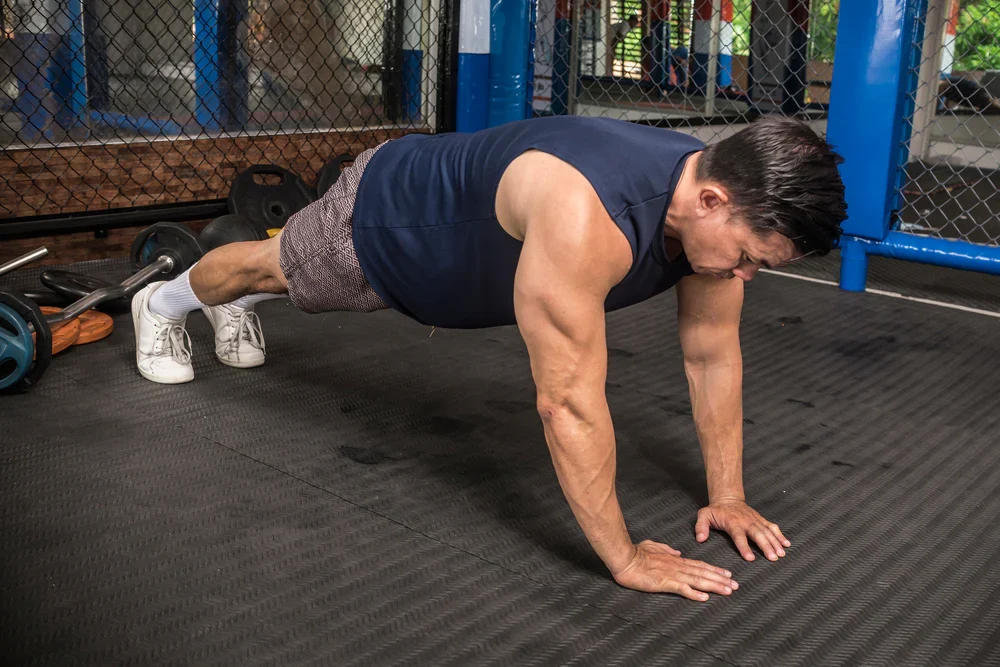
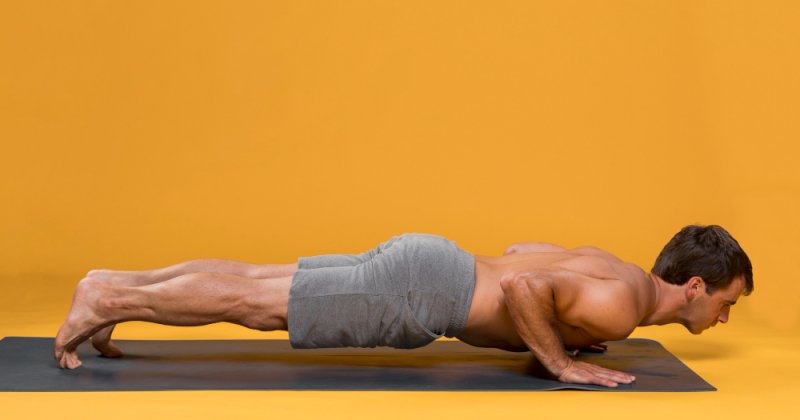
A close-grip push-up looks simple until the wrists, elbows and shoulders must share the work. Start in a high plank with your hands under your shoulders or slightly nearer together, fingers spread, palms planted and thumbs wrapped naturally around the base of support. Your exact hand spacing should be based on a repeatable, comfortable position rather than a rule requiring everyone to touch their thumbs together. A diamond shape is one version of a narrow push-up, not the only legitimate version.
Place your feet at a stable width, straighten the legs and lightly brace the abdomen and glutes. Imagine maintaining a long line through your ribs and pelvis instead of allowing the lower back to sink. Press into the floor with the whole palm rather than loading only the heel of the hand. Take one slow test repetition before starting a hard set. Your forearms should travel in a path you can control without the wrists folding sharply inward.
If the hands are touching but your elbows flare unpredictably or the bottom position causes wrist discomfort, separate them slightly. Moving your hands an inch or two wider is preferable to forcing a painful shape. An incline against a sturdy bench may make learning the same hand path easier. The goal is an orderly press with a narrower support base, not a photographic imitation of someone else’s anatomy.
Use the same placement for your comparison sets. Changing grip width, floor slope and repetition depth all at once makes it impossible to know why the effort changed. These basic setup decisions matter more than arguing whether a diamond push-up is automatically harder than every other variation.
Read the 20-man EMG study without turning it into a growth claim

A 2026 laboratory study compared standard, diamond and wide push-ups in twenty young men. Participants completed six repetitions of each version while researchers recorded electrical activity in the pectoralis major and triceps brachii. The investigators considered both the raw root-mean-square readings and measurements normalized to the peak recorded muscle activity. That distinction matters because absolute electrical amplitude and normalized relative activation are not interchangeable explanations of muscular effort.
In this experiment, diamond push-ups produced the highest relative activation among the tested hand placements for the measured chest and triceps muscles. The reported triceps signal was especially prominent in the diamond condition, followed by standard and then wide push-ups. Absolute RMS measurements were higher during the lifting phase than the lowering phase, but that concentric-versus-eccentric difference did not persist in the same way after normalization to peak RMS. That is a more specific result than simply declaring that every push-up phase is dramatically different.
These findings describe immediate electrical activity during a controlled task. The researchers did not train participants for months to compare muscle size, long-term strength, tendon health or injury rates. You therefore cannot convert a higher EMG value directly into a promise of faster triceps hypertrophy. It is reasonable to treat the diamond version as an option for emphasizing the triceps in a session; it is not evidence that other hand positions should be discarded.
Individual anatomy and technique can influence what a narrow position feels like. An EMG average across twenty young men is useful context, not a personal guarantee for every lifter, every repetition tempo or every body mass. Keep the finding in proportion: hand width changed the measured task, while actual training outcomes still depend on effort, sustainable volume, recovery and progressive difficulty.
Compare diamond, shoulder-width and wide push-ups on equal terms

Picture three possible working positions. In the diamond version the thumb-and-index-finger bases approach each other beneath the midline. In a shoulder-width version the hands are roughly under the shoulder joints. In a wide version they sit farther apart. All three still require a controlled press from the floor, and all three involve the chest, front shoulders, triceps and trunk. The name on the variation does not turn the other muscles off.
Prior research points in a compatible but not completely identical direction. A study of forty people compared narrow, shoulder-width and wide push-ups and found greater pectoralis and triceps EMG with narrow than wide placement. Another investigation of twelve men found greater triceps and some other muscle activity with hands set at half the reference width, while the serratus anterior favored wider placement on one measure. Different protocols, muscles and normalization choices mean these are not exact replications of the 2026 experiment.
To find your own useful comparison, perform a few controlled repetitions at each width with the same floor, comparable depth and similar tempo. Notice where the elbows travel, whether the wrists stay comfortable and whether your torso can remain aligned. A wider hand position is not automatically a better chest-building shortcut, just as an extreme diamond is not automatically a better triceps-builder. If your range of motion becomes much shorter, you may be solving the exercise with a technique compromise.
Keep the easiest repeatable width for the work you actually want to do. You can cycle positions between training blocks for variety, but avoid switching every set merely to chase an imagined activation number. A movement that you can load or progress steadily has a more useful place in a program than a novel position that falls apart after three repetitions.

Equipment Worth Exploring
Explore equipment, accessories and gear from our carefully selected range.





VOLTRA
Compact digital cable trainer with smooth, adjustable resistance.

VForce Wall Trainer
Space-saving wall-mounted functional trainer with pivoting cable arms and variable resistance ratios.

Foldable Wall Rack
Wall-mounted folding squat rack designed to save floor space between workouts.

Control the descent, elbow path and lockout

Start the lowering phase by bending your elbows while keeping the ribs and pelvis stable. Your body should travel as a connected unit instead of letting the head or hips reach the floor first. With close hands the elbows often track nearer the torso than they do during a wide push-up, but they do not need to be glued against your ribs. Let the forearms follow a smooth path that respects your wrist position and keeps the shoulder comfortable.
Lower until you reach the deepest position you can repeat with control. That may bring the chest close to the floor; it should not demand that you slam down or force an uncomfortable shoulder angle. Stop briefly if you tend to bounce, then push the ground away until the arms are extended again without losing the abdominal brace. Repetition consistency matters: keep the same depth and avoid making the final three reps shorter just to earn a larger number.
Common breakdowns include exaggerated wrist extension, hands drawn so close that they twist, elbows shooting sideways, the pelvis dropping and shoulders shrugging toward the ears. Identify which one shows up first. If the wrists complain, try a modestly wider position or a stable set of parallettes that allows a more neutral hand angle, provided those supports cannot slip. If the trunk is the limiter, raise the hands against a secure bench and practice the same body line.
Do not train into sharp wrist, elbow or shoulder pain. A narrower support base is not medically protective on its own. For people with an existing injury or ongoing symptoms, a qualified clinician can help choose an appropriate pressing modification. For everyone else, the practical standard is simple: the final repetition should still resemble the first in hand placement, depth and control.
Scale the movement without losing the reason you chose it
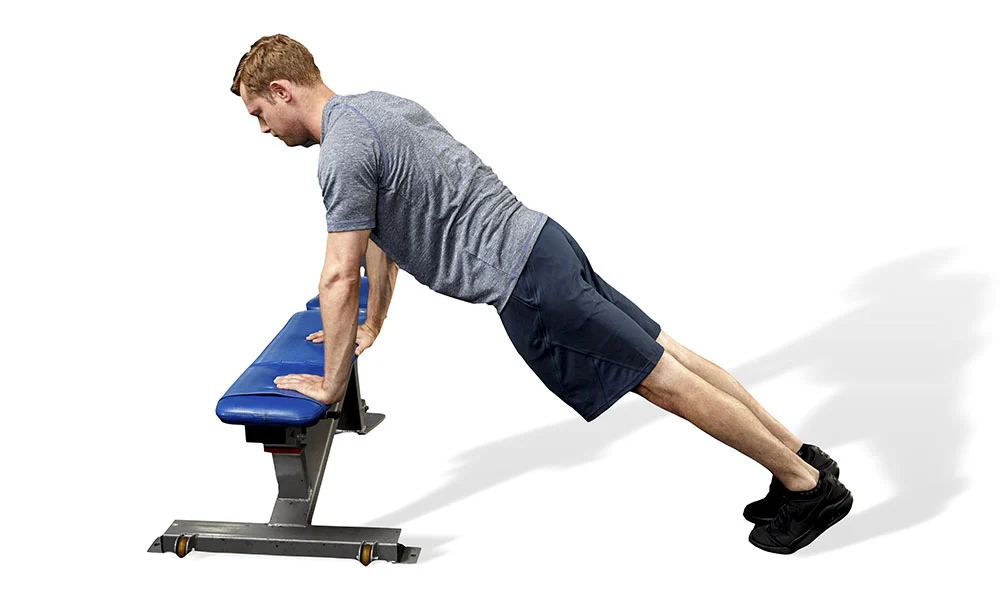
The easiest way to adjust a narrow push-up is to change the height of the hands. A stable bench or elevated surface reduces the proportion of body weight you must press while preserving most of the movement pattern. Check that the surface cannot tip or slide, and do not assume an adjustable bench is safe for every unusual sideways loading direction. As strength improves, lower the support gradually until you can work on the floor with comfortable wrists and the same steady trunk position.
If a regular floor version becomes too easy, progress difficulty in small, measurable steps. You can slow the lowering, add a brief pause just above the bottom or gradually increase repetitions while leaving one or two technically sound reps in reserve. A properly secured weighted vest can eventually be an option for experienced lifters, but extra load should come after repeatable floor technique. A band or loose plate on the back is not an automatically safer shortcut.
Parallettes and handles can be useful when they allow a more natural wrist angle, though raising the hands also changes the available depth. Rings add a moving support and much more stabilization demand; they are a separate advanced variation rather than a straightforward replacement for a floor diamond push-up. Stable dumbbells with flat sides may work as handles if their shape and floor prevent rolling, but do not gamble with moving weights under your hands.
On difficult days, an incline or a slightly wider stance lets you preserve productive repetitions instead of turning the workout into a battle against wrist position. On strong days, record one clear improvement: another clean rep, a lower incline or a controlled pause. Those progressions are easier to interpret than adding several challenges at once.
Build a four-week close-grip push-up practice
Start with two sessions each week and place the exercise where your pressing quality will be high. If it is the priority of the session, perform it early after a sensible warm-up; if you already train heavy bench presses or overhead presses, use it as lighter assistance and account for the total elbow and triceps work. There is no single ideal weekly dose for all lifters. Your history, body mass, other presses and recovery capacity decide whether two sets or four sets is appropriate.
During week one, select a hand width and surface height that allow two or three sets of six to ten controlled repetitions. Leave one or two good repetitions in reserve and note any wrist discomfort rather than trying to hide it. In week two, keep the same setup and add one clean rep per set only when technique holds. If you can already complete the upper end comfortably, keep the reps steady but try a short pause at the bottom.
In week three, increase difficulty in only one direction. You might lower the incline slightly, choose a narrower comfortable hand placement or perform one additional set, but not all three. Continue to check the elbow path and trunk alignment. Week four is a consolidation week: repeat your best technically sound setup and assess whether the average rep quality and volume improved. There is no need to test an all-out maximum if the goal is consistent muscle-building practice.
Pair the exercise with pulling work and other pressing only according to your overall training plan. The 2026 EMG study suggests that diamonds are a useful variation to keep available, not a mandatory cornerstone of every chest workout. Use the research as a guide to exercise selection, then let carefully logged sets, comfort and gradual progress decide whether the version deserves a permanent place in your home gym routine.

Calisthenics Shirts & Street Workout Gear
Calisthenics and bodyweight-training gear for pull-ups, dips, handstands and street-workout athletes.

T-Rex Hates Push Ups Decal for Water Bottles Laptops Ca Sticker
Put “T-Rex Hates Push Ups” gym humor on your laptop, bottle, or gym gear.

Big Dip Energy Hooded Pullover for Calisthenics Dips Fa Hoodie
Show off your lifting humor in a laid-back “Big Dip Energy” hoodie.

Be Stronger Than Your Excuses – Motivational T-Shirt
Rep “Be Stronger Than Your Excuses” humor in and out of the gym.

Calisthenics Heartbeat Muscle Shirt Athletic Vest Human Tank Top
Bring “Calisthenics Heartbeat” humor to your next lifting session.

Calisthenics Evolution
Show some lifting attitude with a playful “Calisthenics Evolution” tee.

Pull Up or Shut Up Crewneck Pullover Sweater for Calist T-Shirt
For laid-back days and bodybuilding humor: “Pull Up or Shut Up”.

Shirt – Lord Of The Calisthenics Rings – Meme T-Shirt
Rep “Lord of the Calisthenics Rings” humor in and out of the gym.

Turn Off Gravity Funny Calisthenics Gym Decal for Water Sticker
Give your everyday gear a playful “Turn Off Gravity Funny Calisthenics” twist.


Funny Calisthenics Gym Crewneck Pullover Sweater for Bo T-Shirt
Add a playful “Calisthenics” touch to your casual rotation.