Advertising disclosure: This page includes affiliate product links that may earn us a commission, as well as products from our own store.
The Smith machine reverse lunge is a useful way to load one leg at a time while the bar follows a guided path. But a fixed track is not a substitute for a good stance: front-foot position, rear-step length, bracing and the machine’s safety stops all affect whether the movement feels smooth or awkward. Here is how to set it up, progress it and decide when a free-weight alternative makes more sense.
Check the Smith track, safeties and bar position before you step back
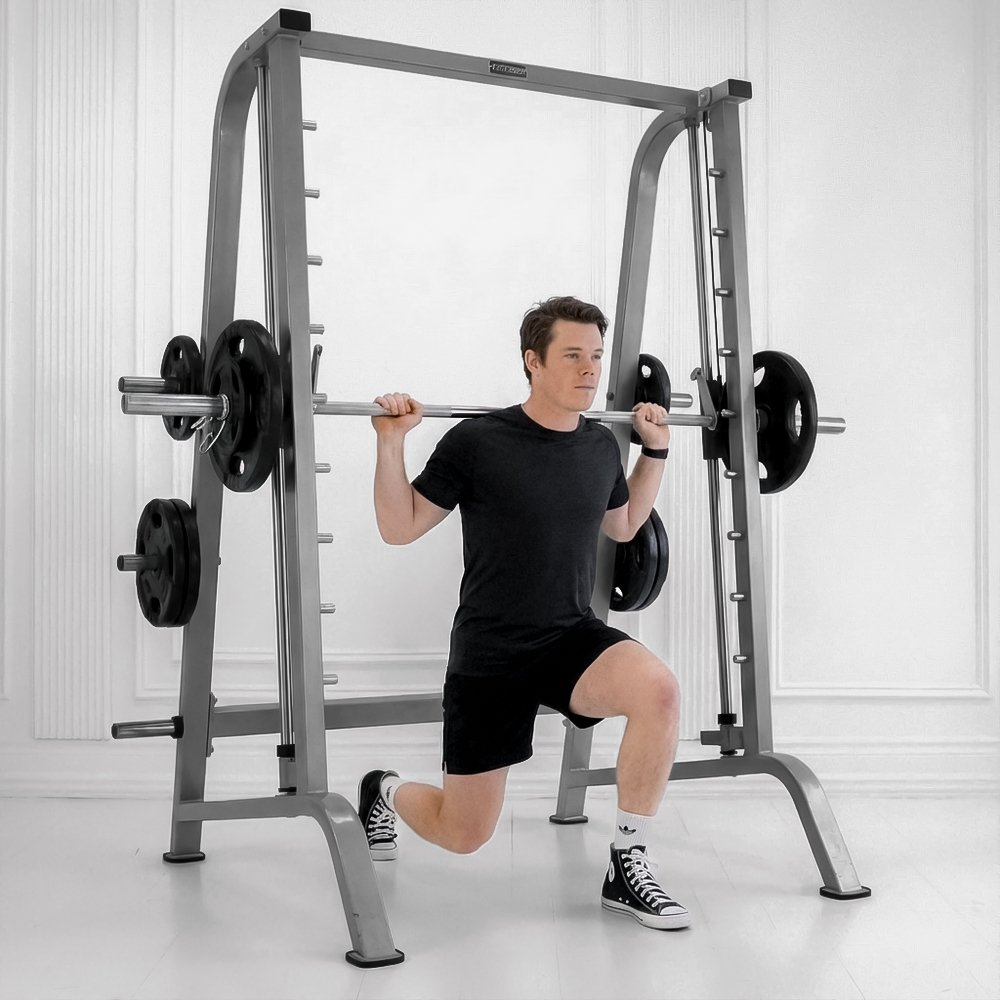
Unlike a free-bar reverse lunge, the Smith version keeps the loaded bar on a predetermined track. That can make the movement feel predictable, but it does not choose your stance for you. Some machines have a vertical path, others are angled, and counterbalanced models can have a much lighter effective starting bar. Test the actual machine rather than assuming every Smith feels the same.
Set the bar at a height that lets you stand under it without rising onto your toes. Rest it across the muscular upper back, not directly on the cervical spine. Take a comfortable overhand grip, brace your trunk, and practice the hook rotation with no plates. Verify how the safety stops are adjusted and make sure they can catch the load below your intended bottom position without interfering with a normal rep.
Before a working set, perform two or three unloaded practice repetitions on each side. Watch whether your feet clear the frame, whether the rear foot has space to travel, and whether the bar’s trajectory makes your torso bend or lean backward. If your natural stance clashes with the rails, reposition the front foot or use another exercise. A guided bar is only useful when you can move comfortably under it.
Do not equate a Smith-machine plate number with the same total load on a conventional barbell. Counterbalance, friction and carriage mass vary between machines. Record the machine and weight configuration if you intend to compare progression across sessions.
Find a front-foot position that works with the fixed bar path
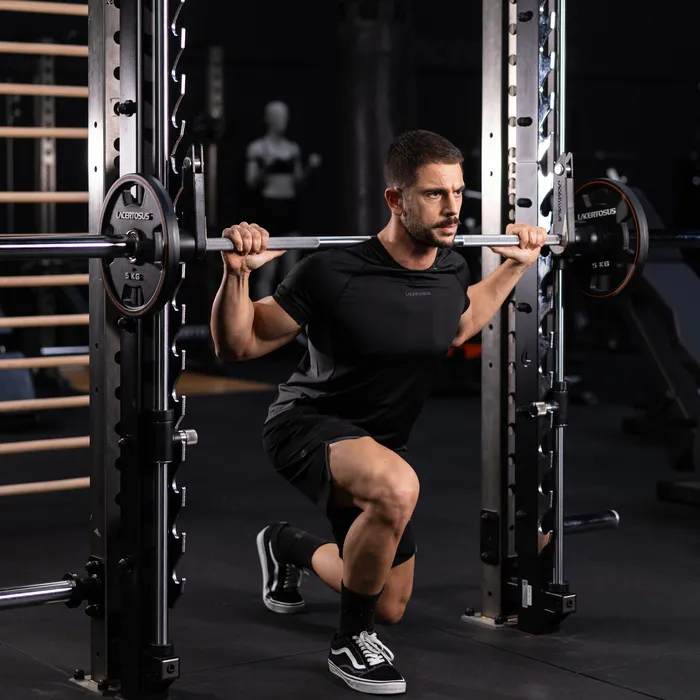
Plant the working foot about hip-width from the other foot, rather than placing both feet on a tightrope. Then step the nonworking foot backward and land on its forefoot. Most of the vertical push should come from the front leg. The rear toes contribute balance and a little support, but should not turn the rep into a forceful hop off the floor.
Your front foot must be positioned where the bar can travel without dragging your body into the rails. On a vertical Smith, that often means arranging the front foot under the loaded shoulder line while giving the back knee a clear path. On an angled model, the preferred stance may change with which direction you face. Neither an extreme forward stance nor a completely upright front shin is a universal law.
Allow the front knee to move naturally in the direction of the toes. Some forward knee travel is normal and is not automatically unsafe. What matters more is whether you can keep the full foot planted, control the descent and avoid collapsing inward or twisting at the hip. Try a slightly shorter step if an oversized stride forces the pelvis to rotate or makes the back hip uncomfortable.
Mark an effective front-foot spot using a floor seam or a reference in the Smith frame. Consistent placement makes it easier to repeat the same depth and compare sets. If you are new to the pattern, practice bodyweight reverse lunges or light dumbbells before making the guided bar your working load.

Equipment Worth Exploring
Explore equipment, accessories and gear from our carefully selected range.

Multi Pull Smith Rack MPHR-780
All-in-one rack with a Smith machine, functional trainer, lat pulldown and low row.

VForce 3IN1 Max
Six-post all-in-one rack with Smith machine, functional trainer, and variable-force cables.

VForce 3IN1
All-in-one rack combining an adjustable Smith machine, functional trainer, and free-weight station.


Leg Press/Hack Squat BPR-790
Convertible 45-degree leg press and hack squat machine with a broad footplate and band pegs.

Studio V-Squat
Plate-loaded V-squat machine for supported lower-body strength training.

Compact Leg Press CLP-700
Compact reverse-style leg press with a moving seat carriage and an adjustable footplate.


Lower on two stable legs and drive through the working leg
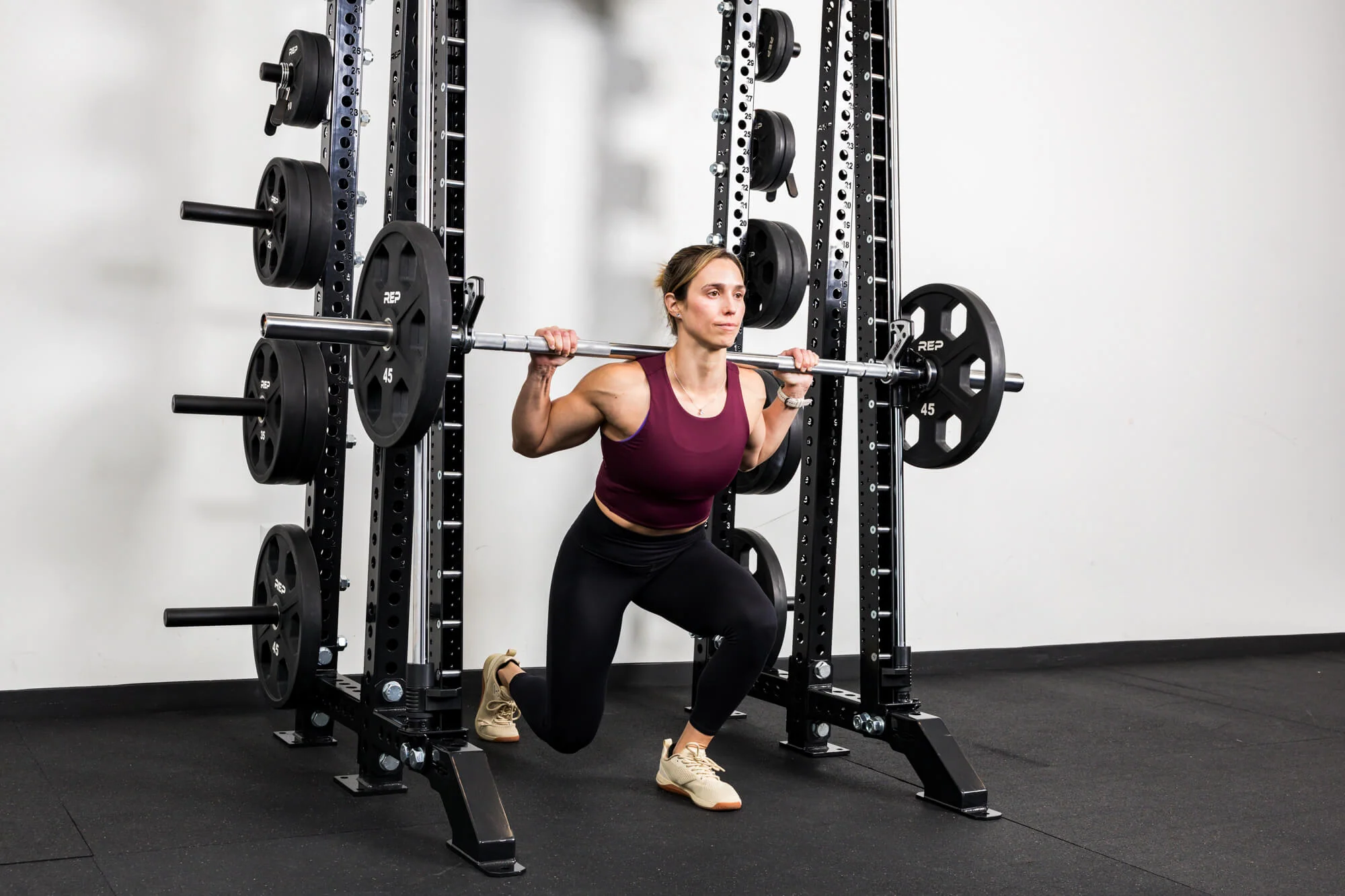
Stand tall under the unracked bar and inhale into a firm brace before you move. Step one foot back deliberately; then bend both knees and let the hips descend between them rather than throwing the shoulders forward. The front knee can move over the toes if needed, provided it follows the foot’s line and the heel stays down. Keep the chest and pelvis moving as a unit.
Lower to a depth you can control. A back knee hovering just above the floor is a useful visual reference for many people, but it is not compulsory if hip range, knee tolerance or equipment geometry prevents it. More range is not better when you reach it by rounding the lower back, tipping sideways or letting the front heel peel up.
To stand, press the planted front foot firmly into the floor and extend the front knee and hip. Think of moving your torso and the Smith bar upward together. Avoid a dramatic push from the rear toes, which can hide weakness in the front leg and create a different movement from one rep to the next. Return the back foot to the start slowly rather than rushing into the next repetition.
Alternate sides if that helps you maintain rhythm, or finish all repetitions on one side before changing. Either method works when recorded consistently. For a harder, more stable hypertrophy set, keeping one foot planted and repeating the same side often makes sense. Always count repetitions per leg, not as one combined total.
Decide whether you want more quad or glute emphasis
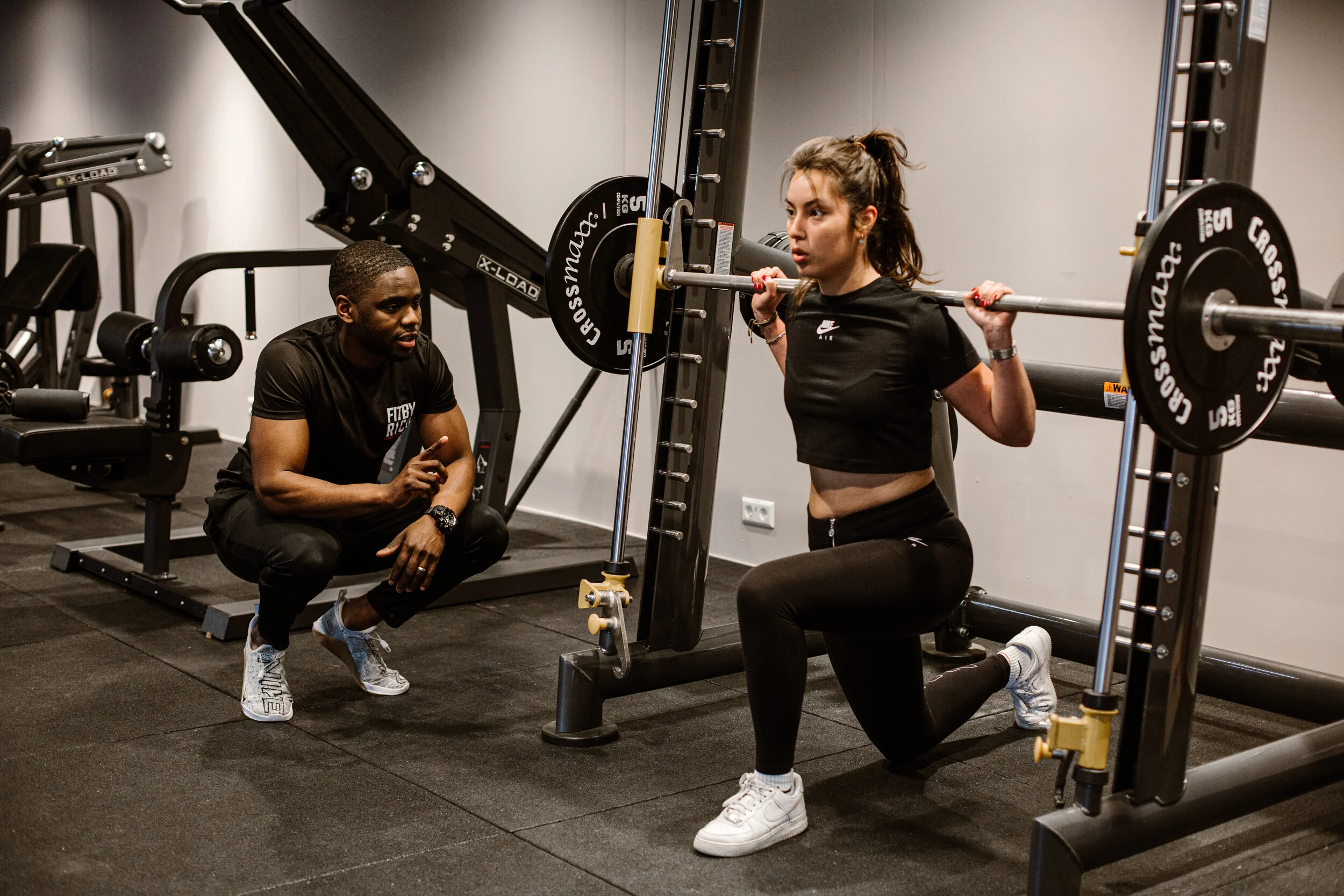
The reverse lunge trains knee and hip extension together, so the quadriceps and glutes do substantial work. The rear leg assists balance, while the hamstrings, adductors and trunk contribute to stabilizing and coordinating the movement. There is no reliable universal percentage of activation that tells you exactly how much each muscle will grow from a particular stance.
A slightly shorter step with greater comfortable front-knee travel can increase knee-extension demands, although the individual machine and your proportions matter. A longer controlled step and modest forward torso inclination may feel more hip-dominant. These are practical changes in joint positioning, not guarantees of selective muscle isolation or a promise that one version is superior for every lifter.
Experiment with one adjustment at a time: front-foot location, rear step length or torso angle. Keep the bar on its safe guided path and do not chase a target muscle sensation by twisting your pelvis. If the back leg becomes the limiter, pause and reset the stance before adding load. If the movement irritates a joint, shorten range or choose a more comfortable option rather than forcing through pain.
Smith reverse lunges are an accessory, not a complete leg program. Squats, leg presses and leg extensions offer different loading profiles for the quads. Hip thrusts, hinges and leg curls complement hip-dominant and hamstring training. The right choice depends on fatigue, range of motion, equipment and what your main lifts already cover.
Correct the five mistakes that spoil otherwise strong repetitions
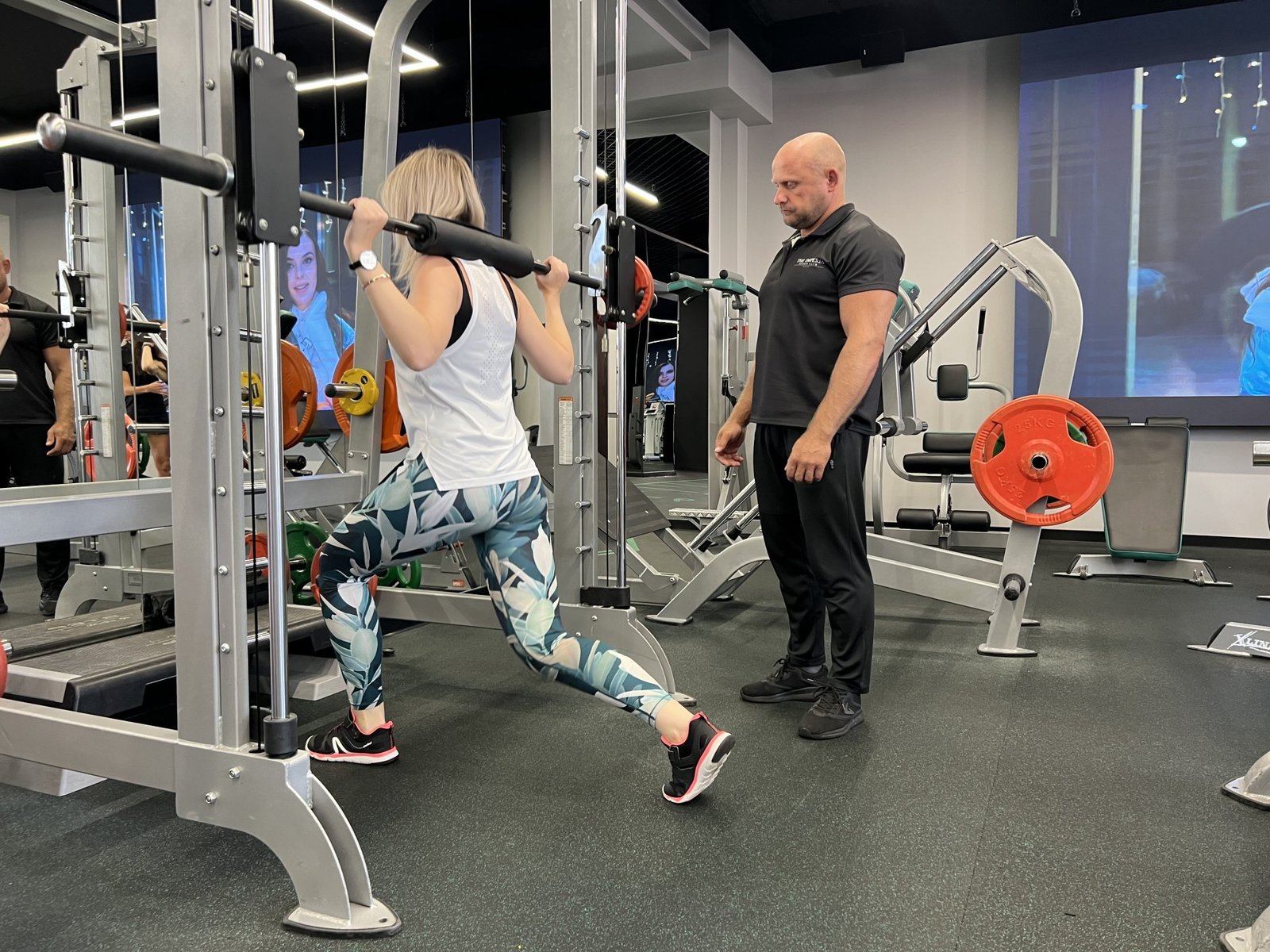
First, letting the knee collapse inward changes your working-leg alignment. Think about pressing the floor away while keeping the knee oriented with your toes. Second, using the rear leg to bounce upward turns the lift into a two-leg push and makes load progression hard to interpret. Slow the transition at the bottom and let the front leg initiate the ascent.
Third, stepping backward too far can pull the hips into an awkward position or cause the pelvis to rotate. Bring the rear foot closer until you can keep the torso controlled. Fourth, starting with the front foot too far from the bar’s path can make you lever against the Smith rails rather than rise vertically. Rehearse the pattern unloaded before changing to heavier sets.
Fifth, racing the eccentric portion makes the bottom position inconsistent. A controlled two-second descent is a simple coaching choice, not a required scientific tempo. Stay steady enough to preserve your brace, foot pressure and chosen range. If a new rep is noticeably shallower than the last, count it as a quality warning instead of simply celebrating one more repetition.
Also check the practical details that often escape form videos: shoes that grip the floor, plates that do not hit the frame, hooks that you can rotate into place, and an unobstructed path for the stepping leg. Stop if you cannot safely rerack or if the machine’s mechanical travel conflicts with your natural position.

Leg Day Shirts & Workout Gear
Leg-day gym shirts and workout gear for lifters who never skip squats, lunges and lower-body punishment.


Never Skip Legday – Chicken Legs Meme , , & Leg Day T-Shirt
Heavy lifts, good laughs, and a little “Never Skip Legday” energy.

Leg Day Is Calling You Squats, Deadlifts & Gains T-Shirt
Rep “Leg Day Is Calling You” humor in and out of the gym.

Shirt – Squat Inspector Leg Day & Booty Gains – Meme T-Shirt
Make gym days more fun with “Squat Inspector” style.


Squats R Us Shirt – Leg Day Gains & T-Shirt
Heavy lifts, good laughs, and a little “Squats R Us” energy.

Let It Grow Leg Day Sweater Squats & Booty Gains Meme T-Shirt
For laid-back days and leg-day humor: “Let It Grow”.

Muscle Mommy Gym – Peach Booty Training for Gym Girls a Hoodie
Show off your gym-girl humor in a laid-back “Muscle Mommy” hoodie.

Swolebob Squatpants Gym | Funny SpongeBob Leg Day Meme Sticker
Give your everyday gear a playful “Swolebob Squatpants” twist.
Build four weeks of lunges without turning every set into a balance test
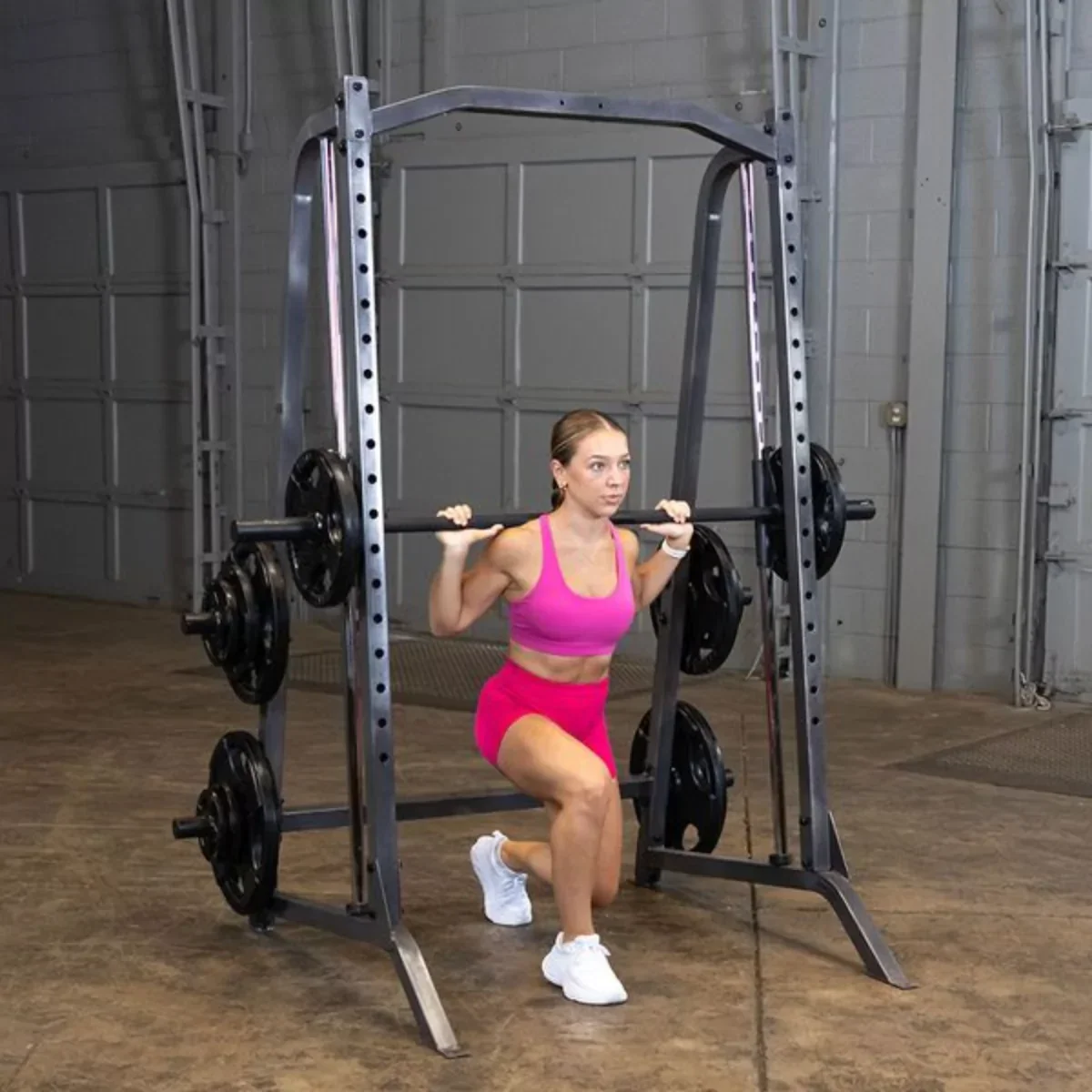
Begin with a few sets of bodyweight or lightly loaded reverse lunges to establish a repeatable front-foot location. In week one, try two working sets of eight controlled repetitions per leg at a load that leaves roughly three good repetitions in reserve. In week two, use three sets with the same technique and a similar effort level. Rest long enough for steady foot placement and breathing; sixty to one hundred twenty seconds is a practical starting range.
In week three, work toward ten or twelve repetitions per leg in the same number of sets if the movement remains stable. In week four, add a small amount of weight only if you can keep the same depth, controlled lowering and front-leg drive. You could alternatively keep the load unchanged and improve the final set’s technique. These are illustrative programming choices, not a trial-proven optimal progression.
Fit the exercise around heavier bilateral work. After a squat or leg press, two or three Smith reverse-lunge sets may be plenty. If lunges are the main quad or glute lift of that day, place them earlier and consider more rest. Track which leg you start with and avoid allowing the stronger side to dictate extra repetitions that the other cannot match.
When you want less external support for coordination, use dumbbell or free-bar reverse lunges. For a more fixed stance, consider a split squat. If your balance is currently the main limiter and the Smith geometry suits you, its guided path can make a useful training option. The final measure of success is controlled repeatable lower-body work, not the machine’s apparent weight advantage.
Some product links may be affiliate links, which can support Mind Muscle Perfection at no additional cost to you.