Advertising disclosure: This page includes affiliate product links that may earn us a commission, as well as products from our own store.
Incline cable flyes are easy to turn into a confusing mix of chest fly, front raise and press. The exercise becomes far more useful when you center the bench, put the pulleys in the right position and move the upper arms through a controlled arc. Here is a practical setup and progression for training your chest without guessing at every rep.
What an incline cable fly does differently from a press
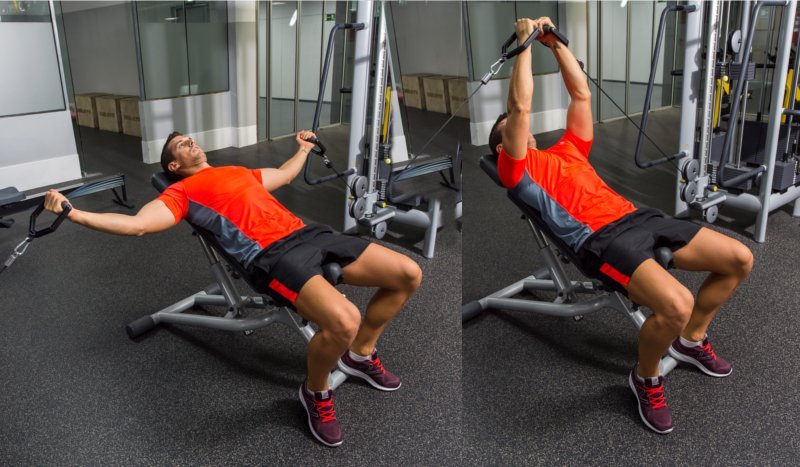
An incline cable fly is a chest-focused accessory performed while lying against an adjustable bench between two cable stacks. The arms travel inward in a sweeping path rather than straightening against a bar or dumbbells. Both movements recruit your pectorals, but a fly puts a larger share of the visible movement at the shoulder instead of the elbow. It is not a replacement for every chest press: it gives you another way to load the chest without making your triceps the usual limiting factor.
The bench changes the angle of your torso relative to the cable. A modest incline can emphasize the clavicular, or upper, region of the pectoralis major compared with some flatter paths. That does not mean only your upper pecs work, or that a specific pulley notch guarantees more growth. Your shoulders, torso position, arm path and the resistance direction all matter. Treat the bench angle as a repeatable setup choice, not a secret muscle-isolation switch.
Low cables pull diagonally outward as you bring the hands together above the chest. Unlike a dumbbell fly, whose resistance is always pulled downward by gravity, a cable keeps its line of pull toward the pulley. Tension still changes across the arc: it is not literally uniform at every joint angle. The practical payoff is that you can choose a smooth movement with a useful resistance feel in both the open and closed portions.
Use this exercise when you want controlled chest volume after pressing, or when the combination of bench support and an adjustable cable path feels better than swinging free weights. If your main goal is maximal pressing strength, keep pressing in the plan as well. More cable-fly weight is not automatically a better training stimulus if it turns the movement into an unstable press.
Place the bench and pulleys before loading the cables
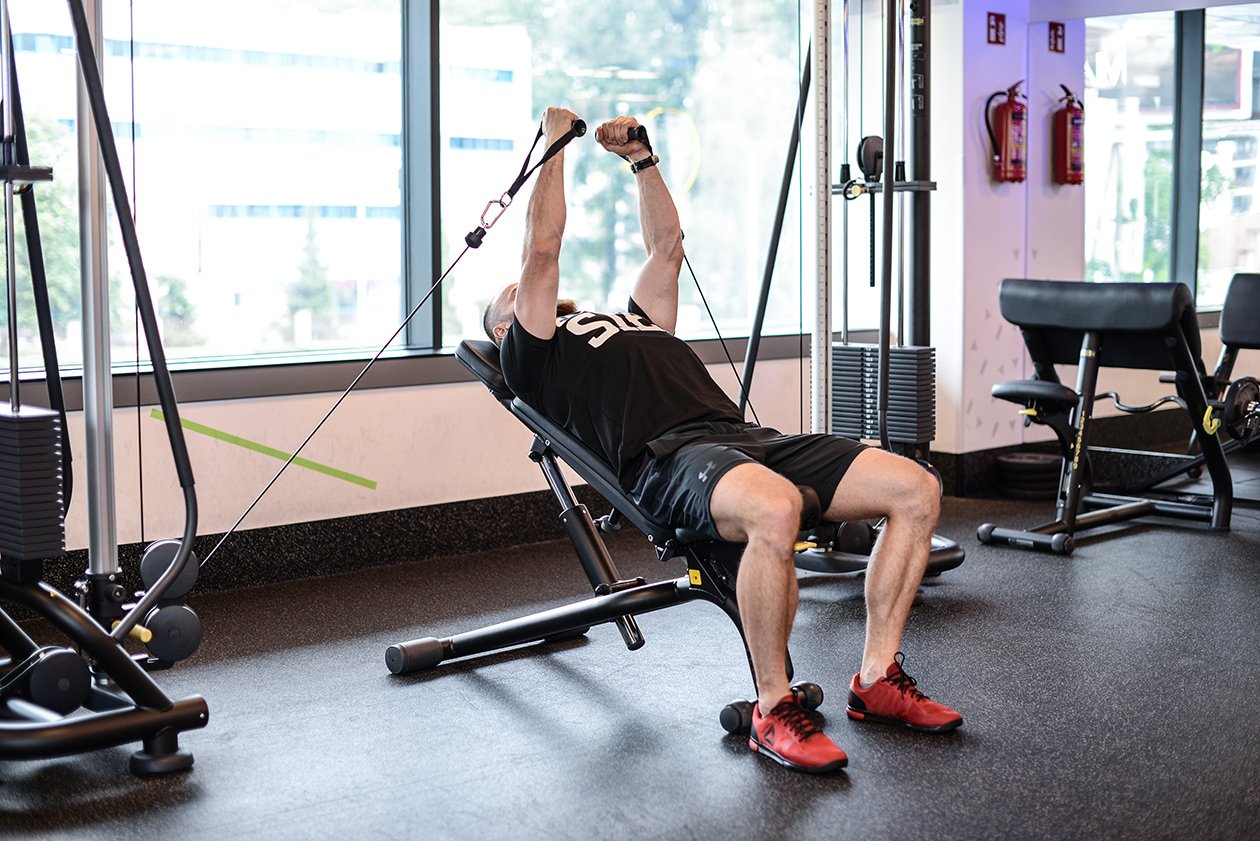
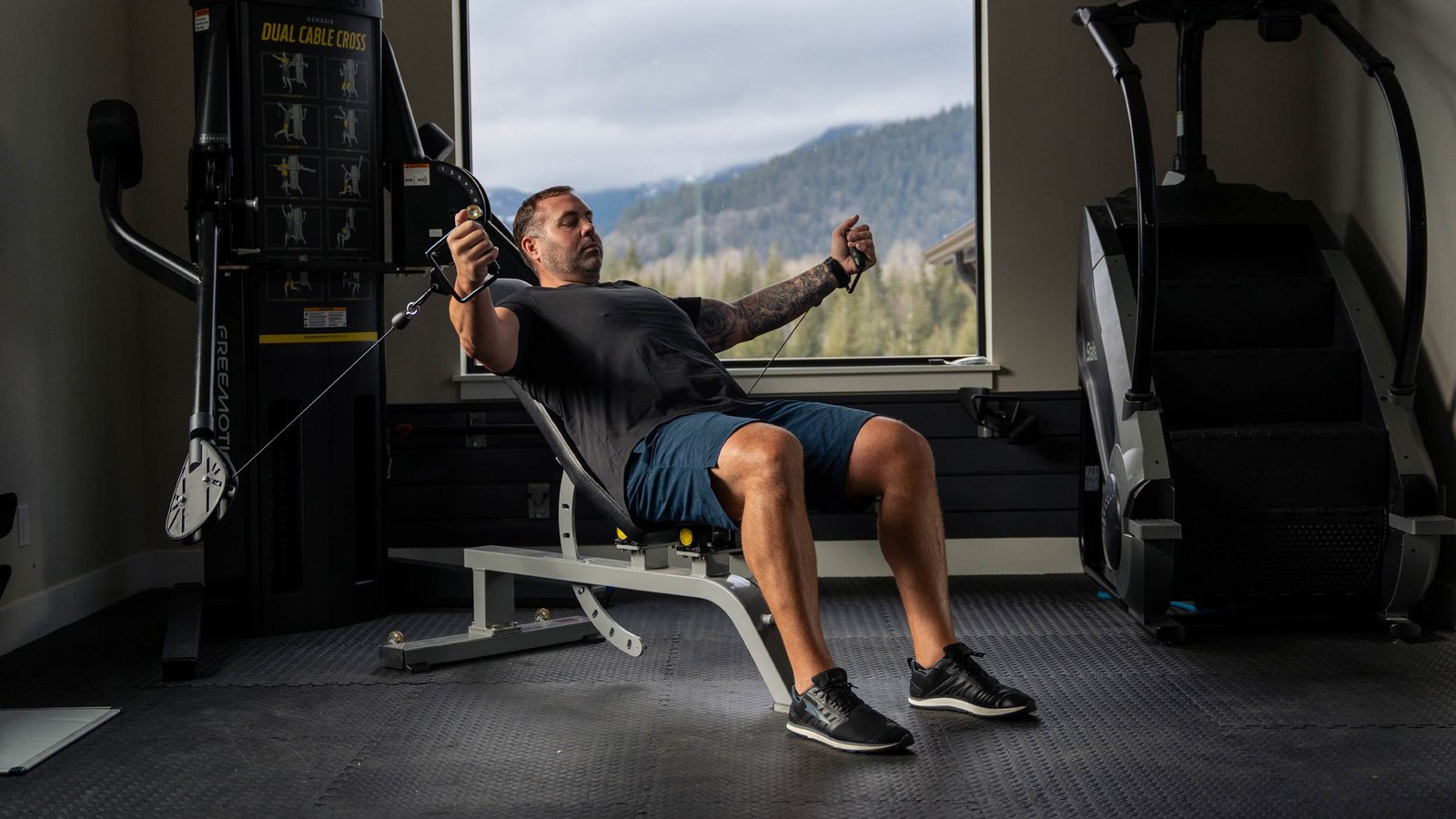
Start with two matched single handles, one attached to each side of a dual cable station. Put the bench as close to the centerline between the two stacks as space allows. Set the backrest to a low-to-moderate incline, roughly 20–40 degrees as a workable starting range, rather than assuming a steep upright seat is best. More upright angles can increase how much the front shoulders participate. The exact number is less important than being able to repeat it next time.
Set both pulleys low enough that the cables approach from below or slightly behind the hands when the arms are open. Depending on your machine, the bottom notch may be suitable; on a different machine it may direct the cables into the bench or your legs. Check the actual line and eliminate rubbing before you lift. The two stacks should start on matching resistance settings, but remember that machines differ in pulley ratios and displayed weights.
Test the setup with the stacks near their lightest useful setting. Sit down, retrieve the handles one at a time, plant both feet and lean back against the bench. If retrieving the handles requires a violent shoulder stretch or a twisting struggle, adjust the start position, have a partner pass them to you or choose a different exercise. A bench that creeps forward, uneven cable angles or a carabiner touching the frame is a reason to reset, not a form challenge.
- Bench: stable backrest, firm seat and room for both arms to open without hitting the uprights.
- Pulleys: symmetric height and position, with the cables free of bench legs and other attachments.
- Hands: neutral or nearly neutral grip, wrists aligned with forearms, elbow bend established before the first rep.
- Feet and torso: stable floor contact, upper back against the pad and no need to slide down to reach the handles.
Film a light rehearsal from the front if you are unsure. Look for an even start on each side rather than judging success solely by the appearance of the finished squeeze.
Sweep the wrists together without turning the fly into a press
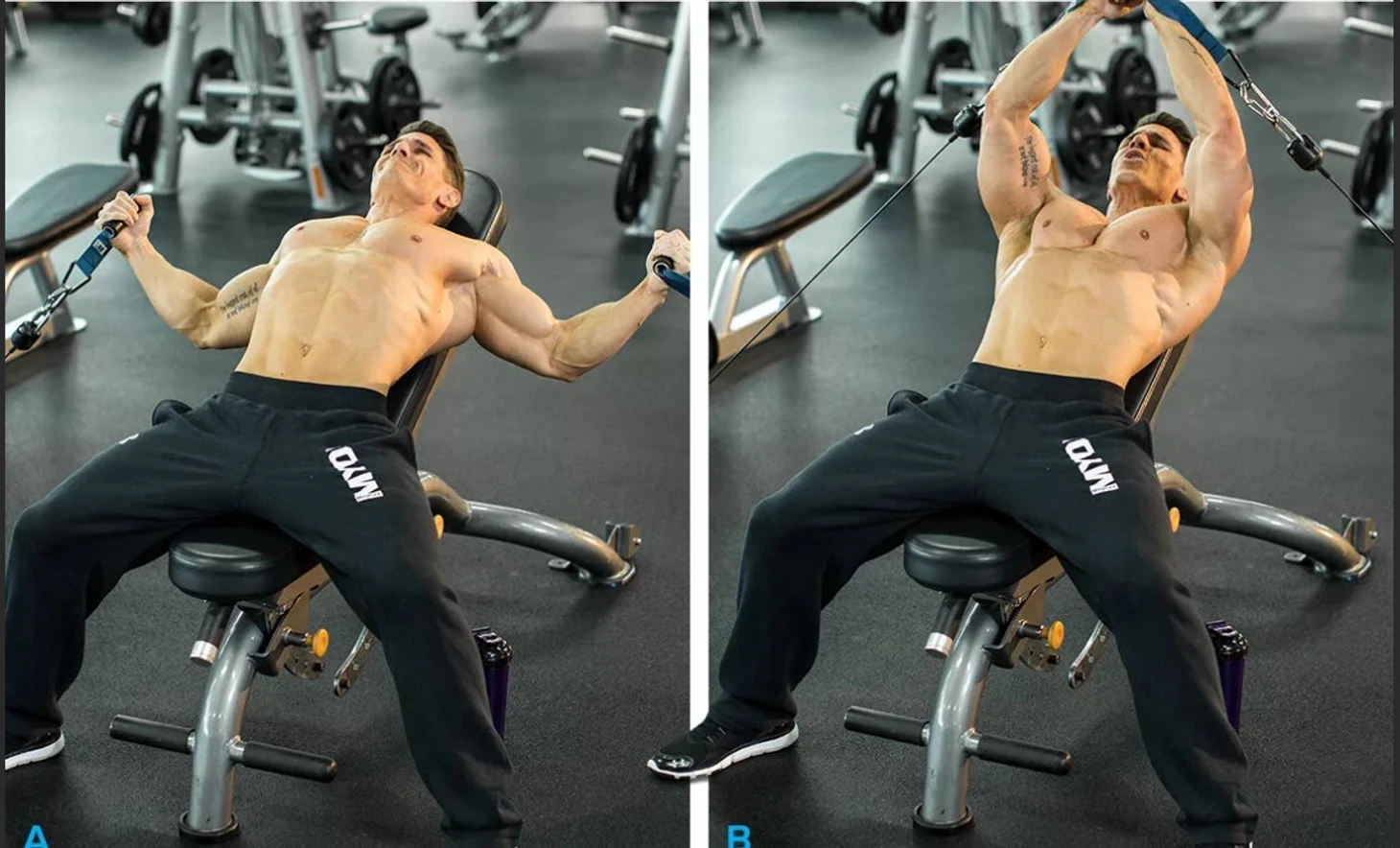
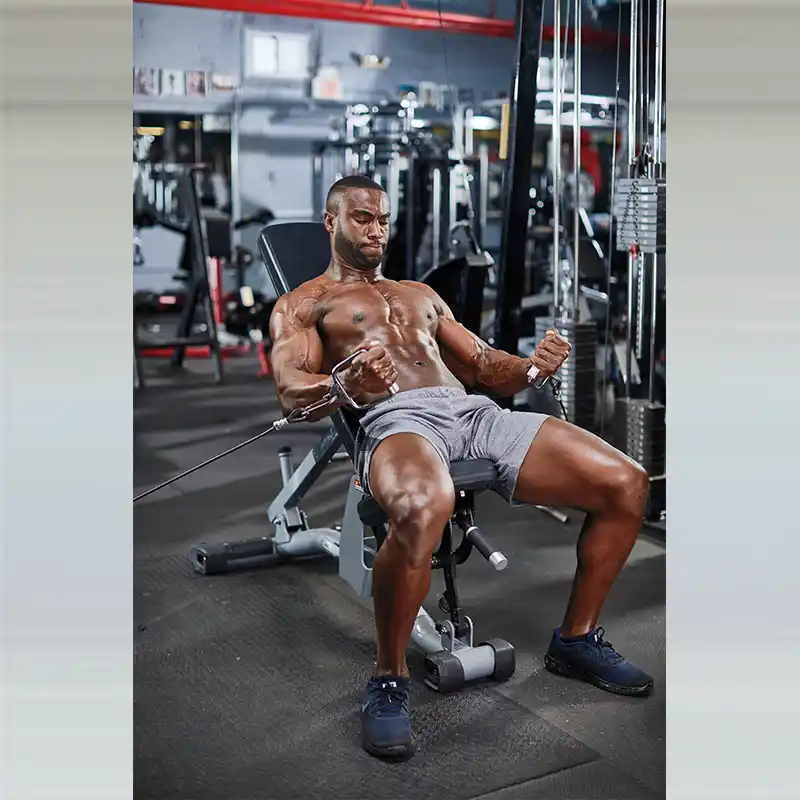
Begin with the upper arms opened to a comfortable position, hands somewhat wider than the shoulders and elbows slightly bent. Keep that bend approximately constant as you bring the arms inward and upward in a broad hugging arc. Think about moving the upper arms toward each other while the forearms simply connect the hands to the cable handles. If the elbows straighten dramatically during the lift, you have changed the exercise into a hybrid press.
Let the hands meet, or nearly meet, above the upper chest at a height that feels natural for your bench angle. They do not need to crash together or cross over. A brief controlled pause can help you confirm that you are finishing with the chest rather than throwing momentum through the last few centimeters. Keep the ribs from flaring and avoid lifting the shoulders toward your ears to manufacture extra range.
Reverse the path slowly. The elbows should keep their soft bend, and the shoulder blades can remain comfortably supported by the pad rather than being actively jammed into an extreme position. Open until you feel a manageable stretch across the chest without a painful anterior-shoulder pinch or the sense that the load is pulling your arms behind your body. This bottom limit depends on mobility, cable direction and grip; it is not a universal rule about elbows lining up with the bench.
A practical repetition uses about one or two seconds to close, a short pause if desired, and two or three seconds to open. There is no need to force an exact tempo if it disrupts the motion. Instead, make every rep resemble the preceding one. If the last five are far shallower than the first five, either end the set earlier or reduce the load next time.
One useful self-check is to hold the upper arms in roughly the same posture while the hands travel. Another is to compare left and right cables: if one side finishes earlier because the torso has rotated, simplify the setup. Symmetry should be observable, not just something you assume because both stacks show the same number.
Fix the four mistakes that make chest flyes uncomfortable
Too much weight: The most common giveaway is a large change in elbow angle. You start by sweeping the arms together, then finish by forcefully extending the elbows. Another clue is the bench rocking or the upper back peeling off its pad. Cut the resistance until you can keep the same shoulder arc for the entire set. This is an accessory movement; you do not need to impress anyone with the selector pins.
Opening too far: A deep-looking stretch is not automatically useful. The shoulder is under load while the upper arm moves into horizontal abduction. If your front shoulder feels pinched, reduce the bottom depth, soften the angle slightly or use lighter weight. Sharp or persistent pain is a reason to stop and reassess rather than chase a stretch sensation. A cable stack that abruptly moves you past your comfortable range is a setup problem as much as a technique problem.
Bench placed off center: When one pulley is farther away, the direction of resistance becomes different from side to side. That can encourage a shoulder to shrug, twist or finish earlier. Measure by eye from the bench to the uprights, center the headrest and ensure each cable travels without obstruction. On machines with independently adjustable arms, matching pulley position and direction matters more than matching the printed height numbers.
Turning the rep into a shoulder shrug: An excessively steep incline, hands traveling toward the forehead or a torso sliding forward can shift the feel toward the front deltoids. Start with a shallower bench, bring the finish point back above the chest and keep the shoulders quiet. You should not need to jam the shoulder blades down and back with maximal force. Good positioning is stable but comfortable.
Wrist discomfort is another useful warning. A free-rotating D-handle usually lets the hand find a neutral orientation; a rigid straight bar can restrict that freedom. If the wrist has to bend sideways to complete the arc, change the attachment or cable position before simply adding warm-up sets. Different equipment and anatomy mean some lifters will prefer a one-arm version or a conventional machine fly instead.
Incline cable fly, standing crossover or dumbbell fly?
These exercises share a chest-adduction goal but do not feel identical. The incline bench cable fly supports your torso and gives you a fixed body angle. That is useful when you want to focus on the arc rather than bracing your whole body against two stacks. The tradeoff is setup time: the bench must fit the cable station, the arms need clearance and getting into position can be awkward when the resistance is heavy.
A standing low-to-high cable fly uses a similar upward arm path but asks your legs and trunk to resist the cables. Some lifters prefer the freedom to step forward or adjust torso lean, while others find themselves drifting through every set. If you cannot place a bench securely between the stacks, this is often a practical alternative. Use the same rules about light starting resistance, slight elbow bend and a repeatable finish.
An incline dumbbell fly needs little setup beyond a bench and dumbbells. But gravity changes the torque across the lift: the bottom half can be demanding while the top often becomes easier as the dumbbells stack over the shoulder joints. That is not inherently a defect. It simply means the dumbbell version rewards careful load and depth selection, and it will not recreate the exact cable resistance profile.
An incline press allows elbow extension and generally supports heavier loading, making it better suited to the part of a session where you want a progressive compound lift. Neither exercise makes the other redundant. For example, a chest session could start with an incline machine or dumbbell press, continue with a flat press if desired, then finish with two deliberate sets of cable flyes. You can also swap a machine pec deck for flyes when the cable station is busy.
Choose based on the repeatability of the setup, your shoulder tolerance and whether the exercise gives your chest a challenging but controlled range. Choosing the movement with the most dramatic stretch or the heaviest displayed weight is a weak reason to reorganize an entire training program.

Equipment Worth Exploring
Explore equipment, accessories and gear from our carefully selected range.
VOLTRA
Compact digital cable trainer with smooth, adjustable resistance.

VForce Wall Trainer
Space-saving wall-mounted functional trainer with pivoting cable arms and variable resistance ratios.

Go-Tone Pro
Portable digital cable trainer with up to 66 lb (30 kg) of adjustable resistance.

VForce 2IN1
Half rack and pivot-arm functional trainer with switchable 1:1 and 2:1 pulley ratios.



GymPin D Cuffs
Adjustable wrist cuffs with textured grips for supported cable-machine exercises.

GymPin Ergo Handles
Pair of ergonomic cable handles shaped for comfortable triceps and pulling exercises.

Build four weeks of chest volume without chasing a heavier stack
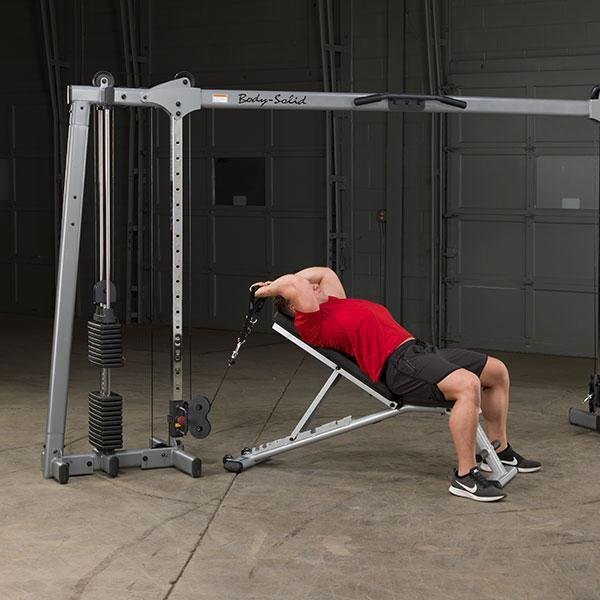
Treat incline cable flyes as a measurable accessory. Pick a load you can move for eight to fifteen smooth repetitions with one to three reps left in reserve. You should be able to hold the bench position, match both sides and keep the same elbow angle. If you cannot, use a lighter pair of stacks. Rest roughly 60–120 seconds between sets, extending the rest if breathing or grip fatigue is hiding the actual quality of your chest work.
Week 1: Complete two sets of 10–12 after your main press. Spend the first session dialing in bench angle, pulley height and bottom range. Record those settings. If your machine has a highly variable pulley system, note the model or ratio rather than comparing raw stack numbers across gyms.
Week 2: Keep the same setup and aim for one extra clean repetition per set, up to 13–14. Do not shorten the opening phase to beat the logbook. If the last rep is already a press with flared ribs, stop there and keep the previous number as your honest benchmark.
Week 3: Work toward two sets of 15 if the preceding reps are still controlled. Only after you own the top of the rep range should you consider a small load increase. When you add weight, your repetitions can return toward 10–12 without meaning you have lost progress.
Week 4: Repeat the new load or the best prior load with cleaner execution; add a third set only if your overall chest recovery and existing weekly volume allow it. A third set is not mandatory. You could also keep the same two sets and focus on consistent depth and left-right timing. Judge progress over multiple sessions, not one crowded cable-station workout.
For a lifter already doing substantial chest pressing, adding two or three quality fly sets once or twice a week may be plenty. Beginners can start with fewer total chest sets and progress gradually. There is no special need to take flyes to absolute failure, particularly when shoulder comfort depends on maintaining a smooth bottom reversal. Log the exercise using bench incline + pulley position + load + strict reps, and you will know what actually improved.

Bodybuilding Shirts & Workout Gear
Bodybuilding shirts, tanks and gym gear for lifters chasing muscle, size, symmetry and the pump.

Gym Dost Thou Even Fly Medieval Knight Pec Fly for Body Hoodie
Show off your medieval humor in a laid-back “Dost Thou Even Fly Medieval Knight Pec Fly” hoodie.

Gym Sir Swole of Benchalot Medieval Knight Bench Press T-Shirt
Make gym days more fun with “Sir Swole of Benchalot Medieval Knight” style.

Shirt – Kanye Chest , Meme Gains & Bros T-Shirt
Heavy lifts, good laughs, and a little “Kanye Chest” energy.

I Love Bench Press Valentine'S Day Meme – Chest Day T-Shirt
Make gym days more fun with “I Love Bench Press Funny Valentine's Day” style.

My Bench Press Is Stuck Horror Movie Meme Sweater T-Shirt
Show some gym-day personality with “My Bench Press Is Stuck”.

If You're Reading This Its Chest Day | Drake Album Cove Hoodie
Bring “If You're Reading This Its Chest Day” gym humor to lazy days and post-workout plans.

Chest Day Decal Water Bottles & Equipment Meme Sticker
Bring “Chest Day” attitude to your water bottle or laptop.


Work on His Pecks Tee
Show some bodybuilding attitude with a playful “Why Did The Chicken Go To The Gym? To Work” tee.

The Chestfather Arnold – Big Chest , Meme Shirt, T-Shirt
Bring “The Chestfather Arnold” humor to your next gym day.
The best incline cable fly is the one you can set up identically, perform without painful joint positions, and progress in small, verifiable steps. Keep the bench centered, control the arc and leave ego lifting to a movement that suits it.