Advertising disclosure: This page includes affiliate product links that may earn us a commission, as well as products from our own store.
Squat Jumps: Control the Landing Before Chasing More Repetitions
A squat jump is easy to make exhausting. Repeating it quickly until your legs burn is much simpler than keeping every takeoff and landing comparable. If your purpose is deliberate jumping practice, the useful question is not how long you can keep moving. It is whether you can still leave the ground, return to it and organize the next attempt with control.
This guide focuses on the basic bodyweight movement: a two-foot takeoff and a two-foot landing on the same surface. It is not a box jump, a tuck jump or a prescription to add weight. Start with an intensity you can manage and make the landing part of the repetition, rather than something that happens after it.
1. Choose the task and clear the landing space
Before jumping, check the space above, beside and beneath you. A ceiling light, a low beam, a moving gym partner or a plate beside your shoes can turn a simple drill into an avoidable obstacle. Pick a level, dry surface with reliable traction. A very soft mat that shifts or lets the foot sink sideways is not automatically better than a stable training floor.
Use shoes you can move and land in securely, and start with a few ordinary bodyweight squats. Then rehearse a small jump with a deliberate stop after landing. You should be able to return to a balanced stance without an extra hop or a step to save the attempt. Build from that version instead of opening with your highest possible jump.
Be clear about what you are practicing. A jump with an immediate downward dip is different from one that begins after holding still in a squat. Both can be purposeful, but the same repetition count does not make them equivalent. Pick one version for a set, and record whether you used a pause or a continuous dip.
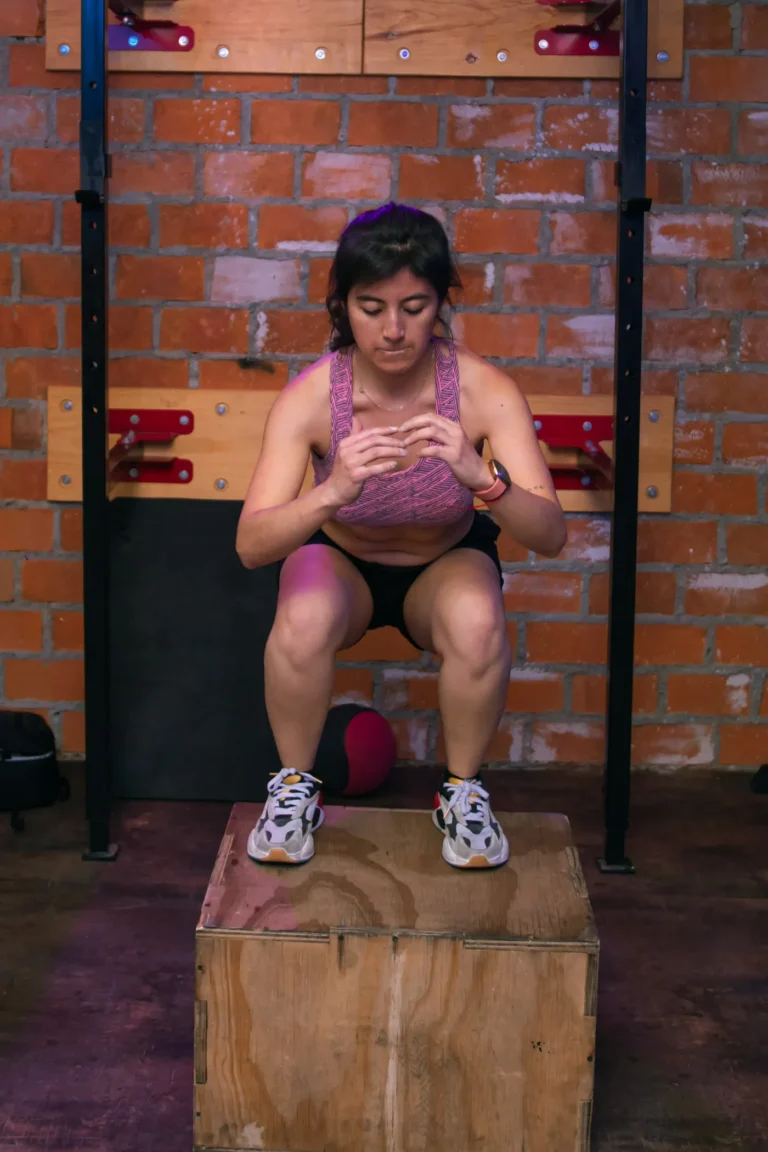
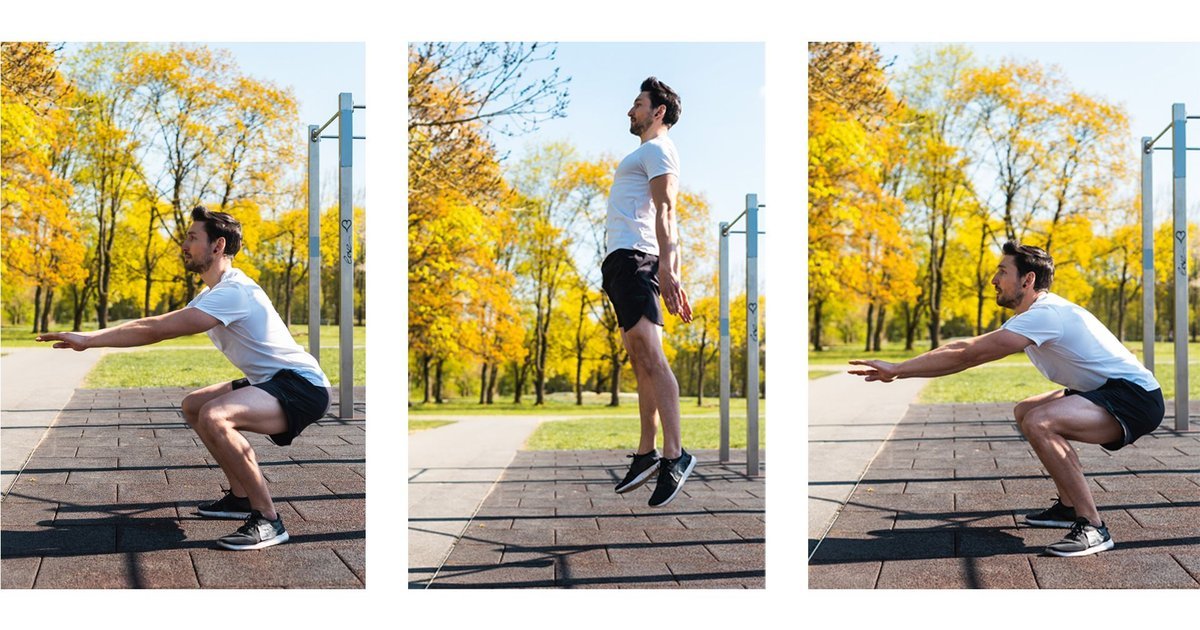
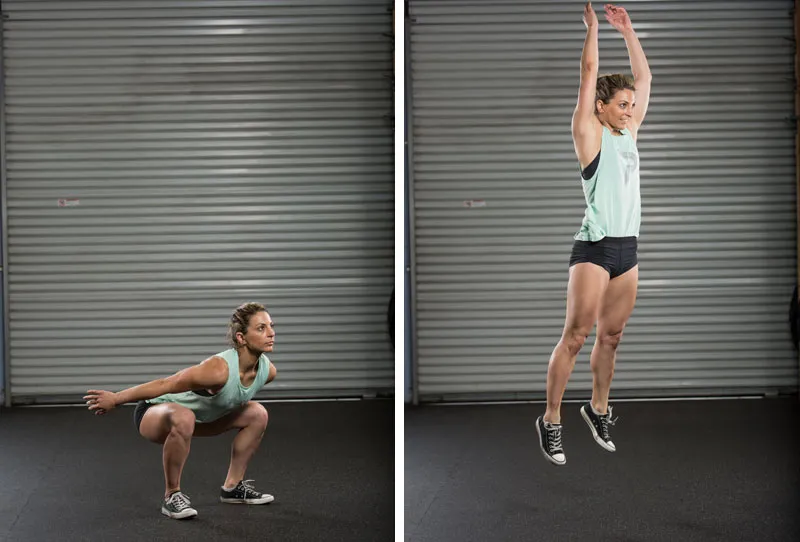
A photo of somebody airborne cannot establish how well they landed. Use it to recognize the exercise, then assess your own full repetition. If you are uncertain about landing mechanics, a coach can help establish the starting version before you add height, speed or repeated contacts.
2. Make the dip and arm swing repeatable
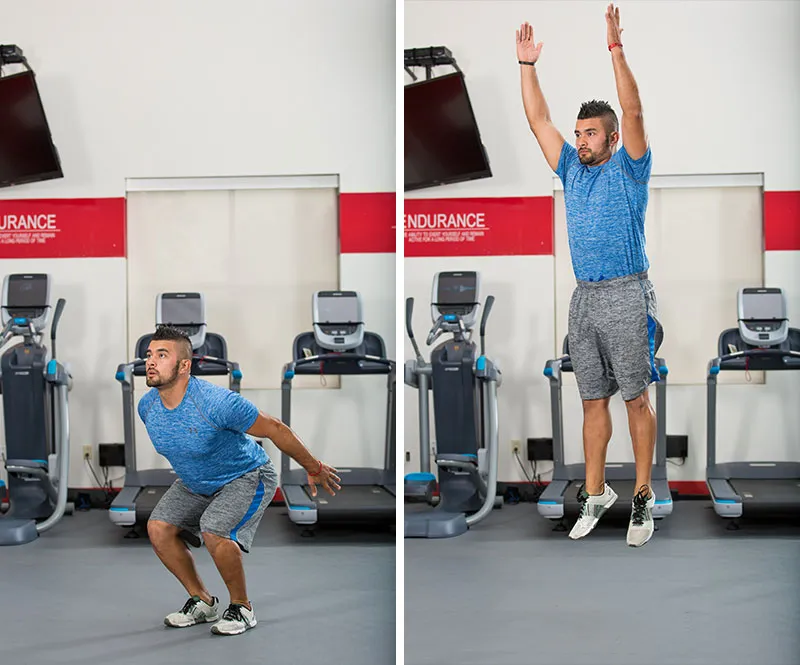
Start with a comfortable stance around hip to shoulder width, then bend at the hips and knees to prepare for the jump. You do not have to force the deepest squat you can reach. A modest dip that you can reverse smoothly is a practical starting point; an excessively deep position can become a different challenge from the one you intended.
Drive upward through the legs and let the arms contribute if that is the version you have chosen. In an arms-free repetition, the arms move to assist the jump. In a hands-fixed version, they remain in a prescribed position. Do not compare the height of one version with the other as though nothing changed.
Try to move upward rather than deliberately traveling across the floor. Keep the body organized as you leave the ground instead of throwing the head backward to create the appearance of a bigger effort. Bringing the knees toward the chest in the air turns the task toward a tuck jump; it is not proof of a higher takeoff.
For a simple comparison between sessions, keep the stance, dip style and arm rule similar. If you use a video, record from the same position. Otherwise, a change in camera angle or reaching technique can look like progress that came from the legs.
3. Finish the repetition with a landing you can hold
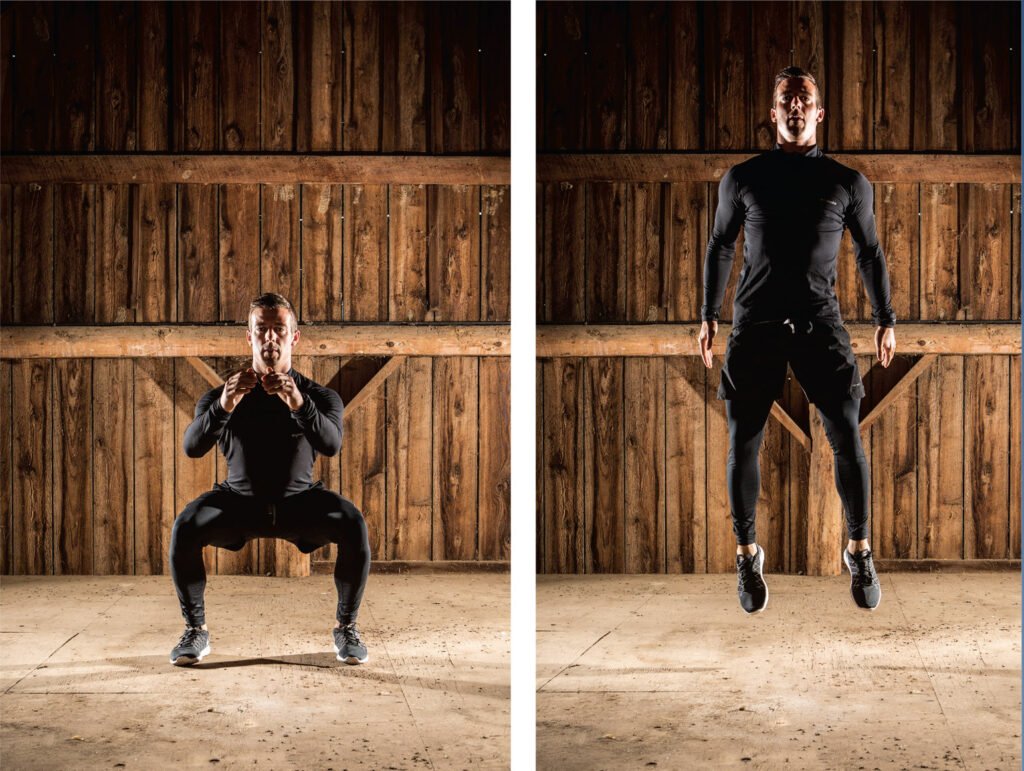
As you return to the floor, allow the ankles, knees and hips to bend rather than landing with rigid legs. Aim for a controlled, relatively quiet contact and a balanced finish. The feet should return to a position you can support, rather than spreading dramatically wider or landing noticeably one before the other.
Listen to the contact, but do not make silence your only test. A quieter landing can still involve a large inward knee movement, an uncontrolled trunk drop or a stagger. Watch the whole movement: where the feet arrive, how the knees track and whether you can remain in place after absorbing the landing.
Begin with a small jump and hold the finish long enough to notice your position. If you need another step, reduce the next attempt and reset. A repetition that looks good only because it immediately flows into another jump has not shown you the same ability to stop.
Do not force a universal rule that the knees must never travel forward of the toes. The aim is a controlled whole-leg landing that suits your movement and the task. Sharp pain, instability or repeated difficulty absorbing even a small jump calls for stopping the drill and getting the problem assessed rather than adding more contacts.
4. Separate reset jumps from continuous rebounds
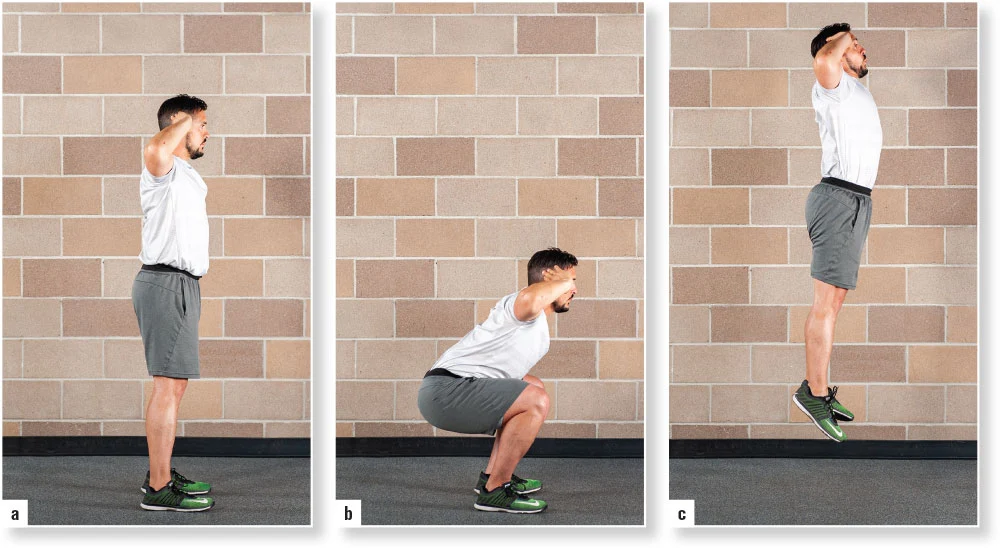
A reset repetition gives you time to stand, regain your position and prepare again. It is useful when learning because each landing can be checked before the next takeoff. Continuous jumps remove much of that pause and ask you to organize the transition more quickly. That is a progression in demand, not simply a faster way to complete the same set.
Use an explicit rule. For example, a set of individually reset attempts ends each jump in a controlled landing before you return to standing. A continuous set connects the repetitions without that full reset. If the goal is the first version, do not quietly switch to bouncing as the set becomes tiring.
The opposite also matters: if continuous contacts are the intended task, an increasingly long hesitation between them changes what you are practicing. Record what actually happened rather than treating every movement away from the floor as the same unit of work.
Neither version needs to become a contest to failure. End the set when landings become harder to organize or the takeoffs no longer resemble the opening attempts. Rest until you can repeat the intended movement; chasing an arbitrary timer is less useful than preserving the task.
5. Progress one demand and keep the rest of leg training distinct

For a power-focused session, place jumping practice after a suitable warm-up while you can give the attempts your attention. A few deliberate repetitions with recovery create a different session from a long conditioning circuit. Decide which you want before training, because fatigue changes both performance and the way you manage the landing.
Change one feature at a time. You might make the same reset jumps a little more forceful, add a small amount of high-quality practice or learn a continuous version. Adding height, contacts and pace together makes it harder to identify which change you can actually tolerate and repeat.
Keep a short log: surface, footwear, arm rule, reset or continuous style, sets and completed repetitions. Add one useful observation, such as an extra landing step appearing late in the session. The note helps explain why two workouts with the same total count did not feel or look alike.
Ordinary strength work still has its own role. Loaded squats, hinges and other suitable leg exercises can be progressed without turning every repetition into a jump. The optional dumbbells, kettlebells, plates and vest below are tools for that separate work. They are not instructions to perform weighted squat jumps; loading an airborne exercise changes both the takeoff and landing demands.

Equipment Worth Exploring
Explore equipment, accessories and gear from our carefully selected range.

Rubber Hex Dumbbells
Rubber-coated hex dumbbell pairs with a stable shape for home and commercial strength training.


Cast Iron Kettlebells
Textured cast-iron kettlebells for swings, squats, carries, and full-body training.


Grip Plates
Rubber-coated weight plates with handholds for loading barbells and machines.
The leg-day, squat and controlled-practice designs below fit the wider lifting routine. Keep the same practical standard in the gym: a repetition includes its finish. More attempts are useful only when they still serve the movement you set out to train.

Funny Gym Shirts & Workout Gear
Funny gym shirts, tanks, hoodies and workout gear for lifters who like training hard.

5 Plates Squat Club – Motivational T-Shirt
Show some leg-day attitude with a playful “5 Plates Squat Club” tee.

Shirt Meme – Leg Day Yesterday Wheelchair Top T-Shirt
Rep “Funny Gym Shirt Meme” humor in and out of the gym.

Stars Stripes & Squats Patriotic Eagle – 4th of July Wo Tank Top
Add some leg-day attitude to training with “Stars Stripes & Squats Patriotic Eagle”.

Anti Leg Day Leg Day Club Decal Water Bottles & Sticker
Give your everyday gear a playful “Anti Leg Day Leg Day Club” twist.

Negative Leg Day Review 1 Star Not Recommended Tank Top
Train hard, laugh a little, and rep “Negative Leg Day Review”.

Leg Day No Thanks Skip Leg Day Meme Sweater Squats T-Shirt
Show some gym-day personality with “Leg Day No Thanks”.

I Love Squats – Valentine's Day Leg Day Meme Vest Muscl Tank Top
Add some leg-day attitude to training with “I Love Squats”.

Safety Practice Safe Sets Sweater Jumper T-Shirt
Show some gym-day personality with “Gym Safety”.

Lift Smart Brain Weight Plate Mind Muscle Connection 45 Hoodie
Keep it laid-back with a little “Lift Smart Brain Weight Plate” attitude.