Advertising disclosure: This page includes affiliate product links that may earn us a commission, as well as products from our own store.
A set of incline dumbbell presses can feel completely different depending on the bench notch, where your elbows travel and how you get the weights into place. Those details matter as much as the number printed on the dumbbell. A good press should be challenging for the chest while remaining stable and repeatable, not an improvised rescue of two heavy weights.
This guide breaks the lift into five practical decisions: setting the bench, finding a controlled press path, choosing an incline, progressing working sets and ending the set safely. It also separates what muscle-activation observations can tell us from what they cannot prove about long-term growth. You can apply the principles in a commercial gym or anywhere with a stable incline bench and suitable dumbbells.
1. Set the incline bench and get the dumbbells into position
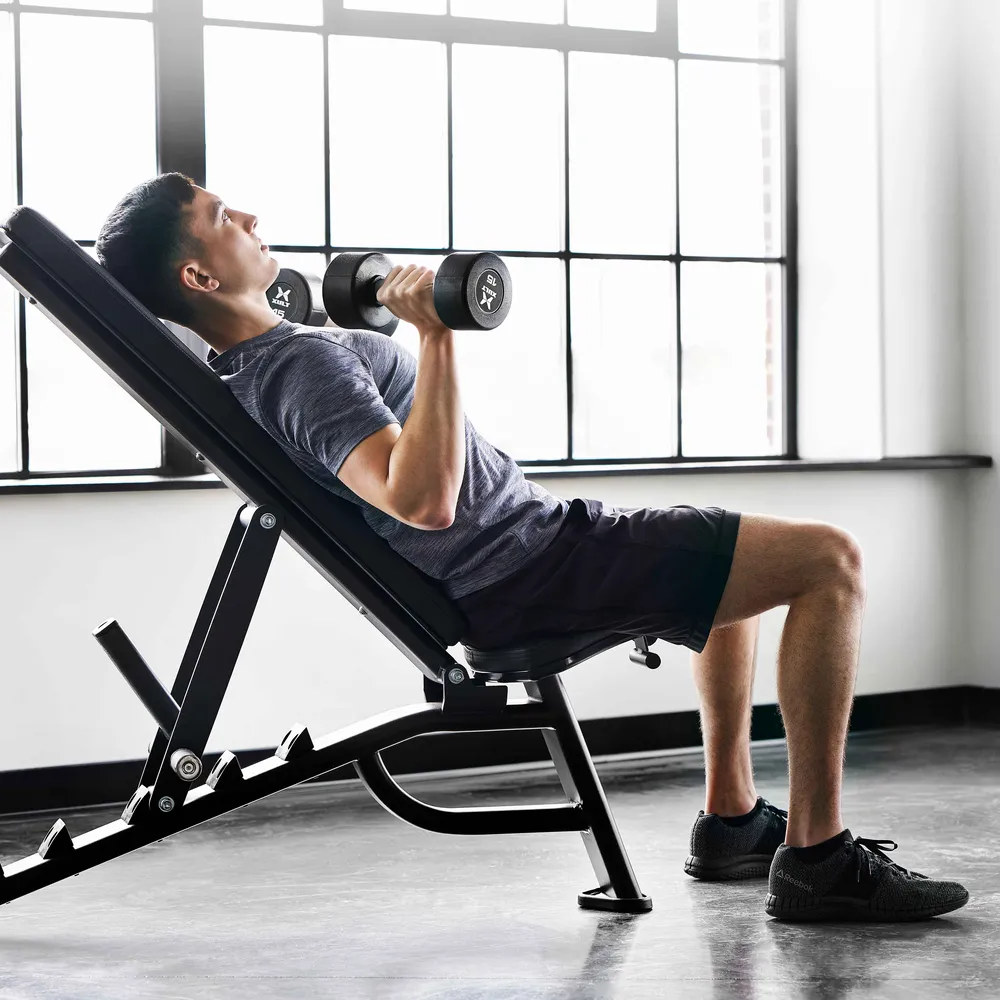
An adjustable bench is not just a place to lie down. The backrest angle changes the direction of the press, while the seat height and your foot position determine whether you can create a stable base. Begin with the back pad around 30 degrees relative to horizontal. This is a practical starting setting rather than a magic number. On a bench with wide adjustment increments, choose the nearest comfortable position and record which notch you used. Set the seat so you will not slide toward the floor when the weights get challenging.
Before picking up heavy dumbbells, sit against the back pad without weight. Check that your head and upper back have support, your feet can stay planted, and your lower back maintains a natural, manageable arch rather than being forced flat or excessively extended. A shorter lifter may need a stable foot platform; a taller lifter may need a different seat notch. The aim is a repeatable position, not identical posture across every body.
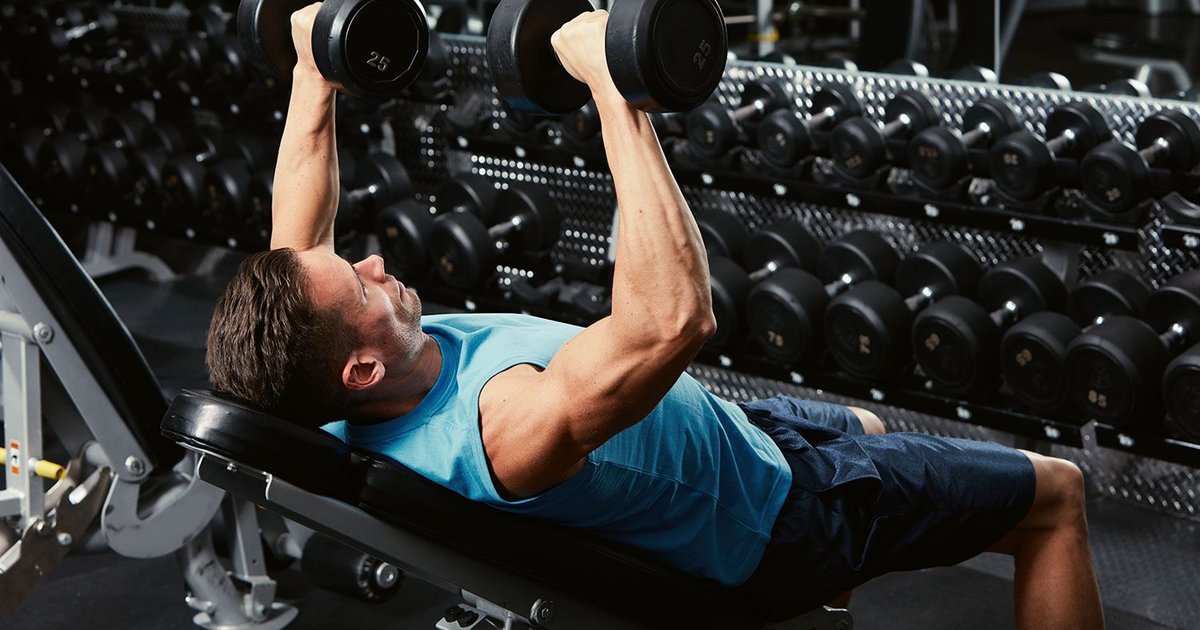
Bring the dumbbells onto your thighs while seated. For a manageable pair, use a controlled knee-assisted transition as you lean onto the backrest and guide each weight toward shoulder level. Do not turn the start of the set into an uncontrolled curl or throw the dumbbells backward. If you cannot establish the start position safely without momentum, the pair may be too heavy for the setup available. A trained spotter can assist with the initial position; a machine press may be more practical when training alone near failure.
Take one breath, brace lightly through your trunk, and establish the first repetition before thinking about the target number. Starting from a reproducible setup is particularly important with adjustable dumbbells, whose heads and handle shapes may change the clearance around your thighs and chest.
2. Find an elbow and wrist path that stays controlled
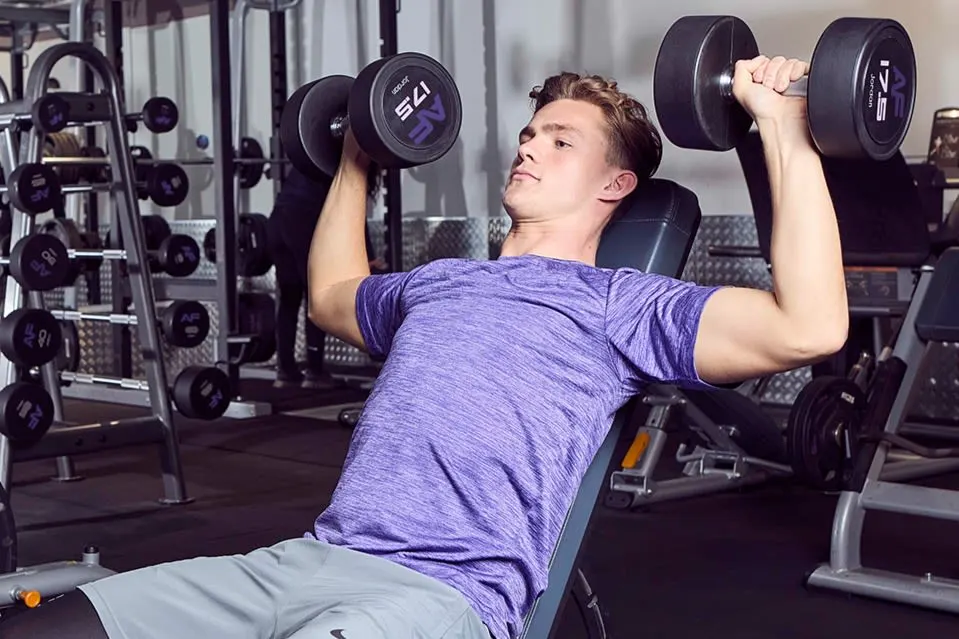
As you lower the weights, let the elbows travel slightly below and outside the shoulders rather than trying to make the upper arms form a perfectly straight line across your body. An approximately diagonal upper-arm position often feels more natural than pushing with both elbows flared directly sideways. The exact angle depends on shoulder anatomy, dumbbell size, bench position and grip. Keep the forearms reasonably aligned beneath the handles when viewed from the front.
Start with a moderately pronated grip, where your palms face mostly toward your feet, or rotate the handles slightly inward if that gives you a smoother path. The wrists should not fold dramatically backward under the load. A completely neutral grip is another option, but it changes hand and elbow positions; it is not automatically safer or better for growing the chest. Compare variations with the same bench setting and similar effort rather than assuming one is superior from how the first repetition feels.
Lower the dumbbells to a depth you can own without losing the position of your shoulders or bouncing off the bottom. Some lifters reach approximately chest height with the handles; others stop earlier because of shoulder tolerance or dumbbell geometry. More range can be useful, but forced extra depth under high load is not a useful goal. The lowering phase should look deliberate, with the weights descending together instead of one elbow collapsing more quickly than the other.
Press upward and slightly inward as the arms extend, keeping the path consistent from rep to rep. You do not need to strike the dumbbells together over your face. Finish with control, not with a violent elbow snap or a last-second shrug. A brief pause at the top is a good chance to check whether both weights are balanced and whether your feet and upper back have stayed fixed. On video, compare your first and final clean reps: a changed elbow path or shortened depth is often the first sign that the set is becoming a different exercise.
3. Understand the bench angle and what it can actually change
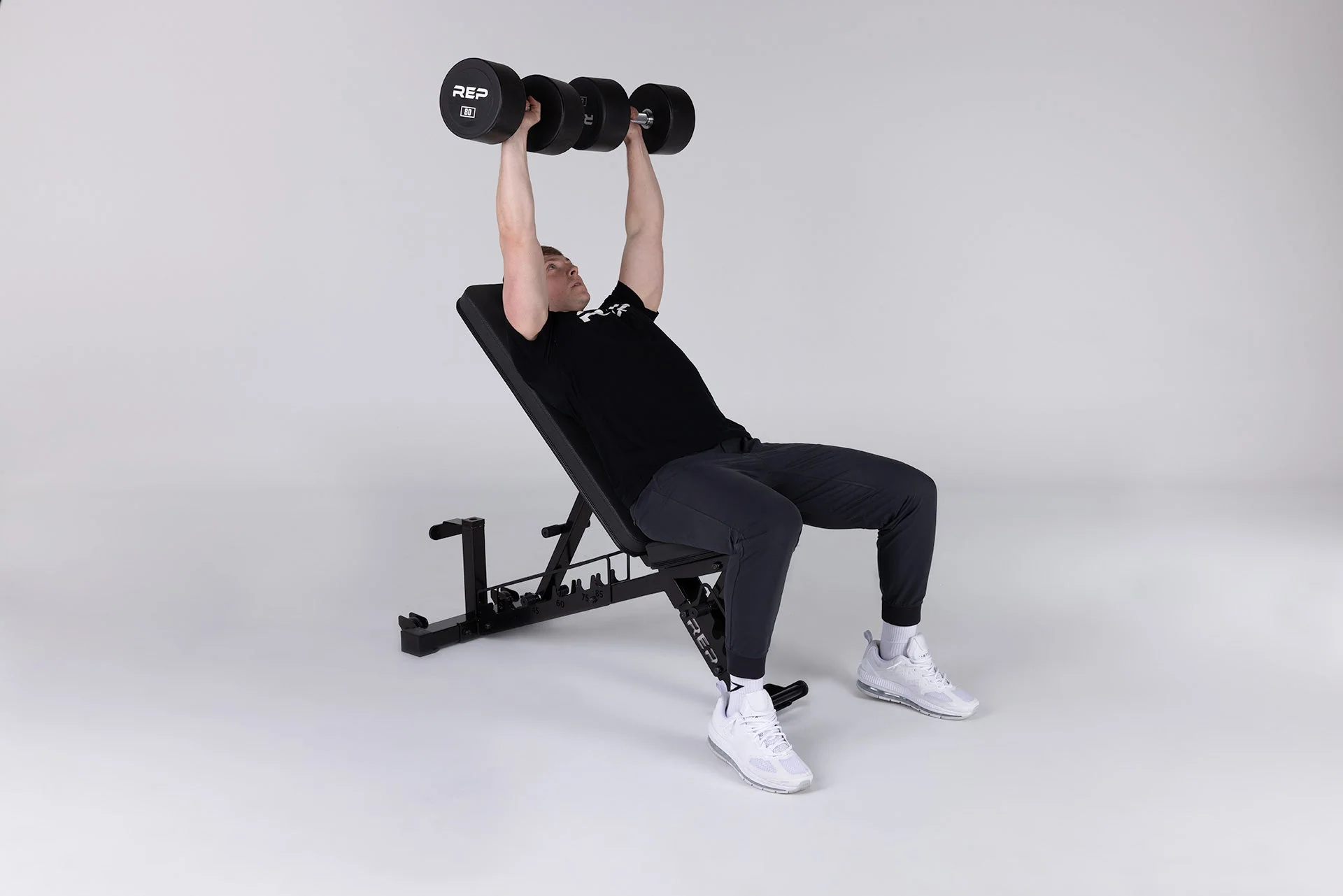
The incline press is often sold as an exercise that isolates the upper chest. It does not. The clavicular portion of the pectoralis major, the rest of the pec, the front deltoids and the triceps contribute to pressing in different proportions. Raising the bench changes joint angles and the demands placed on those muscles; it does not switch the rest of the chest off.
A small laboratory comparison involving 14 resistance-trained men tested barbell bench pressing at several inclines and found that chest-muscle electrical activity differed by angle during particular parts of a repetition. This is useful context for choosing an incline, but it is not a long-term muscle-growth comparison and it tested barbells, not this specific dumbbell exercise. One EMG snapshot cannot establish that a particular bench notch produces the biggest upper chest in the long run.
For most lifters, an incline near 15–30 degrees is a sensible place to explore first. A steeper 45-degree incline may still suit some people, especially when they want more shoulder involvement. As the bench approaches an upright press, front-deltoid demand often becomes more prominent. You can test two settings over several sessions, keeping effort, total sets and exercise order similar, before deciding which feels repeatable and allows you to progress without discomfort.
Do not confuse a chest sensation with a complete training result. Chest development depends on adequate challenging work, recovery, food intake and progression across months. Flat pressing, incline pressing and chest isolation movements can complement one another. If your flat press is already the biggest movement in the session, the incline dumbbell press can provide a different angle and independent-arm coordination without having to carry the entire chest routine.
4. Progress the exercise without losing the same repetition
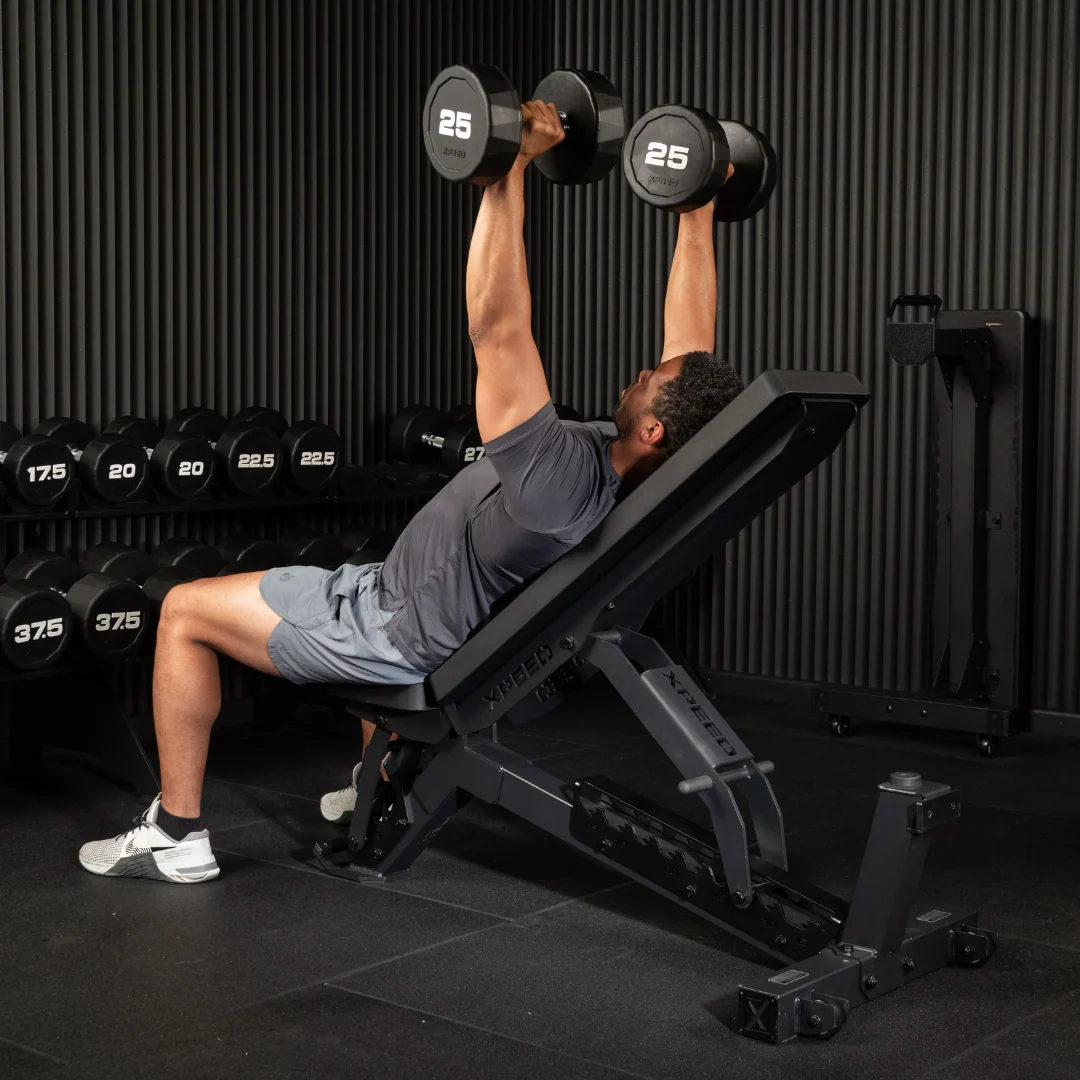
The most reliable progression is one you can measure. Choose a dumbbell pair that allows two or three working sets of six to twelve controlled repetitions, stopping with roughly one to three good reps still available at the beginning of a training block. That range is an example, not the only hypertrophy-effective rep zone. The useful constraint is that every counted repetition uses the same bench notch, similar controlled depth, and a comparable elbow and wrist position.
Try a simple double-progression rule: keep the same weight until you can perform three sets at the top of your chosen range without shortening the lowering phase. Then move to the next available dumbbell increment and start again closer to the low end. If your weight jumps are large, add repetitions or improve consistency before moving up. Writing down only the dumbbell number conceals a lot; record weight per hand, bench setting, repetitions and approximate reps in reserve. Those four pieces make next week’s decision easier.
Rest long enough to complete another useful set, often around two to three minutes for demanding presses. If your second set suddenly drops several reps because you rushed the clock, an extra minute may accomplish more than an unnecessary exercise change. A steady lowering phase is good for technical control, but there is no reason to force an arbitrarily slow five-second negative on every rep. Keep a pace you can repeat without turning one set into a completely different fatigue challenge.
A practical two-day example is one incline dumbbell session with three sets in the six-to-ten range and another, several days later, with two sets in the eight-to-twelve range after a different main press. Start with fewer sets if your chest and pressing muscles already receive substantial weekly work. Over six weeks, aim to improve repetitions or loading when technique allows; a plateau is a reason to inspect recovery, load increments and exercise order before assuming you need a more exotic variation.

Equipment Worth Exploring
Explore equipment, accessories and gear from our carefully selected range.


FID Bench MAX
Adjustable bench offering flat, incline, and decline positions + adjustable headrest.


Multi Bench MBX-650 2.0
Adjustable multi-bench with roller adjustment, 15 backrest positions and accessory mounts.


Rubber Hex Dumbbells
Rubber-coated hex dumbbell pairs with a stable shape for home and commercial strength training.


Standing Chest Press SCP-760
Standing chest-press machine with adjustable handle positions for chest and close-grip pressing.

Lever Arm Multi Press LMP-650
Multi-press with independent lever arms and an integrated adjustable bench for upper-body training.
5. Finish the set safely, troubleshoot pain and choose alternatives
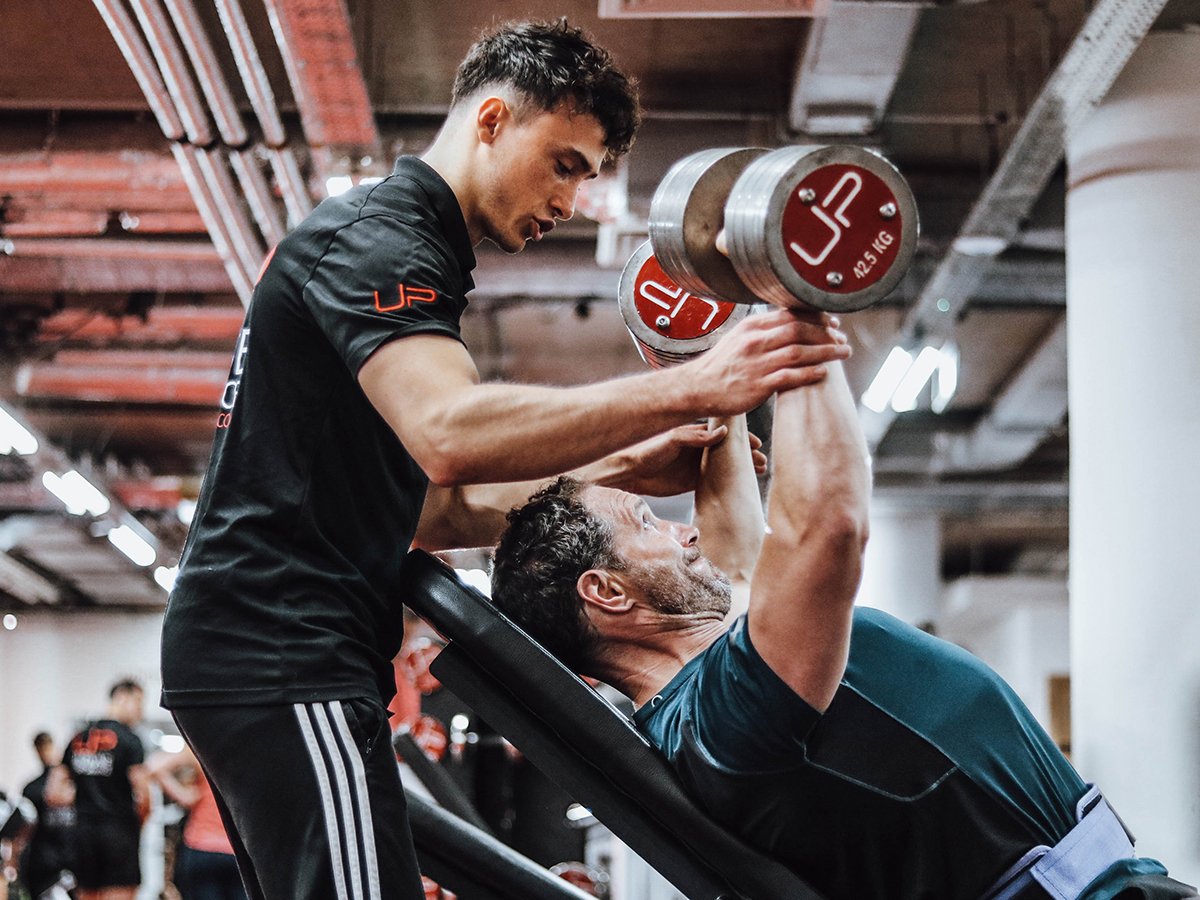
The last rep is not finished until you have returned the dumbbells safely. With moderate weights, bring the handles toward a neutral grip, guide the ends back onto the thighs as you sit up and use a controlled transition to stand. Do not fling a pair of heavy dumbbells outward across an occupied gym floor. When the pair is beyond what you can safely start or return by yourself, use an experienced spotter, appropriate assisted setup or a different pressing station. A spotter should understand where to assist and should not grab the weights unexpectedly mid-rep.
Common warning signs include lifting the feet, sliding down the bench, driving the elbows into an uncomfortable extreme position, or twisting one wrist as fatigue builds. Reduce the load and recover a stable baseline before adding more repetitions. If front-shoulder discomfort shows up, try a slightly lower incline, a modestly more inward-facing grip, or less depth and see whether the motion feels comfortable. Sharp, persistent or worsening pain is a reason to stop the painful variation and seek an appropriate assessment rather than treating discomfort as proof the exercise is working.
Dumbbells are not required for every chest session. An incline chest-press machine can remove the awkward initial transfer and provide a repeatable path, while an incline barbell press makes the two arms share a bar and introduces different balance demands. Cable presses offer adjustable resistance direction but require a stable stance or bench placement. None of these are universally superior; each changes setup, stability, loading increments and the training experience. Choose the version that lets you perform enough high-quality, progressive chest work.
For a productive finish, judge the set by what the video and training log show: matching left and right depth, controlled lowering, no unintended bounce, stable feet and an exit you can repeat. The incline dumbbell press rewards those unglamorous basics. A slightly lighter pair lifted consistently for months is likely to be more useful than a spectacular first repetition followed by several unstable ones.

Bodybuilding Shirts & Workout Gear
Bodybuilding shirts, tanks and gym gear for lifters chasing muscle, size, symmetry and the pump.

My Bench Press Is Stuck Horror Movie Meme Sweater T-Shirt
Show some gym-day personality with “My Bench Press Is Stuck”.


Bench Press and Chill Funny Gym T
Make gym days more fun with “Bench Press and Chill” style.


I Love Bench Press | Red Heart Weight Plate Decal Sticker
Put “I Love Bench Press” gym humor on your laptop, bottle, or gym gear.

Shirt – Dumbbell Heartbeat Gymbros, & Meme Lovers T-Shirt
Show some bodybuilding attitude with a playful “Dumbbell Heartbeat” tee.

Gym Sir Swole of Benchalot Medieval Knight Chest Day Mu Tank Top
Bring “Sir Swole of Benchalot Medieval Knight” humor to your next lifting session.

Dost Thou Even Fly Tee
Make gym days more fun with “Dost Thou Even Fly Medieval Knight Pec Fly” style.