Advertising disclosure: This page includes affiliate product links that may earn us a commission, as well as products from our own store.
Deficit Push-Ups: Deeper Chest Reps, Safer Setup and a Six-Week Plan
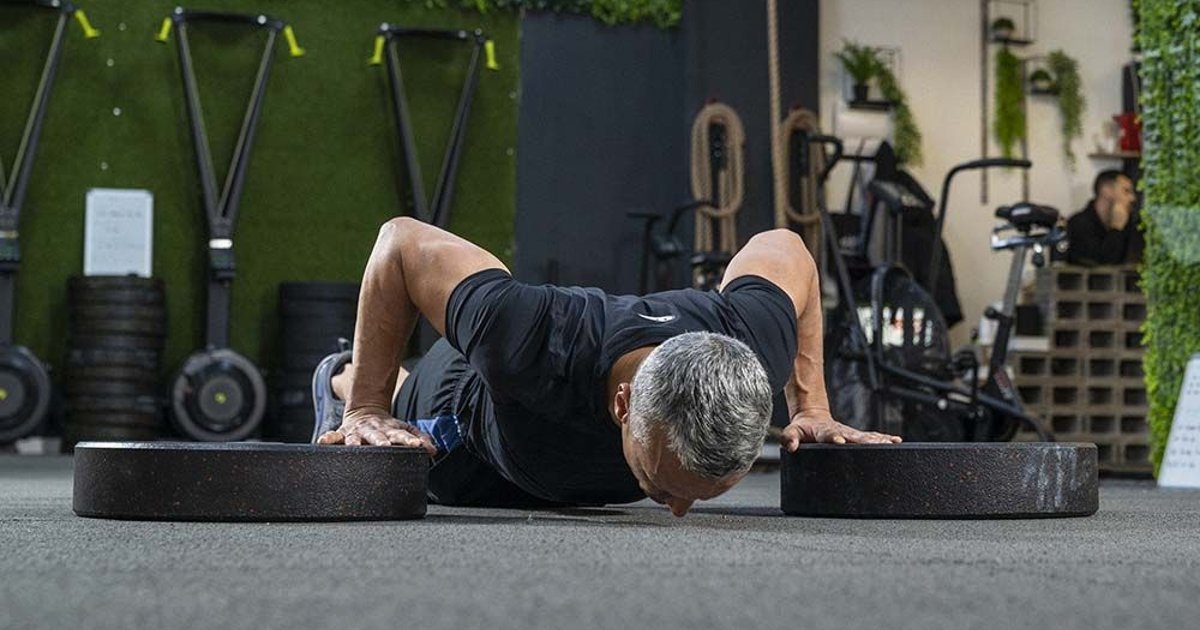
Ordinary push-ups become limited by the floor: the chest reaches it before the shoulders can travel any farther. Raising each hand on a stable support opens space underneath the torso, creating a deficit. It sounds like a small change, yet the longer route down and up can make familiar bodyweight reps surprisingly demanding.
The catch is that more clearance is not a command to descend as far as possible. A useful deficit must be stable, comfortable for the shoulders and easy to reproduce across sets. This guide separates the benefit of extra available motion from unproven promises of automatic muscle growth, then shows how to make the movement a measured part of chest training rather than a high-risk party trick.
1. Choose stable supports before chasing a deeper rep
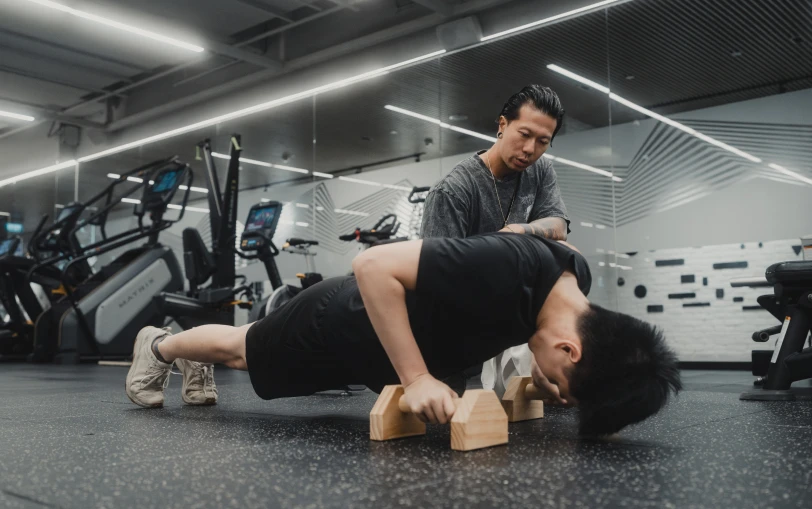
Start with two platforms of the same height, placed approximately under or a little outside your shoulders. Low parallettes, fixed push-up handles or solid low blocks leave a channel for your chest to travel between your hands. Test each support with downward and sideways pressure before stepping into position. A handle that twists, a stack of plates that slides, or a dumbbell that rolls is not an upgrade. A flat, nonslip floor matters as much as the equipment. The gap must be wide enough for your torso to pass without pinching your shoulders into a needlessly wide grip.
A small lift is enough for your first attempts. Your hands being higher than the floor does not automatically make this an easier incline push-up; the defining feature is that your chest can pass below your hands. However, taller supports can reduce the percentage of bodyweight borne by your arms if your feet stay low and your body angle changes. Compare like with like: record both support height and foot position, not merely the number of repetitions. Place your feet far enough behind you to establish a long, braced plank, but do not use an exaggerated reach that leaves your wrists far in front of the shoulders.
Do one ordinary floor push-up first. Observe your natural hand spacing, elbow travel and trunk line. Transfer that same controlled shape to the supports, then lower only an extra small distance on the first few repetitions. Before every work set check four simple things: the supports do not wobble, the floor is clear, your hands are equally high, and your feet are placed symmetrically. If you cannot confirm those conditions, choose a conventional floor push-up. The goal is repeatable resistance, not an improvised balancing trick.
2. Lower the chest between your hands without losing your plank
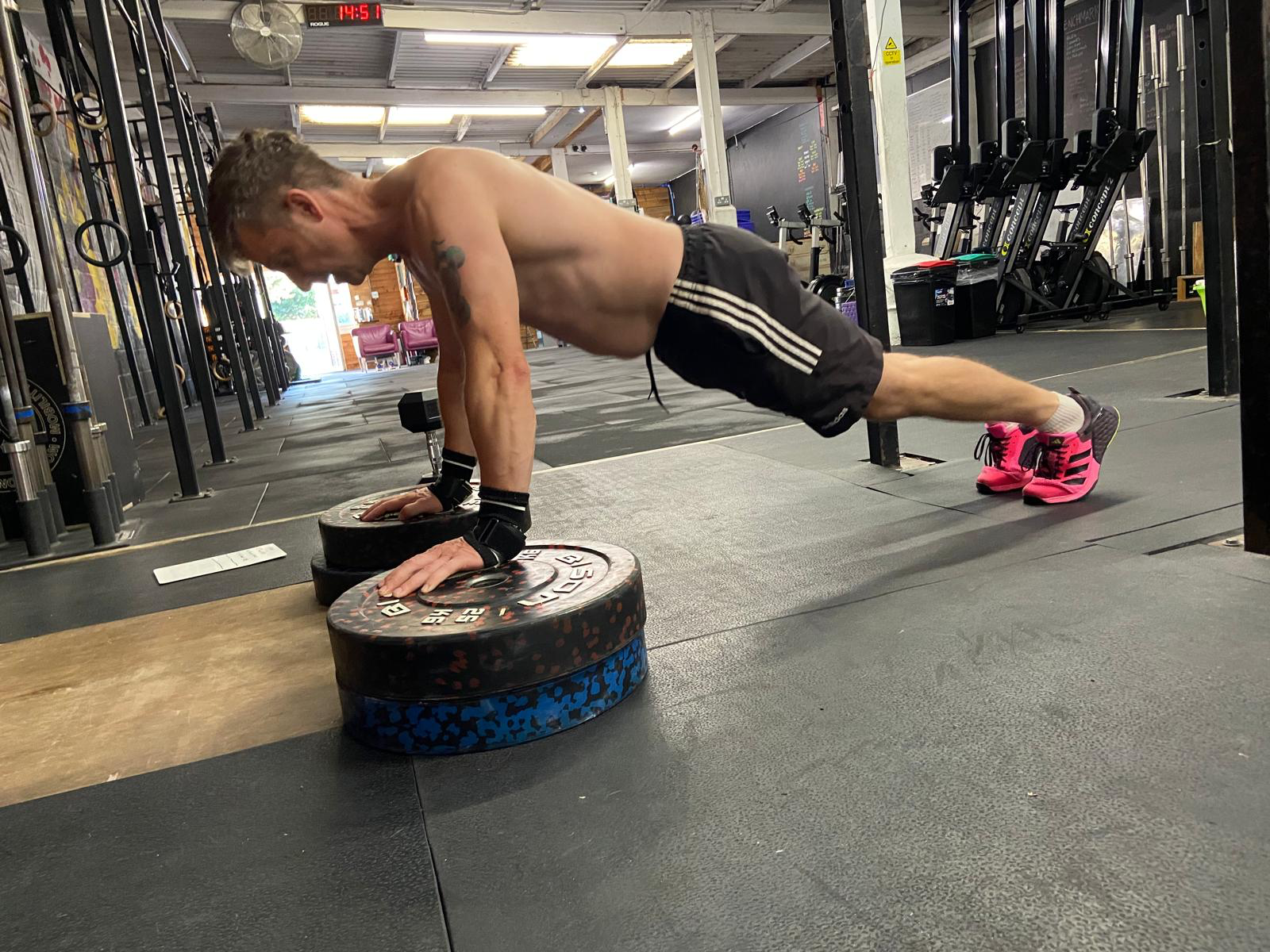
At the top, straighten the arms without forcibly locking the shoulders down. Brace the abdomen and glutes and keep the hips, rib cage and head travelling together. Your torso should move as a connected unit: no low-back arch, no hips diving, and no head reaching toward the floor ahead of the chest. Inhale during a deliberately controlled descent while your elbows bend diagonally backward rather than spreading straight out to either side. A comfortable angle varies by person, so treat roughly halfway between tucked and flared as a starting cue rather than a mandatory number.
Imagine steering your sternum into the open space between the supports. Pass below hand level only until you can still hold the bottom for a moment without a sudden shoulder shift, bounce or sag. Then push firmly through both hands, following the same path back to the top. Exhale as you press and let the shoulder blades move naturally around the ribs on the way up. The hands stay planted; the shoulders and chest do the travelling. An abrupt drop may make the rep look deeper but sacrifices the most useful part of the movement: controlling load while the chest is lengthening.
For the first session, film one set from the side and another from an angle near the front. Side footage reveals whether the hips and head remain aligned. A front-quarter view shows unequal arm movement and a platform shifting under pressure. Look for the same chest depth on early and late repetitions. If the fifth rep is noticeably shallower than the first or the elbows flare dramatically as fatigue arrives, finish that set. A smaller consistent deficit is more informative than a dramatic first rep followed by progressively shorter ones.
3. Protect the shoulders and distinguish depth from a growth guarantee
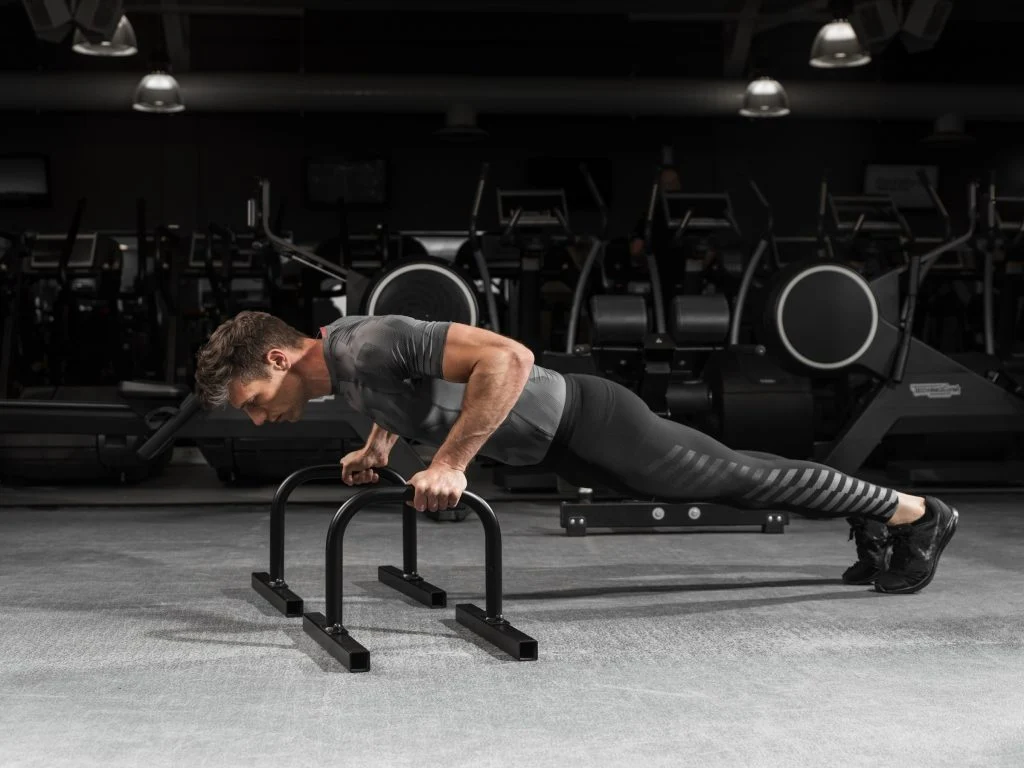
The lower position exposes your shoulders to more extension than a standard push-up on the floor. That is the reason the variation can provide a different challenge, but it also makes depth a personal constraint. Some lifters can lower comfortably several centimetres below their hands; others reach their useful limit much sooner. A clear chest stretch with control may be acceptable. Sharp front-shoulder pain, pinching, sudden instability, tingling or a feeling that the joint is sliding forward is a reason to stop rather than push a little deeper.
Neutral-grip parallettes can keep wrists straighter than a palm-flat position, but wrist comfort alone does not prove that the shoulders tolerate the added depth. Keep the range inside the point where the shoulder stays centred and you could reverse smoothly without bouncing. If changing hand spacing, handle orientation or support height alters symptoms, do not assume there is one universally correct grip. Try a floor push-up or an incline version while you assess the issue, and seek professional advice for persistent symptoms or a recent shoulder injury.
The movement can make a bodyweight set more demanding by expanding the available travel. It should not be advertised as automatically producing more chest growth than a well-programmed floor push-up or a loaded press. Research on resistance training across muscle lengths gives a plausible reason to explore a deeper controlled range, but does not by itself prove this particular variation beats every alternative. The chest, triceps, front shoulders, serratus and trunk work together; your training effect still depends on the number of challenging sets, recoverable effort and whether performance progresses over time. Comfort and consistency are not optional footnotes to the exercise.
4. Choose productive regressions and loading tools
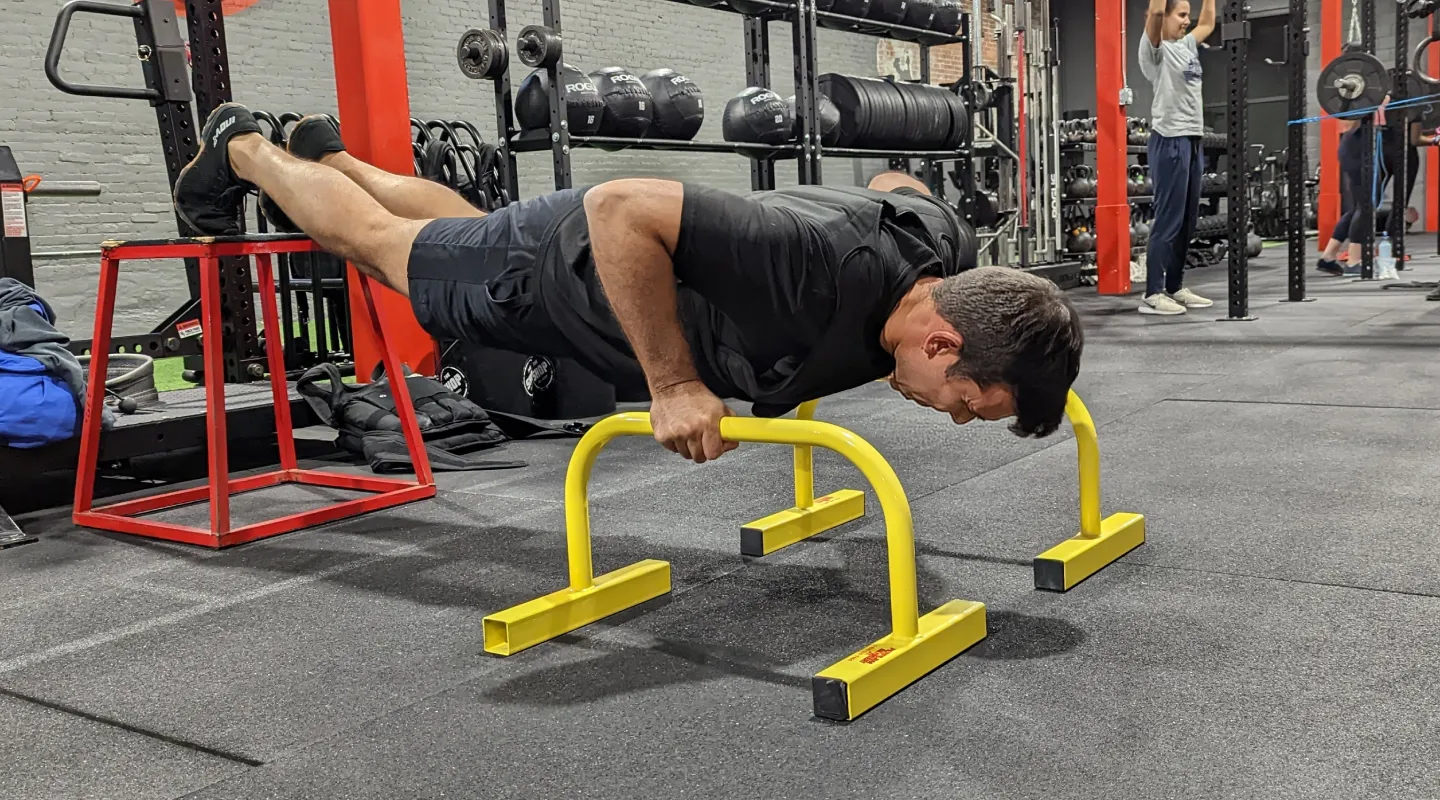
If eight tidy standard push-ups are not yet repeatable, first build that baseline. An elevated-hand incline push-up against a secure bench or fixed bar can reduce the load without demanding extra shoulder depth. A normal floor push-up is also a sensible regression after a hard set of deficit work. To make the exercise easier without changing technique, reduce the deficit, elevate your hands and torso together, or leave more repetitions in reserve. Using a short range only because a larger one hurts is not failure; it is intelligent exercise selection.
Once a small deficit feels stable, you have several ways to progress. Add reps, lengthen the lowering phase slightly, pause briefly at the bottom or add a carefully secured weighted vest. Do not stack every change into one week. A pair of low wooden parallettes is usually a more predictable starting support than round kettlebells or a rolling dumbbell. Stable hex dumbbells can serve as handles only if their heads sit flat and cannot rotate. Rings and suspended handles offer a separate stability challenge; they are not interchangeable with rigid platforms and may be inappropriate when the purpose is to learn a controlled deeper press.
Deficit push-ups also do not replace every other chest exercise. A standing chest press, dumbbell press, cable fly or ordinary push-up can provide a useful alternative when equipment, goals or joint tolerance differ. If you already bench press heavily, use the deficit variation as a measured secondary press instead of treating every set as a maximum-range test. Keep a few repetitions in reserve while learning the movement. The accompanying equipment choices cover stable supports, optional load, chest-training alternatives and related calisthenics tools; they are not all intended to be gripped under bodyweight during a deficit push-up.

Equipment Worth Exploring
Explore equipment, accessories and gear from our carefully selected range.


Power Tower
Freestanding pull-up and dip station with adjustable handles for bodyweight training.

Rubber Hex Dumbbells
Rubber-coated hex dumbbell pairs with a stable shape for home and commercial strength training.


Grip Plates
Rubber-coated weight plates with handholds for loading barbells and machines.

Standing Chest Press SCP-760
Standing chest-press machine with adjustable handle positions for chest and close-grip pressing.
5. Follow a six-week plan built around repeatable depth
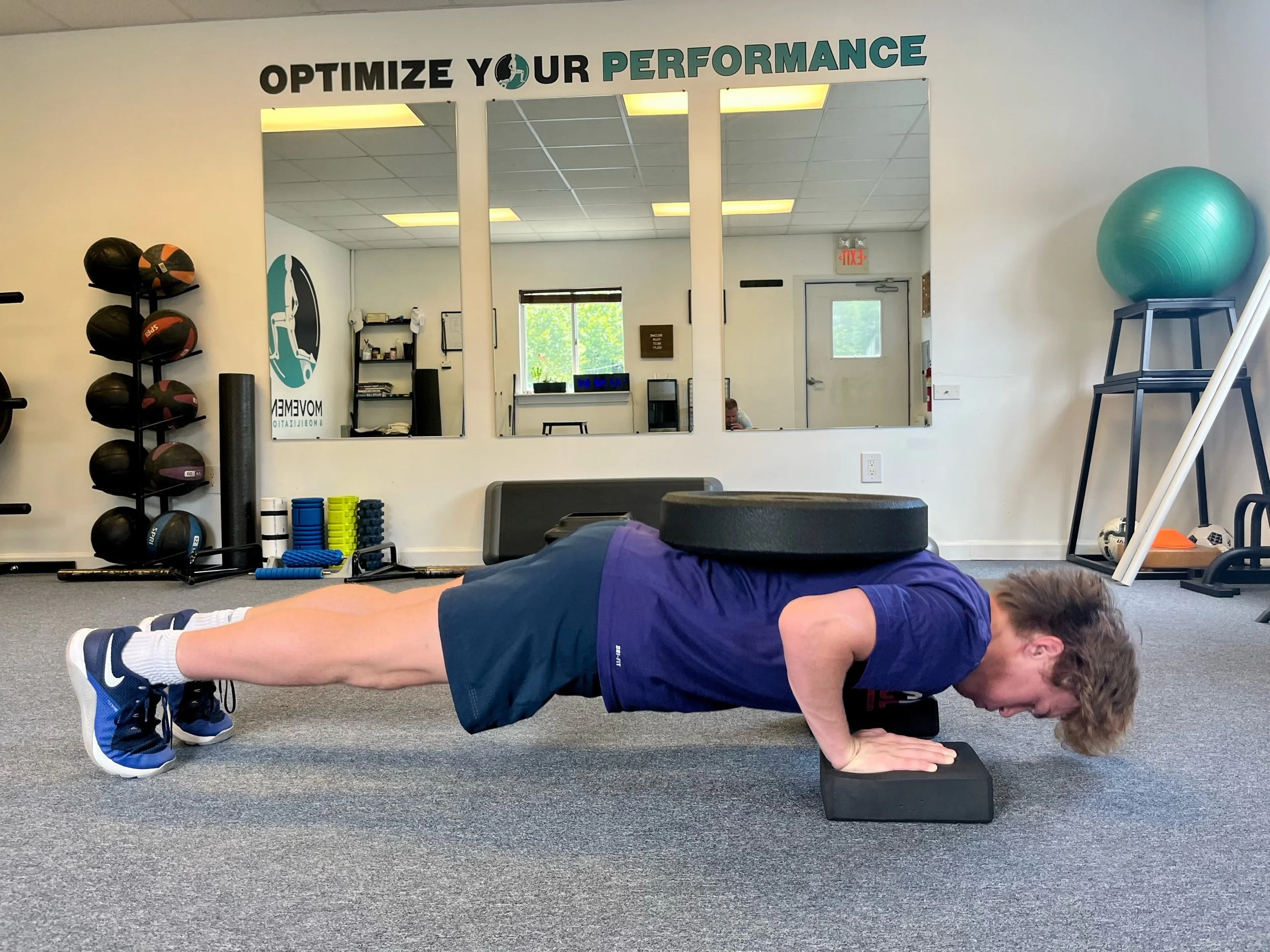
Use the variation on two nonconsecutive pressing days each week. Begin each workout with an easier warm-up set of floor push-ups, then make one or two low-deficit practice sets before the working sets. During weeks one and two, complete two or three sets of six to eight controlled repetitions, stopping with roughly two or three good reps in reserve. Use the same support height on both days. If you cannot pause quietly just below hand level, make the depth shallower. The first goal is a stable movement standard, not fatigue.
During weeks three and four, aim for three sets of eight to ten while maintaining the same controlled bottom position. Increase the number of clean reps before lowering farther. Keep rest periods long enough to recover your plank and pressing strength—about ninety seconds to two minutes is a practical starting point, adjusted by performance. If you train bench press or overhead press in the same session, account for that workload rather than silently doubling all hard pressing. Shoulder tenderness that grows from session to session is a prompt to reduce volume or return to a standard push-up.
During weeks five and six, keep three working sets and work toward ten to twelve consistent repetitions. Only when the top of the range is comfortable should you consider either a slightly deeper position or a modest increase in resistance, not both together. Advanced feet-raised push-ups change the body angle and may increase difficulty; they are a different progression variable from the deficit itself. In a training log record support height, foot position, reps, estimated reps in reserve and any discomfort. The best sign of progress is more quality work under comparable conditions, not a dramatic stretch sensation the next morning.
At the end of week six, compare videos and notes from week one. Can you travel a little farther while keeping the same elbow path? Can you repeat the depth across all sets? Does the pressing feel stable rather than precarious? If the answers are yes, continue gradually. If the extra range continues to irritate the shoulders, use floor push-ups or another chest press without apology. A good plan keeps the challenging parts you can own and discards the range you cannot control.

Bodybuilding Shirts & Workout Gear
Bodybuilding shirts, tanks and gym gear for lifters chasing muscle, size, symmetry and the pump.


Work on His Pecks Tee
Show some bodybuilding attitude with a playful “Why Did The Chicken Go To The Gym? To Work” tee.

Bench Press and Chill Funny Gym T
Make gym days more fun with “Bench Press and Chill” style.

I Love Bench Press Gym | Funny Bench Press Meme Crewnec T-Shirt
For laid-back days and gym-girl humor: “I Love Bench Press”.

The Chestfather Arnold Meme Big Chest Vest Tank Top
Add some lifting attitude to training with “The Chestfather”.

Dost Thou Even Fly Tee
Make gym days more fun with “Dost Thou Even Fly Medieval Knight Pec Fly” style.

Gym Sir Swole of Benchalot Medieval Knight Bench Press T-Shirt
Make gym days more fun with “Sir Swole of Benchalot Medieval Knight” style.