Advertising disclosure: This page includes affiliate product links that may earn us a commission, as well as products from our own store.
The indoor rower can make a strong lifter feel surprisingly inefficient. You can have plenty of leg strength, a strong back and good grip, yet find yourself breathing hard after three minutes while the pace on the monitor barely improves. The answer is often not to pull harder. It is to distribute your effort through the stroke in a way that lets each body part contribute at the right time.
Rowing combines a forceful work phase with a less demanding return to the starting position. The trick is making those phases distinct without introducing a jerky stop between them. For anyone who trains with weights and wants a repeatable way to build conditioning, that coordination is worth learning before chasing a personal best. Here is how to practise it, diagnose common errors and build a short rowing programme alongside your regular lifting.
Set up a catch you can repeat
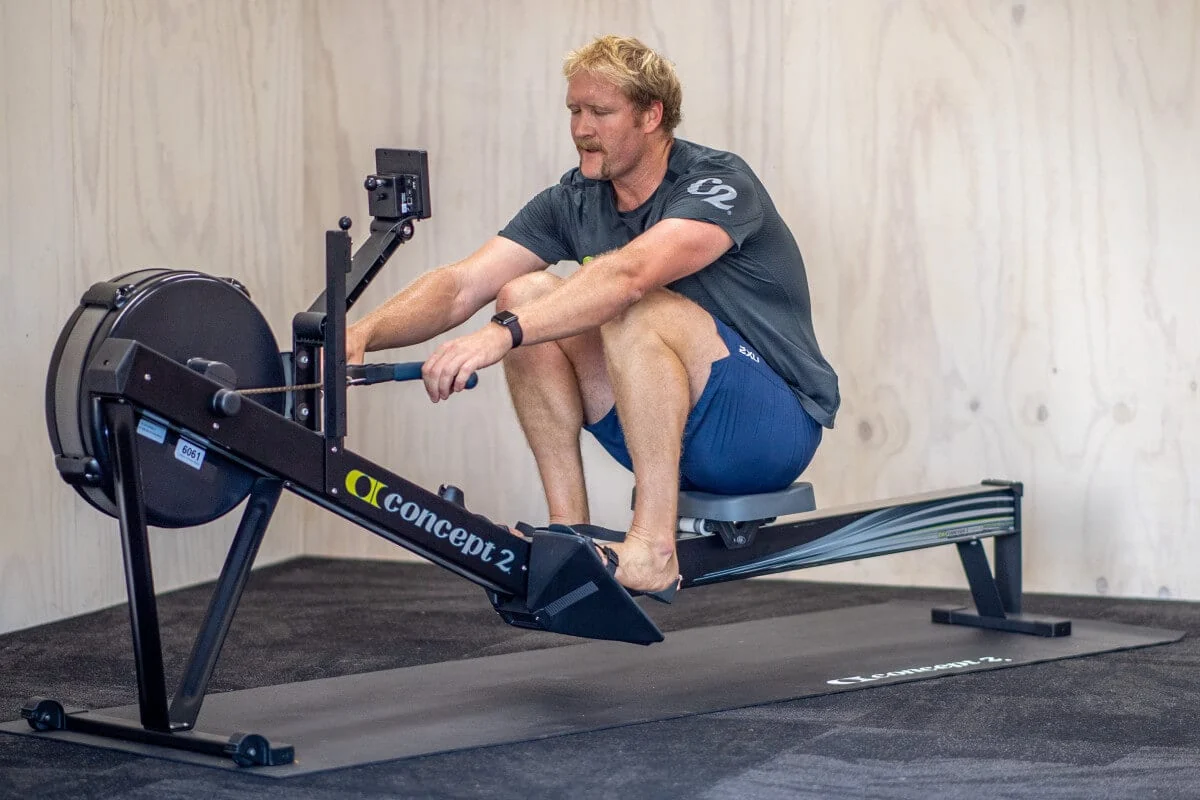
Start by adjusting the footrests so that the straps sit securely across the broad part of your feet. You want your shoes to stay connected to the footplates without needing to curl your toes or wrench against the straps. Position the monitor where you can glance at it without dropping your head for every stroke. Choose a manageable resistance setting; a heavy-feeling first pull is not a test of your strength.
Slide forward until your knees are comfortably bent and your lower legs are approximately upright. Your arms should reach forward without the shoulders being dragged towards your ears. Tip the trunk from the hips rather than rounding the upper and lower back to gain another few centimetres. A slight heel lift can be perfectly normal. Your anatomy, ankle mobility and proportions will influence how far forward you can move comfortably.
Resist the temptation to compress yourself as far as the seat will travel. If your knees end up far ahead of your ankles and your hips tuck under, the extra distance may leave you poorly positioned for the next push. A shorter, controlled reach beats a longer stroke that starts with a loss of posture. A useful check is to film yourself from the side at an easy effort and pause the recording just before the seat starts moving backwards.
Notice whether your handle is already moving towards your torso before you have applied pressure through your legs. If you see that, you are probably setting up to pull with the arms too early. Repeat five easy strokes with your elbows long and your shoulders relaxed. Do not deliberately lock the elbows into a painful position; simply allow the legs to initiate the movement.
Drive through the feet before you pull
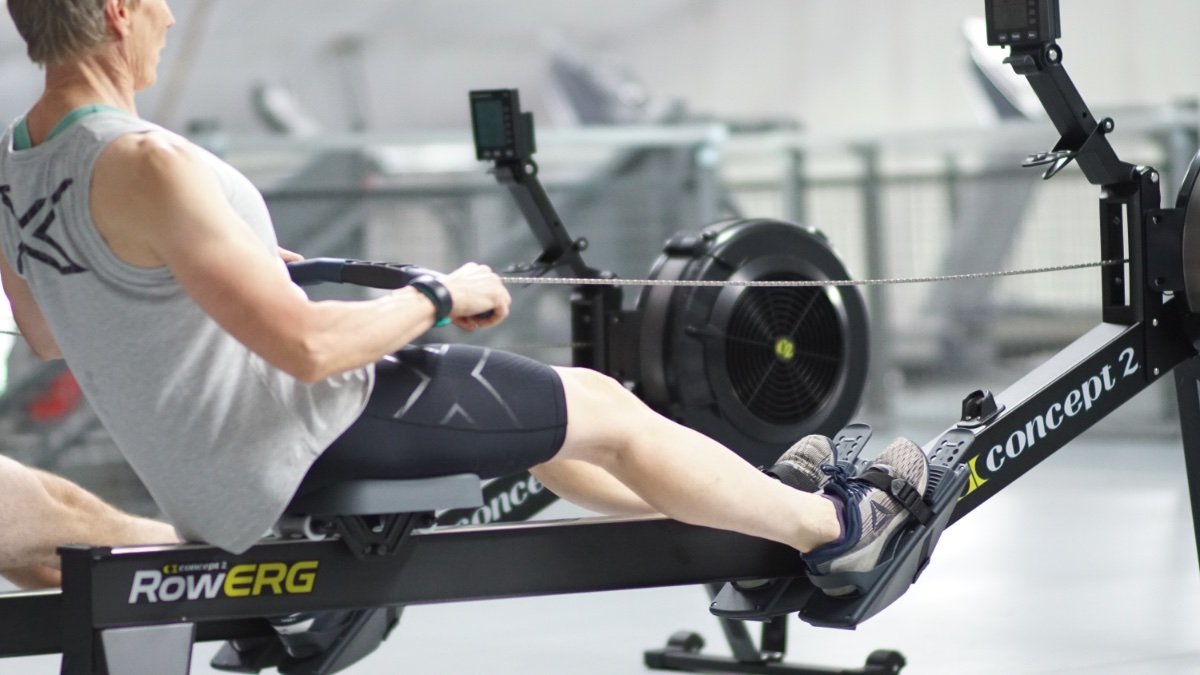
Think of the first part of the stroke as pushing the machine away rather than yanking the handle towards you. Your legs extend against the fixed footplates while your trunk provides a reasonably stable connection to the handle. As the knees straighten, the hips open and the torso swings towards a modest backward lean. The arm pull completes the movement, rather than providing the initial acceleration.
The phases overlap smoothly. You do not need to stop with straight legs, wait a second and then deliberately hinge backwards. Those exaggerated pauses are useful only when you are learning what each component feels like. During normal rowing, the transition from leg drive to hip movement should feel continuous, with the handle travelling smoothly towards your body.
One small study of ten trained male rowers compared stationary and dynamic rowing machines with rowing on water. The researchers found differences in movement and muscle recruitment between conditions, and activity in parts of the quadriceps rose with exercise intensity. That is a reminder that an indoor machine is its own skill; the exact mechanics of an elite boat crew cannot simply be transplanted into a gym session. It also supports the practical observation that the legs do meaningful work, not just the arms.
Try a low-intensity drill: five strokes with an emphasis on the initial leg pressure, followed by five full strokes in which you add the hip swing and arm finish. Keep the resistance and approximate pace similar. If the second group becomes markedly smoother, you have found something useful to practise. If you feel your lower back doing all the work, shorten the reach, reduce effort and recheck the sequence. Persistent pain is a reason to stop and seek appropriate assessment, not to force more repetitions.
A rower is not a replacement for heavy resistance training. Squats, leg presses, hip hinges and conventional rows let you train force production and muscle growth with deliberately chosen loads. Indoor rowing gives you a different task: repeat coordinated contractions while sustaining an aerobic effort. You can benefit from both without treating them as interchangeable.
Some product links may be affiliate links, which can support Mind Muscle Perfection at no additional cost to you.

Equipment Worth Exploring
Explore equipment, accessories and gear from our carefully selected range.


T-Bar Row Attachment
Welded barbell attachment that connects a D-handle bar for landmine and T-bar rows.

Rubber Hex Dumbbells
Rubber-coated hex dumbbell pairs with a stable shape for home and commercial strength training.


Leg Press/Hack Squat BPR-790
Convertible 45-degree leg press and hack squat machine with a broad footplate and band pegs.


FID Bench MAX
Adjustable bench offering flat, incline, and decline positions + adjustable headrest.

Finish without wasting movement
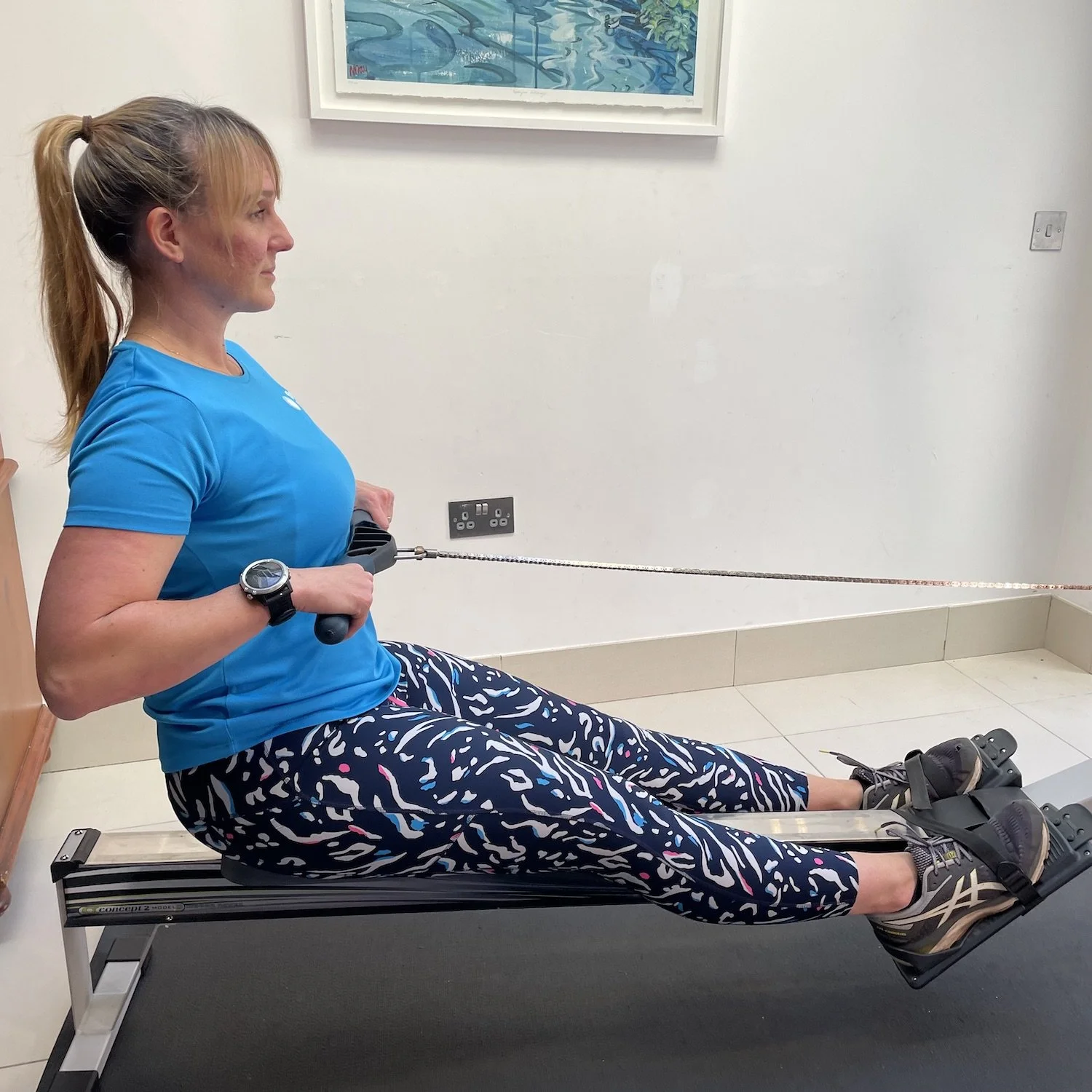
At the back of the stroke, the legs are almost straight, the trunk is inclined slightly backwards and the handle reaches the region around the lower ribs. The elbows travel behind the body in a natural line rather than flaring high. Keep the wrists approximately straight and use only as much grip pressure as is needed to control the handle.
Two common errors are exaggerating the backward lean and pulling the handle up towards the neck. Both can add movement without necessarily improving useful power. A large lean also creates more distance to cover on the return and may make it difficult to get your hips back in position. If you have a bodybuilding background, the final pull may feel like a familiar cable row, but the aim here is not to maximise the contraction of your upper back independently of the rest of the stroke.
Try comparing two easy one-minute intervals. During the first, row as you normally do. During the second, concentrate on a compact finish and a light grip. Match the approximate stroke rate and perceived effort. Look at whether you maintain the same pace with less tension in your forearms, neck or shoulders. The difference might be small, but over several hundred strokes that reduction in unnecessary effort can be valuable.
Do not obsess over an exact trunk angle. A comfortable, controlled position matters more than reproducing a particular photograph to the degree. The finish should feel like a place from which you can immediately start the return, not a maximal contraction you have to hold.
Make the recovery a controlled return
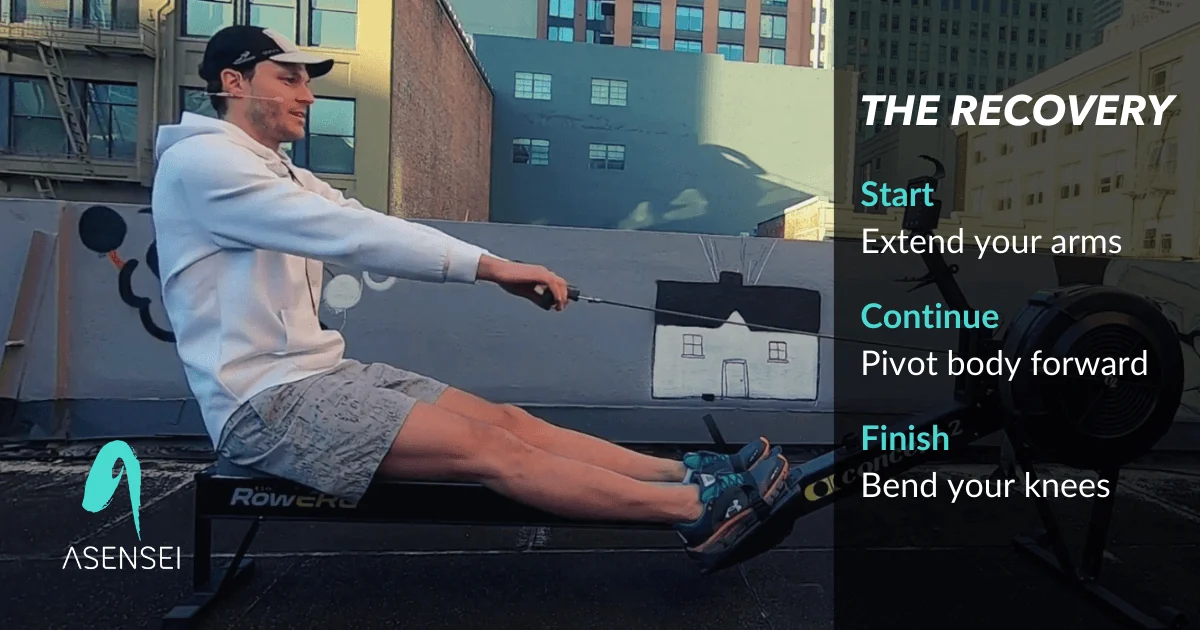
Many beginners get the hard part approximately right and then waste energy on the way forward. They bend their knees immediately, lift the handle over them, and rush the seat into the catch. This leaves the next push starting from an unstable position. It can also make a moderate workout feel like a succession of short sprints.
Reverse the sequence: extend the arms away from the trunk, pivot forward at the hips while the legs are still extended, then allow the knees to bend and the seat to slide. Think of clearing a straight path for the handle before the knees rise. You should not have to make a large arc around your legs.
Use a deliberate return to establish rhythm. At a modest stroke rate, the recovery will often take roughly twice as long as the drive, though that relationship changes with effort and rate. Counting can help you learn the difference: a brisk drive followed by a longer, relaxed return. Do not turn the count into a rigid prescription for every pace. The aim is to avoid rushing, not to perform robotic intervals inside each stroke.
A useful distinction on the monitor is stroke rate versus pace. Stroke rate counts how many complete strokes you take in a minute. Pace is usually expressed as the time per 500 metres. The two numbers do not have to rise and fall together. At the same stroke rate you can change the power of each stroke, which changes your pace. Conversely, increasing your rate without applying meaningful force may not deliver the improvement you expect.
Practise at about 18 to 22 strokes per minute, at a level that allows conversation. Watch how consistent your pace is. If you cannot keep a stable rhythm without pulling extremely hard, slow the pace rather than increasing the rate. Once you can control that rhythm, introduce slightly more challenging efforts and observe what happens to the quality of the stroke.
Turn better technique into a four-week conditioning block
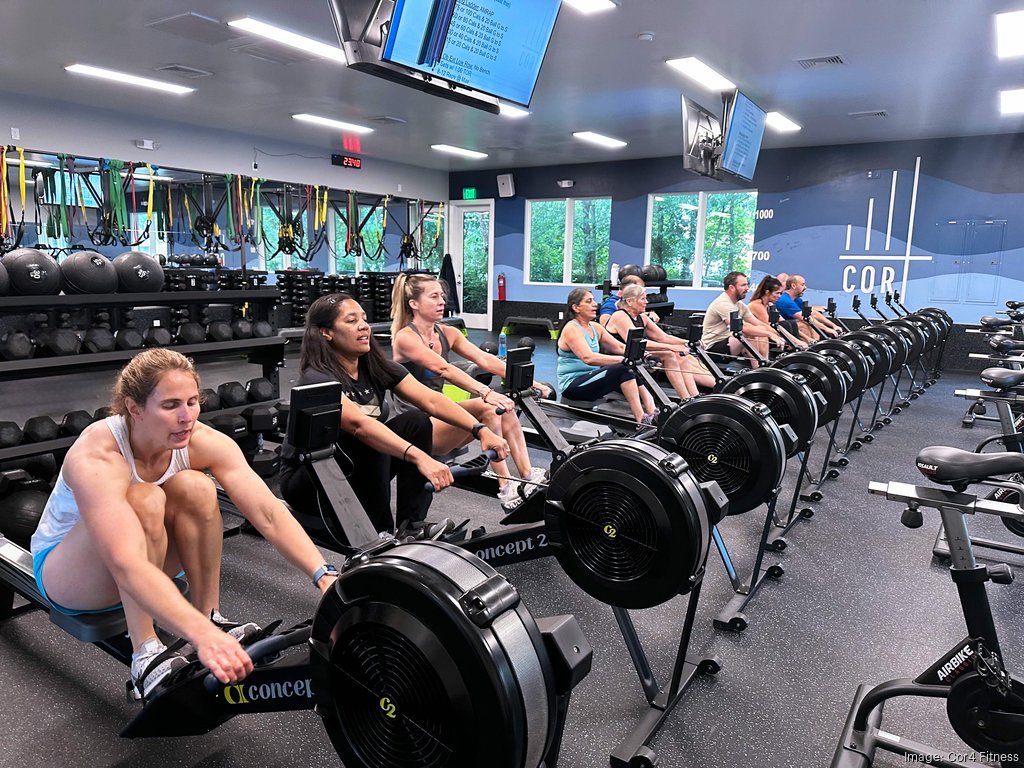
For lifters, the best introductory conditioning programme is one that does not make the next squat or deadlift session unexpectedly miserable. Start with two nonconsecutive rowing days each week, and make the first goal consistent technique, not a competitive 2,000-metre time. The following is an adaptable example, not a promise of a particular fitness result.
- Week 1: Two sessions of 10 to 12 minutes, including a few minutes of easy warm-up. Use comfortable strokes and stop briefly to reset when the sequence falls apart.
- Week 2: Two sessions of 15 minutes. Keep one steady; during the other, practise four slightly stronger 30-second efforts separated by at least 90 seconds of easy rowing.
- Week 3: One steady 18-minute row and one interval session of five 45-second controlled efforts with 90 to 120 seconds easy between them. Do not sprint all-out.
- Week 4: Repeat the same sessions with a small increase in steady duration or a modest improvement in pace if technique and recovery are good. Change one variable, not every variable at once.
Record average pace, stroke rate, duration and how hard the session felt. Note whether your legs and back are recovered for your next lifting workout. If performance in the gym is dropping or you are still unusually sore, move the harder row farther from demanding lower-body work or shorten it. A hybrid fitness session can combine rowing with a strength circuit later, but you need not add burpees, sleds or kettlebell swings before you can row efficiently on their own.
Finish each workout with a few minutes of easy movement. The most useful sign of progress is not necessarily a new best time; it might be the ability to cover the same distance at a lower perceived effort while maintaining a consistent rate. When the catch, drive, finish and recovery work together, the machine stops feeling like a fight against the handle. You have a tool for conditioning that can grow with your strength instead of competing with it.

Cardio Shirts & Workout Gear
Cardio and conditioning gym gear for runners, endurance athletes and anyone who earns the sweat.

Anti Rowing Rowing Club Shirt – Meme & Top T-Shirt
Show some cardio attitude with a playful “Anti Rowing Rowing Club” tee.


Exercise I Thought You Said Extra Fries Retro Workout C T-Shirt
Show some gym-day personality with “Exercise I Thought You Said Extra Fries”.

Everything Hurts And I'M Tired Motivation Vest Tank Top
Your gym-day look, with a playful “Everything Hurts And I'm Tired” twist.

Shirt – Cardio Is Hardio – & Gymbros T-Shirt
Show some cardio attitude with a playful “Cardio is Hardio” tee.

Don't Quit Do It – Motivational Workout Decal for Gym B Sticker
Give your everyday gear a playful “Don't Quit Do It” twist.

Cardio Is Calling Decline Bros Meme Hooded Hoodie
Make your off-duty look more fun with “Cardio Is Calling”.

Cardio Sucks Negative Review 1 Star Hooded Hoodie
Show off your cardio humor in a laid-back “Cardio Sucks” hoodie.