Advertising disclosure: This page includes affiliate product links that may earn us a commission, as well as products from our own store.
Parallel-Bar Dips: Build Chest and Triceps Without Chasing Depth
A good dip is a repeatable press. You support your body, lower under control and push back to a stable finish. The exercise becomes less useful when every extra repetition comes from a bigger swing, a shorter descent or a bounce out of the bottom. Adding a plate does not solve those problems.
Parallel-bar dips can challenge the chest and triceps, but they are already a demanding bodyweight exercise. Some lifters need assistance before they can practice them well; others need a small amount of extra load. Start by choosing a version you can control, then make its progress measurable. The following approach separates technique, assistance, loading and programming so that each change has a clear purpose.
Chest or triceps? Change the emphasis without inventing isolation
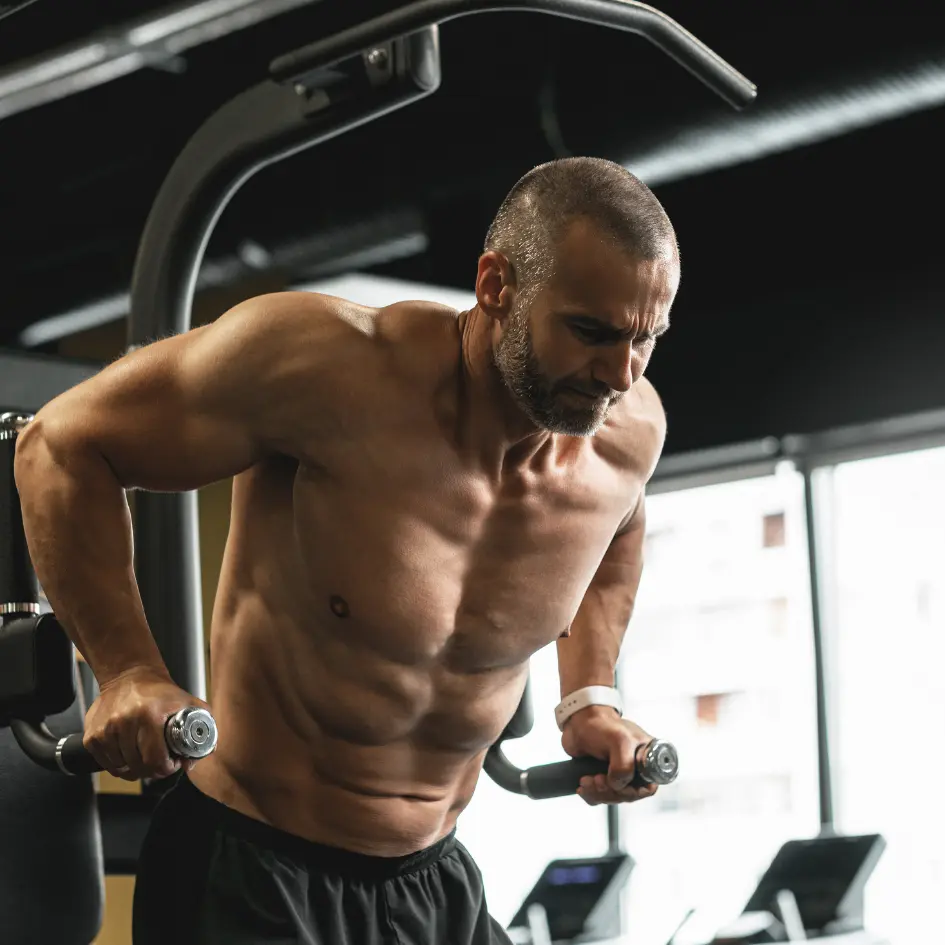
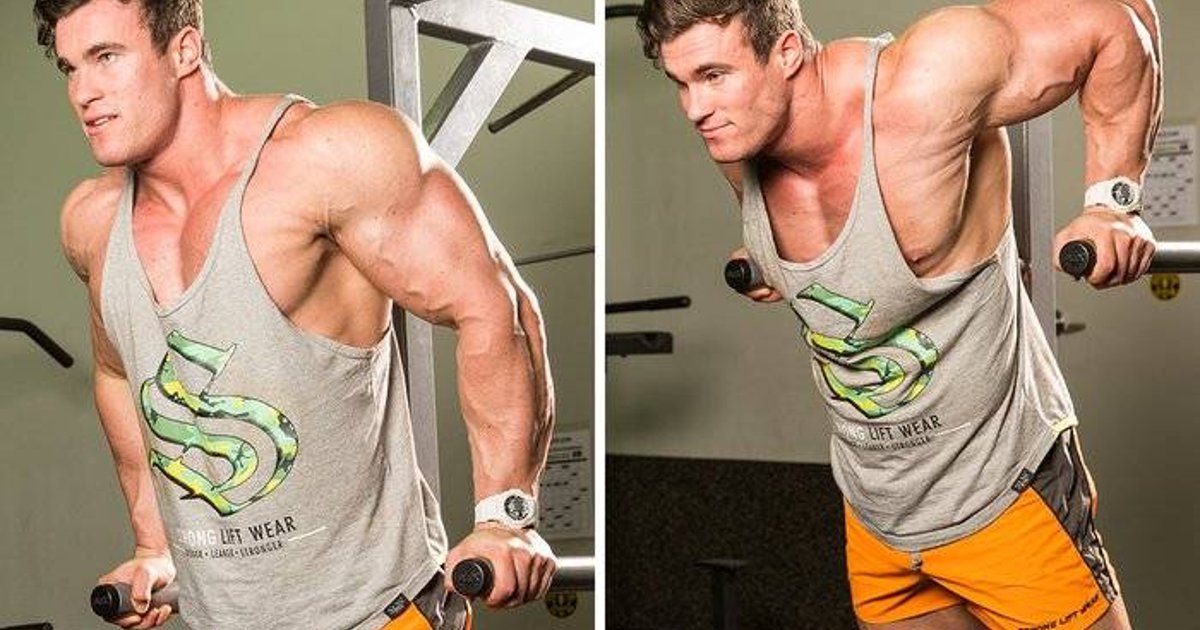
Both the chest and triceps contribute to a parallel-bar dip. Your elbows bend and straighten while the upper arms move relative to the torso. A modest forward lean is commonly used for a chest-focused variation, while a more upright position is often used for a triceps emphasis. Neither position switches the other muscle off, and an exaggerated lean is not a shortcut to better chest training.
Choose a comfortable grip on a stable station. If the bars offer different widths, start with a position that lets the elbows track naturally rather than forcing them tightly inward or spreading them as far as possible. Keep your chosen torso position reasonably consistent through the repetition. A slight change in angle is normal; diving the head forward and then throwing the hips back makes comparisons harder.
Think about the training goal before changing the setup. If you want to progress a chest-focused dip, keep the same station, similar lean and a repeatable depth across sessions. If you change all three and lift more weight, you cannot tell whether strength improved or whether the movement became easier. A short side-view clip can reveal changes that are difficult to feel during a set.
Muscle activity measurements can help describe which muscles participate, but they do not tell you how much muscle a particular dip style will build over months. A bigger electrical signal in one laboratory comparison does not establish a universal exercise ranking. Your useful outcome is a pressing movement you can train consistently, recover from and gradually make harder.
For bodyweight training, keep the wider session balanced too. Pull-ups or rows can occupy a separate pulling slot; you do not need to turn every exercise into a dip progression. Calisthenics includes both pressing and pulling skills, each with its own practice demands.

Calisthenics Shirts & Street Workout Gear
Calisthenics and bodyweight-training gear for pull-ups, dips, handstands and street-workout athletes.

Big Dip Energy Decal for Water Bottles Laptops Dip Love Sticker
Give your everyday gear a playful “Big Dip Energy” twist.

Funny Calisthenics Gym Crewneck Pullover Sweater for Bo T-Shirt
Keep things casual with a little “Calisthenics” attitude.

Calisthenics Evolution
Show some lifting attitude with a playful “Calisthenics Evolution” tee.

Turn Off Gravity Funny Calisthenics Gym Hooded for Huma Hoodie
Show off your lifting humor in a laid-back “Turn Off Gravity Funny Calisthenics” hoodie.

T-Rex Hates Push Ups Crewneck Pullover Sweater for Cali T-Shirt
For laid-back days and bodybuilding humor: “T-Rex Hates Push Ups”.

Calisthenics Heartbeat Muscle Shirt Athletic Vest Human Tank Top
Bring “Calisthenics Heartbeat” humor to your next lifting session.

Stronger Than Excuses Tank
Show some personality between sets with “Be Stronger Than Your Excuses”.

Calisthenics Hanging Out Decal for Water Bottles Laptop Sticker
A fun “Calisthenics Hanging Out” touch for bottles, laptops, and lockers.

Pull Up or Shut Up Hooded Pullover for Calisthenics Pul Hoodie
Keep it laid-back with a little “Pull Up or Shut Up” attitude.

Make the start, bottom and finish look like the same exercise
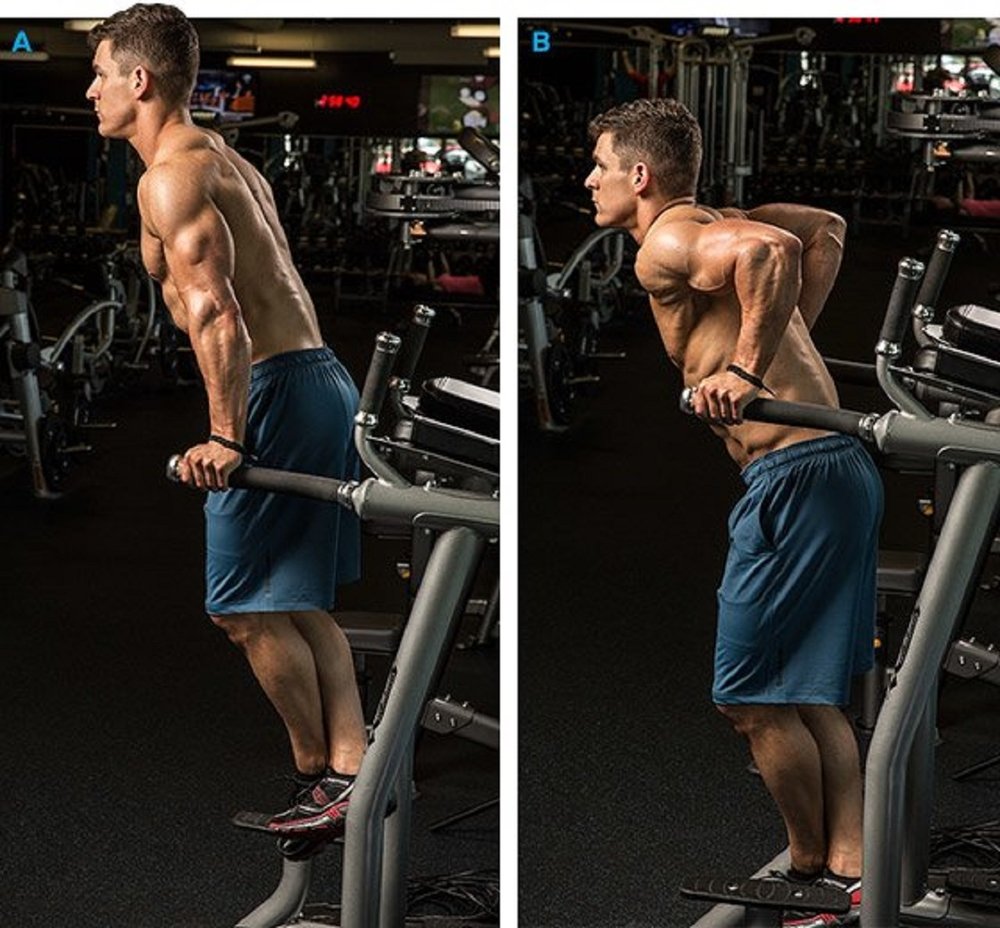
Use the station’s steps or a secure platform to enter the support position. Establish your grip and balance before starting the descent. At the top, support yourself through the hands with the arms extended comfortably and the trunk organized. Avoid beginning each repetition from a shrug or relying on a kick to get moving.
Lower at a speed that lets you notice where control changes. Your elbows bend as your shoulders move into extension, with the upper arms traveling behind the torso. Stop at a depth you can reverse smoothly. Do not chase a particular elbow angle simply because it looks impressive in someone else’s photograph. Body proportions, bar geometry, experience and individual tolerance all affect the position.
A useful technical boundary is the deepest position you can reach repeatedly without dropping into it or changing the whole shape of the movement to escape. That does not mean every lifter should immediately train at their deepest possible range. Start with a manageable range, establish control and avoid treating discomfort as proof that you have found a better stretch.
Press back toward the same support position, then briefly regain your balance before the next repetition. Keep the legs quiet enough that swinging is not driving the set. If the last few repetitions become noticeably shallower, record them honestly rather than adding them to a supposed personal best with identical technique.
Use three simple video questions: did the first and last repetition reach a similar bottom position, did the body stay controlled between the bars, and could you finish without a kick? These are coaching checks, not a medical test. Stop a set that causes pain rather than repeatedly experimenting under fatigue. Persistent or recurring symptoms deserve individual assessment before you keep loading that movement.
Use assistance to practice the dip you actually want
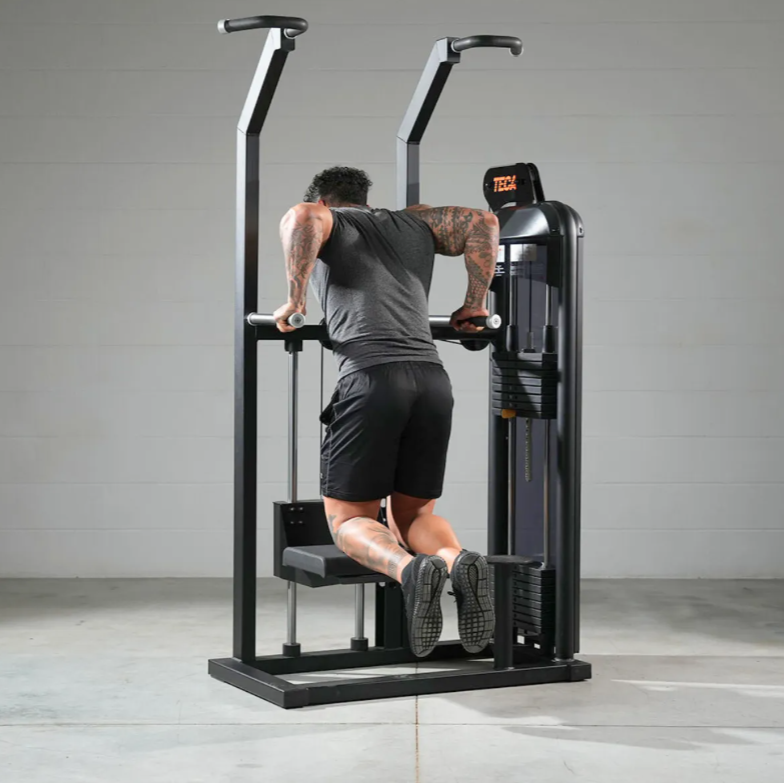
If you cannot perform controlled bodyweight repetitions, an assisted dip machine can make the movement trainable. The counterweight supports part of your body mass through a pad or platform. On a typical counterweighted machine, selecting more assistance makes the exercise easier; check the instructions on the actual machine rather than assuming its numbers work like a chest press.
Start with enough assistance to complete a modest set while keeping the same descent and finish. For example, you might choose three sets of six to eight controlled repetitions, stopping while another clean repetition still looks possible. That is a practical starting example, not a research-established requirement. When every set reaches the upper end with the intended technique, reduce assistance by the smallest available step.
Record the machine and assistance setting. Different machines have different lever arrangements and friction, so subtracting the displayed number from body mass will not necessarily give a comparable external load. The useful comparison is your performance on the same machine under similar conditions. If a lower-assistance setting destroys the movement, return to the previous one and build more repetitions there.
A band can also assist, but its contribution changes as it stretches. Entry, exit and band security need attention. Do not improvise an unstable arrangement simply because the band feels easier at the bottom. An incline push-up is another way to build pressing practice while you work toward dips, although it is a different exercise rather than an exact substitute.
Bench dips deserve the same distinction. Putting the hands behind the body and the feet on the floor changes the exercise geometry; a laboratory comparison found greater shoulder extension in bench dips than in bar dips. Easier loading does not automatically make that position the best regression for everyone. Choose assistance for its training value, rather than treating every exercise with “dip” in its name as one compulsory ladder.
Add weight only when your baseline is worth keeping
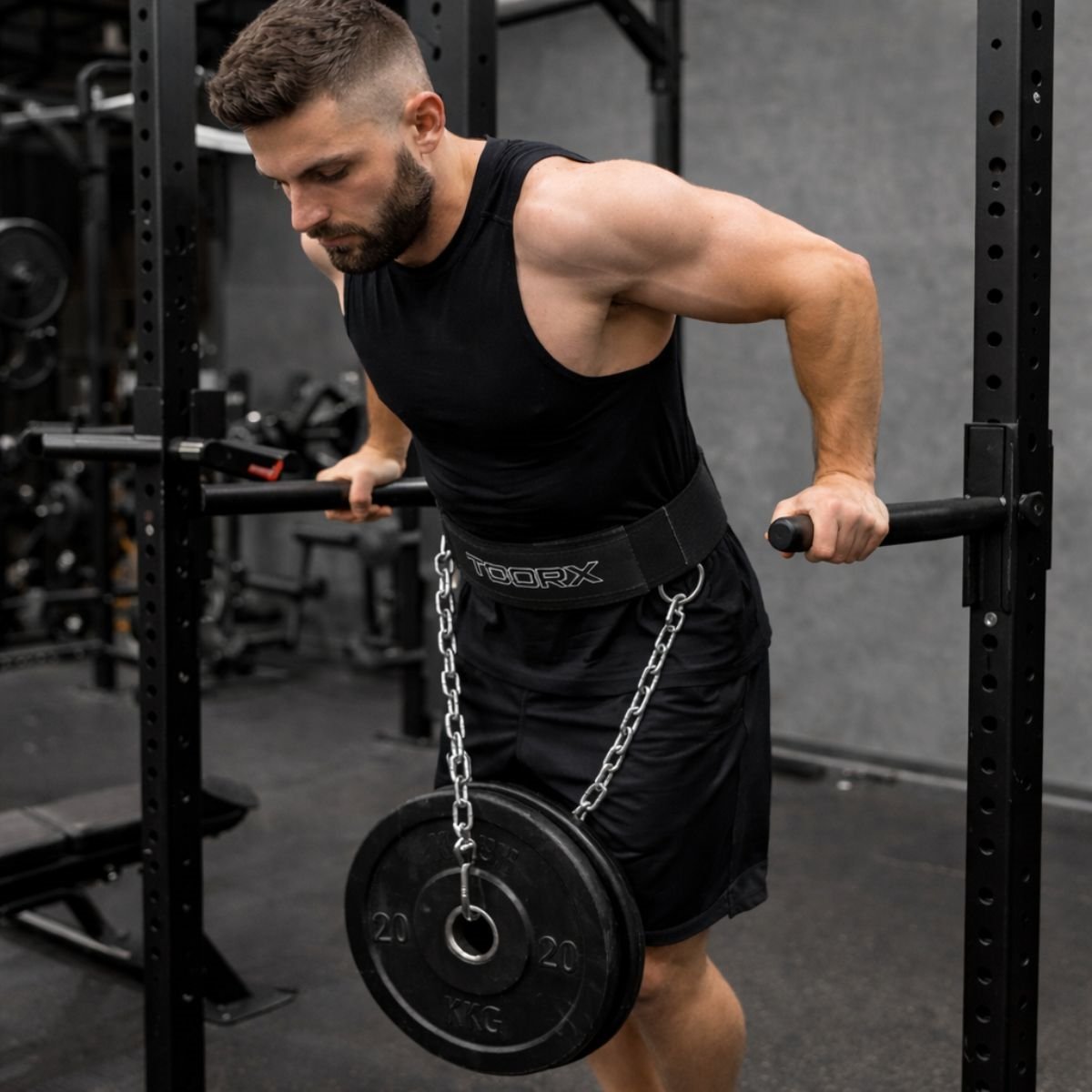
Before loading a dip belt, establish bodyweight sets that look consistent. You do not need an arbitrary lifetime milestone such as twenty repetitions, but you should have enough repeatable performance to distinguish a small load increase from a technique change. If one bodyweight set is controlled and the next depends on momentum, extra weight is unlikely to clarify the problem.
A belt can suspend plates below the waist, while a weighted vest holds the load closer to the torso. These arrangements feel different and require different clearance. Check the actual equipment instructions, load rating, fastening and plate compatibility. Make sure the station is stable and that hanging plates will not strike a step, floor or nearby equipment through your chosen range.
Use the smallest practical increase. One example is three sets of six to ten repetitions: keep the added weight unchanged while you build all three sets toward ten, then add a small increment and work from the lower end again. Keep the depth and technique criteria constant. Reaching ten, eight and seven repetitions is not yet the same progression milestone as three comparable sets of ten.
Track body mass alongside the plate load. A dip moves your body as well as the attached weight, so adding five kilograms to the belt is not the same percentage increase as adding five kilograms to a small dumbbell. Changes in body mass can also influence performance. The log does not need a complicated calculation; date, body mass, added load, repetitions and a brief technique note are enough.
For equipment selection, separate full-height dip supports from low parallettes used for push-ups and other floor skills. Rings add another stability demand rather than automatically improving chest training. Plates, a suitable belt or vest and compatible supports should solve a specific setup problem. None of the products below should be assumed to fit together without checking their actual dimensions and instructions.

Equipment Worth Exploring
Explore equipment, accessories and gear from our carefully selected range.

Power Tower
Freestanding pull-up and dip station with adjustable handles for bodyweight training.


Competition Plates
Competition-style bumper plates for Olympic lifts and loaded strength training.

Grip Plates
Rubber-coated weight plates with handholds for loading barbells and machines.
Bodybuilding Shirts & Workout Gear
Bodybuilding shirts, tanks and gym gear for lifters chasing muscle, size, symmetry and the pump.


Progressive Overload Milo Tee
Bring “Progressive Overload Milo Bull” humor to your next gym day.

Consistency Is Key Stoic Greek God Marble Sculpture T-Shirt
Make gym days more fun with “Consistency is Key Stoic Greek God Marble” style.

Progress Stoic Bodybuilder Greek God Marble Sculpture T-Shirt
Heavy lifts, good laughs, and a little “Progress Stoic Bodybuilder Greek God Marble” energy.

I Love Bench Press | Heart Weight Plate Hooded For Ches Hoodie
Keep it laid-back with a little “I Love Bench Press” attitude.

One More Rep Shirt: Motivational & T-Shirt
Make gym days more fun with “One More Rep” style.

Funny Train Hard Gains Gym | Thomas The Tank Engine Wor T-Shirt
Show some gym-day personality with “Train Hard Gains”.

Discipline Greek God Statue Stoic Sigma T-Shirt
Heavy lifts, good laughs, and a little “Discipline Greek God Statue Funny Stoic” energy.
Give dips a clear place in the week—and keep alternatives
Choose whether dips are the main press you want to improve or an accessory after another press. If dip strength is the priority, practice them early enough that fatigue from bench pressing has not already determined the result. If bench strength is the priority, put the bench first and accept that accessory dip performance may be lower. Keep that order stable when comparing sessions.
A simple starting arrangement is one or two weekly exposures with a few working sets, fitted around the pressing you already perform. Start conservatively rather than adding a large block of dips on top of an unchanged chest and arm routine. For example, replace an existing pressing accessory with two or three dip sets, then watch how performance and recovery respond over several sessions.
Rest long enough between sets to repeat the intended movement. If you are still breathing hard or cannot establish a steady support position, rushing the next set makes the log less useful. You can pair pressing with pulling work elsewhere in the session, but a time-saving pairing should not turn the dip into a balance test performed while exhausted.
Taking every set to failure is not necessary for learning the exercise. A small study of experienced men performing one bodyweight set found longer repetitions and higher chest and triceps muscle activity as fatigue developed, without significant changes in the measured peak joint angles. It did not measure long-term muscle growth or prove that repeated failure sets are injury-free. Leave room to finish and dismount under control.
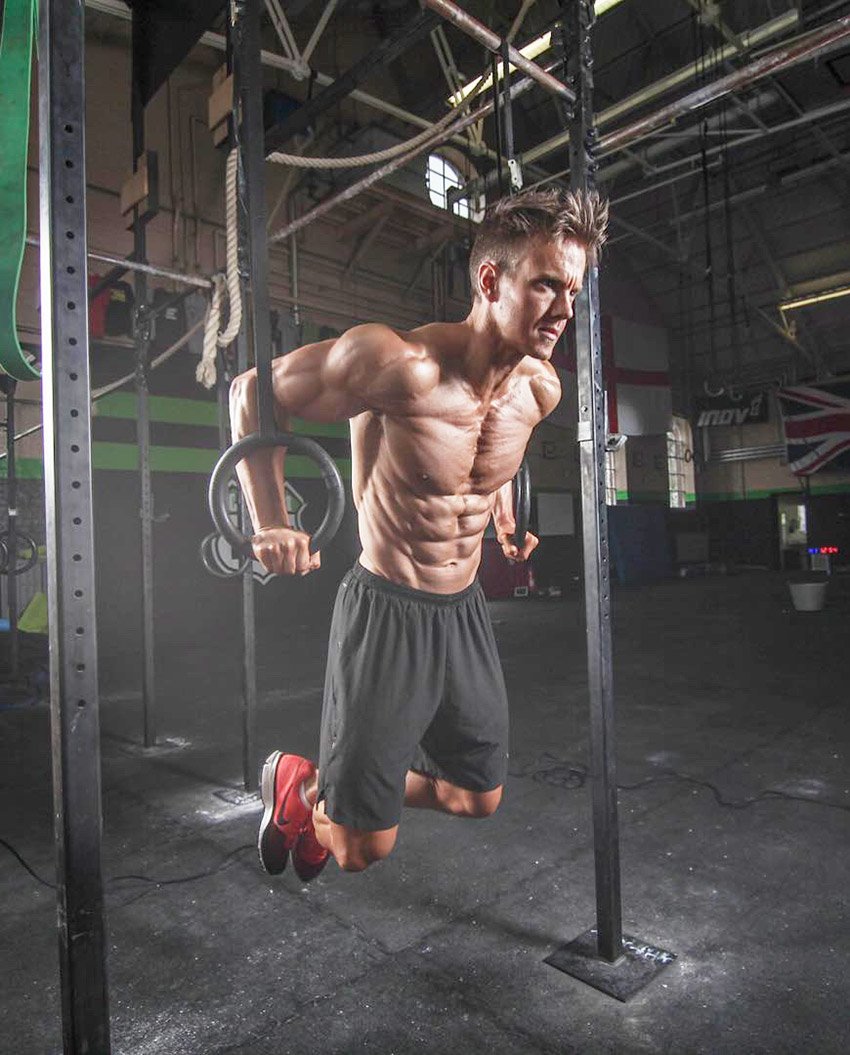
Ring dips, pictured here, are a separate skill with moving supports. They can be useful for an experienced athlete who specifically wants that challenge, but they are not the default next step for someone still struggling on fixed bars. Keep the rings out of your progression until you can manage their additional control demands; adding load and changing supports simultaneously makes the result particularly difficult to interpret.
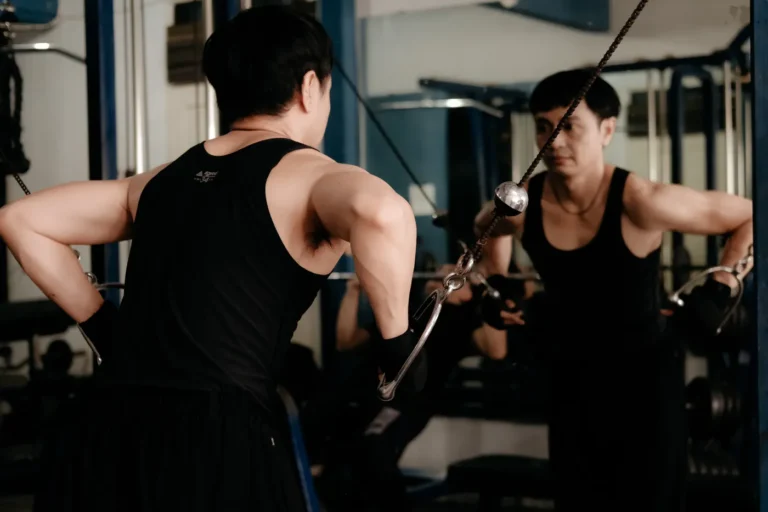
If fixed-bar dips remain uncomfortable or the station does not suit you, use another press. Push-ups, a dumbbell bench press or a chest-press machine can occupy a chest-focused slot; cable pressdowns can provide separate triceps work. A stable bench and dumbbells serve a different setup from a dip station, and a rope attachment is for a compatible cable system. Select the movement you can train productively, then progress its own technique and loading rather than forcing dips to be mandatory.
Equipment Worth Exploring
Explore equipment, accessories and gear from our carefully selected range.


Rubber Hex Dumbbells
Rubber-coated hex dumbbell pairs with a stable shape for home and commercial strength training.


FID Bench MAX
Adjustable bench offering flat, incline, and decline positions + adjustable headrest.


Standing Chest Press SCP-760
Standing chest-press machine with adjustable handle positions for chest and close-grip pressing.

Lever Arm Multi Press LMP-650
Multi-press with independent lever arms and an integrated adjustable bench for upper-body training.

Long Tricep ERGO Ropes
Extended triceps ropes with ergonomic grips for cable pressdowns and overhead extensions.
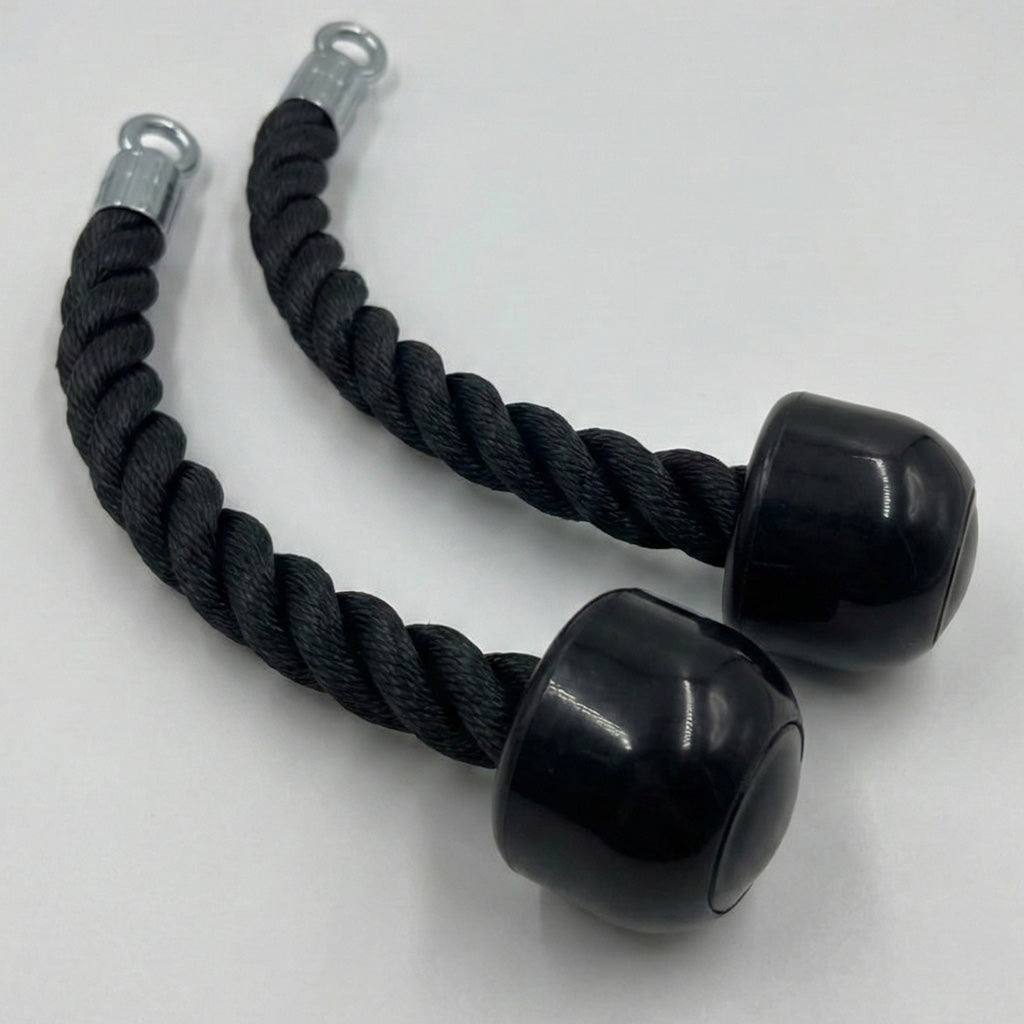
Individual Tricep Ropes
Pair of individual cable ropes for triceps pressdowns and cable hammer curls.