Advertising disclosure: This page includes affiliate product links that may earn us a commission, as well as products from our own store.
Medicine-ball slams can serve different purposes within a training week. The useful starting point is choosing suitable equipment and a repeatable movement, then deciding whether the session calls for brief power practice or a controlled conditioning block. The ball, the reset and the recovery period all shape that decision.
Learn the slam before adding speed or weight
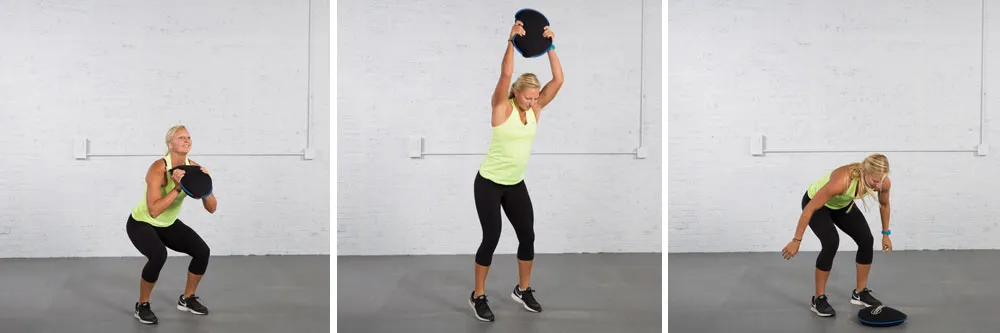
An overhead slam is a release into the floor, followed by a controlled reset. Hold the ball securely, stand with a comfortable base and rehearse the overhead position without throwing. You should be able to raise your arms without forcing your lower back into a large arch. If that position feels restricted, reduce the movement or choose another drill rather than forcing the throw.
As you bring the ball down, let the hips and knees contribute while keeping the trunk organized. Direct the release into a clear patch of floor in front of you, away from your toes. Your arms transmit the effort, but trying to perform every repetition through the shoulders alone makes it harder to coordinate the whole movement.
Separate the throw from the pickup when learning. Allow the ball to settle, approach it with your feet in a useful position and retrieve it through the hips and knees. Avoid repeatedly folding through your back because the next repetition feels urgent. A deliberate reset is part of the exercise, even when it makes the set look less dramatic.
Use an easy rehearsal set to check the setup before a harder one. Watch where the ball lands, whether your feet move unexpectedly and whether you can finish balanced. A partner can watch from outside the throwing area, or you can review a short side-on recording. The useful question is whether your setup remains repeatable as effort rises, rather than whether the impact sounds impressive.
Use the same starting position for the first few sessions. That gives you a fairer way to assess technique than switching immediately between kneeling, jumping and turning variations. Add complexity only when there is a clear reason for it.
Choose the ball by its intended use and rebound
Medicine ball is a broad label, and similar-looking balls can behave differently. Check the manufacturer's instructions for the specific model, including whether repeated floor slams are permitted. A textured surface, a heavy weight or a soft covering does not establish impact tolerance. Inspect seams and the outer surface, and remove damaged equipment from use rather than testing it with a harder throw.
A low-rebound slam ball makes it easier to separate throwing from retrieval. A bouncing ball introduces a return path that you must predict and control. Do not lean your face over the landing point or reach blindly for a fast rebound. Establish what the ball actually does with a gentle test in the approved area before progressing the effort.
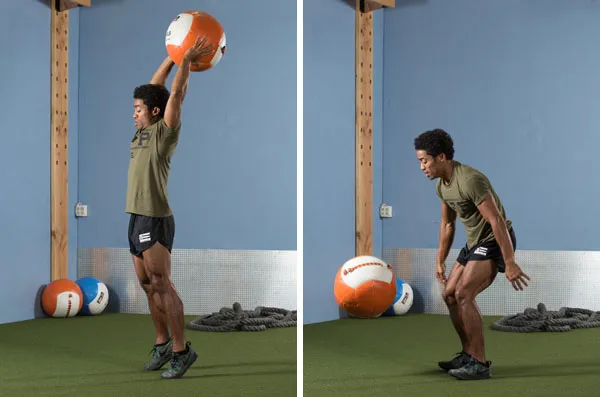
Larger wall balls are commonly used for wall throws and catches, but that does not make every model suitable for floor impacts. The photograph illustrates a medicine-ball overhead action; approval for slamming still comes from the equipment's instructions. Keep ball selection specific to the task instead of assuming that all weighted balls are interchangeable.
The training space matters too. Use a stable surface approved for the activity, with clearance around the landing area and overhead. Check gym rules about impact exercises. If there is no suitable floor or safe throwing lane, choose a different conditioning station that day. A quiet corner near other lifters is not automatically a safe place to throw a heavy object.
Weight markings alone cannot compare two different balls. Diameter, surface and rebound affect handling, so note the model as well as the load. When training somewhere new, take a moment to learn the available equipment instead of assuming it matches your usual setup.
For power, stop while the repetitions are still sharp
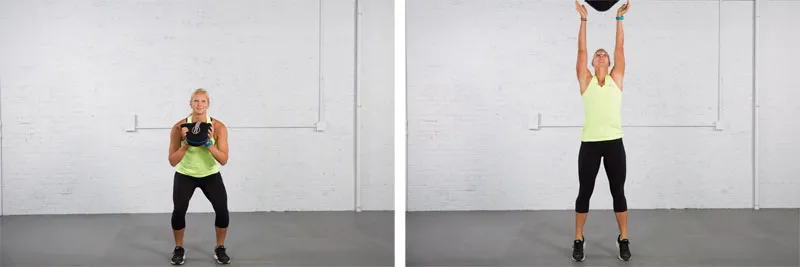
Power practice rewards a fast, coordinated effort that can be repeated after recovery. It does not require a long set. A practical starting experiment is three sets of three slams with an individually manageable ball, resting roughly one to two minutes between sets. These numbers are a starting template, not a proven optimum or a requirement to use maximal effort immediately.
Choose a load that lets you accelerate confidently. If adding weight turns the movement into a slow lift and drop, you have changed the task. A lighter ball can be useful when it permits a clearer release and a more consistent movement. Record the exact ball and setup so that a later improvement reflects something more useful than switching equipment.
End the set when timing becomes unreliable, the pickup starts to dictate the movement or you repeatedly lose balance. Rest longer if the next set is noticeably worse. Do not add repetitions simply because your arms could keep moving. That would increase work, but it would not necessarily preserve the quality you intended to practise.
Other throws can also be organized around brief, rested efforts. The overhead throw pictured here releases the ball along a different path from a floor slam and requires its own clear space and suitable equipment. Treat it as a separate movement option, not an interchangeable repetition. Improving one drill does not automatically establish better performance in every sport or lift.
A simple set-quality record can be more useful than another repetition target: write down whether the first and final releases looked similarly controlled. If you cannot tell, keep the dose modest until you have a clearer baseline.
For conditioning, control the pace and the reset

A conditioning block has a different aim: repeat manageable work while controlling the overall demand. One simple trial is four rounds of ten seconds of comfortable slams followed by fifty seconds of rest or easy movement. Begin conservatively and assess whether every round stays organized. There is no obligation to chase a particular heart rate or exhaust yourself to make the block worthwhile.
Count clean repetitions without racing the pickup. If the ball rolls away, stop and collect it rather than lunging after it between other people. When later rounds deteriorate, reduce the work interval, use a lighter approved ball or extend recovery. The timer is a framework for the session; it should not override the quality of each release and retrieval.
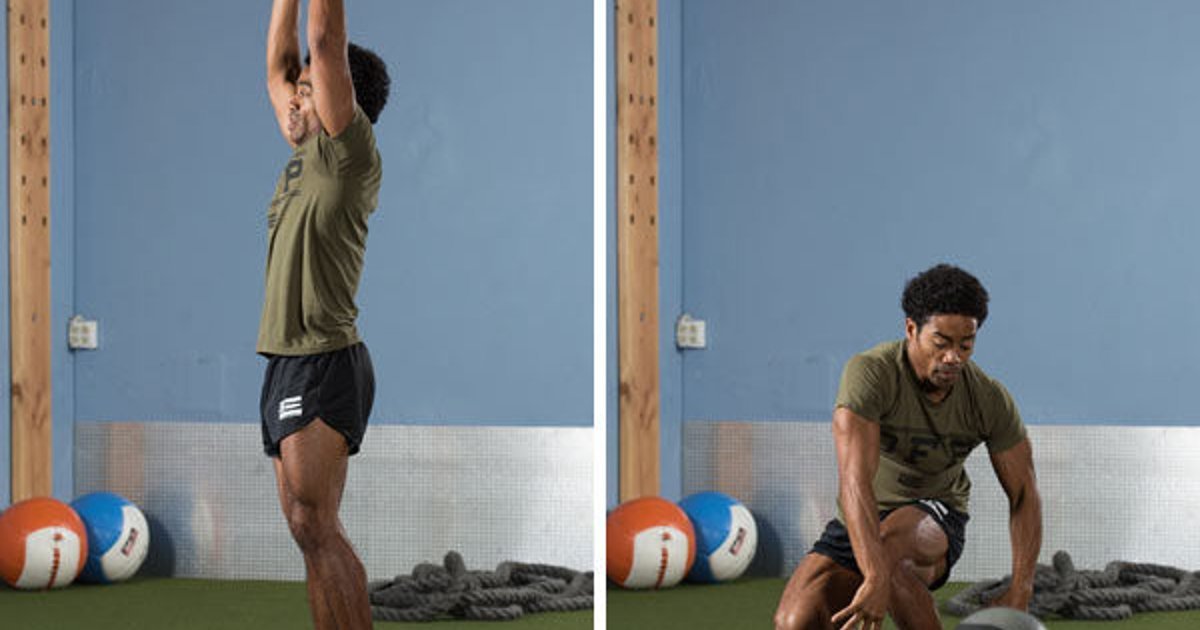
A slam combined with a burpee, as pictured, adds a floor transition and changes the exercise substantially. Learn each component first and keep enough space to move safely. You can also keep the stations separate: finish the slams, move to a clear area and perform a simpler bodyweight drill. Combining movements is optional and makes comparisons with basic slam sessions less direct.
Progress just one demand at a time. For example, keep the same ball and work interval while adding a round, or keep the round count while slightly extending work. Changing load, pace and rest together makes it difficult to understand why the session became harder. Breathlessness is useful feedback about effort, but it does not measure throwing power or prove a specific calorie expenditure.
Keep the recovery period honest. Walking to another demanding station does not give the same recovery as standing or moving easily. If you use a circuit, record the other exercises too, because their demands help determine how the next slam interval feels.

Equipment Worth Exploring
Explore equipment, accessories and gear from our carefully selected range.

Slam Ball
Low-bounce weighted slam ball for explosive throws and high-intensity conditioning.

Competition Wall Ball
Competition-style weighted wall ball for HYROX, wall-ball shots, and functional conditioning.

Cast Iron Kettlebells
Textured cast-iron kettlebells for swings, squats, carries, and full-body training.


Rubber Hex Dumbbells
Rubber-coated hex dumbbell pairs with a stable shape for home and commercial strength training.


Fit slams around the training you actually want to improve
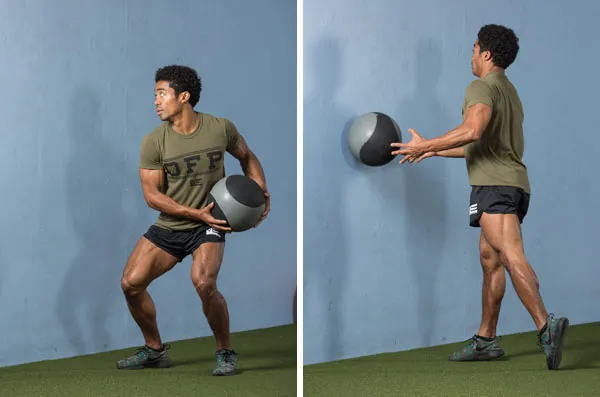
Decide where the drill belongs before starting the workout. If crisp power practice is the priority, perform a small amount after warming up and before a demanding lifting session. If you want a short conditioning finish, place it after the main strength work and adjust the dose to the fatigue already present. Doing both versions hard in every workout adds demands that may not serve your plan.
Build the surrounding session with familiar movements. Dumbbells or kettlebells can serve the planned strength work; a trap bar and securely loaded plates may suit a separate lower-body strength session. Jump rope or sled work can provide another conditioning option when the space and skill requirements are met. These tools are for their intended exercises, never substitutes for a ball you release into the floor.
Wall throws introduce another direction of force, as the rotational example shows. They need an approved wall, appropriate ball and a controlled receiving pattern. Keep them separate in your training record from overhead slams. Likewise, do not add a new throw, a new slam load and a demanding lifting progression together if you want a useful view of how well you tolerate the change.
Log the ball model and load, sets or timed rounds, rest periods and a brief note about consistency. Review those details alongside the rest of your week. Power, endurance and recovery are related concerns, but they are not the same outcome. Keep the version that supports your actual goal, and reduce the dose if it repeatedly compromises the sessions you value more.
Review the plan after several comparable sessions rather than one unusually energetic workout. Look for repeatable execution, manageable recovery and progress in the outcome you actually care about. A harder finisher can be enjoyable without needing to call it a superior power session.

Funny Gym Shirts & Workout Gear
Funny gym shirts, tanks, hoodies and workout gear for lifters who like training hard.

Power Stoic Sigma Greek God Marble Sculpture Shirt – T-Shirt
Heavy lifts, good laughs, and a little “Power Stoic Sigma Greek God Marble” energy.

Endurance Stoic : Sigma Bodybuilder & T-Shirt
Heavy lifts, good laughs, and a little “Endurance Stoic” energy.

Hybrid Athlete Strength & Endurance Tank
Add some lifting attitude to training with “Hybrid Athlete”.

Cardio Is Hardio – Workout Meme Pullover Jumper T-Shirt
For laid-back days and cardio humor: “Cardio Is Hardio”.

Negative Cardio Review Cardio Sucks 1 Star Decal Sticker
Give your everyday gear a playful “Negative Cardio Review” twist.

Shirt: Does Running Out Of F*Cks Count As Cardio? & T-Shirt
Heavy lifts, good laughs, and a little “: Does Running Out Of F*cks Count As” energy.

Rest Day Sloth – Essential T-Shirt
Show some bodybuilding attitude with a playful “Rest Day Sloth” tee.

Off-Season Rest Day & Meme Fans Hooded Hoodie
Keep it laid-back with a little “Off-Season Rest Day” attitude.

Anti Cardio Cardio Club Shirt Meme & Top T-Shirt
Bring “Anti Cardio Cardio Club” humor to your next gym day.

Burpees Bad Breaking Bad Shirt – Meme & Cardio Haters T-Shirt
Show some cardio attitude with a playful “Burpees Bad Breaking Bad” tee.