Advertising disclosure: This page includes affiliate product links that may earn us a commission, as well as products from our own store.
A lying cable hamstring curl looks simple until the cuff pulls you along the floor or your hips lift to finish the rep. The useful skill is to bend the knee against resistance while keeping the rest of the setup predictable. You can practise that on a mat or a stable bench, usually one leg at a time. The best starting arrangement is the one that lets you enter the position comfortably, complete a controlled repetition and return the resistance without a scramble. Here is how to build that arrangement and make the exercise worth logging.
Set the cuff and cable before lying down
Start with a purpose-made ankle cuff, a secure cable connection and a suitably low resistance setting. Fasten the cuff according to its instructions so it sits securely without pinching. A handgrip or a wrist cuff is not automatically suitable for an ankle. Check the attachment and cable path before adding meaningful load; a loose connection becomes much harder to sort out once you are face down.
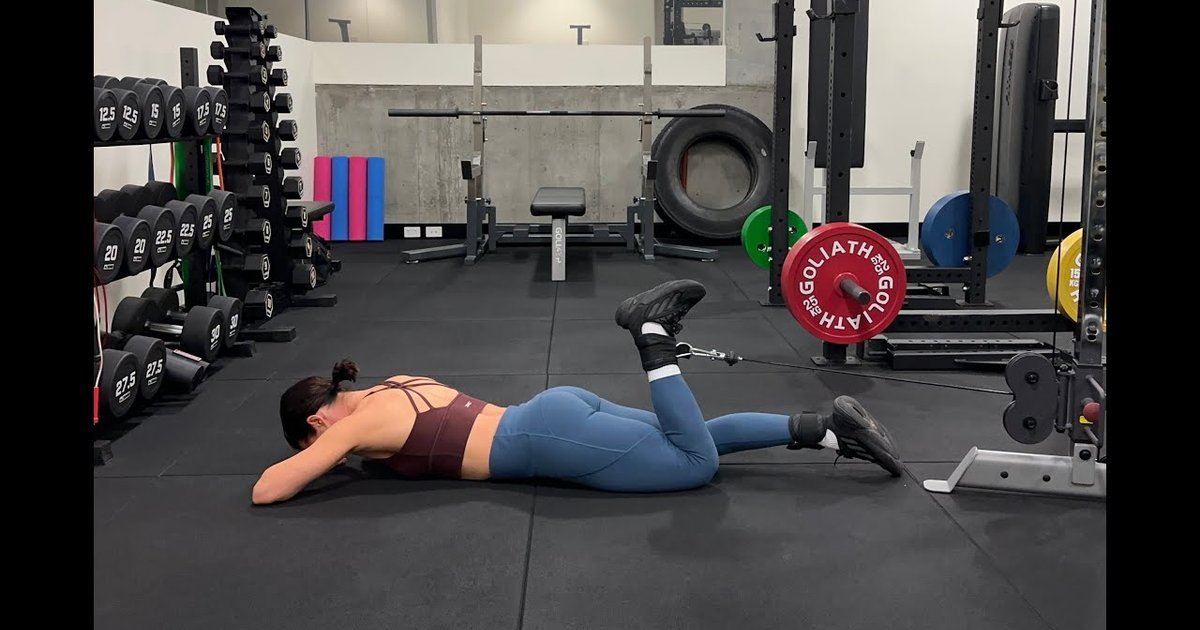
For the floor version, lie on your stomach with the working leg pointing towards the cable's anchor. The cable should pull away from your feet rather than across the opposite leg. Choose enough clear space that the cuff, shoe and cable can move without catching a bench foot or the machine frame. Start close enough to get into position without dragging a raised stack around the gym.
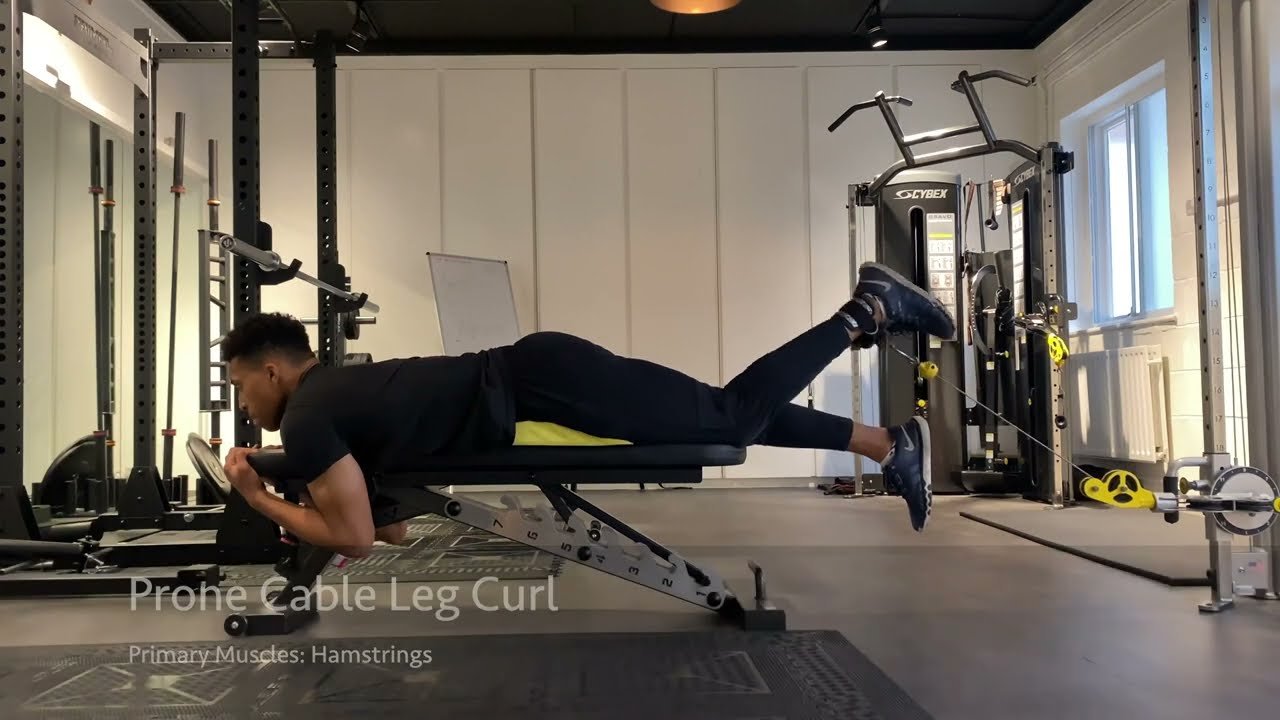
A bench can make the movement easier to arrange when floor clearance is awkward. Use a stable, locked bench and position the knee near the end so the lower leg can move freely. Check that the cable clears the padding and frame throughout the intended repetition. Do a very light rehearsal before committing to that position. Raising a bench on loose plates or blocks adds another variable and is unnecessary for learning the exercise.
Curl the knee while the thigh stays quiet
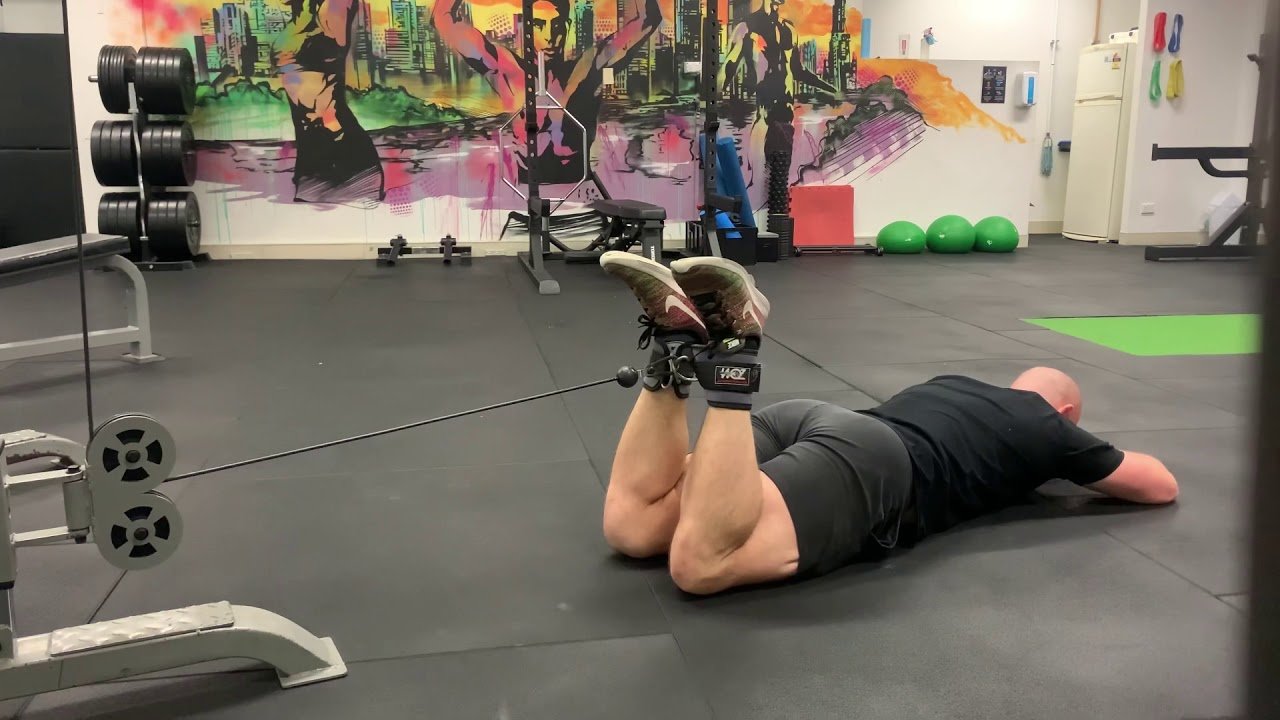
Settle your chest and pelvis into the support. Gently brace your trunk, then bend the working knee to bring the heel towards your buttock. Think about the lower leg moving around the knee while the upper leg stays relatively still. The hamstrings are doing knee-flexion work here; throwing the entire thigh upwards changes the movement you are trying to practise.
Use a comfortable range. Heel-to-buttock contact is not a requirement, and reaching it by lifting the pelvis does not make a repetition more complete. If the hips begin to hike or the low back starts arching to gain another few centimetres, finish the curl earlier. Lower the resistance if you cannot find a useful range without repeatedly changing position.
Keep your ankle relaxed enough that the cuff remains settled. A lightly flexed ankle, with the toes drawn a little towards the shin, is one practical starting position. Avoid turning foot position into an elaborate muscle-targeting trick. Keep it consistent while you learn the knee movement. Exhale as you curl and keep breathing between repetitions rather than holding a long breath while struggling against the cable.
A short side-view recording can help you notice a rising thigh or sliding pelvis. It is feedback about the repetition, not a demand to freeze every part of the body perfectly. Compare early and late reps: a gradual loss of the chosen position is a useful cue to end the set or reduce the next set's load.
Control the return and keep the geometry consistent
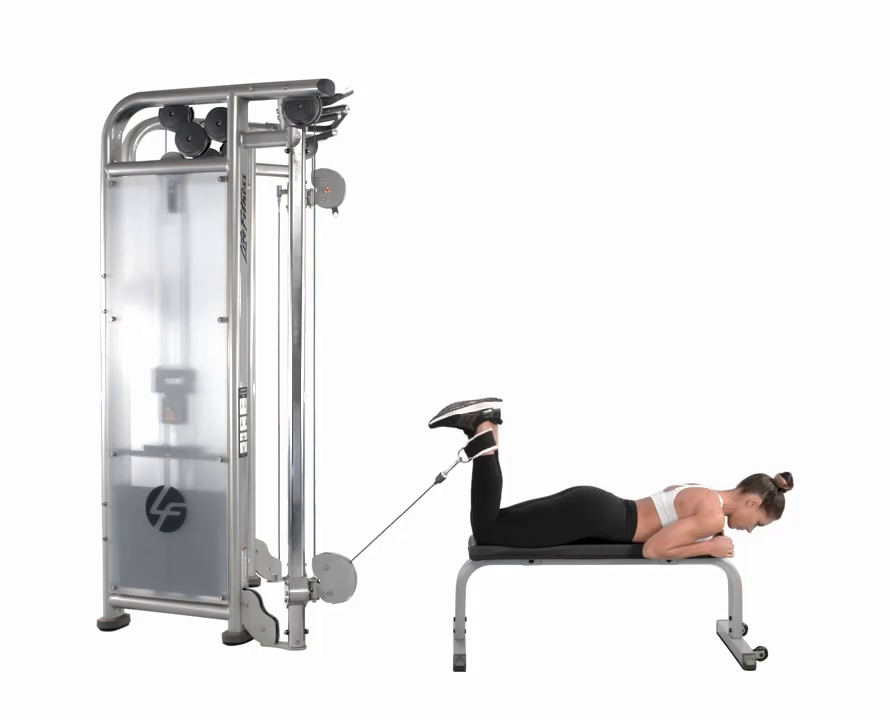
The repetition includes the trip back towards a straighter knee. Let the lower leg travel under control rather than allowing the cable to snap it down. Stop at a comfortable starting position, take a breath and begin the next curl without bouncing. You do not need a dramatic pause or a painfully slow count; aim for a return you could interrupt if the cuff shifted.
Watch the weight stack during the light rehearsal, or ask a training partner to check it. The selected plates should move through the range without repeatedly crashing into the stack or reaching the machine's travel limit. If you run out of cable travel, change the arrangement before increasing resistance. More effort cannot fix a cable that has nowhere left to go.
Distance from the pulley changes the cable's line of pull. Bench height and knee position also affect how the movement feels. A cable being taut does not mean the demand at the knee stays identical at every angle. Treat each arrangement as its own exercise setup rather than assuming all cable curls have the same resistance profile.
Record a simple landmark, such as the bench foot lining up with a floor seam, together with the pulley height and cuff used. That makes next week's load and repetition numbers easier to compare. If you move to a different machine, take a lighter trial set first. Stack labels and pulley systems do not provide a universal measure of resistance at the ankle.
Choose the variation that fits your session
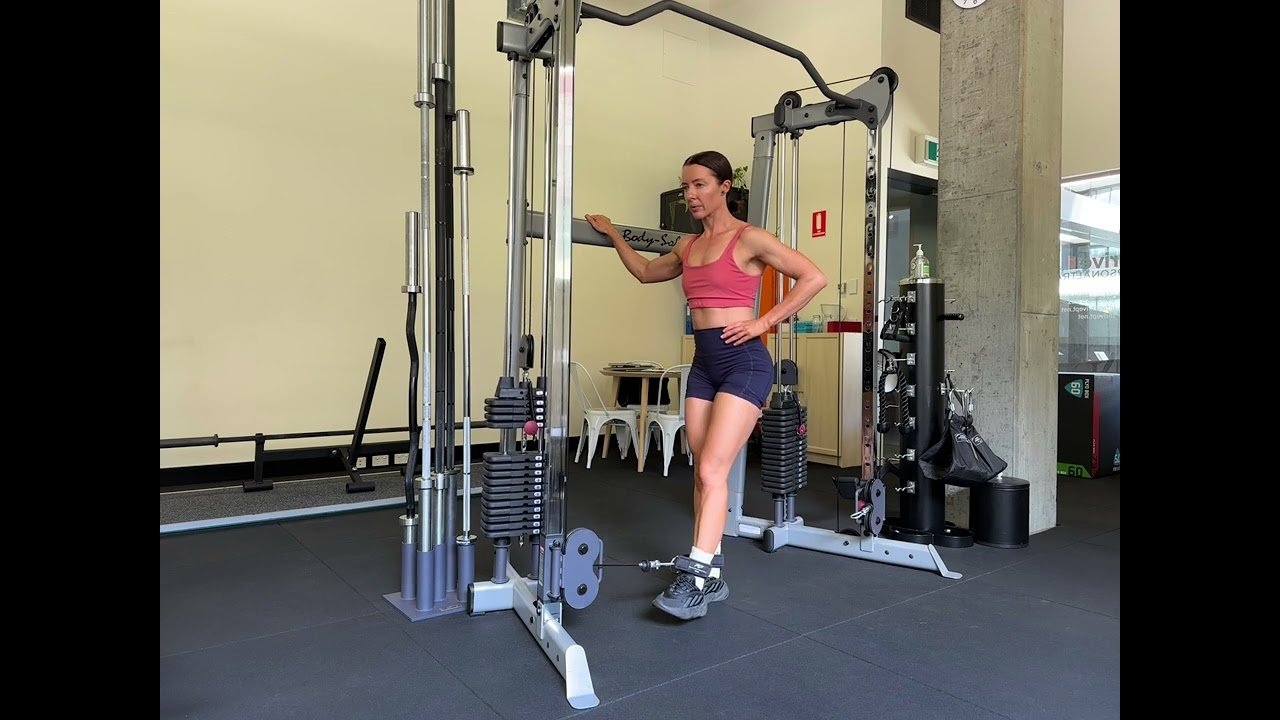
Floor and bench curls solve slightly different practical problems. The floor gives broad support and requires no bench, but your shoe or cuff may limit clearance near the start. A bench lifts the lower leg clear of the floor, although getting on and off it with an attached cable takes more planning. Neither arrangement earns extra credit for being harder to organise.
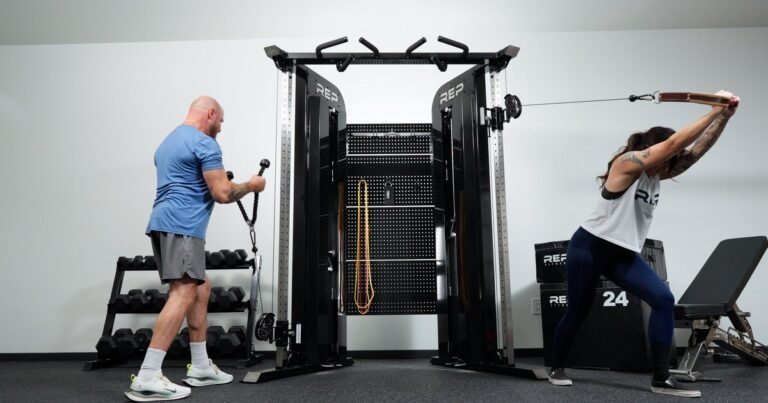
A standing cable curl, shown here, removes the need to lie down. Hold a stable support, keep the working thigh reasonably still and bend the knee without swinging the leg behind you. Balance and the standing leg now become part of the task. Choose it when that setup is more convenient, and track it separately from the lying version rather than comparing the stack numbers directly.
A dedicated leg-curl machine provides its own body support and lower-leg pad. Adjust it to your proportions and follow its setup instructions, including the pad position above the ankles. That can be a simpler choice when a free cable station is crowded or the cuff arrangement keeps distracting you. Machine and cable versions both deserve a comfortable range and a controlled return.
If you are comparing equipment, focus on a suitable low cable path, secure attachments and stable support. Adjustable cable units and benches are possible building blocks; leg-curl machines or compatible bench leg developers are alternatives with their own setup requirements. Check the particular model and attachment instructions rather than assuming every combination fits. You can also use an existing gym station instead of buying equipment for this one movement.

Equipment Worth Exploring
Explore equipment, accessories and gear from our carefully selected range.
VOLTRA
Compact digital cable trainer with smooth, adjustable resistance.

Go-Tone Pro
Portable digital cable trainer with up to 66 lb (30 kg) of adjustable resistance.

VForce Wall Trainer
Space-saving wall-mounted functional trainer with pivoting cable arms and variable resistance ratios.

VForce 2IN1
Half rack and pivot-arm functional trainer with switchable 1:1 and 2:1 pulley ratios.

VForce 3IN1
All-in-one rack combining an adjustable Smith machine, functional trainer, and free-weight station.

VForce 3IN1 Max
Six-post all-in-one rack with Smith machine, functional trainer, and variable-force cables.


FID Bench MAX
Adjustable bench offering flat, incline, and decline positions + adjustable headrest.


Multi Bench MBX-650 2.0
Adjustable multi-bench with roller adjustment, 15 backrest positions and accessory mounts.
Log each leg and progress a repeatable curl
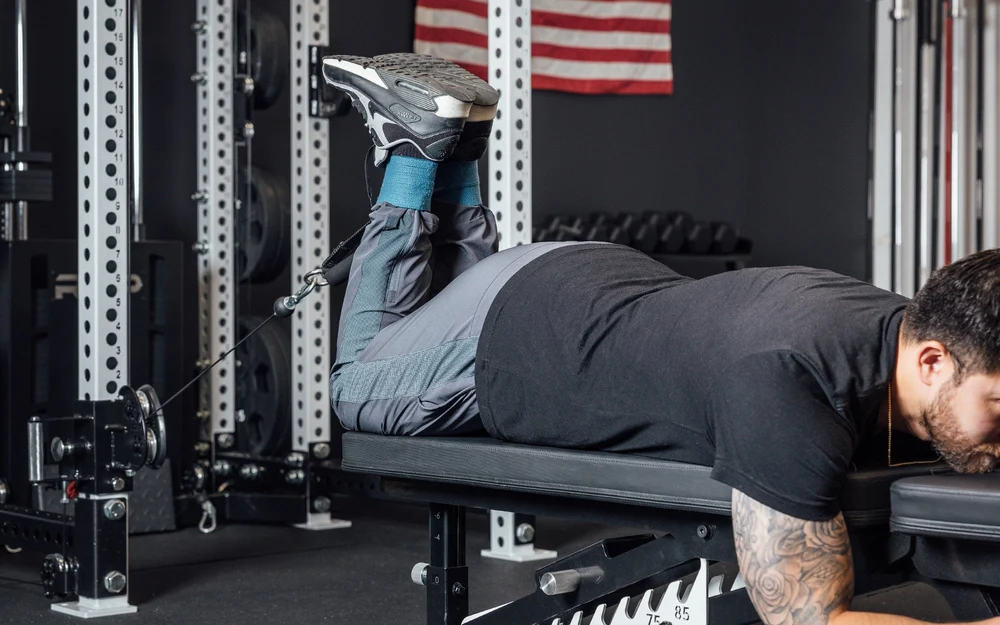
Begin with a load that leaves several smooth repetitions available. As a simple trial, perform one or two sets of roughly 10–15 controlled repetitions per leg, resting enough to repeat the position. Those numbers are an example for learning the setup, not an optimum prescription. Fit the work to the rest of your training and adjust if the position deteriorates quickly.
Write down the load, reps per leg, support used and chosen range. You might log 12 controlled reps on the left and 11 on the right, both ending before the pelvis began to lift. That is more informative than recording 15 on each side when the last few were produced by a different movement. Keep a similar effort level when comparing sessions.
Add repetitions within your chosen range before making the smallest practical load increase. After increasing load, expect the repetition count to drop somewhat. If the next stack jump is too large to control, stay with the current setting and build consistency rather than forcing the heavier number. Changing load, bench position and range together makes it difficult to tell what improved.
Use the curl for its knee-bending role within a broader leg session. Squats and hip hinges ask for different movement patterns, so a cable curl does not have to replace them or become the whole workout. Choose an order that preserves the quality of the exercises you care about most. A repeatable cuff position, clear cable path and honest record give this small accessory movement a useful job.

Funny Gym Shirts & Workout Gear
Funny gym shirts, tanks, hoodies and workout gear for lifters who like training hard.

Never Skip Leg Day Chicken Legs Meme Sweater & Bros T-Shirt
Show some gym-day personality with “Never Skip Leg Day”.

Shirt Never Skip Leg Day NSLD Meme – Chicken Legs & T-Shirt
Show some leg-day attitude with a playful “Never Skip Leg Day NSLD Meme” tee.


Strong Progress Pride – LGBTQ+ & Gymbros T-Shirt
Bring “Strong Progress Pride Powerlifting” humor to your next gym day.

I Love Squats | Valentine's Day Leg Day Hooded Pullover Hoodie
Keep it laid-back with a little “I Love Squats” attitude.

Shirt – Squat Bench Deads Gains T-Shirt
Heavy lifts, good laughs, and a little “Squat Bench Deads” energy.

Mind Muscle Perfection Brain and Biceps Gym for Science Tank Top
Bring “Mind Muscle Perfection Brain and Biceps” humor to your next lifting session.


One More Rep Shirt: Motivational & T-Shirt
Make gym days more fun with “One More Rep” style.