Advertising disclosure: This page includes affiliate product links that may earn us a commission, as well as products from our own store.
Kroc rows turn a familiar dumbbell exercise into a heavy, high-repetition challenge. The important decisions are how much movement you permit, what your grip is supposed to do and when the set should end. Define those choices before you chase a larger dumbbell.
Define the row before you choose the dumbbell

A Kroc row is a demanding one-arm dumbbell row usually performed with a heavy load for a relatively long set. It permits more movement than a deliberately strict row. That description gives you a training option, not permission to turn every repetition into an uncontrolled heave. The useful question is whether you can keep the same recognisable movement as fatigue builds.
Treat strict rows and Kroc rows as separate entries in your log. A load lifted with a fixed torso cannot be compared directly with the same load moved using some assistance from the body. Both can be challenging. Recording the variation prevents a bigger number from disguising a change in what you actually trained.
The movement involves the back and elbow flexors, while the hand must hold the dumbbell and the trunk must support the position. Which part ends the set matters. A tired grip, an exhausted pulling arm and a support position that has become impossible to maintain are three different outcomes, even if each produces the same repetition count.
Before the first work set, decide on a visible standard: the support stays planted, the dumbbell follows a repeatable route and the lowering phase remains under your control. Some movement is intentional; a steadily shorter pull and increasingly violent twist are signs that the exercise is changing. Stop counting equivalent repetitions when those standards disappear.
There is no obligation to adopt this variation because you have become comfortable with ordinary rows. If your current row is progressing and suits your back session, keep it. Use the more demanding option when you can explain its purpose and recover from the work, rather than simply because the name sounds harder.
Build a support position that survives the last few reps

Place the supporting hand on a solid bench or another suitable fixed support. With both feet on the floor, use enough distance between them to remain balanced while the dumbbell clears your leg. A knee-supported arrangement is another option. Choose one arrangement for a training block instead of changing it whenever the load becomes difficult.
Test the path with a lighter dumbbell. You need room for the plates or heads at the bottom, clearance beside the bench and a safe place to return the weight. The largest dumbbell is not useful if its shape forces it into your thigh or makes the support hand slide. Check the actual implement, not just its labelled mass.
Brace before pulling, keeping the head in a comfortable continuation of the torso. Think about moving the upper arm back and bringing the dumbbell toward the lower rib or hip region, rather than curling it straight toward the shoulder. Avoid forcing an exaggerated finish after the useful rowing movement has ended.
Let the arm lengthen during the return while retaining control of the weight. A heavy dumbbell can pull the shoulder downward abruptly if you simply let go of muscular tension. You do not need to freeze every part of the shoulder blade, but the descent should remain something you perform rather than something that happens to you.
Film a short set from the side if you cannot tell whether the support position is changing. Look for the same hand contact, broadly consistent torso angle and a similar finishing point. Video is feedback about the movement; it does not diagnose an injury or measure how much each muscle contributed.
Choose grip work or supported pulling on purpose
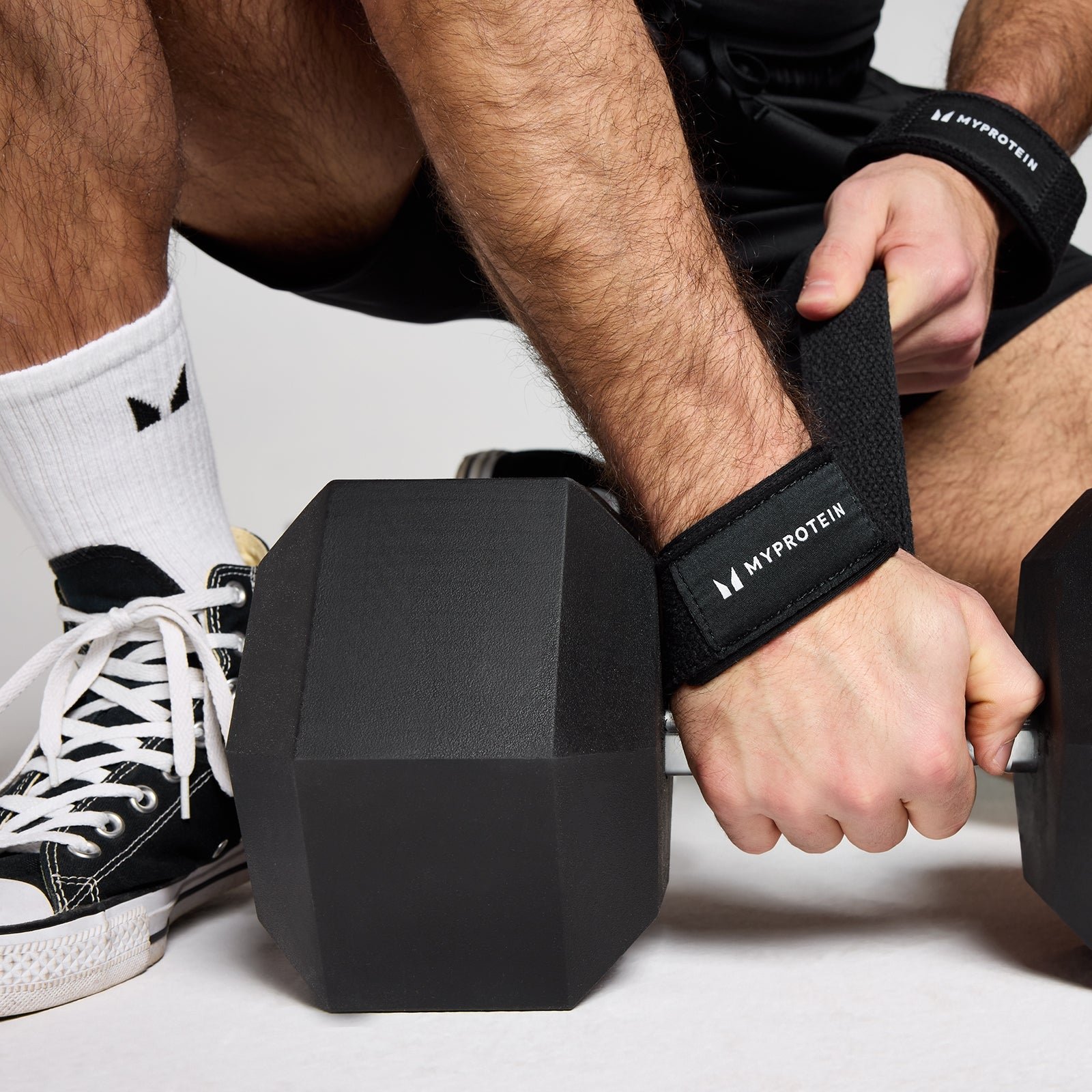
Without straps, the fingers and forearm have to maintain the handle throughout the set. That may be useful when grip endurance is part of your goal. It can also end a back exercise before the pulling muscles receive the work you intended. Neither outcome is automatically wrong, but you should know which one you are getting.
Lifting straps can help maintain contact with the handle when grip is the limiting factor. They do not replace a secure hold or make an uncontrolled dumbbell safe. Follow the instructions for the actual strap or grip you own, practise the attachment with a light load and understand how to release it before attempting a demanding set.
Record whether a set was strapped. For example, 18 repetitions without straps followed next week by 22 with straps shows a change in performance under different conditions. It does not establish that your unassisted grip improved by four repetitions. Keep separate comparisons when the grip assistance changes.
You can also separate the goals within the session. Perform manageable warm-up rows without assistance, then use straps for a planned back-focused set if appropriate. Alternatively, keep the row unassisted and choose a more supported back exercise afterward. These are programming choices, not proof that one method is universally superior.
Thick handles and add-on grips change the challenge again. They are optional tools for a different grip emphasis, not an automatic upgrade for every heavy row. If a thicker handle sharply reduces your repetition count, that may reflect the altered grip task rather than a sudden loss of back strength. Keep the handle diameter consistent when tracking progress.

Equipment Worth Exploring
Explore equipment, accessories and gear from our carefully selected range.


Rubber Hex Dumbbells
Rubber-coated hex dumbbell pairs with a stable shape for home and commercial strength training.


Leather Lifting Straps
Padded leather straps support grip during heavy rows, deadlifts and pulling exercises.

Leather Wrist Grips
Padded leather lifting grips help support the hands and wrists on heavy pulling exercises.


FID Bench MAX
Adjustable bench offering flat, incline, and decline positions + adjustable headrest.


Multi Bench MBX-650 2.0
Adjustable multi-bench with roller adjustment, 15 backrest positions and accessory mounts.
Keep a strict alternative available
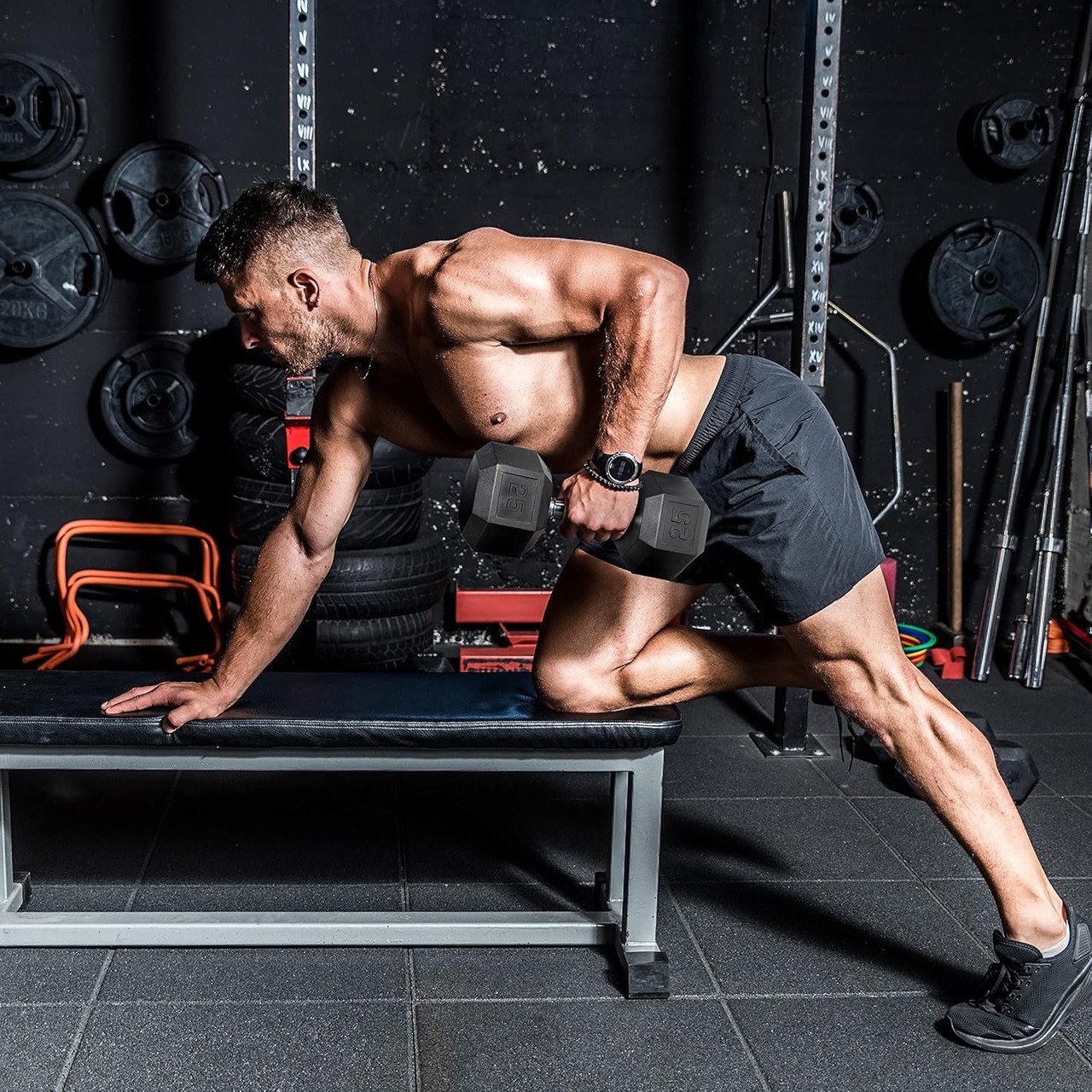
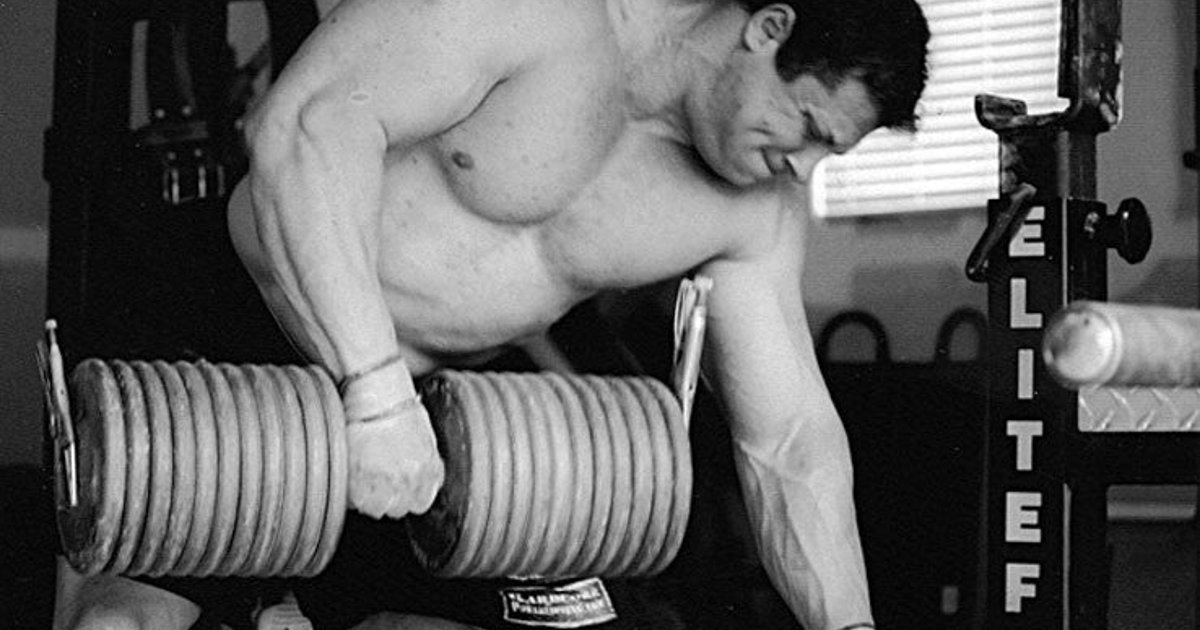
A conventional bench-supported one-arm row is a useful reference when you want to limit movement elsewhere. You can practise the arm path, establish a repeatable range and learn how the support should feel before increasing the demands. The photograph here illustrates that supported variation; a still image cannot establish whether a repetition was explosive or strict throughout.
Choose a lighter load when the purpose is to keep the torso quiet. Trying to make a strict row look like a heavy, assisted row while keeping the same label defeats the comparison. A controlled set at a lower weight may be the better choice when your lower back is already tired from other training.
For a useful side-by-side review, write down the intended role of each variation. Your strict row might provide repeatable back work at a consistent range. Your Kroc-style set might provide a demanding high-repetition challenge with some permitted movement. You do not need to decide which one wins every possible training goal.
Watch for discomfort that changes the way you move. A sharp sensation, a support hand that cannot stay secure or a load you cannot put down safely is a reason to stop and reassess. Adding more momentum is not an appropriate solution to a painful position. Persistent symptoms need individual assessment rather than another technique cue from an article.
If you repeatedly struggle to tell where useful assistance ends and uncontrolled movement begins, simplify the task. Use ordinary supported rows for a while and make their execution consistent. Returning to a demanding variation later is more productive than practising a movement you cannot yet evaluate.
Progress the work without turning every session into a test

Start with progressively heavier preparation sets that let you check the handle, support and path. Your first exposure should not be an attempt to discover the heaviest dumbbell you can move once. The working load must allow a meaningful set of rows, not just the effort required to get the weight into position.
As an illustrative starting structure for an experienced lifter, consider one challenging set per side in a planned range such as 12–20 repetitions after preparation. Keep some margin to stop before control disappears. This is a practical example, not a validated universal prescription or a requirement to reach failure. Adjust the work to your existing pulling volume.
Use the less capable side to guide the initial load and keep the setup comparable on both sides. Rest enough to regain a stable position and a secure grip. There is little benefit in racing the second side when breathlessness, rather than pulling performance, is deciding how the set ends.
Add repetitions while preserving the same standards before making the next available load jump. If you reach the top of your chosen range, increase the weight only when the new implement still allows a useful set. Large dumbbell increments can make repeating the same load sensible for several sessions. More load is one form of progress, not the only one.
Log the load, repetitions, support arrangement, strap use and the reason you stopped. A note such as grip opened on rep 16 is more informative than a number alone. Review performance alongside your other rows, pulldowns and deadlifts so that a new hard set does not quietly become extra work you cannot recover from.
The equipment options below and earlier in the guide serve different roles. Dumbbells, stable benches and lifting grips are directly relevant; plates and thicker grips depend on your implement and goal. Check dimensions, loading limits and compatibility rather than assuming every listed item can be combined. Judge the exercise by repeatable training quality, not by how spectacular the final repetition looks.

Bodybuilding Shirts & Workout Gear
Bodybuilding shirts, tanks and gym gear for lifters chasing muscle, size, symmetry and the pump.

Shirt Pull Day – Back & Biceps Meme Top T-Shirt
Heavy lifts, good laughs, and a little “Pull Day Graphic” energy.

Lifting Is In My DNA Shirt – & Gains T-Shirt
Make gym days more fun with “Lifting Is In My DNA” style.

Slip Not Grip Training – Heavy Metal Workout Vest Muscl Tank Top
Show some personality between sets with “Slip Not Grip Training”.


Dumbbell Meme Shirt – Essential & Gymbros Seeking T-Shirt
Make gym days more fun with “Dumbbell Gym Meme” style.

Shirt – Dumbbell Heartbeat Gymbros, & Meme Lovers T-Shirt
Show some bodybuilding attitude with a playful “Dumbbell Heartbeat” tee.

Lifting Is My Therapy Gymbros, & Meme Shirt & Gains T-Shirt
Rep “Lifting Is My Therapy” humor in and out of the gym.

Effort Is The Only Way: Stoic Meme Marble Sculpture T-Shirt
Rep “Effort Is The Only Way: Funny Stoic” humor in and out of the gym.

Lift Heavy – Hardcore Heavy Metal Powerlifting for Seri Hoodie
Show off your metalhead humor in a laid-back “Lift Heavy” hoodie.

Strong Inside And Out Shirt Weights And Brains Meme T-Shirt
Rep “Strong Inside And Out” humor in and out of the gym.