Advertising disclosure: This page includes affiliate links that may earn us a commission at no additional cost to you.
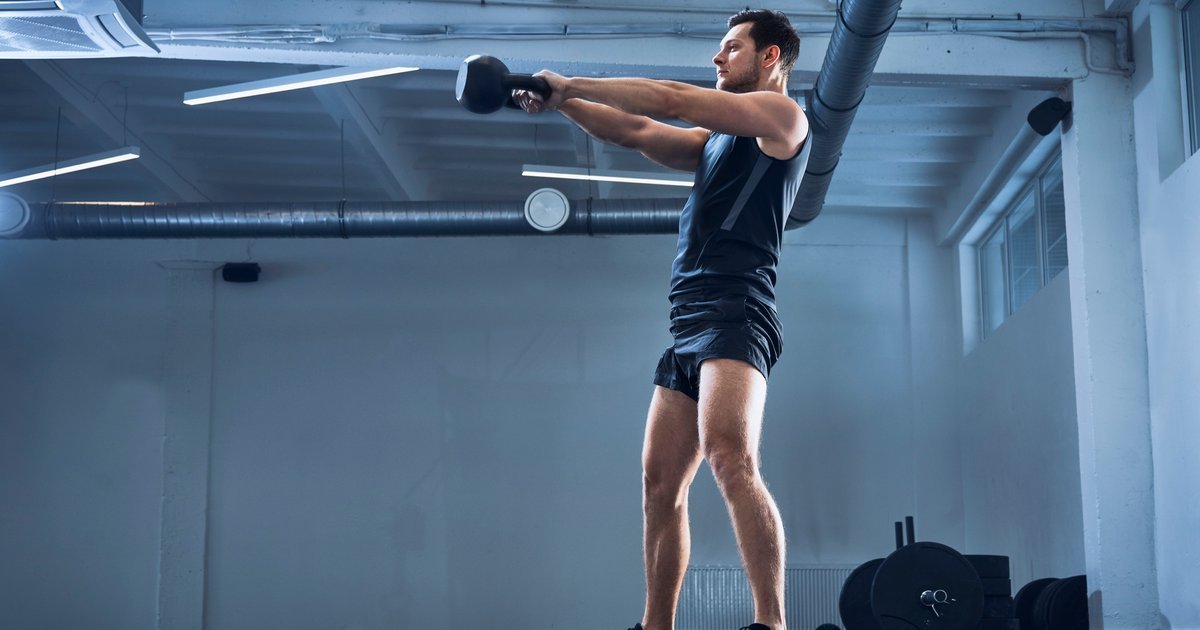
A kettlebell swing can be a conditioning exercise, a power exercise or a short preparation drill. The difference is not just the weight of the bell. It is what you are trying to accomplish and how much fatigue you are willing to carry into the next exercise. If the next task is a maximal jump, a short sprint or a fast change of direction, a warm-up should leave you ready to move quickly, not simply feeling as though you have worked hard.
An October 2026 experiment offers an interesting clue: a load associated with less than an individual’s highest measured swing power produced promising immediate changes in several lower-body performance tests. The finding is worth exploring, but it is not a prescription to use a particular percentage of your heaviest kettlebell. Here is how to interpret it and build a useful trial of your own.
What the October 2026 experiment actually tested
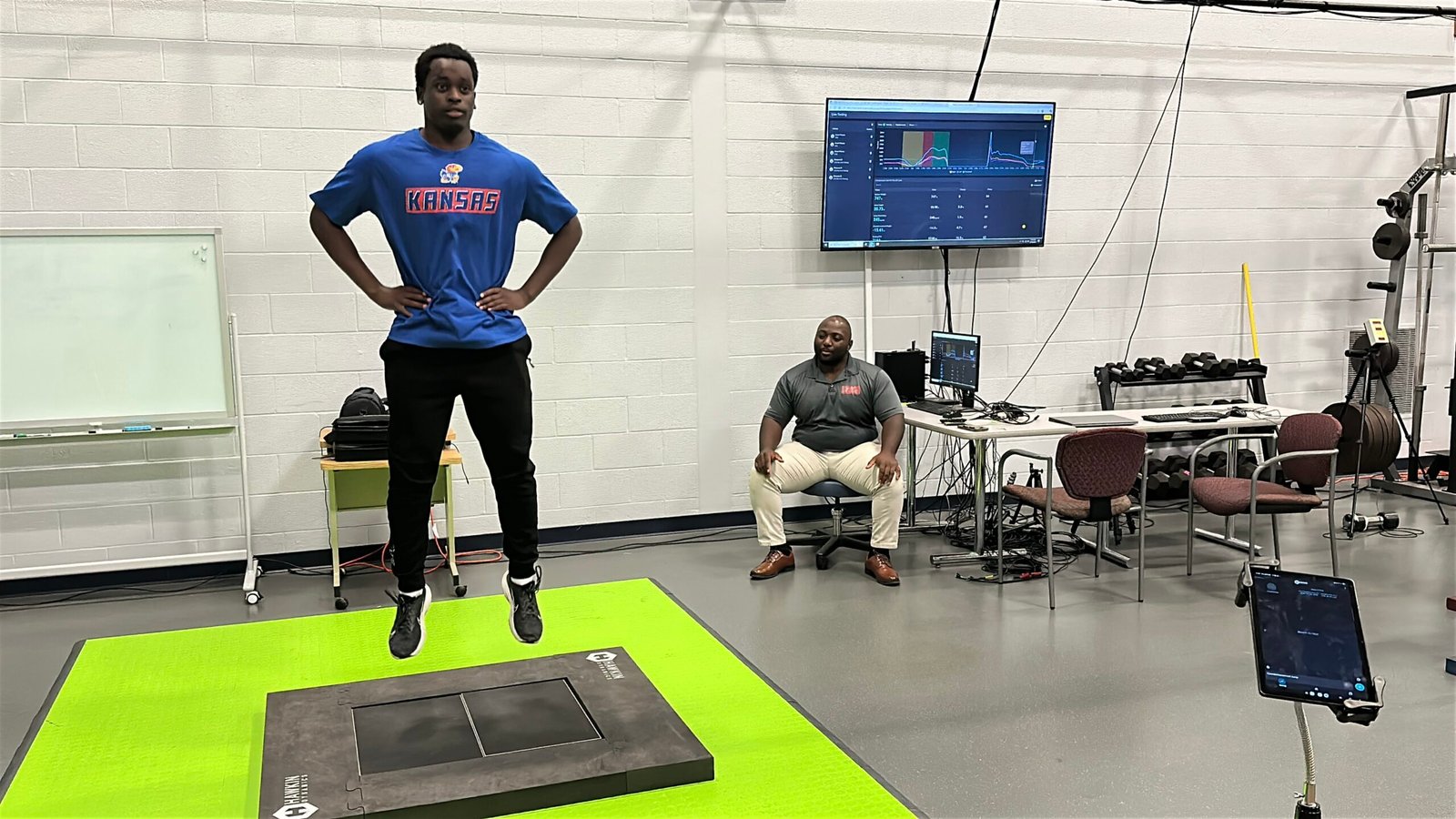
Eighteen male university physical education students participated in a randomized repeated-measures experiment. They completed six testing visits, separated by at least 72 hours. At each visit, they warmed up, performed a baseline performance test, completed swings at the assigned load, rested for four minutes and repeated the test. The tests were a countermovement jump, a 20-metre sprint and a 505 change-of-direction test.
The experiment used individual load-power profiles to choose two different kettlebell loads. One corresponded to the highest mean power measured during the swing. The other corresponded to 60% of that highest measured mean power. In the latter condition, the students improved their jump performance, sprint performance across the measured distances and change-of-direction performance relative to their own pre-tests. The highest-mean-power condition did not show significant performance improvements.
Several details prevent a stronger conclusion. The publicly available abstract describes paired pre-to-post tests, not a direct statistical demonstration that the two loads differed from each other. It does not establish how much of the change would have occurred after resting or repeating the tests without swings. The complete session prescription and individual response data are also not available from the abstract. We should not invent the repetitions, the set count or the average improvement.
What we can take from this is a hypothesis with practical value: the most productive movement preparation may not be the most demanding version of a power exercise. Test that idea before treating it as a rule.
Why maximum power is not necessarily the best warm-up load
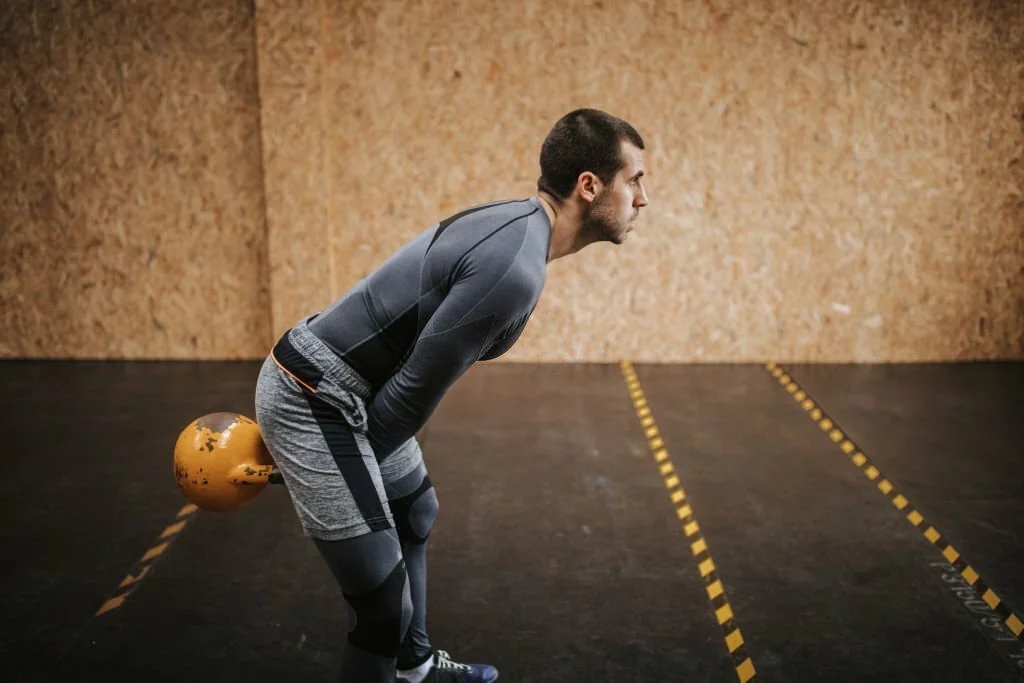
Imagine two athletes doing the same swing. One uses a bell they can accelerate sharply with a relaxed grip and stable trunk. The other needs substantial effort to overcome the inertia of the bell, then struggles to keep the same rhythm. Both can be useful training choices. Only the first is likely to leave that athlete with considerable capacity for a fast task a few minutes later.
Power depends on force and velocity. Increasing external resistance does not necessarily increase power indefinitely, because movement velocity usually changes with load. The same bell can represent very different demands for two people, even if they have similar deadlift numbers. Limb proportions, experience with swings, strength, technique and the intended range of motion all influence the result.
A separate biomechanical experiment examining swing loads equivalent to 10%, 15% and 20% of body mass found that increasing the load raised demands at the hip, trunk and ankle. Those measurements help explain why selecting a bell for movement preparation should be a different decision from selecting a bell for overload. They do not provide a universal warm-up weight.
Crucially, 60% of the highest measured mean power is not 60% of one-repetition maximum, 60% of body weight or 60% of the kettlebell that produces maximal power. Without measuring power across several loads, you cannot reproduce the experimental load-selection method. A gym-floor approximation should instead focus on crisp movement, low perceived effort and minimal loss of speed. That approximation is an experiment, not an equivalent protocol.
If you have a choice of bells, start with one you already handle comfortably. A lighter bell is not automatically easier to control; avoid accelerating it so violently that you lose your hinge or have to catch it awkwardly.

Equipment Worth Exploring
Explore equipment, accessories and gear from our carefully selected range.


Cast Iron Kettlebells
Textured cast-iron kettlebells for swings, squats, carries, and full-body training.

Slam Ball
Low-bounce weighted slam ball for explosive throws and high-intensity conditioning.

Competition Wall Ball
Competition-style weighted wall ball for HYROX, wall-ball shots, and functional conditioning.


Pro Sled System
Heavy-duty push-pull training sled for loaded conditioning, speed, and strength work.


Rubber Hex Dumbbells
Rubber-coated hex dumbbell pairs with a stable shape for home and commercial strength training.

Some equipment and apparel links may be affiliate links. Purchases through them may support Mind Muscle Perfection.
Jumping higher does not guarantee sprinting faster
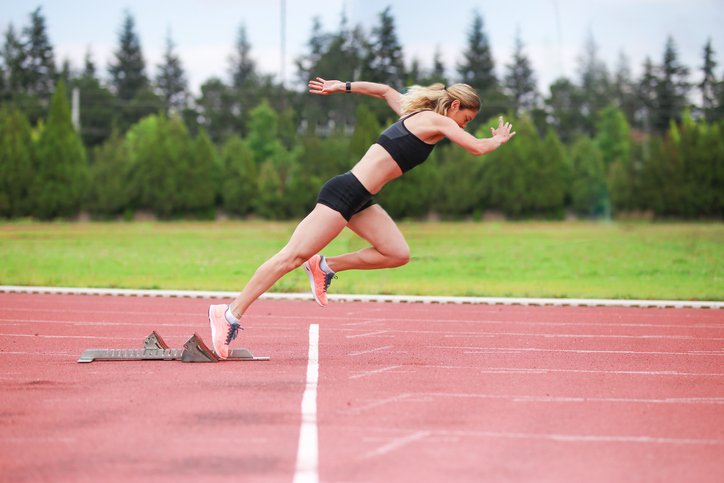
There is a difference between a temporary performance change and a training adaptation. A useful warm-up might improve an athlete’s next jump without producing meaningful increases in strength or power over subsequent months. Conversely, a demanding swing session could contribute to long-term development while making the next sprint slower. The question is whether the timing matches the objective.
Earlier research on the immediate effect of swings in 20 moderately trained adults did not identify a sprint advantage over the control condition. That is a good reason to avoid treating the newer result as a guarantee. The movements used, training histories, rest periods and performance tests can all affect what happens next.
A June 2026 synthesis of warm-up studies in trained or competitive athletes found an average countermovement-jump benefit of about 2.4 centimetres when a conditioning activity was added to a general warm-up. It did not establish a clear pooled sprint benefit. Results for change of direction were encouraging but based on only three studies. Those findings concern several types of conditioning activity, not kettlebell swings alone.
The task itself matters. A vertical jump involves producing force against the floor over a short period. Sprinting requires repeated contacts and effective force application while moving horizontally. A 505 test also requires braking, turning and accelerating again. A preparatory hip hinge may help some shared abilities, but practicing an appropriate sprint or change-of-direction progression remains important.
Longer-term swing training has separate evidence. A small six-week comparison of swings with jump-squat training found gains in maximal and explosive strength, without establishing a statistically significant advantage between the groups. That supports swings as one possible training tool, not a replacement for sprint practice, jumping technique or progressive strength work.
Turn the evidence into a practical warm-up
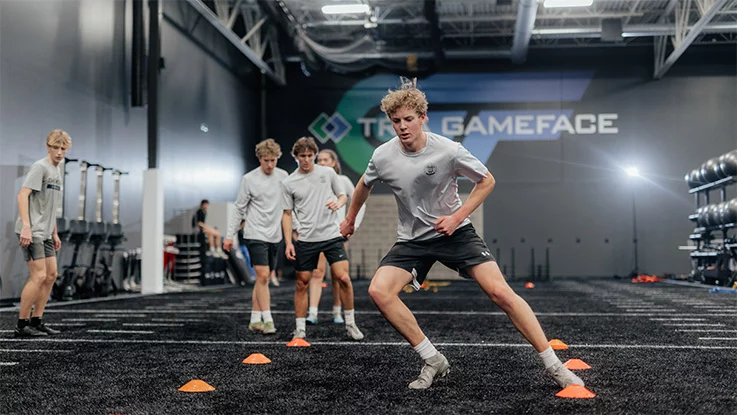
If you are already comfortable with kettlebell swings and have no pain during the movement, try adding them after your general warm-up but before the high-priority explosive task. The following is a conservative practical starting point, not the protocol used in the 2026 experiment.
- Raise your temperature. Spend about five minutes walking briskly, cycling or using another comfortable activity. Move your ankles, hips and knees through comfortable ranges.
- Rehearse the hinge. Perform a handful of unloaded hip hinges and a few easy deadlifts with the bell. Make sure you can keep control without forcing the lower back into extension.
- Perform a short swing set. Start with five or six controlled two-handed swings. Use your hips to accelerate the bell; the arms guide it. End the set if speed, balance or trunk control deteriorates.
- Recover. Begin with four minutes after the final swing. Walk gently or stand rather than adding conditioning work during the break.
- Prepare specifically. Use an easy rehearsal of the target task if appropriate, then perform your planned jump or acceleration test on a safe surface. Do not sprint maximally from cold muscles.
Choose a safe clear space and appropriate footwear. Do not attempt a maximal sprint or a violent change of direction simply because the swing felt easy. If you are new to either activity, learn and build tolerance progressively first. For a strength session, retain the normal progressively heavier warm-up sets before your main lift.
Signs that you have overshot the dose include breathlessness that persists into the next exercise, heavy legs, deteriorating landings, an unusually tired grip or loss of the normal rhythm of your first working set. The answer is not always more rest. Sometimes it is a lighter bell, fewer repetitions or removing the extra exercise altogether.

Functional Fitness Shirts & Workout Gear
Functional-fitness shirts, tanks and workout gear for athletes who train strength, conditioning and everything in between.

Shirt – Pink Macaroon Kettlebell Bros, & Meme Lovers T-Shirt
Heavy lifts, good laughs, and a little “Pink Macaroon Kettlebell” energy.

Super Kettlebell Crewneck Pullover Sweater Kettlebell T T-Shirt
Add a playful “Super Kettlebell” touch to your casual rotation.

Cheeseburger Kettlebell – Burger Swings Meme Decal for Sticker
Stick a little “Cheeseburger Kettlebell” humor on your favorite gear.


Heart Shaped Kettlebell Valentine’s Day Gym for Kettleb Hoodie
Show off your lifting humor in a laid-back “Heart Shaped Kettlebell Valentine’s Day” hoodie.


Grunge Kettlebell Shirt Rock Music & Gymbros Top T-Shirt
Rep “Grunge Kettlebell” humor in and out of the gym.

Shirt – Watermelon Kettlebell , Gymbros & Meme Lovers T-Shirt
Rep “Watermelon Kettlebell” humor in and out of the gym.

Shirt – Day Of The Dead Kettlebell – Dia De Los T-Shirt
Bring “Day of the Dead Kettlebell” humor to your next gym day.

A four-week experiment for your own training
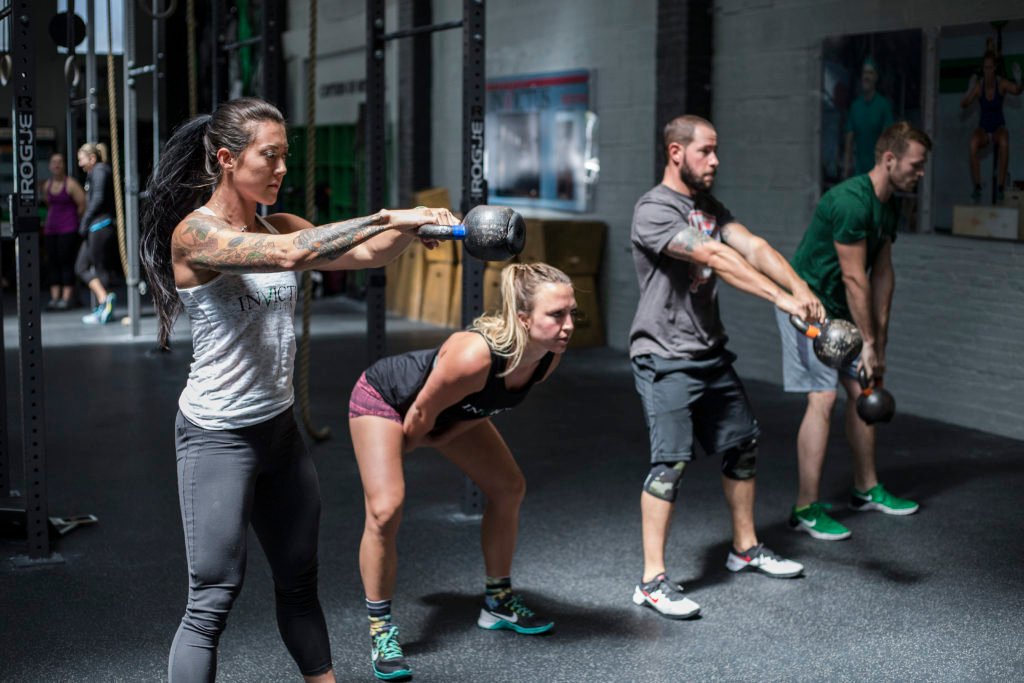
A useful personal trial starts by making the comparison fair. Select one familiar task such as a countermovement jump. Test it on two comparable training days per week, allowing enough recovery between sessions. Use the same warm-up, shoes, surface, time of day when practical and measurement method. Avoid comparing a fresh Monday with a Friday after an unusually hard leg session.
During week one, establish your normal performance without adding swings. Take two or three well-controlled attempts after the general warm-up, with the same rest between attempts each day. Record your results and how ready you felt. A jump mat can be useful if you have access to one; otherwise, a consistent phone-video method may help track broad changes, although measurement noise is greater.
During weeks two and three, alternate a normal warm-up and a warm-up with one short swing set plus four minutes of rest. On normal days, keep the overall timing comparable by resting instead of performing the swings. Write down the bell weight, repetitions, rest and the result. Avoid changing several variables together. If the swing condition consistently leaves you slower or less coordinated, stop using it for that purpose.
In week four, repeat the better condition on one or two additional comparable days. Look for a pattern larger than the day-to-day variation you observed in week one. A single personal best is not enough: motivation, sleep, measurement error and ordinary training variation can explain a surprising result. There is no need to chase a tiny improvement that makes your preparation longer or less predictable.
If neither approach reliably improves the outcome, keep the simpler warm-up. Save heavier or higher-volume swings for a separate power or conditioning block. If a low-dose version repeatedly helps you move faster without adding fatigue, it may earn a place in your routine. The goal is to perform the exercise that matters better, not to accumulate impressive warm-up exercises.