Advertising disclosure: This page includes affiliate product links that may earn us a commission, as well as products from our own store.
A barbell squat is hard enough when both feet are planted. Jason Auld took 60.5kg onto a unicycle and completed a record-breaking squat while controlling the bar and a rolling wheel. The British athlete’s unusual August 2026 achievement deserves a closer look, not because it is a workout everyone should copy, but because it exposes an often-overlooked difference between strength and specialized skill.
Auld’s result was recognized in a defined record category, after years of professional unicycling and previous one-wheel lifting feats. What can a regular lifter actually learn from it? Quite a lot about training specificity, balance, progression and why spectacle is not a substitute for intelligent programming.
The record was a 60.5kg squat – not a conventional gym lift
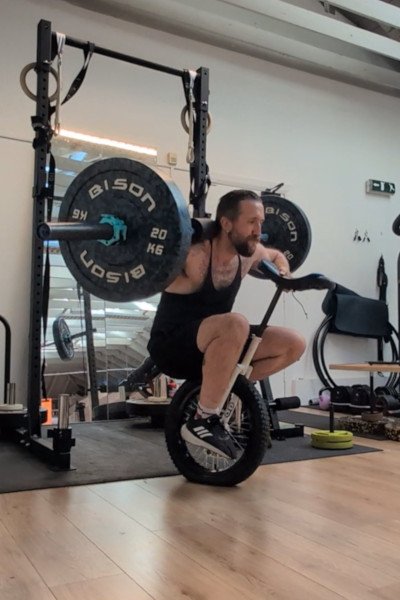
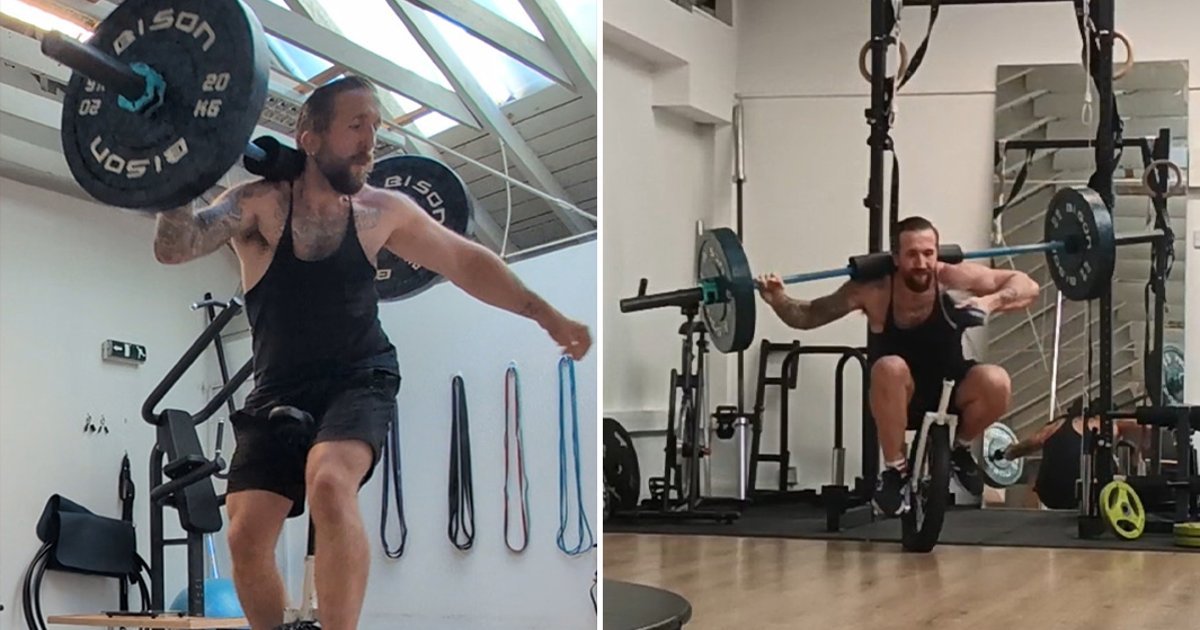
On 29 August 2026, British performer Jason Auld completed a 60.5kg barbell squat while riding a unicycle. The achievement was recognized in a highly specific male record category. It was not the heaviest squat in ordinary powerlifting, nor a claim that unicycle training is a superior way to build leg strength. The feat combined a loaded bar, a moving contact point and one athlete’s unusually practiced control.
The attempt began with Auld positioning the barbell across his upper back and rising from the unicycle seat. He could not keep both hands on the bar throughout the movement. As he adjusted his body position, one hand was needed to manage the unicycle seat and his balance. He then lowered and rose while the wheel moved beneath him, stabilized the bar and returned it to the rack. The movement looked improvised, but its success rested on years of skill learning.
The date matters: the squat happened in August and was described in a public account dated 1 October 2026. Treating that October story as a record newly set in late November would misstate the timeline. Likewise, the impressive figure is 60.5kg in this particular balancing event, not a general comparison with a trained squatter’s one-repetition maximum.
A standard squat distributes control between two planted feet, the bar and the hands holding it. Auld added a single tire-sized rolling base beneath the athlete, and the seat position changed in the middle of the lift. Those constraints make the movement a fascinating coordination test, but they also make it a poor exercise to copy casually.
The hardest part may have been changing the position, not lifting 60kg
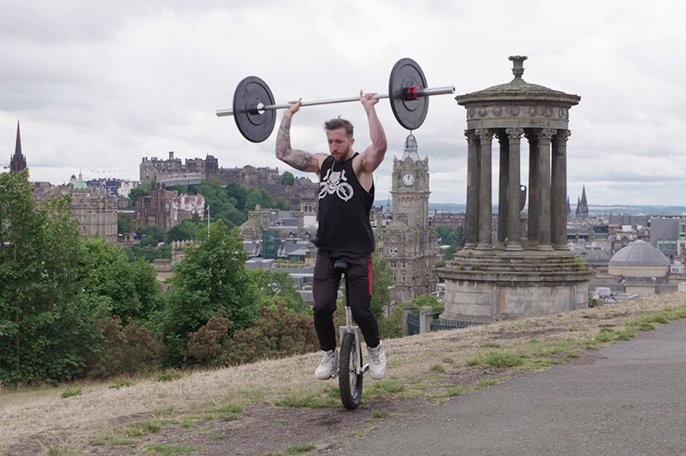
Watch the geometry rather than focusing only on the weight plates. A barbell squat normally asks a lifter to maintain the combined center of mass over a fairly predictable base. With a unicycle there is almost no margin for a misplaced adjustment: a small shift in the wheel, torso or load can trigger an immediate correction. Auld’s seat also occupied the space his body needed during descent.
His solution borrowed from trials unicycling. Moving the seat away from his torso created room to squat, but it demanded different bar control at the very moment he most needed stability. One arm could assist with the wheel or seat while the shoulders and remaining arm kept the barbell organized. That is an extraordinary, specialized movement pattern, not a lifting cue that should be generalized to normal heavy squats.
The effort also resists a neat percentage comparison. The barbell load was 60.5kg, but the challenge included a sequence of mount, balance, bar control, descent, ascent and reracking. Someone who can squat twice that weight on the ground is not automatically able to do a lighter version on one wheel. Someone who rides a unicycle comfortably is not automatically prepared for a loaded bar either.
The useful idea for gym training is that changing a task changes what ability is being tested. Stable maximal strength, moving balance, anticipation and the skill of correcting errors overlap, but no single trick measures them all. Instead of asking whether the feat proves a new squat method, ask which component the performer spent years developing.
Twenty years on one wheel explain more than a viral highlight
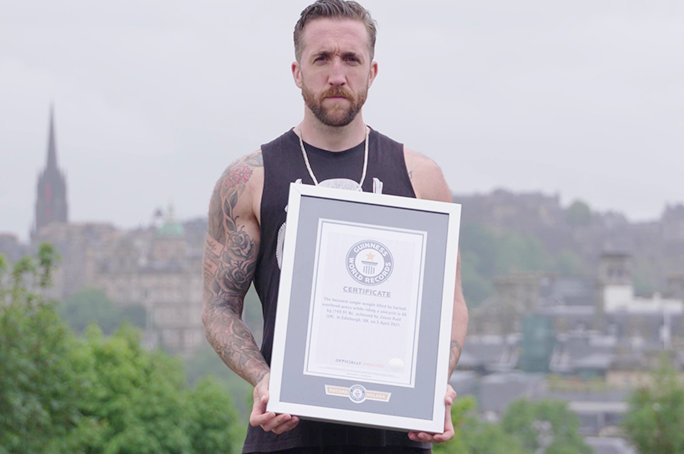
Auld began unicycling as a teenager and built a professional performance career long before the 2026 barbell squat. His background spans roughly two decades of performing on one wheel, and he has combined riding with strength feats since the mid-2010s. He also pursued personal-training qualification in 2023 to understand physical adaptation more systematically. That history makes the record look less mysterious.
His earlier verified milestones show the same experimental streak. In April 2021 he lifted a 68kg barbell overhead while unicycling; that category has since moved forward, with Dan Galanto taking the overhead mark to 93.71kg. Auld has also been associated with a 1.15m box jump from a unicycle. These are separate event categories with different requirements, not interchangeable evidence of a superior total-body workout.
The sequence reveals a practical lesson about athletic longevity: develop one unusual skill deeply, retain standard physical preparation and explore combinations only after the pieces are reliable. A professional performer can spend months breaking down a movement that a recreational lifter will never need to attempt. A ten-second clip conceals an enormous amount of practice that rarely becomes part of the headline.
That is also why a record does not establish anyone’s general health, lifting superiority or everyday program. It establishes that a named performer met the conditions for a defined feat on a stated date. The achievement is impressive on its own terms; it needs no inflated claim about calorie burn, functional strength or an alleged new training secret.

Equipment Worth Exploring
Explore equipment, accessories and gear from our carefully selected range.


Safety Squat Handles
Barbell squat handles that reduce shoulder positioning demands during high-bar squats.

GymPin Squat Wedges
Non-slip 15-degree squat wedges help elevate the heels for deeper quad-focused squats.

Speed Collar
Quick-release collars designed to secure weight plates on standard two-inch Olympic bars.

Competition Plates
Competition-style bumper plates for Olympic lifts and loaded strength training.

Foldable Wall Rack
Wall-mounted folding squat rack designed to save floor space between workouts.

Belt Squat Collar
Heavy-duty collar adapter for compatible belt-squat and landmine bar setups.
Does instability make strength training better? The evidence is narrower
Unstable lifting feels harder because the athlete must devote attention and muscle activity to keeping the equipment or body in position. But a harder-feeling rep is not automatically a more effective stimulus for maximal strength. The relative load, movement speed, range of motion and ability to repeat a productive set all change when balance becomes the main task.
Controlled comparisons of stable and unstable resistance exercise generally find tradeoffs rather than universal advantages. An investigation of 33 recreationally trained men reported that adaptations to lifting power were specific to the tested conditions; work on unstable equipment did not simply transfer into greater power on stable squats and presses. A systematic review likewise found little reason to assume adding unstable surfaces produces superior strength and balance development in healthy young lifters.
Other experiments show why the question needs nuance. Placing a moving load on a bar can increase measured activation in some stabilizing muscles while slightly reducing certain force measures. That tells us a stability challenge changes muscle coordination; it does not prove that everyone should replace ordinary barbell squats with wobbling implements. Auld’s unicycle feat sits far outside the equipment and populations used in these controlled studies, so direct experimental claims about his movement would be unwarranted.
For gaining squat strength, the boring tools still matter: a stable floor, sensible loading, consistent depth, suitable rack safeties and progressive practice. Balance work can be useful as a separate skill or sport-specific demand, especially when trained at appropriate intensity. It is not a mandatory instability tax on every heavy set.

Powerlifting Shirts & Lifting Gear
Powerlifting shirts and gym gear for squat, bench and deadlift lifters who live for heavy numbers.


Squat You Must – Leg Day Meme , Top Gains T-Shirt
Heavy lifts, good laughs, and a little “Squat You Must” energy.

Lift Heavy Be Happy Meme Bros & Gains Top T-Shirt
Show some powerlifting attitude with a playful “Lift Heavy Be Happy” tee.

Shirt & Barbell Heartbeat , Gymbros & Meme Lovers T-Shirt
Heavy lifts, good laughs, and a little “Funny Gym Shirt & Pump” energy.

Squats R Us Shirt – Leg Day Gains & T-Shirt
Heavy lifts, good laughs, and a little “Squats R Us” energy.


Raise The Barbell Shirt – Motivational & T-Shirt
Show some powerlifting attitude with a playful “Raise The Barbell” tee.

Pizza Weight Plate On Cheat Day & Bulking Season Tank Top
Bring “Pizza Weight Plate” humor to your next lifting session.

Heavy Squatter Harry Potter Squat Meme Sweater Leg T-Shirt
Show some gym-day personality with “Heavy Squatter”.

I'M Still Gonna Squat You Monster Gingerbread Meme – Sticker
Give your everyday gear a playful “I'm Still Gonna Squat You Monster” twist.
A practical four-week plan inspired by the lesson, not the stunt
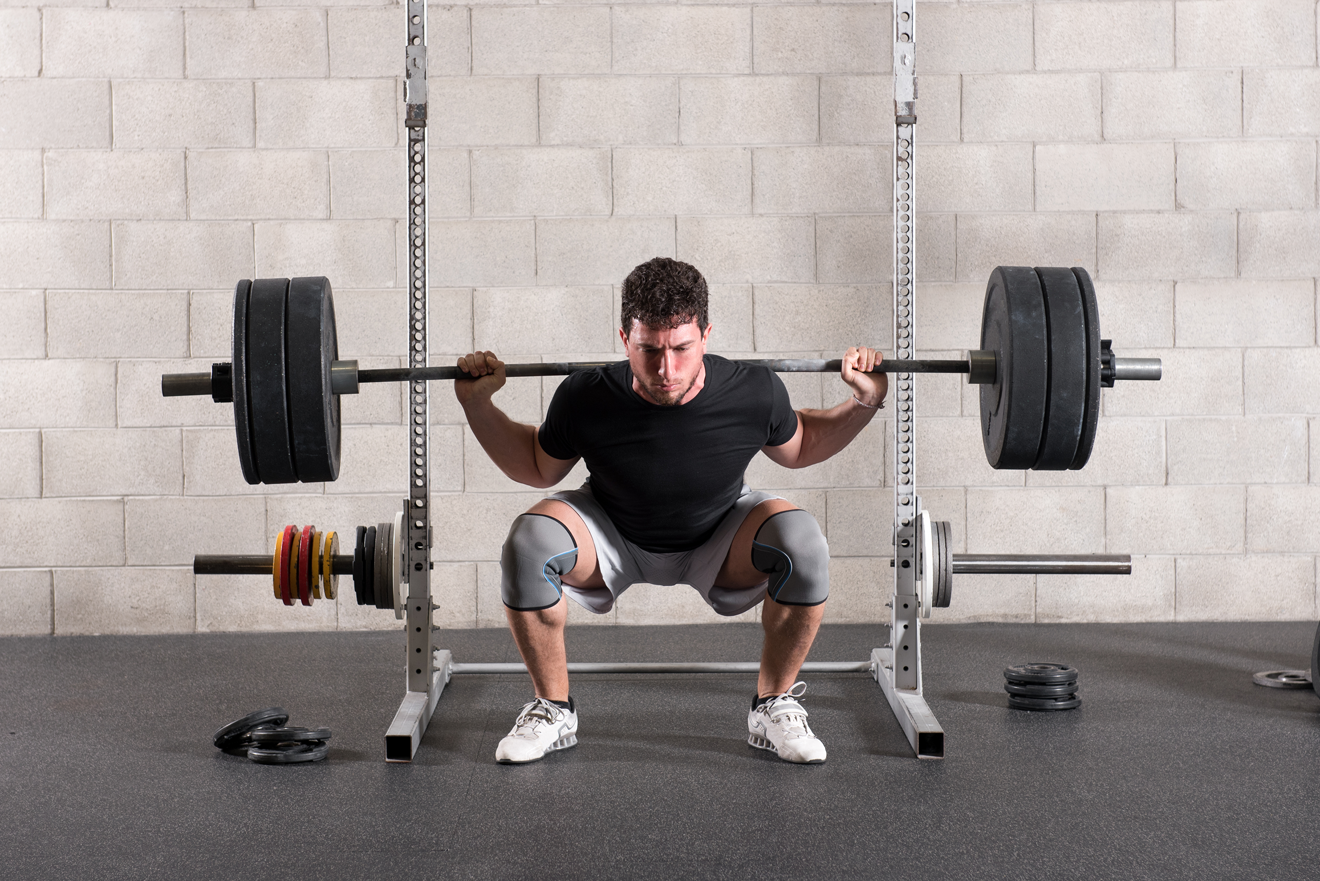
You can train the two qualities without trying the dangerous combination. For weeks one and two, squat twice a week on a stable surface. Begin with three sets of five to eight controlled repetitions at an effort that leaves roughly two or three technically clean reps in reserve. On a separate easy day, practice a balance task that matches your ability: single-leg stands beside support, slow step-downs or ordinary unicycle riding only if you already have instruction and suitable protective equipment.
During weeks three and four, keep the same squat pattern and increase the load slightly only when bar path, depth and bracing remain consistent. Make the balance drill a little more challenging by improving control or increasing duration rather than adding a loaded bar. If one-leg stands are too easy, controlled reaches and slow movement may be appropriate; if they are difficult, hold on to a stable support and reduce the demand.
An example week could be Monday: squat, hip hinge and trunk bracing; Wednesday: short separate balance-skill practice; Friday: another squat session with a lighter variation and loaded carries. Allow at least a day between demanding squat sessions when recovery calls for it. The goal is not to reproduce Auld’s world record. It is to learn something from the patience behind it.
Use a correctly adjusted power rack or a trained spotter for challenging barbell work. Keep safeties at an appropriate height, never improvise a rolling base beneath heavy weights, and do not test one-handed loaded back squats. People with pain, dizziness or balance-related limitations should modify the movement with a qualified professional. Training can be adventurous without turning an ordinary workout into a circus hazard.
Equipment Worth Exploring
Explore equipment, accessories and gear from our carefully selected range.


Multi Pull Smith Rack MPHR-780
All-in-one rack with a Smith machine, functional trainer, lat pulldown and low row.


Open Hex Bar
Open-frame trap bar with multiple handles for deadlifts, carries, and lower-body training.


VForce Wall Trainer
Space-saving wall-mounted functional trainer with pivoting cable arms and variable resistance ratios.

Cast Iron Kettlebells
Textured cast-iron kettlebells for swings, squats, carries, and full-body training.

Leather Lifting Straps
Padded leather straps support grip during heavy rows, deadlifts and pulling exercises.

Studio V-Squat
Plate-loaded V-squat machine for supported lower-body strength training.
The real takeaway: specialize boldly, measure progress honestly

Auld’s 60.5kg squat is entertaining because it makes a familiar lift look unfamiliar. It also demonstrates the value of asking a precise question and working on its constraints. What seems like a raw-strength contest becomes a multi-year solution to a motor-control puzzle once you examine the seat position, wheel movement and bar handling.
That distinction matters when evaluating viral fitness feats. Ask for the actual event name, date, completed standard and conditions. Then separate the performer from the program: a spectacular achievement can be legitimate without being transferable training advice. Different records have different rules, and a personal video does not automatically establish a recognized competitive title.
For your own training, choose measurable skills and progress them intelligently. A stronger squat is measured by repeatable load and technique on a stable platform. Better balance might be measured by consistent controlled movements within your sport. Combining difficult skills is something to earn, not something to rush because a short clip made it look easy.
Jason Auld’s August 2026 feat deserves attention for exactly what it was: a world-record unicycle squat performed by a specialist with deep experience on one wheel. The bigger lesson is not that wobblier workouts build more muscle. It is that impressive results often emerge from sustained, disciplined practice in the exact skill that matters.