Advertising disclosure: This page includes affiliate product links that may earn us a commission, as well as products from our own store.
A Helms row gives you a way to train a demanding dumbbell pull without turning the set into a test of how long your lower back can hold a hinge. The important detail is not the exercise name on a workout card. It is where the bench touches your upper chest, how the dumbbells travel and whether your torso stays in the same position from the first rep to the last. Here is how to build a useful back movement around those details.
Know which chest-supported row you are actually doing
The term Helms row commonly refers to an incline-bench-supported dumbbell row associated with strength coach Eric Helms. In one popular version, the lifter stands behind an incline bench with the top of the pad under the upper chest, leans forward and rows two dumbbells beside the body. Some exercise libraries use the same label for the more familiar fully prone incline row, with most of the chest resting on the pad. Both can be good rows, but they are not identical setups.
With the standing version, your feet stay on the floor and your hips are behind the bench. The pad provides a contact point that limits large torso swings, rather than replacing all the work of standing in a hinge. The fully prone variation supports more of your torso and may be easier to hold consistently if you can position your feet and legs comfortably. Choose one and describe it accurately in your log. Changing from a near-horizontal supported position to a much more upright one changes your arm path and how the exercise feels.
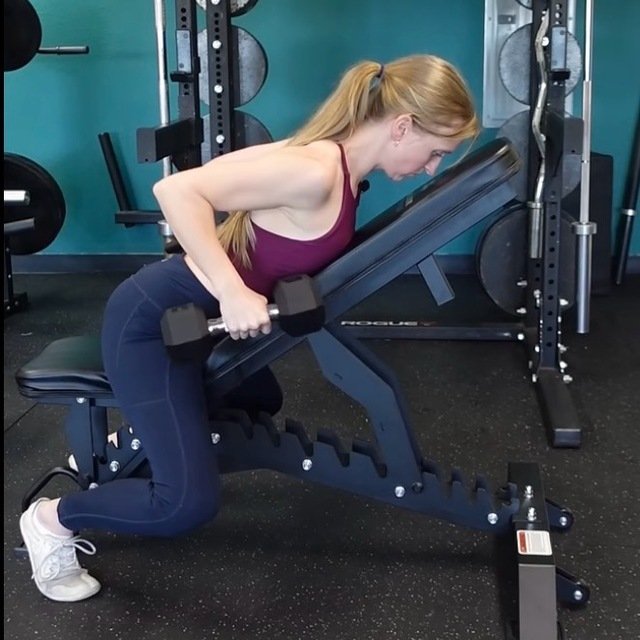
The photo here shows a conventional chest-down incline dumbbell row. Notice the stable bench contact and the arms hanging outside the pad. It illustrates the shared chest-support principle; it is not proof that every incline row is the standing, upper-chest-only Helms variation. If your bench is too low, too steep or unstable, there is no advantage in forcing the named version. A well-executed supported row is preferable to an awkward imitation.
Set the bench, feet and weights before your first rep
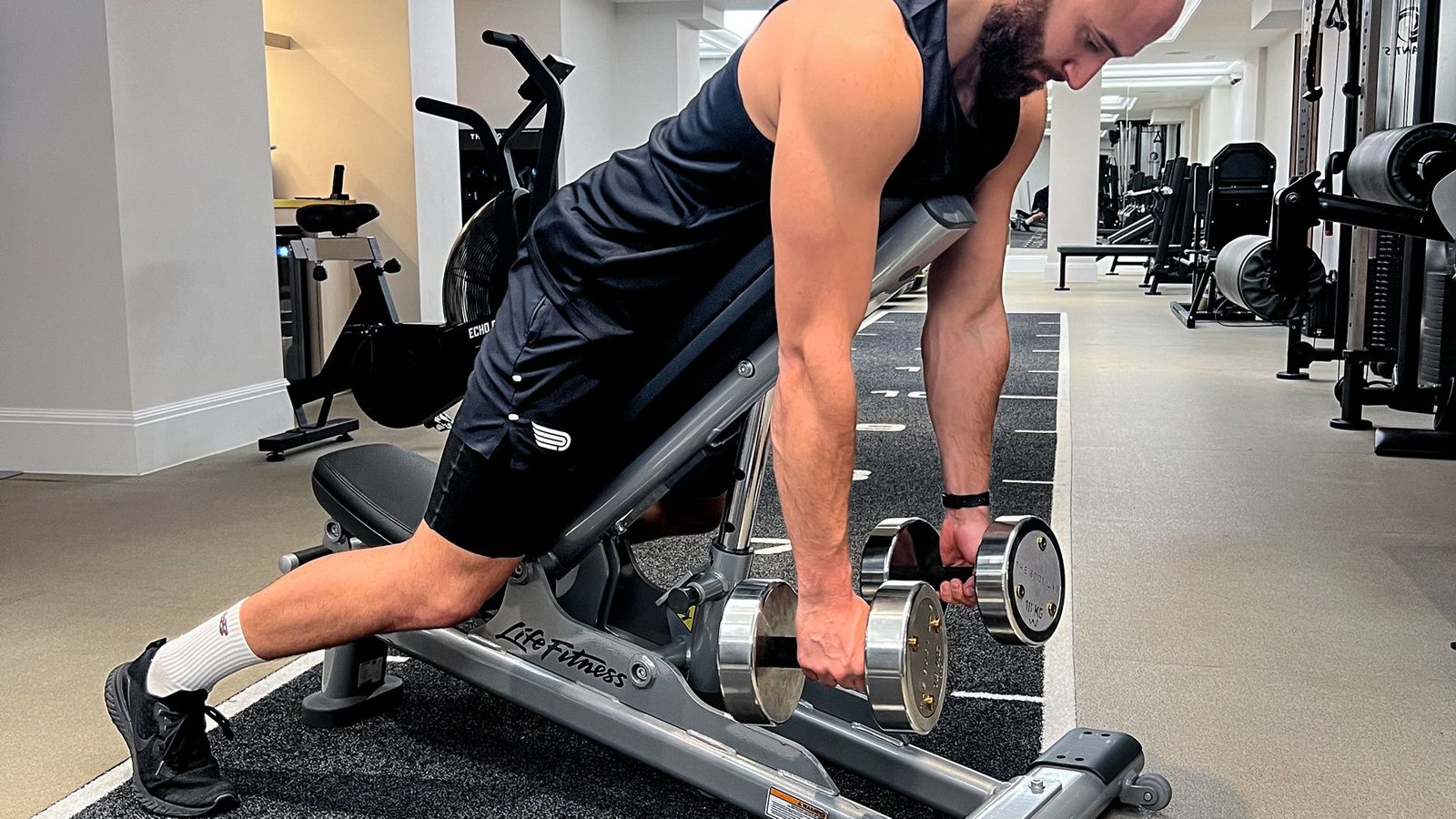
Begin with an adjustable bench on level flooring. For the standing upper-chest version, a modest backrest incline around 30 degrees is a reasonable starting experiment, not a universal prescription. Stand behind it, hinge forward and let the upper portion of your chest meet the top of the pad. Move your feet until your stance is secure and your arms can hang clear of the bench frame. Your torso should be close enough to horizontal to make this a row rather than an upright shrug.
Check that the backrest adjustment is firmly locked. Set two dumbbells where you can retrieve them without a twisting, one-sided scramble. If the start position forces your shoulders into the bench or your dumbbells hit the floor before your arms reach a useful bottom position, change the height, bench location or equipment. Do not stack improvised supports under a loaded bench. Some lifters prefer a slightly steeper bench with the chest further down the pad; that is a legitimate variation, but repeat the same configuration when measuring progress.
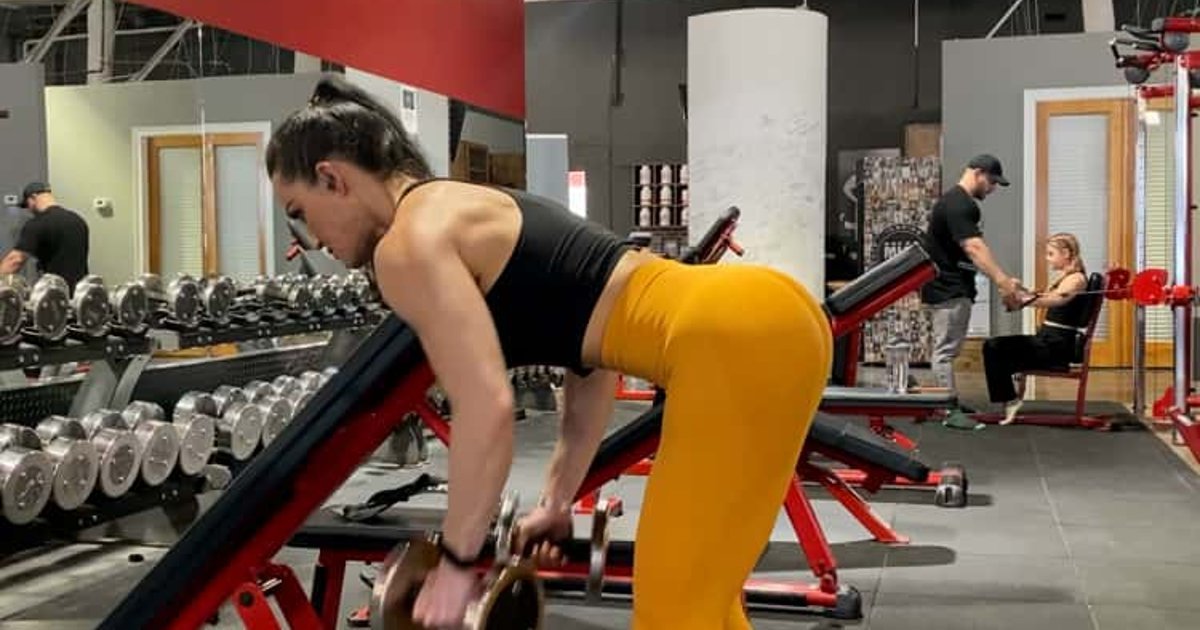
Start lighter than your strongest unsupported dumbbell row. Your actual working load depends on support, arm path and rep tempo, so converting a bent-over barbell-row maximum into a supposedly correct Helms-row weight is unnecessary. From the first rep, keep the feet planted, knees softly bent and abdomen braced without holding your breath beyond what is comfortable. The photograph shows an incline-supported row with dumbbells moving beside the bench, useful for checking basic clearance and stance.
Before your work sets, perform an easy rehearsal set with complete lowered and raised positions. If bench pressure, wrist position or shoulder discomfort already dominates the movement, adjust now rather than waiting until fatigue makes the problem harder to identify.

Equipment Worth Exploring
Explore equipment, accessories and gear from our carefully selected range.


FID Bench MAX
Adjustable bench offering flat, incline, and decline positions + adjustable headrest.

Multi Bench MBX-650 2.0
Adjustable multi-bench with roller adjustment, 15 backrest positions and accessory mounts.


Rubber Hex Dumbbells
Rubber-coated hex dumbbell pairs with a stable shape for home and commercial strength training.


Leather Lifting Straps
Padded leather straps support grip during heavy rows, deadlifts and pulling exercises.

Leather Wrist Grips
Padded leather lifting grips help support the hands and wrists on heavy pulling exercises.
Let the elbow path decide where the row goes
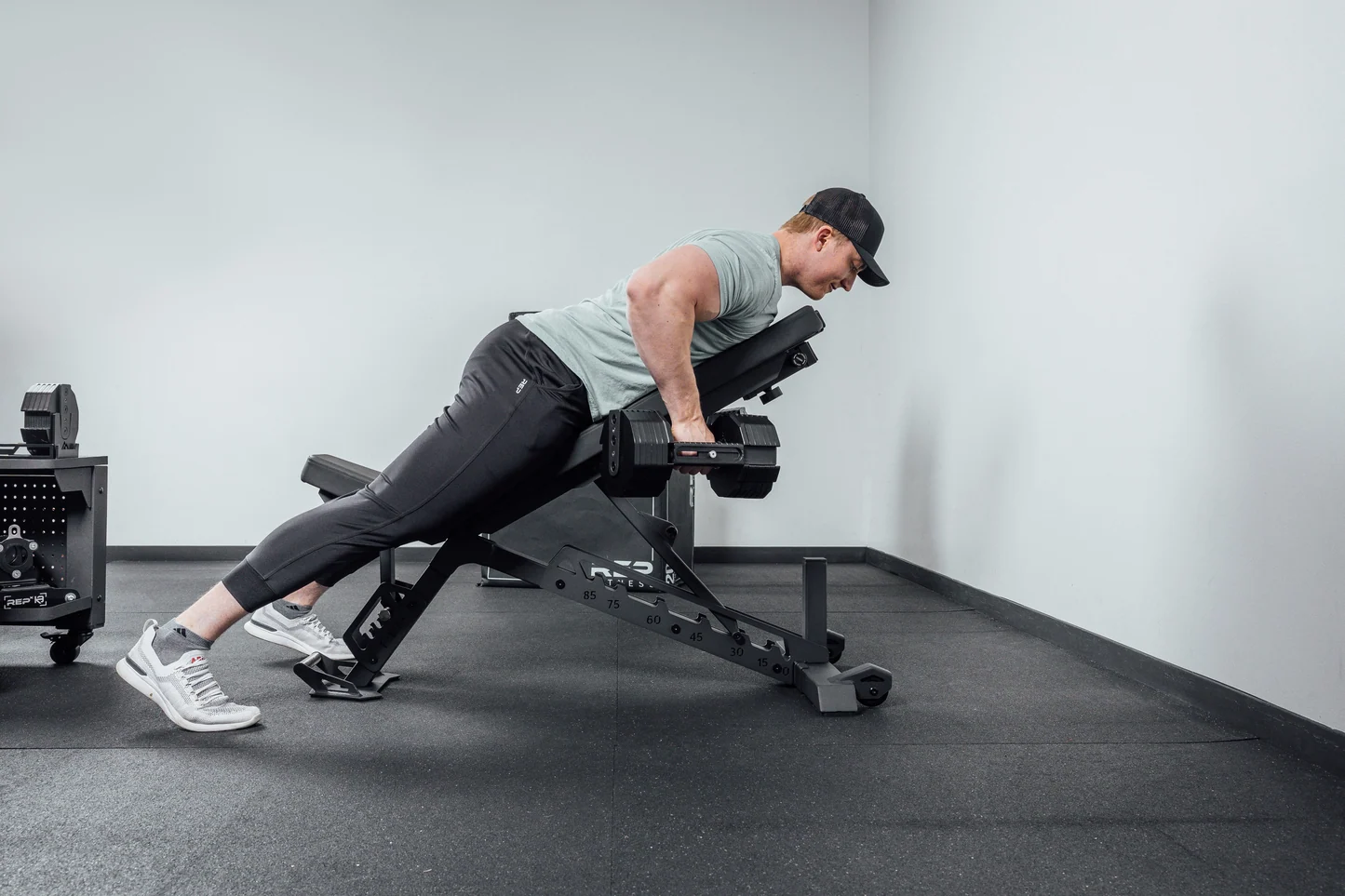
Think about pulling your upper arms, not simply curling the dumbbells toward your shoulders. Begin with arms reaching down and shoulder blades allowed to move naturally. Bring the elbows back toward the sides of your rib cage with a reasonably neutral wrist. For a lat-focused version, keep the elbows relatively close and pull toward the lower ribs or upper waist. Avoid making the elbows travel so far behind you that the chest peels away from the pad.
For more upper-back emphasis, a somewhat wider elbow path and pull toward the upper ribs can be comfortable, but that becomes a different emphasis. Neither path completely isolates one muscle. Your lats, mid-back muscles, rear shoulders, elbow flexors and grip all participate to varying degrees. Treat claims that a precise bench angle or hand rotation produces a guaranteed muscle-growth advantage with caution. Comfort, range, repeatability and progressive training are more useful than a magic angle.
Lower the dumbbells deliberately. The bottom should feel like your arms are reaching through a controlled stretch, not hanging loose off the shoulder joints. Keep the chest contact stable while the shoulder blades move; there is no need to forcibly pin them back throughout every centimeter. At the top, the elbows should arrive without a hard jerk from the hips. A small pause can make inconsistent rows obvious, but it should not turn into a breathless isometric struggle.
The photograph shows a different adjustable-bench incline row setup and the line from hand to elbow. Use it to compare how the elbow path changes with the bench angle, rather than assuming two bench-supported positions train identically.
Fix the mistakes that turn strict rows into body English
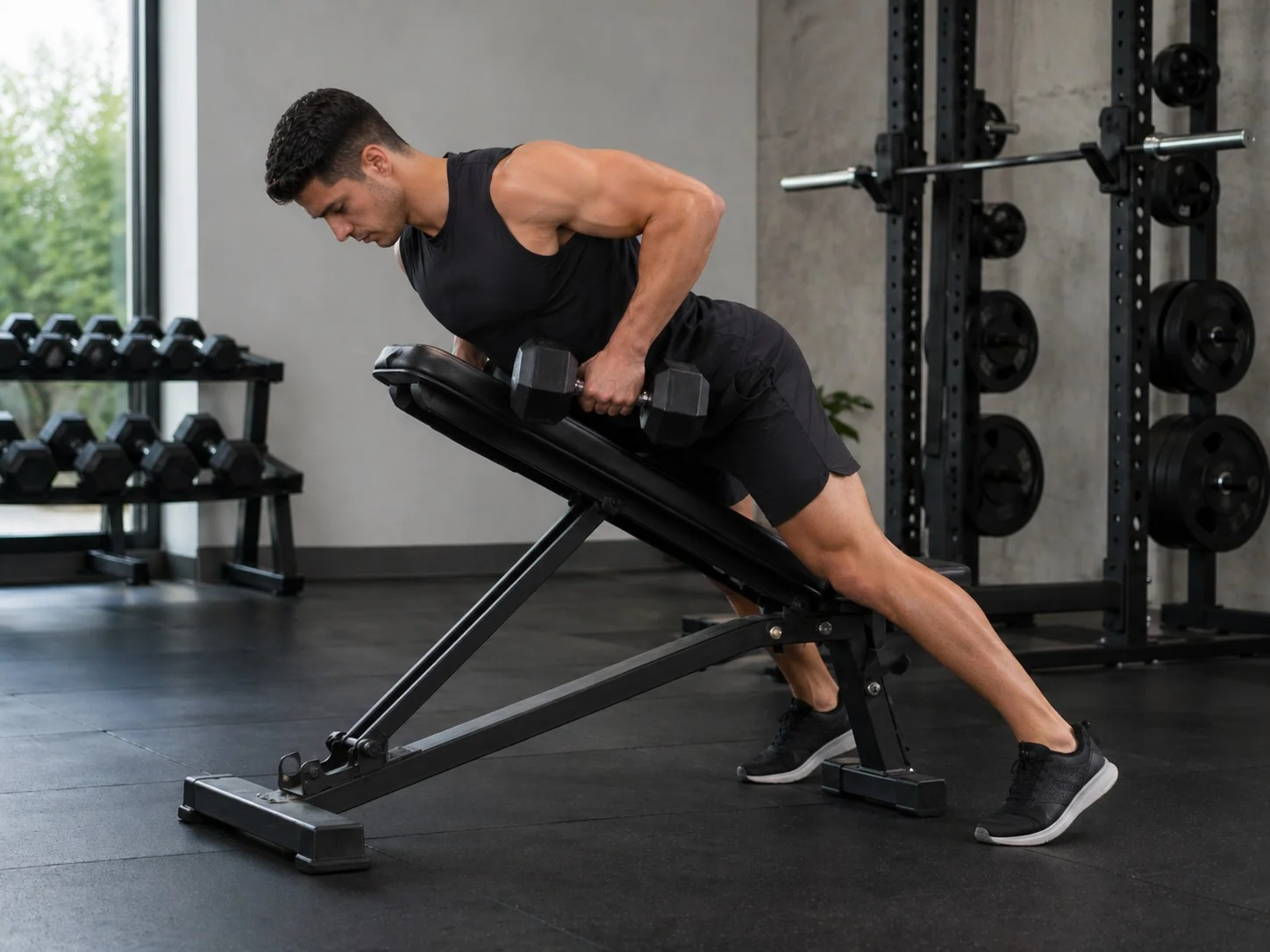
The first mistake is using the bench as a spring. If your chest repeatedly lifts, lands and lifts again, the load or target is probably too aggressive for the variation. Keep your sternum in gentle contact with the support and finish each repetition where you can still control the dumbbells. The second mistake is shortening the bottom half of the movement. If every rep stops several centimeters above the previous one, fatigue is changing the exercise. Lower the weight or finish the set.
The third is elbow drift. If you intend to train a close-elbow row but gradually flare into a wide rear-delt pull, record it as a change rather than calling every rep identical. Similarly, if one dumbbell consistently finishes much higher than the other, try a lighter load and a short pause at the top. A stable stance should not require you to press the toes so hard into the floor that the legs do most of the work.
Grip can become the limiting factor before the back muscles. Use ordinary secure dumbbell handles and experiment with a neutral grip first. Lifting straps may be useful for some higher-rep back work, but they do not solve poor balance or a loose bench. The row pictured here uses an adjustable bench and two dumbbells; the visible chest contact makes it clear when the lifter would need to move the torso to raise the weights farther.
Sharp pain, numbness or a sense of joint instability is different from normal working-muscle effort. Stop and adjust rather than pushing through. If a bench edge is uncomfortable against your chest, reposition the contact point or choose the fully supported variation. A good row has a reproducible start, finish and resistance—not simply a large number written in the notebook.
Use a four-week progression that keeps the movement recognizable
Place the Helms row after your main heavy lift or early in a back-focused session, when grip and technique are still reliable. As a simple example—not a study-proven optimal program—use two sessions per week with two or three working sets of eight to twelve repetitions. Leave about two or three reps in reserve during the first week and choose a load that lets you keep the same bench contact and elbow path for every rep. Rest long enough to repeat good technique, often roughly ninety seconds to two minutes for moderate efforts.
In week one, record bench angle or setting, stance, dumbbell weight, reps and where the row reaches your torso. In week two, repeat the setup and add a rep to each set when you can. In week three, work toward the top of the rep range without shortening the stretch or using more torso movement. In week four, once all working sets reach twelve convincing reps, try the next manageable dumbbell increment and begin nearer the lower end of the range again. Smaller increments may be useful because two heavy dumbbells are a substantial jump.
Pair the row with a vertical pull such as a pulldown or pull-up and, if appropriate, a rear-delt exercise rather than doing five almost identical row variations. Your program still needs sensible weekly pulling volume and recovery. If you already do heavy unsupported hinges, the chest support can make this a practical accessory, but it does not prove that your lumbar muscles are experiencing zero load or that this row is superior for every lifter.
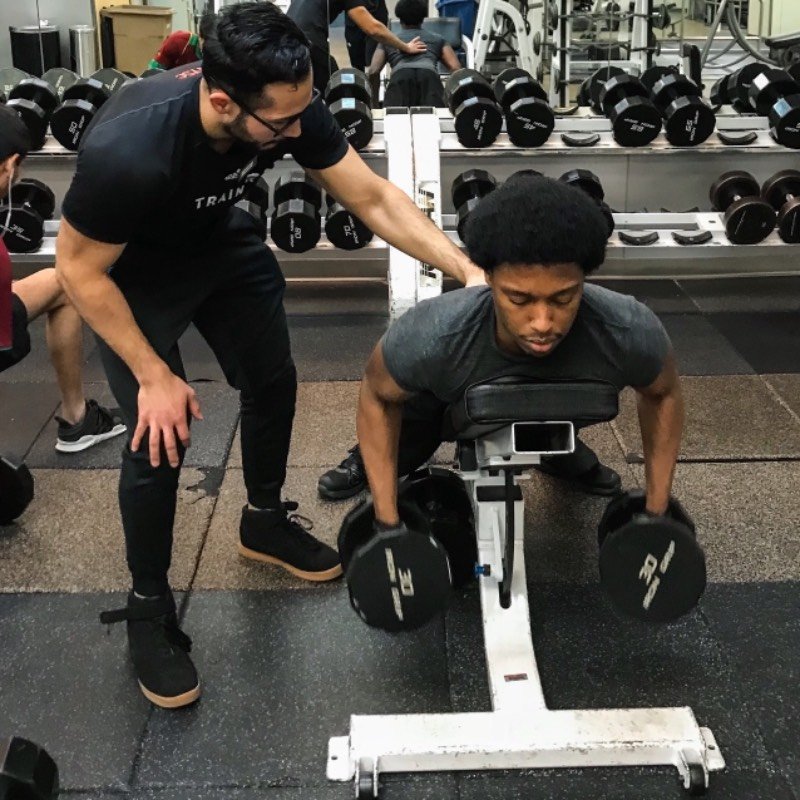
The final photograph shows a coach observing an athlete performing a bench-supported dumbbell row. That kind of side or front view is useful for noticing changes in bench contact and left-right elbow height. Track the quality of your own repetitions and how your back recovers, not soreness alone. The best Helms row is the one you can set up safely, execute consistently and progress without silently changing the exercise.

Bodybuilding Shirts & Workout Gear
Bodybuilding shirts, tanks and gym gear for lifters chasing muscle, size, symmetry and the pump.


Nice Traps Big Back Tee
Heavy lifts, good laughs, and a little “Nice Traps Big Back” energy.


Demon Back Big Back Sweater & Lat Gains Meme T-Shirt
Add a playful “Demon Back” touch to your casual rotation.

Lat Man Big Back – Jumper With Huge Lats – Back Day T-Shirt
Add a playful “Lat Man Big Back” touch to your casual rotation.

Back Sabbath Back Day Funny Gym Hoodie
Bring “Back Sabbath Back Day” gym humor to lazy days and post-workout plans.

Strong Back Bodybuilder Tee
Show some lifting attitude with a playful “Strong Back Bodybuilder” tee.

Happy Weights Emoji Weight Plate Smiley Face Weight Gym T-Shirt
Show some gym-day personality with “Happy Weights Emoji Weight Plate”.

Ice In My Gains Icy Hoodie
Show off your lifting humor in a laid-back “Ice In My Gains” hoodie.