Advertising disclosure: This page includes affiliate product links that may earn us a commission, as well as products from our own store.
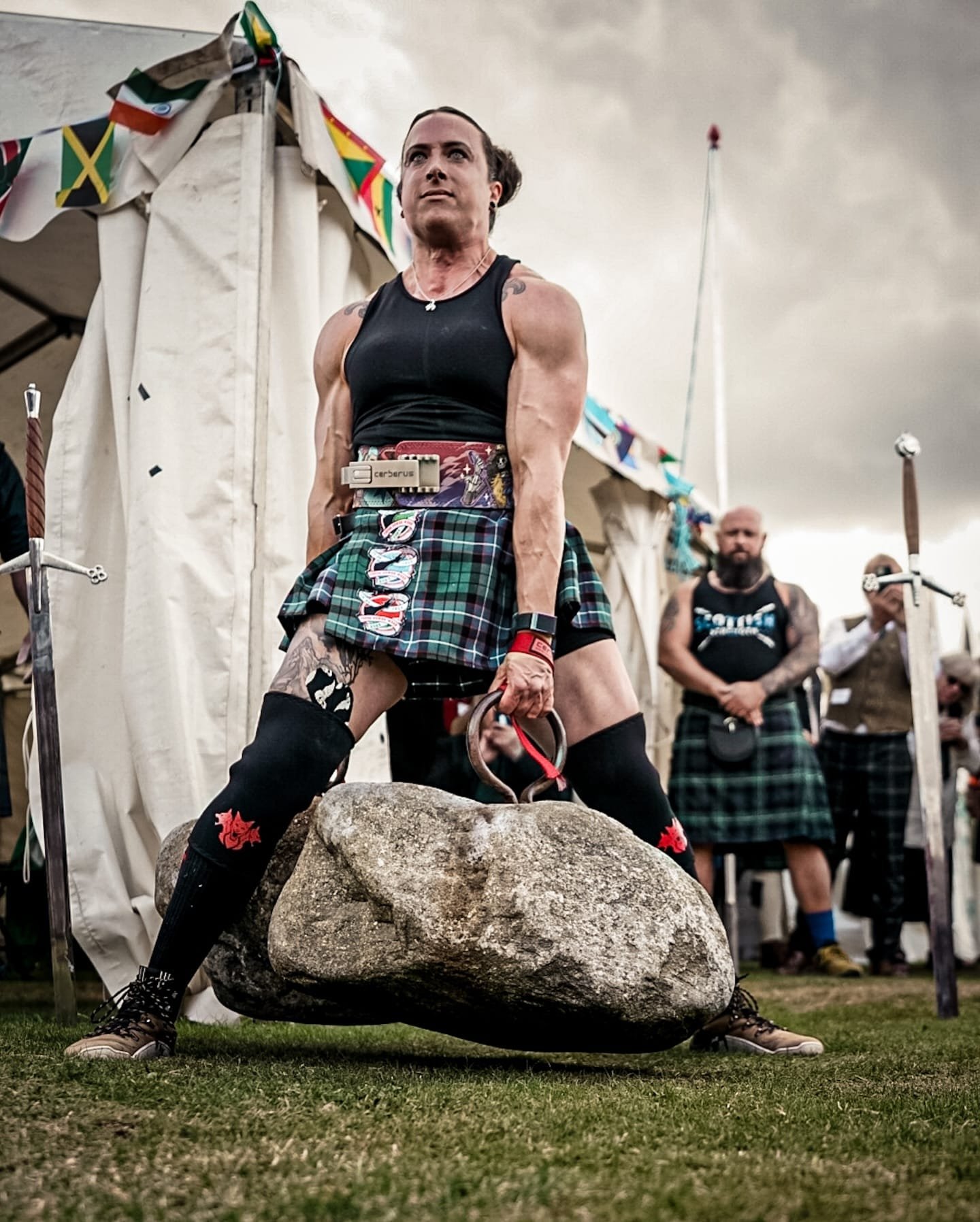
The Dinnie Stones look deceptively simple: two granite boulders, two iron rings and no complicated machine between the lifter and the load. Yet their combined weight tells only part of the story. The stones are unequal, the handles are demanding and getting them clear of the ground is a different achievement from walking with them.
That is why the challenge remains interesting to strongman fans and ordinary lifters alike. It asks what your strength can do with a particular awkward object, rather than how impressive a familiar gym number sounds. Understanding the history and the categories makes the feats more impressive, while also making comparisons more honest.
The total is 332.49kg, but each hand has a different job
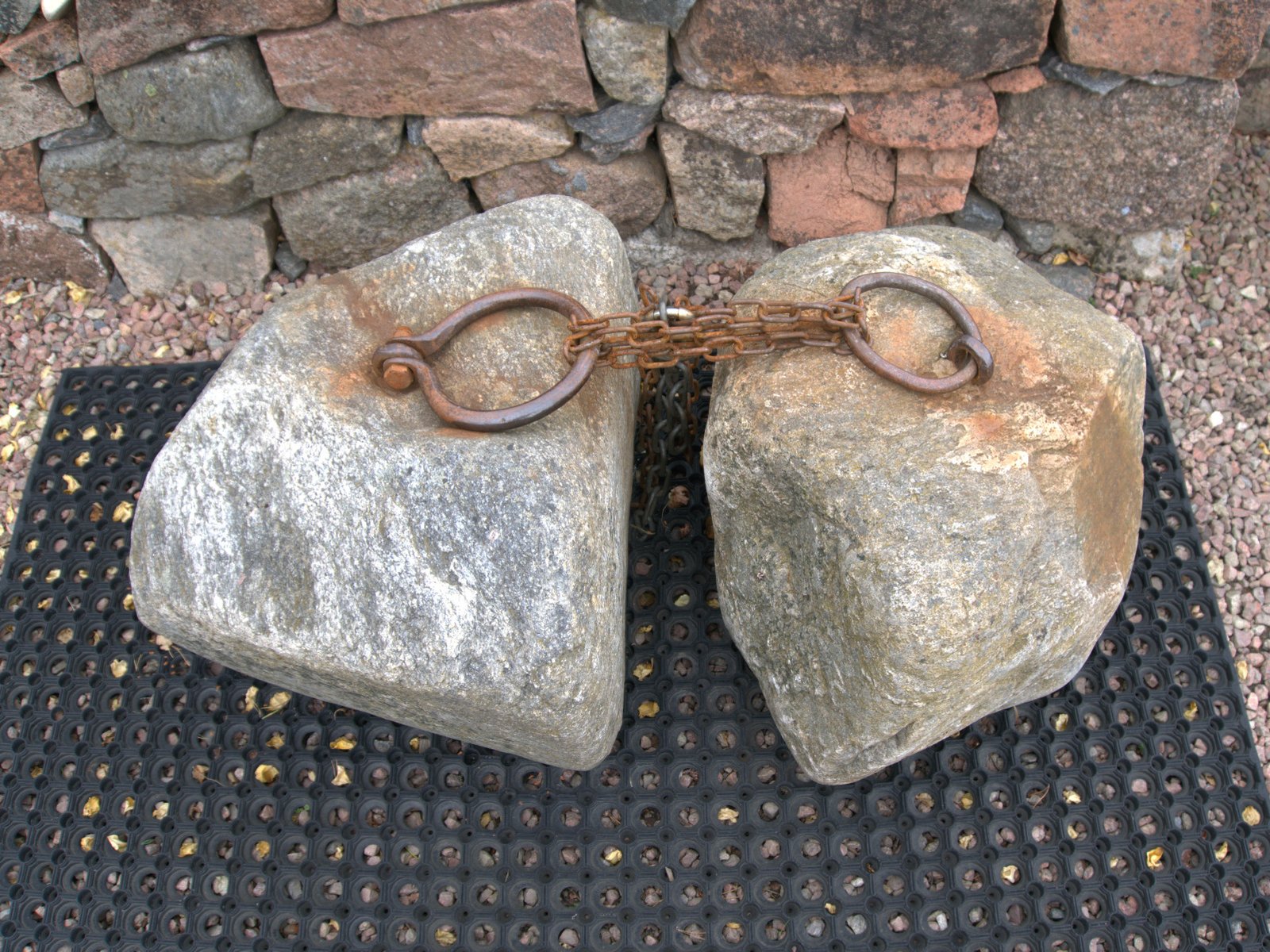
The original Dinnie Stones weigh 188.02kg and 144.47kg, for a combined 332.49kg. They are associated with Potarch in Aberdeenshire, Scotland, and carry iron lifting rings. This is not the same task as picking up a perfectly balanced pair of handles.
The difference between the stones is 43.55kg. Split the total equally and each side would hold about 166.25kg; neither original stone matches that arrangement. Those calculations do not predict who can lift them, but they explain why a symmetrical training setup leaves something important out.
Handle position matters as well as mass. Where the rings sit relative to your hands and body affects the position from which you begin. Two training implements can have the correct combined weight while presenting different pickup heights, spacing and contact with the legs. A training total needs that context before it becomes a convincing comparison.
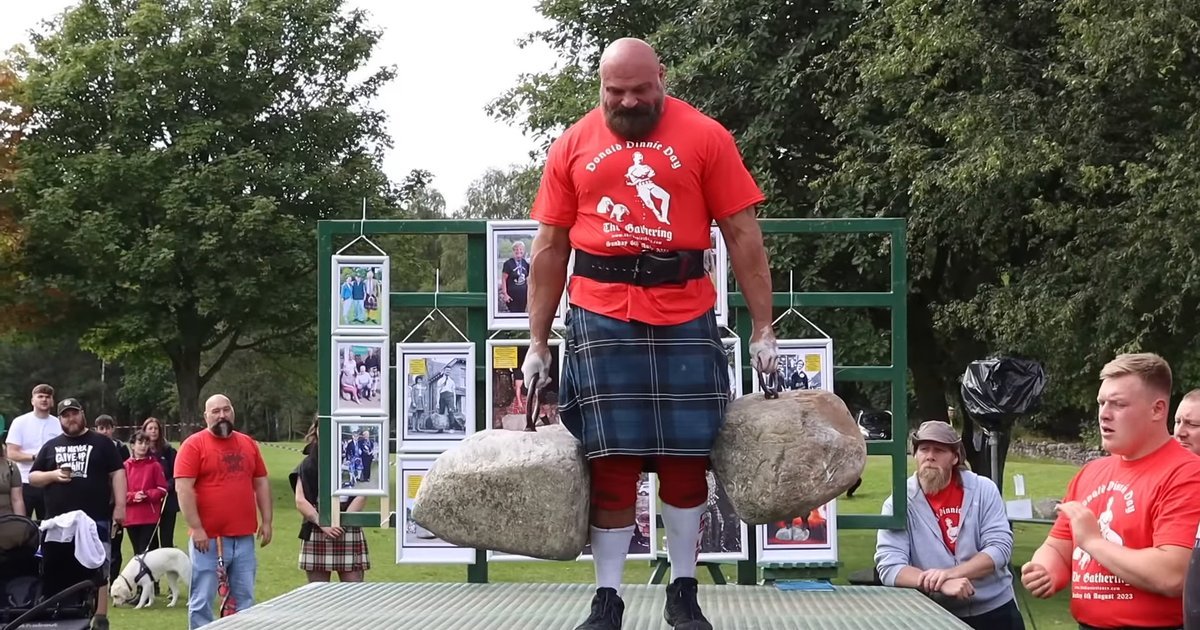
For a viewer, this changes what to watch. Look at how the athlete positions the stones, takes the rings and establishes tension. An awkward start is part of the challenge, rather than an unnecessary inconvenience to edit out of the clip. The object does not become easier to understand merely because its weight can be converted into pounds.
There is no need to declare the stones a superior test of every kind of strength. They test a specific combination of capabilities. A great result with them and a great result with a barbell can both deserve respect without sharing a single ranking.
A bridge-side challenge became a continuing strength tradition
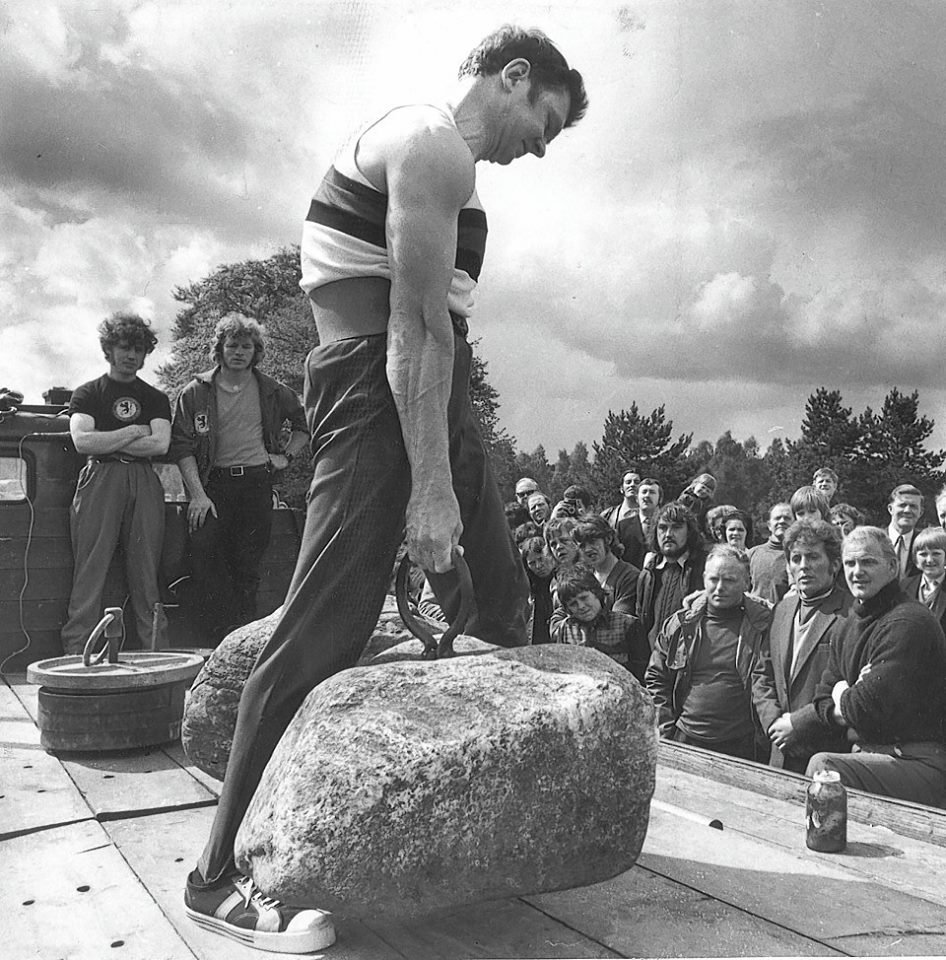
The stones originally served as counterweights for work on Potarch Bridge. Donald Dinnie’s famous carry is associated with 1860. David Webster rediscovered the stones in 1953, and Jack Shanks lifted them barehanded in 1972 before returning to complete the carry the following year.
That history gives the challenge a different appeal from a newly manufactured implement. Athletes are meeting objects with a continuing identity and a connection to earlier lifters. The setting and the effort matter together. The ambition is often to join a tradition, rather than to replace another athlete’s name at the top of a leaderboard.
Historical lifting stories still need careful reading. The wording of old accounts, the units used and the exact distance described do not always line up neatly. Appreciating the story does not require treating every later retelling as a perfectly measured modern result.
Photographs also have limits. A historical image can show a lifter and the stones clearly while revealing little about the duration, preceding attempts or how the whole performance was judged. It remains valuable evidence of the event without answering every question a modern viewer might ask.
The useful connection with present training is the durability of a well-defined challenge. You can return to the same object and ask a clear question about your own capability. That can be more motivating than constantly changing exercises and losing track of what your previous performance actually meant.
A lift, a hold and a carry are three different achievements

The challenge has several forms. A successful full lift involves standing upright with the legs straight and holding the stones clear for two seconds. Assisted lifts using straps and unassisted lifts are recorded separately. Holds for time and carries introduce further demands beyond the initial pickup.
A brief separation from the ground is therefore not interchangeable with a completed full lift. Neither is a long stationary hold interchangeable with travelling a distance. The distinction does not diminish a difficult partial effort; it simply describes what was achieved.
Straps change another important condition. A strapped lift can still require substantial strength, but it does not establish the same unassisted grip performance. For training, an athlete may deliberately use assistance for one purpose and omit it for another. The honest description keeps that choice visible.
Carry comparisons require still more detail. Was the athlete allowed to set the stones down and lift them again? Were they carried beside the body or in another arrangement? Was the result a distance or a duration? A headline that omits these details can make two genuinely different performances look like direct rivals.
Replica stones also have their own identity and records. Similar-looking implements are useful for demonstrations and competition, but a replica result should be labelled accordingly. The name of a challenge is not enough to establish that the actual objects and conditions were the same.
When sharing a clip, a precise description is usually more interesting than an inflated one: name the implement, the assistance and the completed task. That gives the viewer something meaningful to appreciate.
Your deadlift is relevant preparation, not a guaranteed conversion
A strong pull helps, but a barbell number cannot settle the question in advance. Firsthand accounts of visits to the stones describe experienced lifters finding that the rings and the larger stone demanded abilities their usual training had not fully demonstrated. Specific experience remained important even when general strength was already substantial.
Think of preparation in separate parts: producing force from the chosen starting position, holding the handles and controlling the implements. Improving one part does not prove the others are ready. A successful strapped pull may provide information about force production while leaving the unassisted grip question unresolved.
For ordinary gym work, trap-bar pulls, barbell deadlifts and dumbbell carries can develop useful general capabilities. They remain different exercises. A trap bar connects the load through one frame; two separate ringed stones do not. Dumbbell handles introduce another shape and pickup arrangement. Keep the benefits without inventing a one-to-one equivalence.
A simple MMP logging example is to record implement, handle, pickup height, load on each side and whether straps were used. Write down what actually happened: both implements cleared, one stayed down, grip opened or the position changed. This is an observation framework, not a prescribed maximal training session.
For an arithmetic illustration, 40kg in one hand and 30kg in the other totals the same 70kg as two 35kg loads. The totals match, but the tasks do not. Likewise, raising the pickup position while keeping the plates unchanged alters the comparison. These small example numbers are not a suggested starting load or a prediction of stone-lifting ability; they show why the details in a training log deserve as much attention as its biggest number.
Use suitable equipment and loads you can control. Ring-specific training requires equipment designed for that purpose, not an improvised attachment whose capacity is unknown. Loading plates, collars and ordinary strength equipment can support preparation, but purchasing them does not certify readiness for the original stones.

Equipment Worth Exploring
Explore equipment, accessories and gear from our carefully selected range.


Competition Plates
Competition-style bumper plates for Olympic lifts and loaded strength training.

Rubber Hex Dumbbells
Rubber-coated hex dumbbell pairs with a stable shape for home and commercial strength training.


Leather Lifting Straps
Padded leather straps support grip during heavy rows, deadlifts and pulling exercises.

Speed Collar
Quick-release collars designed to secure weight plates on standard two-inch Olympic bars.

Powerlifting Shirts & Lifting Gear
Powerlifting shirts and gym gear for squat, bench and deadlift lifters who live for heavy numbers.

Deadlift Electric Skull Graphic , High Voltage Workout Hoodie
Show off your deadlift humor in a laid-back “Deadlift” hoodie.

Skeleton Meme If You'Re Not Scared Sweater Top T-Shirt
Show some gym-day personality with “Gym Skeleton Meme”.

Praise The Deadlift Holy Lifting Meme Decal Water Sticker
Put “Praise The Deadlift” gym humor on your laptop, bottle, or gym gear.

Nice Try Gravity Astronaut Muscle | Funny Space Workout Tank Top
Show some personality between sets with “Nice Try Gravity Astronaut”.

Shirt – Deadlift – Meme Gains & Bros T-Shirt
Heavy lifts, good laughs, and a little “Deadlift” energy.

Lift Heavy Be Happy Meme Bros & Gains Top T-Shirt
Show some powerlifting attitude with a playful “Lift Heavy Be Happy” tee.

Lift Heavy Sh*T – Essential & Gymbros T-Shirt
Show some powerlifting attitude with a playful “Lift Heavy Sh*t” tee.

Deadlift And Chill Shirt Netflix & Gains Meme Top T-Shirt
Bring “Deadlift and Chill” humor to your next gym day.

Deadlift Addict & Barbell Cigarettes Can'T Quit T-Shirt
Show some deadlift attitude with a playful “Deadlift Addict & Barbell Cigarettes” tee.

3 Plates Deadlift Club : Motivational & Ultimate Top T-Shirt
Rep “3 Plates Deadlift Club” humor in and out of the gym.
Plan the attempt around the stones and their custodians

The original stones are available for arranged attempts rather than casual lifting whenever someone arrives. The organisers currently request video evidence of an unstrapped lift of at least 300kg before booking. That is a preliminary requirement, not a promise that the stones will come up.
Confirm the current arrangements directly before making travel plans. Availability, preparation requirements and the way an attempt is organised can change. A historical article or an old social post should not become a substitute for an agreed appointment.
Respect for the objects belongs inside the performance. These are historic stones with fittings, not disposable gym equipment. Follow the supervising team’s instructions about handling and setting them down. A dramatic drop is not necessary to prove that a demanding lift happened.
Give yourself a realistic purpose for the visit. Watching, learning the setup or completing a carefully defined personal challenge can all be worthwhile. Decide what would count as success before the crowd, travel effort and excitement make every further attempt feel compulsory.
The enduring attraction is that the challenge remains concrete. Two unequal stones ask a clear question, and the answer depends on the task you complete with them. Enjoy the history, describe the performance accurately and let the original objects retain the character that made them famous.