Advertising disclosure: This page includes affiliate product links that may earn us a commission, as well as products from our own store.
A cable curl is not defined by the stack alone. Pulley height, upper-arm position, support and grip all help define the task. Start with a high-pulley setup, compare the alternatives deliberately and keep those details attached to the numbers you record.
Set high pulleys for the arm position you intend to train
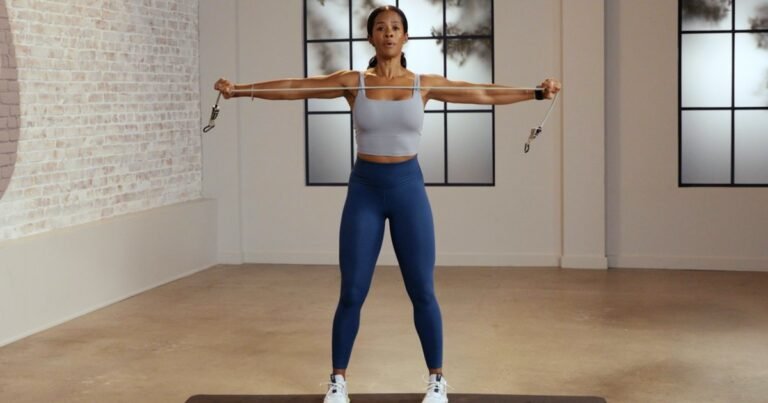
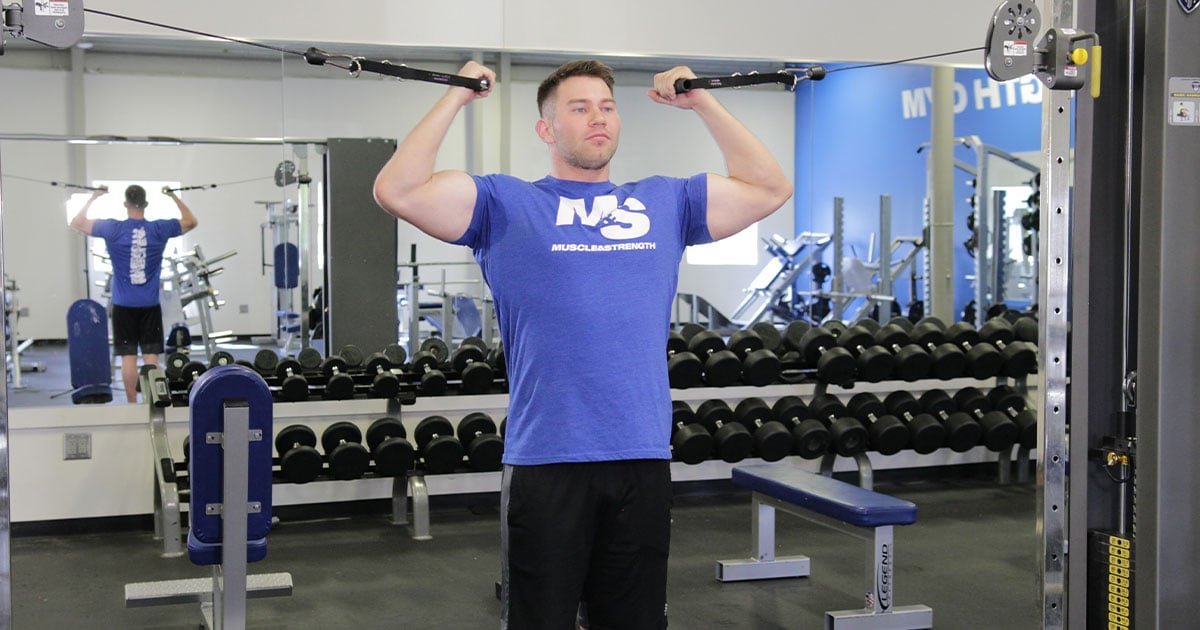
A standing high-pulley curl uses two separate handles with the arms held out to the sides. Attach one handle to each high cable, choose a light starting setting and stand between the stations. With an underhand grip, bend the elbows to bring the handles inward while keeping the upper arms and torso reasonably still. Return slowly to the starting position. The aim is elbow movement against the cables, not pulling the elbows toward the ribs.
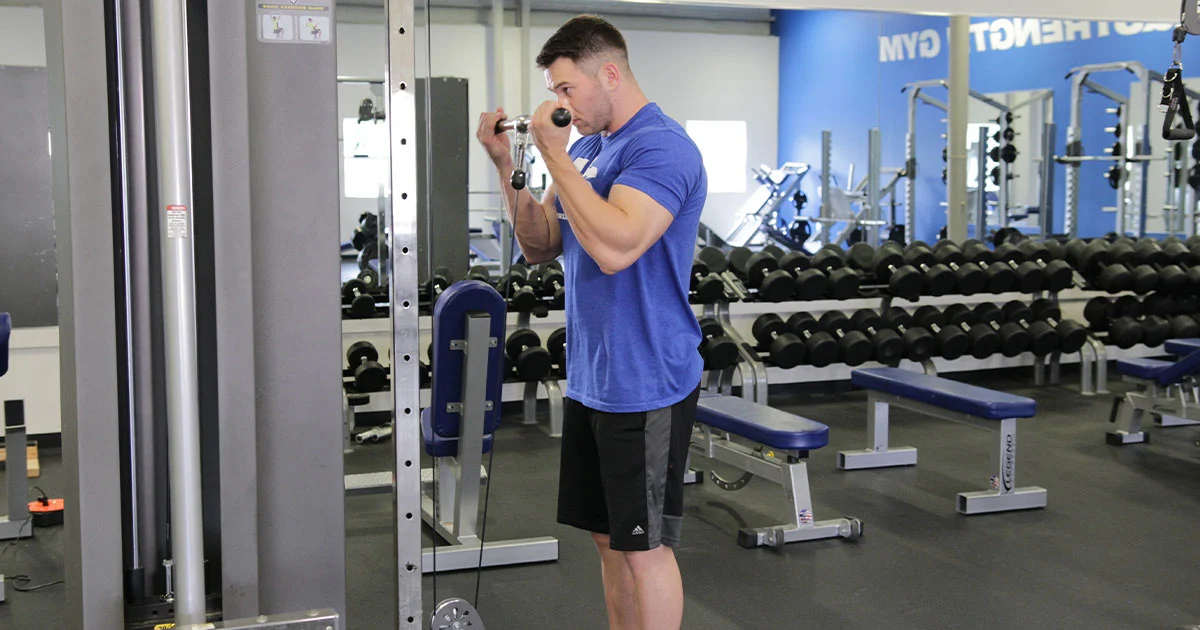
The cover shows that high-pulley arrangement. The section photograph shows a low-pulley bar curl, with the upper arms closer to the torso. These are different setups, even though both involve curling a cable attachment. The high version needs enough space between the stations and a comfortable raised-arm position. Do not force that position if you cannot hold it comfortably or keep the movement controlled.
Check both pulley settings and stacks before beginning. Matching printed numbers is a useful setup detail, but it does not prove two different cable systems provide identical resistance. Record which station you used and how the handles were arranged. If one side starts pulling before the other, stop and check the equipment, position and cable travel. Avoid trying to fix a confusing setup by simply pulling harder.
Begin with a range you can repeat without moving the shoulders dramatically. You do not need to force the handles into your head or lock the elbows aggressively at the other end. A light practice set can reveal whether the height and stance are workable. Make a note of the arrangement before changing the load. Repeatability starts with choosing the task, not with the number on the stack.
Use preacher support to define where the upper arms stay

A cable preacher curl introduces an external support for the upper arms. Position a proper preacher bench facing the low pulley, attach a suitable bar and adjust the seat so the upper arms rest securely on the pad. Check that the cable route is clear and that the bench remains stable under tension. Reach the attachment without dragging the chest away from the support before the first repetition even starts.
Curl the bar upward with an underhand grip, then lower it deliberately. Keep contact with the pad rather than lifting the shoulders and torso to complete the last part of a heavy repetition. A preacher station provides a reference position, but it does not make every repetition strict automatically. If you repeatedly move away from the pad, reduce the load or reassess the arrangement instead of counting that movement as extra range.
This is a different choice from the high-pulley curl. The arms are supported in front of the body rather than held out to the sides. There is no reason to expect the same stack setting to suit both. Give each version a separate entry in the log. You can compare your own preacher-curl sessions without making a universal claim about which variation is better for every lifter.
For example, a useful note might include the station, bench seat setting, attachment and starting distance from the pulley. If the usual bench is unavailable, do not balance an unsuitable bench or pad into an improvised arrangement just to preserve the exercise name. Choose a familiar standing version and record the substitution. The simplest controlled option is often more useful than a complicated setup you cannot reproduce next week.
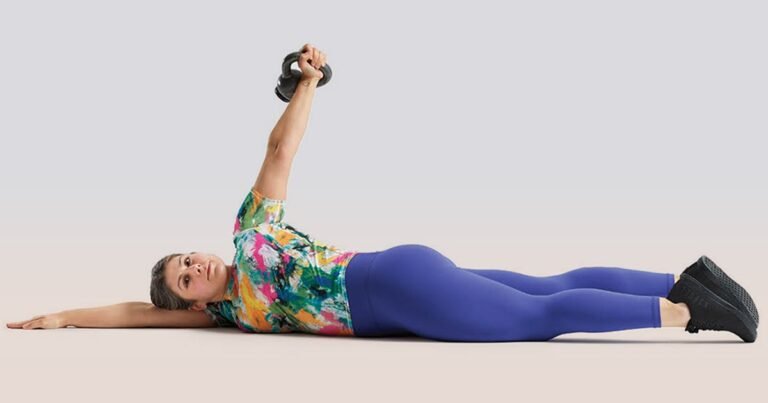
Treat the floor curl as its own setup, not a seated curl lying down
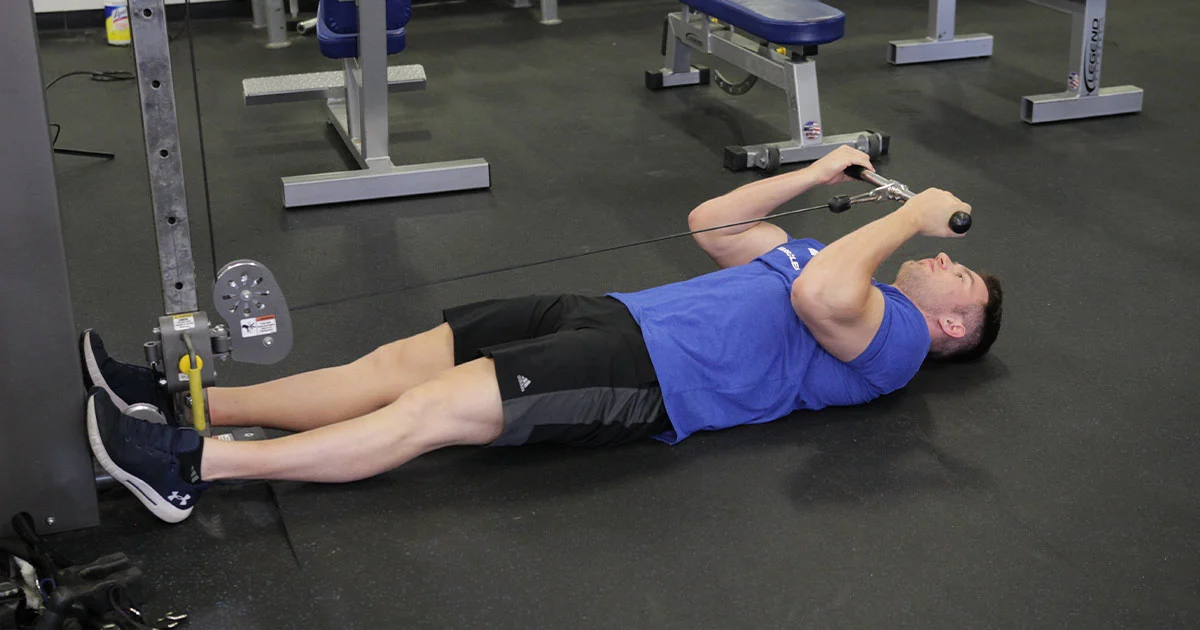
In the lying floor cable curl, the attachment comes from a low pulley while you lie in front of the station. Arrange a clear floor area and a comfortable surface, then check that you can take the handle and return it safely. The photograph shows a straight-bar version. Curl toward the upper body while keeping the chosen upper-arm position controlled, then lower the attachment slowly rather than letting the stack pull you out of position.
Being on the floor reduces the opportunity to sway backward as you might when standing. It also changes how you enter the exercise and where the cable runs relative to your body. Those differences deserve attention. Keep the attachment away from the face and avoid a load that requires a sudden pull to get started. If the setup feels cramped or unstable, choose another version instead of forcing the available floor space to work.
Use a clear endpoint for each repetition. If later repetitions travel farther only because the shoulders move or the torso shifts, the comparison has changed. Decide what counts before the hard part of the set. You can still train with effort while ending the set when that standard is lost. A controlled range gives the next session something useful to repeat, rather than merely a total to beat.
Log this variation separately from the standing curl even if you use the same attachment. Keep your distance from the pulley and body position consistent. If the floor arrangement is impractical in a busy gym, it is an optional variation rather than an essential test of commitment. You can choose one cable curl that fits the environment and perform it consistently without collecting every version in the exercise library.

Equipment Worth Exploring
Explore equipment, accessories and gear from our carefully selected range.
VOLTRA
Compact digital cable trainer with smooth, adjustable resistance.

Go-Tone Pro
Portable digital cable trainer with up to 66 lb (30 kg) of adjustable resistance.

VForce Wall Trainer
Space-saving wall-mounted functional trainer with pivoting cable arms and variable resistance ratios.

VForce 2IN1
Half rack and pivot-arm functional trainer with switchable 1:1 and 2:1 pulley ratios.

VForce 3IN1
All-in-one rack combining an adjustable Smith machine, functional trainer, and free-weight station.

VForce 3IN1 Max
Six-post all-in-one rack with Smith machine, functional trainer, and variable-force cables.

VForce Lat Tower
Wall-mounted cable tower with pivot arms and adjustable 1:1 or 2:1 pulley ratios.

Trinity Lat Machine LSW-850
Weight-stack pulldown tower offering three cable directions and adjustable seated support.


GymPin Ergo Handles
Pair of ergonomic cable handles shaped for comfortable triceps and pulling exercises.
Choose the rope or bar grip for a clear reason
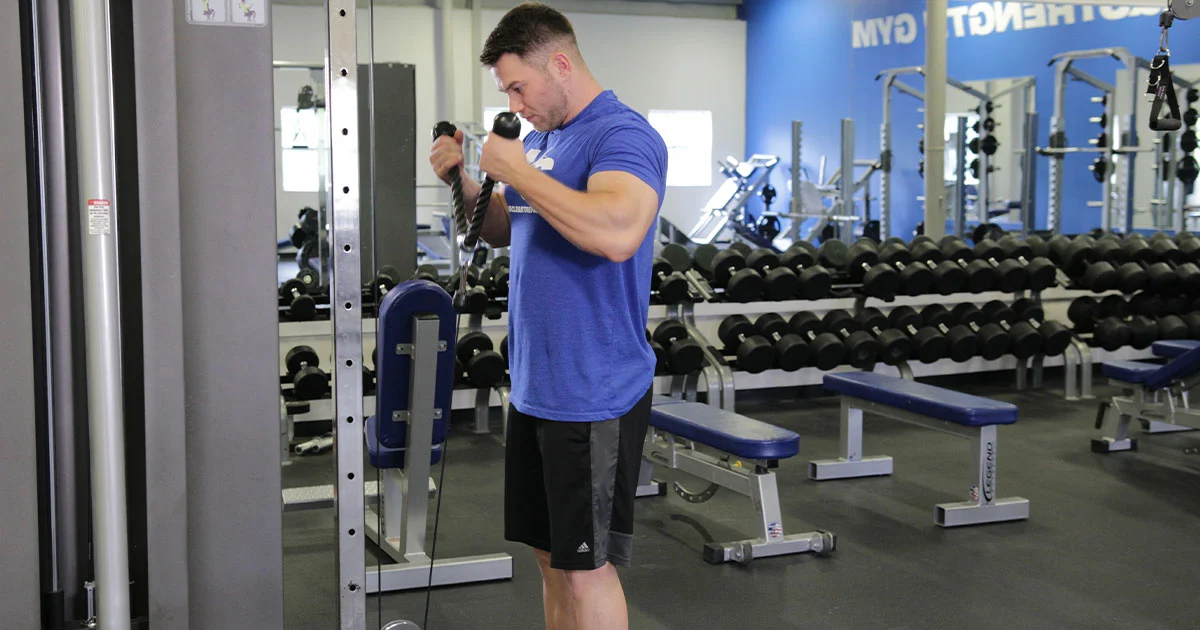
A rope cable curl uses a low pulley and a neutral grip, with the palms facing each other. Stand facing the station, hold the rope securely and curl while keeping the upper arms near your sides. Lower under control. Compared with an underhand bar curl, the hand position changes. Record the attachment and grip rather than treating every repetition performed on the same cable station as an identical exercise.
The rope lets the hands sit independently, but that is not a reason to pull the ends apart violently or bend the wrists to make the handles travel farther. Keep the hand position manageable and the torso quiet. If the rope length makes the start awkward, adjust the setup or select a more suitable attachment. A longer rope is not automatically better; it changes where the hands and cable meet.
With a bar, choose a grip you can maintain without folding the wrists or forcing an uncomfortable width. A straight attachment and an angled attachment offer different positions. Try them lightly before deciding which suits the task. Individual comfort is a useful selection factor, but it does not establish a universal muscle-building advantage. Stop an exercise that causes pain instead of trying to solve it by adding momentum.
The practical question is which version gives you a clear curl you can repeat alongside the rest of your training. You might keep a rope curl as a separate accessory or use an underhand attachment consistently for a training block. Both choices can be deliberate. Avoid swapping the grip, pulley position and repetition standard every session, then interpreting the next higher stack number as straightforward progress.
Progress one variation before building a longer arm routine
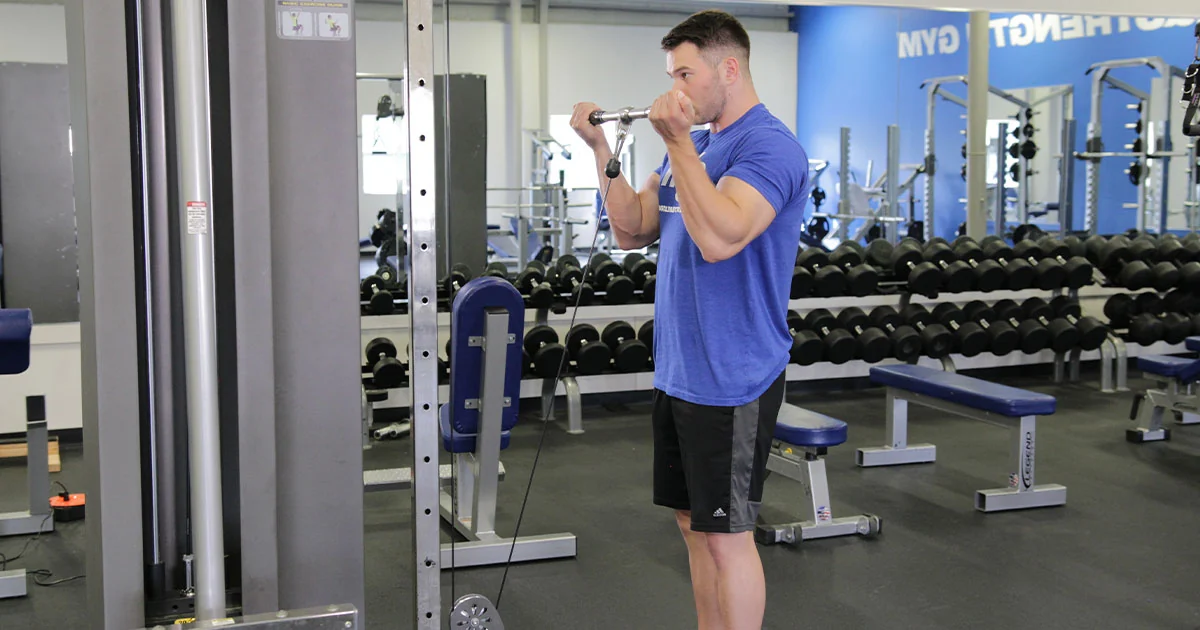
The wide-grip cable curl pictured is another bar variation. A wider hand position changes the setup; it does not prove you have isolated a particular part of the biceps or found a better exercise for everyone. Use a comfortable position and keep the movement controlled. If you change the grip, note it in the log so comparisons retain their meaning. The same principle applies when you return from a low pulley to a high-pulley curl.
As a practical starting experiment, choose one variation for two working sets in a range of eight to twelve controlled repetitions. This is an organisational option, not an evidence-based optimum. Keep enough rest to repeat the chosen standard and account for the pulling and curling already in your week. An arm day or pull day does not automatically need several additional cable exercises simply because the equipment is available.
When both sets reach the upper end across repeated sessions with the same setup and range, consider a small load increase. If the next stack increment makes you swing or lose the arm position, remain at the previous setting rather than changing the task to finish. Another clean repetition can be useful progress. Increasing the number while shortening every repetition makes the training record harder to interpret.
Write down the variation, station, attachment, pulley height, working load and clean repetitions. Add a short note if comfort or fatigue changed the session. Habit and consistency matter because they make comparisons clearer, not because every workout must contain more arm work. Keep a cable curl when it serves a useful role, review how it fits the programme and change one variable at a time when you decide to progress.

Bodybuilding Shirts & Workout Gear
Bodybuilding shirts, tanks and gym gear for lifters chasing muscle, size, symmetry and the pump.

Curls The Girls Shirt – Bicep Curls Top & Gymbros T-Shirt
Rep “Curls For The Girls” humor in and out of the gym.

Big Biceps Theory & Weightlifting Bro Science Hoodie
Stay casual and show some lifting attitude with “Big Biceps Theory”.

Micro Biceps Club President Gym | Funny Workout Sweater T-Shirt
Keep things casual with a little “Micro Biceps Club President” attitude.


OnlyGains Big Biceps Decal Water Bottles & Equipment Sticker
A fun “OnlyGains Big Biceps” touch for bottles, laptops, and lockers.

Muscle Mountain – Shirt , Bicep Mountain Meme T-Shirt
Heavy lifts, good laughs, and a little “Muscle Mountain” energy.

Dumbbell Heartbeat Muscle Shirt Athletic Vest Fitness F Tank Top
Your gym-day look, with a playful “Dumbbell Heartbeat” twist.

Lift Eat Sleep Repeat Meme Sweater & T-Shirt
Bring “Lift Eat Sleep Repeat” humor to your everyday gym style.

Lift Smart Brain Weight Plate Mind Muscle Connection 45 Tank Top
Add some lifting attitude to training with “Lift Smart Brain Weight Plate”.

Mind Muscle Perfection Brain and Biceps Gym for Science Hoodie
Show off your lifting humor in a laid-back “Mind Muscle Perfection Brain and Biceps” hoodie.