Advertising disclosure: This page includes affiliate product links that may earn us a commission, as well as products from our own store.
Battle ropes look simple: grab the ends and make them move. The useful details are which pattern you choose, how consistently you can repeat it and what you expect the training to accomplish. Small muscle-activity experiments help explain why alternating waves, double waves and slams feel different. They do not turn every hard rope interval into proof of future strength gains. Use the evidence to ask better questions, then build a session you can actually repeat.
1. A hard rope set is measurable, but the measurement has limits
Battle ropes can make a short set feel demanding without a barbell ever leaving the floor. That makes them useful to investigate, but a dramatic wave is not a strength test. In one small experiment, twelve resistance-trained volunteers aged 20–24 performed five rope variations while electrical activity was measured in eight muscles. Lower-back recordings were usable for only nine participants because of technical problems.
Slams produced more activity than the other tested movements in several lower-body and trunk muscles. Forearm activity was high across all five variations. Those findings describe the tested exercise bouts; they do not demonstrate that the participants became stronger, developed bigger muscles or improved their sport performance over subsequent weeks.
That distinction matters when choosing a finisher. A muscle-activity reading can help explain how two movements differ in the moment. It cannot tell you how many kilograms your next deadlift will improve or how much training volume the ropes can replace. Treat the exercise as something you can practise and progress, then evaluate the outcome that actually matters to your programme.
For a lifter, the practical question is often modest: can you add a short conditioning block without wrecking the next session or turning each repetition into a different movement? Keep that question separate from claims about maximum strength. A repeatable, well-chosen rope interval can be worthwhile without being marketed as a replacement for every other exercise.
2. Alternating and double waves create different coordination demands
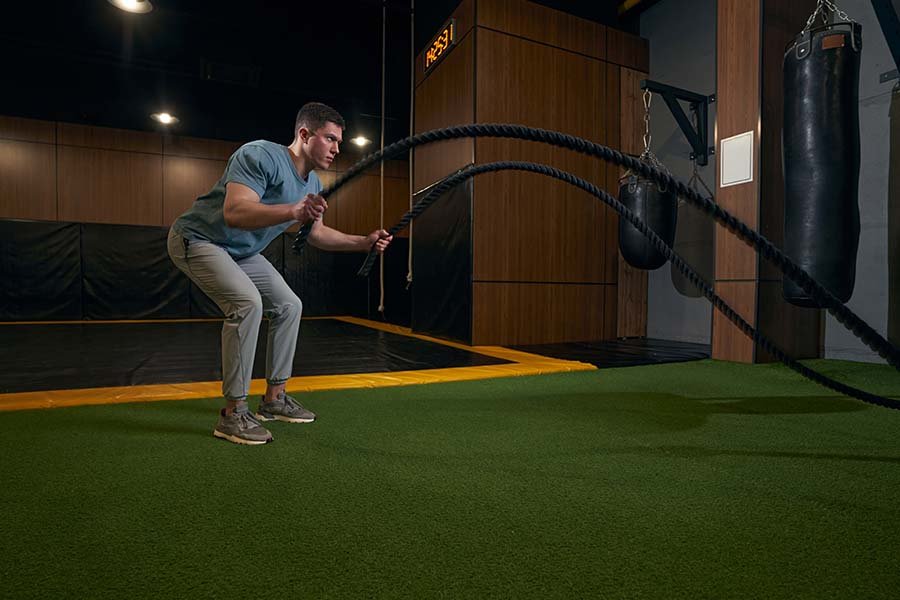
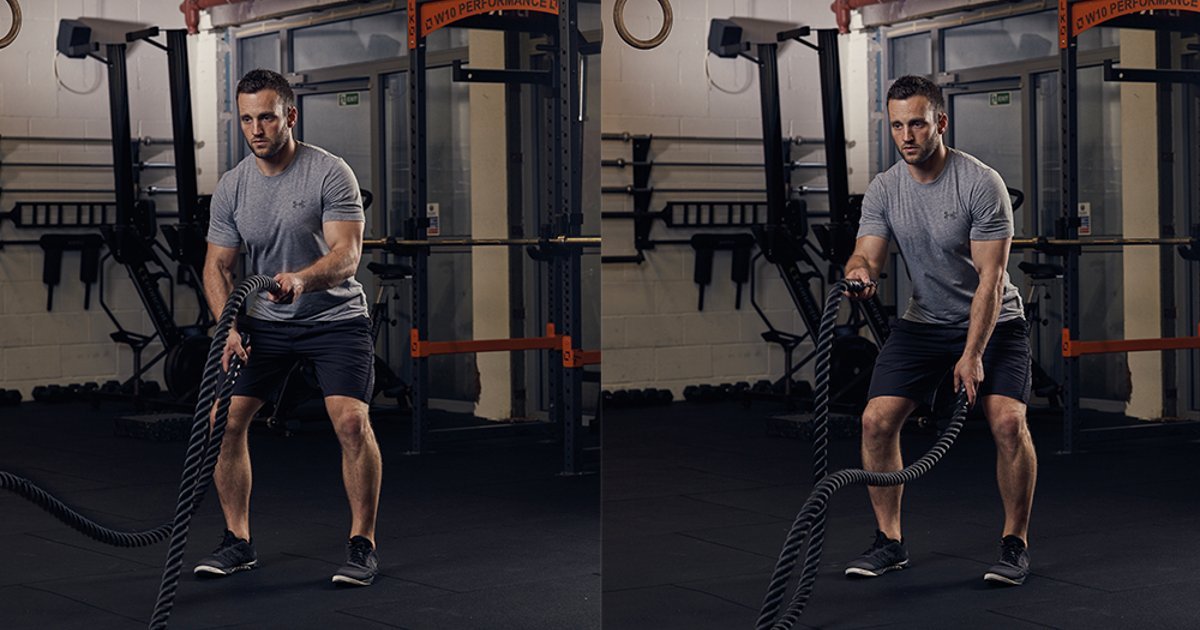
With alternating waves, the hands move in opposite directions: one rises as the other falls. With double waves, both hands rise and fall together. Begin slowly enough that you can identify the intended pattern. If the ropes repeatedly collide or the rhythm becomes random, reduce the speed before trying to make the waves larger.
A separate repeated-measures experiment involving 21 volunteers compared alternating and bilateral waves. It found more external-oblique activity during alternating waves and more lumbar erector-spinae activity during bilateral waves. Several recorded muscles showed moderate-to-high activity, whereas gluteus-medius activity was relatively low. This was another acute comparison, not a long-term muscle-growth contest.
Neither finding makes a variation a universal winner. You might prefer alternating waves when learning to coordinate both arms independently, or use double waves when you want a simpler matched-hand pattern. The useful comparison is one you can reproduce with the same rope, stance and work interval. Switching everything at once makes the difference difficult to interpret.
For practice, compare two short bouts with a full recovery between them. Use similar wave height rather than deliberately making one movement more violent. Notice whether your torso twists, your shoulders rise toward your ears or your stance changes. These observations help you choose a manageable version; they are not a way to estimate the electrical activity of individual muscles by feel.
3. Slams add a larger movement, so control the whole repetition
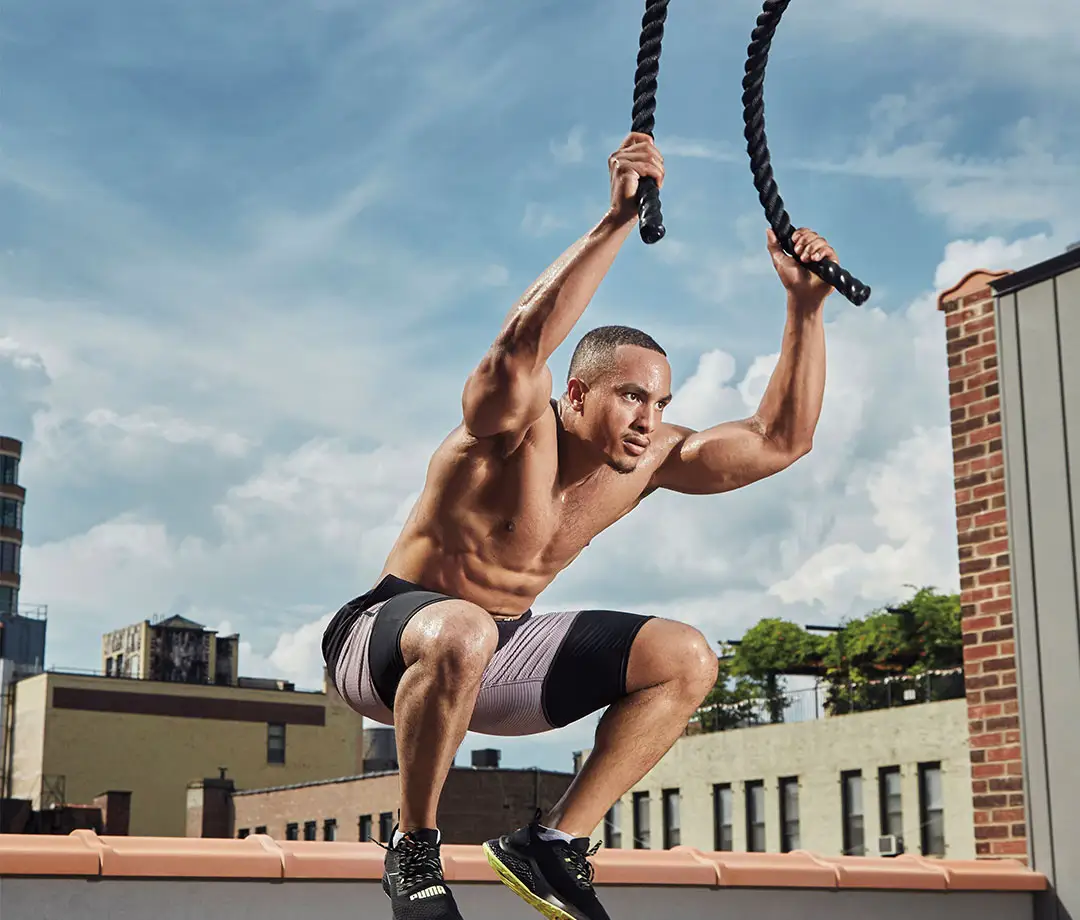
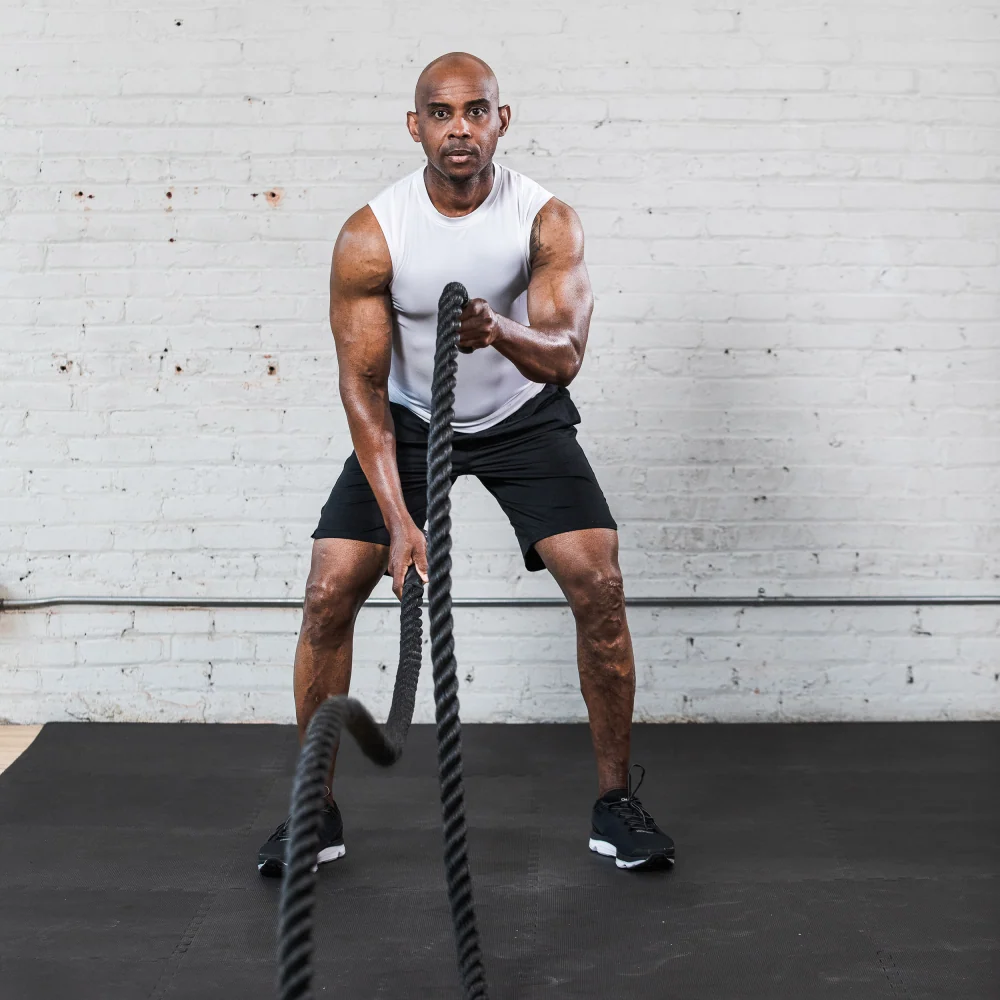
A slam is a deliberate lift and forceful downward movement of the ropes. It is not simply a double wave performed with worse timing. Start with an ordinary standing variation before considering more demanding versions. You should be able to raise and lower the handles while maintaining your balance and keeping the rope path clear.
The larger movement gives you more opportunities to change the exercise accidentally. Deeply squatting on one repetition, barely bending on the next and jumping on the third creates three different tasks. Pick a version, keep the intended range consistent and end the bout when you can no longer reproduce it. Bigger movement is not a licence for an uncontrolled back bend.
The photograph illustrates an advanced jumping variation. Jumping is optional and is not part of the starter session below. If you later choose to practise it, first establish that you can land quietly and regain position without the rope pulling you forward. Do not add a jump merely because an ordinary slam no longer looks dramatic.
Rope exercises are also easy to turn into unplanned maximum efforts. Leave some reserve while learning. A set that ends with consistent rope travel is more useful for comparing progress than one that finishes with repeated stumbles or a sudden change in technique. If a movement provokes pain, stop that movement and get appropriate individual guidance rather than searching for a way to force the final seconds.
4. Anchor, grip and floor space come before interval timing
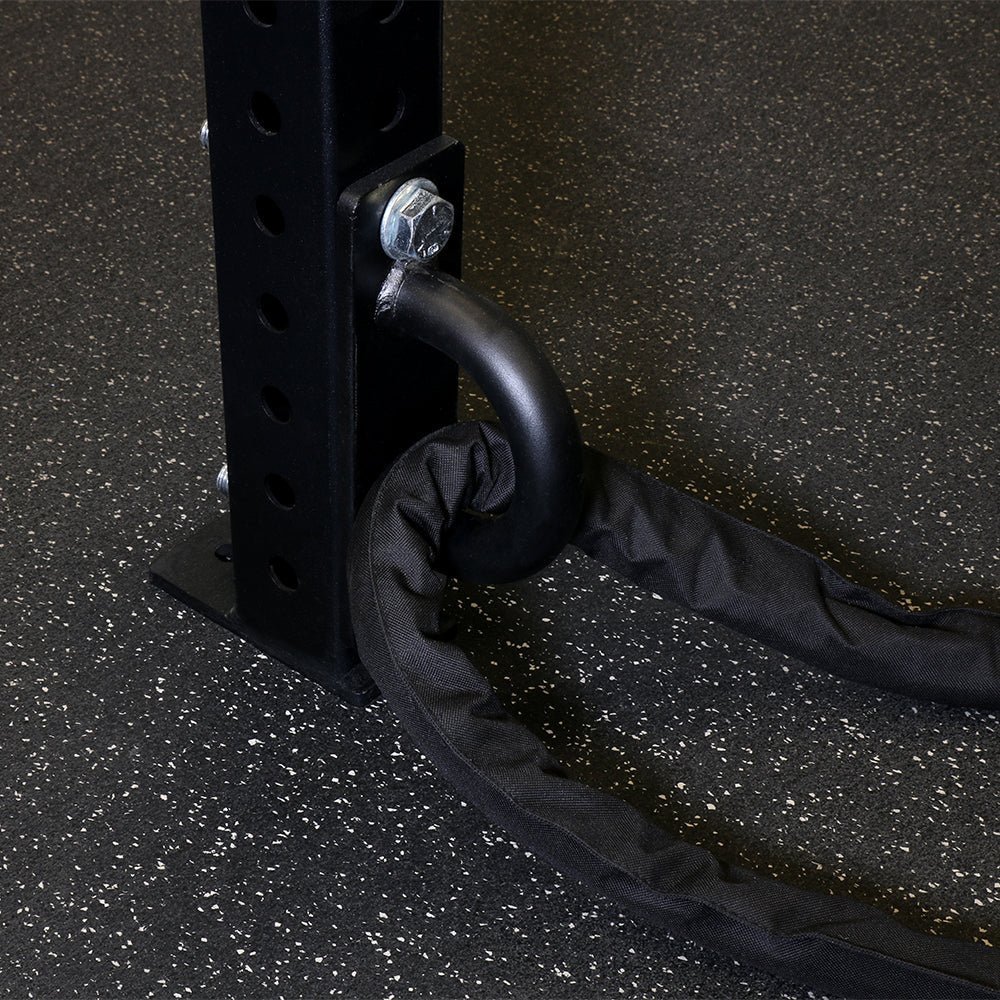
Check the equipment before grabbing the handles. Use the rope's intended anchor arrangement, inspect the rope and end coverings for obvious damage and keep the entire working path clear. An unattended dumbbell or a loosely placed bench is not a substitute for a suitable anchor. Follow the equipment's installation instructions and ask staff when the setup is unfamiliar.
Stand where you can create the selected wave pattern without being dragged toward the fixing. Too much tension or too much loose rope can make the movement awkward, so establish your working distance with a gentle practice bout. Do not borrow a distance from another person without accounting for a different rope, anchor and available space.
A handshake-style grip is a useful starting reference: wrap the fingers and thumb around the handle without bending the wrist into an uncomfortable position. Grip firmly enough to retain control, but avoid treating every interval as an all-out squeezing test. Check whether the end coverings are slippery and keep other people out of the area where the ends could swing.
Rope length and thickness change the task. When you switch to a different rope, repeat a short familiarisation effort rather than assuming that last week's interval length will feel identical. Write down which rope and anchor you used. Those mundane details make training comparisons more meaningful than a note that simply says you did ropes for ten minutes.
5. Progress the wave you can sustain, not the chaos you can survive
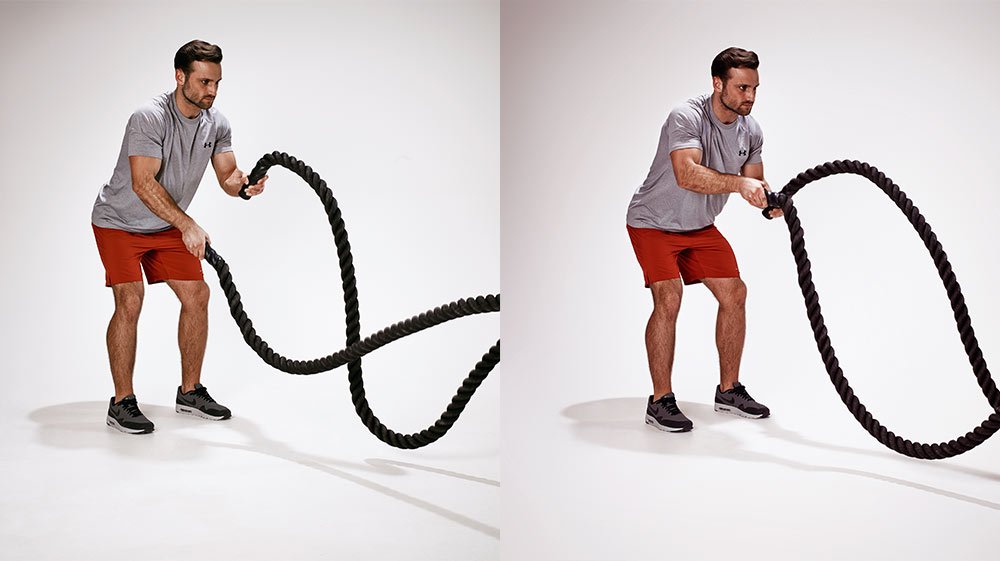
Watch the rope as well as the clock. A clean pattern gives you immediate feedback: waves travel consistently, your stance remains deliberate and the handles follow the movement you chose. If the waves shrink rapidly, your rhythm breaks or you start chasing the rope around the floor, the work interval may be too ambitious for that setup.
There are several ways to make the task harder, including changing speed, wave size, rope characteristics or the work-to-rest relationship. Choose one. Increasing wave height and speed while cutting rest leaves you with little information about which change caused the next session to fall apart. A clear progression is easier to adjust when the rest of your lifting programme becomes demanding.
Here is an original quality check. During a comfortable practice bout, count several consecutive hand cycles and notice the wave pattern. Repeat that observation near the end of the interval. You do not need a laboratory-perfect count; the point is to notice whether you are still performing the same task. A phone video can help if filming is permitted and does not capture other gym members without their consent.
Keep effort separate from execution. You can work hard and still use a short enough interval to preserve the intended movement. You can also finish a very long interval with little consistent rope motion left. The second result is not automatically the better conditioning session. Choose a standard you can explain before the bout, then use it when deciding whether to continue or recover.

Functional Fitness Shirts & Workout Gear
Functional-fitness shirts, tanks and workout gear for athletes who train strength, conditioning and everything in between.

OnlyGains Kettlebell Meme Meme Athletic Shirt Tank Top
Train hard, laugh a little, and rep “OnlyGains”.


Donut Kettlebell – Bakery Gains Meme Hooded Pullover Hoodie
Make your off-duty look more fun with “Donut Kettlebell”.

Kettlebell Heartbeat Crewneck Pullover Sweater Workout T-Shirt
For laid-back days and bodybuilding humor: “Kettlebell Heartbeat”.

Live Love Lift Decal for Water Bottles Laptops Gym Gear Sticker
Put “Live Love Lift” gym humor on your laptop, bottle, or gym gear.

Vive Le Resistance Bands – Resistance Bands Warmup Reha Tank Top
Your gym-day look, with a playful “Vive Le Resistance Bands” twist.

Hybrid Athlete Strength Tee
Show some lifting attitude with a playful “Hybrid Athlete” tee.

Hybrid Athlete – Built Different Gym Pullover for HYROX Hoodie
Show off your lifting humor in a laid-back “Hybrid Athlete” hoodie.


High Rocks HYROX Decal Water Bottles, Laptops & Sticker
A fun “High Rocks” touch for bottles, laptops, and lockers.
6. Use a small finisher and keep strength training purposeful
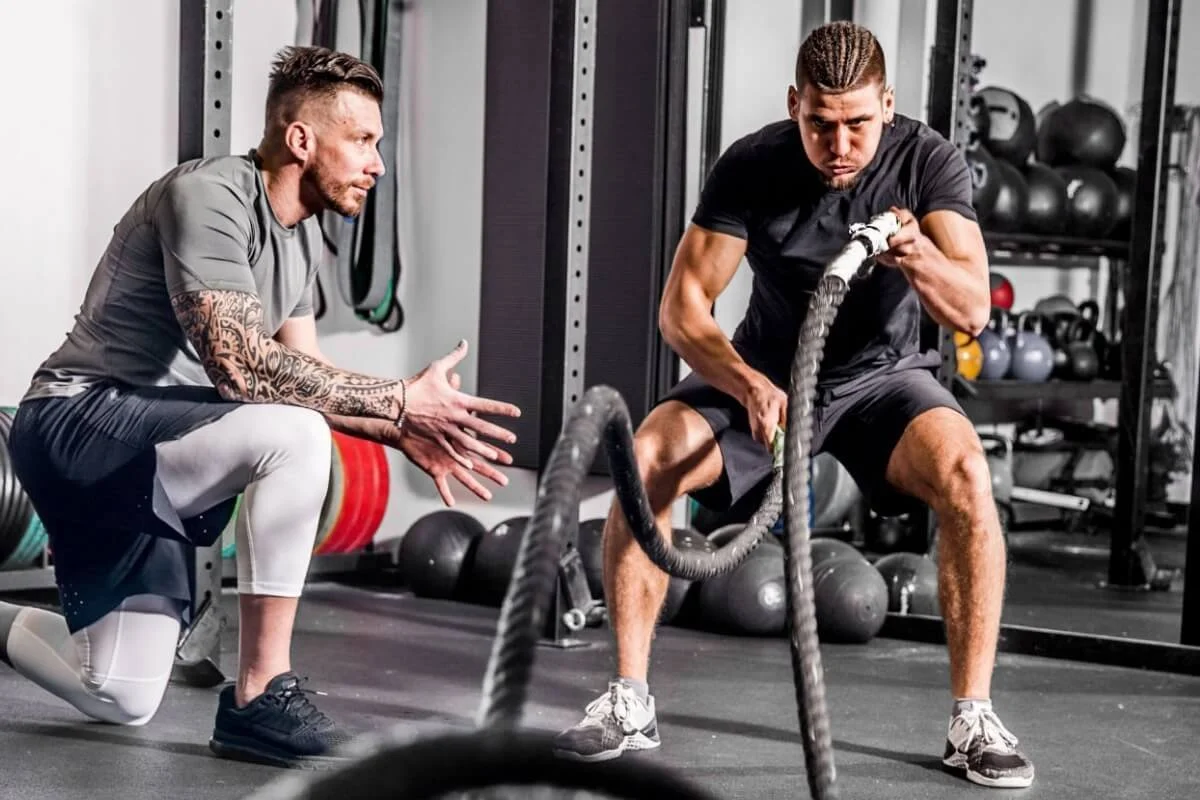
This original starter example is a practical coaching template, not a replication of either muscle-activity experiment and not a validated training programme. After your usual warm-up and some easy rope practice, perform four rounds of fifteen seconds of alternating waves followed by sixty seconds of recovery. Use a pace that keeps the last few seconds recognisably similar to the first few.
If the first round already demands a change in stance or wave pattern, shorten the work period. If every round stays controlled and you recover comfortably, repeat the same session on another day before adding more. You could then add one round or slightly extend the work period. Do not increase duration, rope size and pace together simply to make next week look harder on paper.
Keep strength work intentional. Kettlebell squats, dumbbell rows, carries and conventional resistance exercises let you select and track loads in ways that rope waves do not. A rope finisher can complement them without replacing their role. Resistance bands can serve separate warm-up or accessory tasks, while sled pushes, wall-ball drills or medicine-ball slams are different conditioning choices with their own space and technique requirements.
The equipment selections here are complementary options for a broader functional-fitness session; they are not battle-rope substitutes or attachments. You do not need to buy a second station to use the starter session. If you do build a circuit, choose movements you already perform confidently and allow enough transition time to keep the training area safe.
Track the rope, pattern, number of rounds and recovery time, plus one short note about execution. Review whether the finisher fits your week: does it leave you ready for your next planned session, or do you keep removing important work because you are unnecessarily exhausted? The best variation is the one that serves the intended session and can be progressed consistently. A high muscle-activity reading is interesting evidence, but it is not a promise of future gains.

Equipment Worth Exploring
Explore equipment, accessories and gear from our carefully selected range.


Cast Iron Kettlebells
Textured cast-iron kettlebells for swings, squats, carries, and full-body training.


Rubber Hex Dumbbells
Rubber-coated hex dumbbell pairs with a stable shape for home and commercial strength training.


Competition Wall Ball
Competition-style weighted wall ball for HYROX, wall-ball shots, and functional conditioning.

Slam Ball
Low-bounce weighted slam ball for explosive throws and high-intensity conditioning.


Pro Sled System
Heavy-duty push-pull training sled for loaded conditioning, speed, and strength work.