Advertising disclosure: This page includes affiliate product links that may earn us a commission, as well as products from our own store.
A heavy farmer’s carry can feel like a grip test, a moving shrug and a conditioning drill at the same time. Which part becomes harder when the load rises, the walking direction changes or the lifter uses straps? A small experiment measured muscle activity under those different conditions. Its results offer useful clues for programming, but the data are not proof of long-term muscle growth or a reason to chase dangerous weights.
What the 12-person loaded-carry experiment actually tested
Twelve adults aged 18 to 30 performed loaded walks with a hexagonal trap bar. They were divided according to lifting frequency: people who did not regularly lift, those lifting one to three times per week, and those lifting four to six times weekly. They walked forward and backward with loads set to 50%, 75%, 100% and 150% of their body weight. Extra trials at 100% and 150% used figure-eight lifting straps.
The investigators recorded surface electromyography, or EMG, from the front and rear deltoids, upper trapezius, pectoralis major, latissimus dorsi, teres major and spinal erectors. EMG reflects electrical activation during an exercise. It does not directly quantify mechanical tension or forecast how much muscle a person will gain after a training block. The experiment did not test months of progressive training, and no injury-prevention outcome was measured.
The trap-bar choice is important. A connected frame links both handles, while two kettlebells or dumbbells can swing or rotate independently. A 150%-body-weight trap-bar walk is not necessarily equivalent to carrying two separate objects with the same combined mass. There were only twelve participants spread across three experience groups, so subgroup findings deserve particular caution.
To translate the findings into your own gym, begin by defining the task. Which implement are you using? How far are you walking? Are the straps assisting the hands? Is the pickup controlled, and can you put the weight down without an improvised rescue? That description is more useful than a bare entry in your training log that says only “farmer’s carry.”

Equipment Worth Exploring
Explore equipment, accessories and gear from our carefully selected range.


Open Hex Bar
Open-frame trap bar with multiple handles for deadlifts, carries, and lower-body training.

Rubber Hex Dumbbells
Rubber-coated hex dumbbell pairs with a stable shape for home and commercial strength training.


Cast Iron Kettlebells
Textured cast-iron kettlebells for swings, squats, carries, and full-body training.


Heavier carries affected the traps and rear delts differently
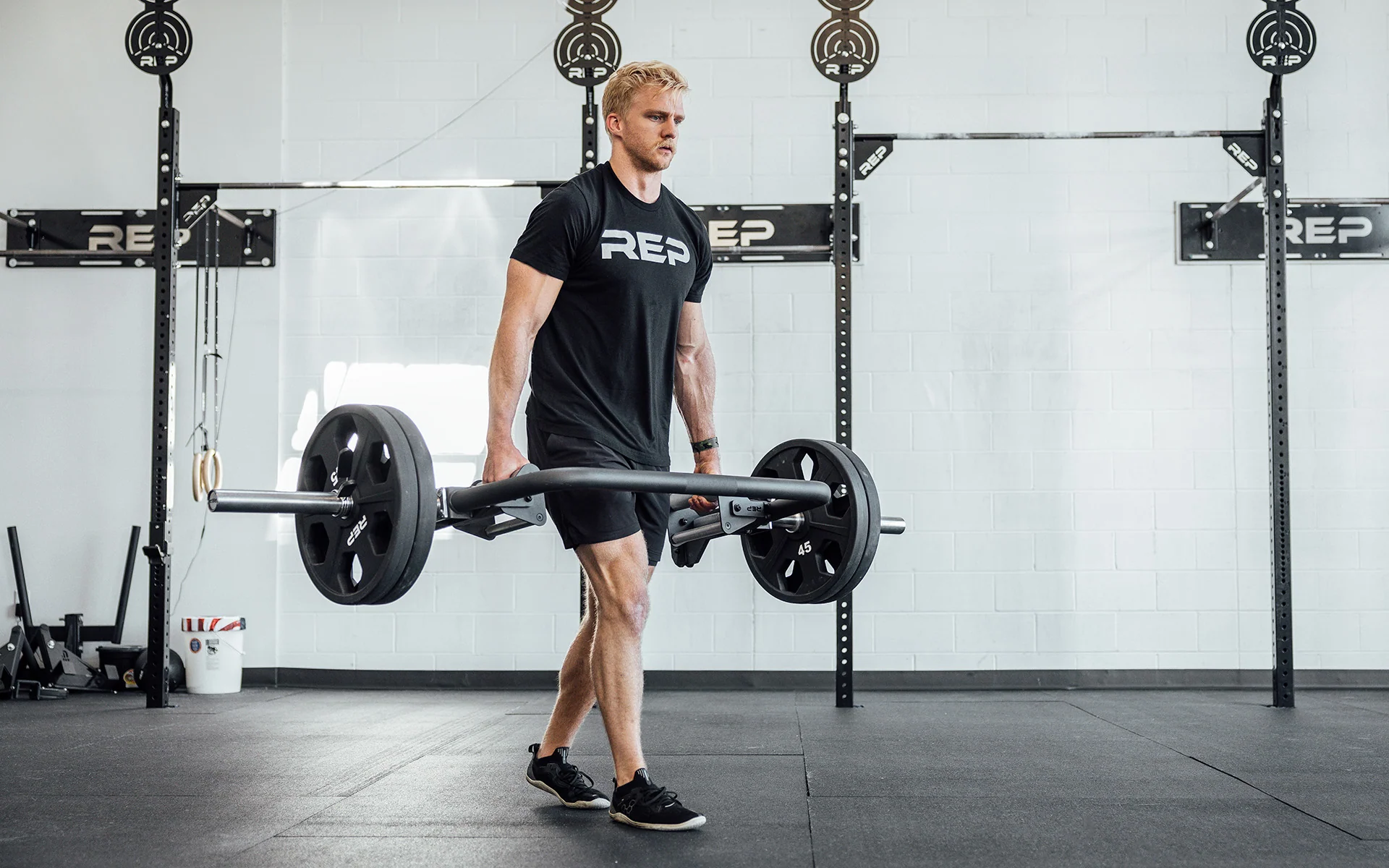
Increasing load did not change all the monitored muscles equally. The upper traps and rear deltoids showed some of the more pronounced load-related responses. Upper-trapezius activation was significantly higher in the 100%- and 150%-body-weight conditions than at the lightest 50% condition. That fits the practical sensation of supporting a heavier frame at your sides while maintaining shoulder and upper-back organization.
It would be a mistake to turn this into the claim that the heaviest possible farmer’s carry is automatically the best trap-building exercise. The experiment measured activation during the walk, not later strength increases or hypertrophy. For one lifter, a heavy but controlled 10-meter carry might make sense. Another lifter may get a better repeatable training session from a lighter load carried for 20 or 30 meters. Quality, exposure, recovery and the goal all matter.
Try not to exaggerate a shrug to make the traps burn. Establish a secure grip, stack your ribs over your pelvis and walk with level shoulders rather than deliberately dragging them upward. Natural shoulder motion is fine; lurching, repeated side bending and banging a frame into your legs are signals to change the load or distance. Keep your eyes on the clear lane instead of staring at your feet.
A useful progression is to make three walks of the same measured distance with similar posture and pacing before changing the weight. Once all three feel controlled, add a modest increment and return to the shorter route. This makes the challenge measurable without pretending that EMG alone identifies an ideal percentage of body weight for everyone.
Figure-eight straps change the exercise, not only the grip
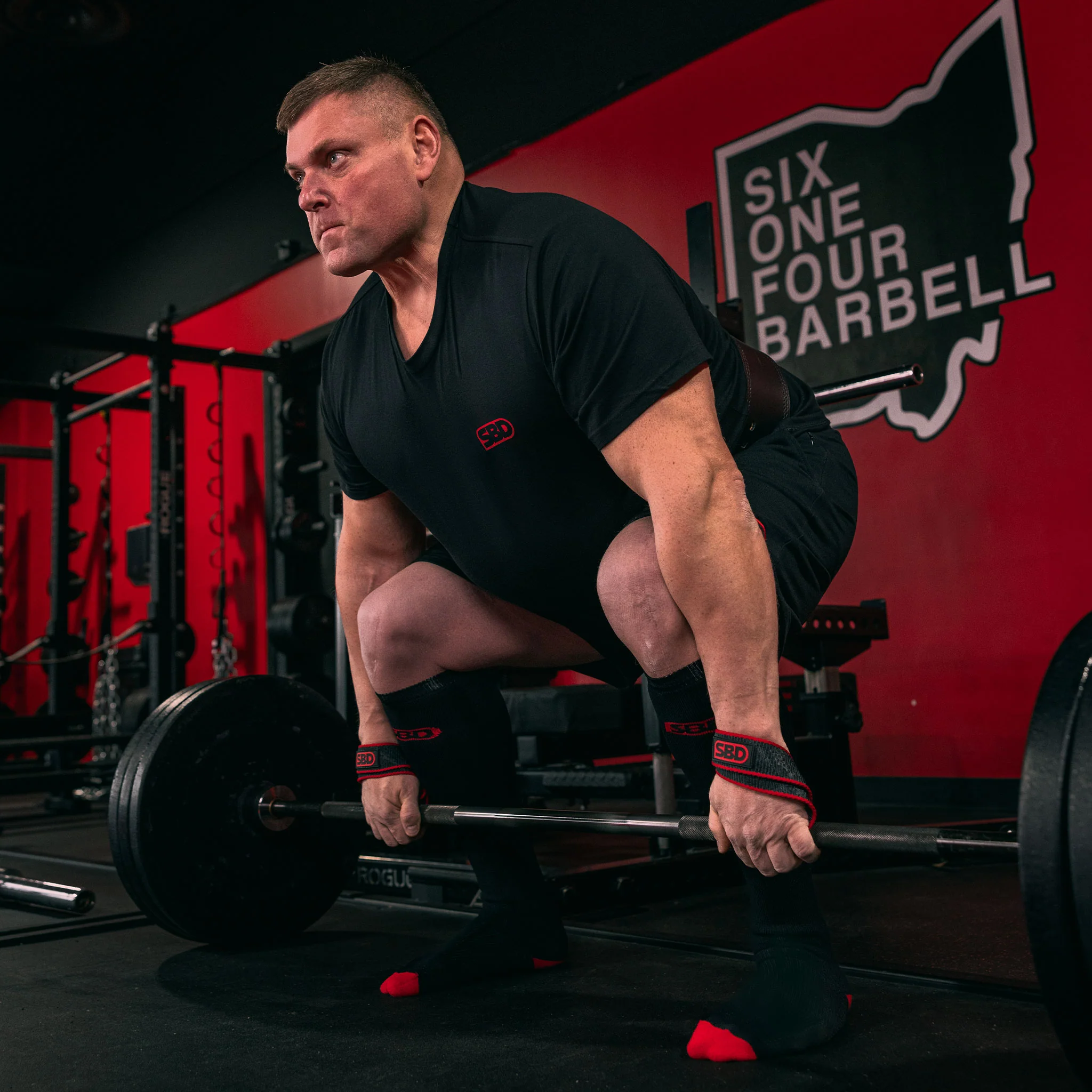
The participants also used figure-eight lifting straps in heavier conditions. Overall measured muscular activation was slightly but significantly lower in the strapped trials. That result is specific to the tested task and muscles; it does not prove straps are bad, that they cannot support heavier training, or that using them reduces long-term results. It shows that external grip assistance can alter the immediate demands of the loaded walk.
If stronger hands are a training priority, retain some unassisted carries at weights you can hold securely. Grip endurance and keeping the handle under control are part of the exercise. If your goal is to practice supporting a heavier frame while grip would otherwise end the set early, properly fitted and compatible straps may serve a different purpose. These are not interchangeable performances, so record them separately.
Not every strap works with every handle. Figure-eight straps wrap in a different manner from ordinary wrist straps, and a fixed connection can make immediate release less straightforward. Check the equipment and route before the set. Never improvise a connection on an unstable or unfamiliar implement, and avoid heavy assisted walks where another person might cross the path.
You could start a session with two or three grip-limited, unassisted passes, then perform assisted work separately if it fits the day’s priority. Alternatively, use only one approach and focus on progressing that consistently. Both are defensible choices. What matters is identifying what you are trying to train instead of calling every strapped and unstrapped performance the same personal record.
Equipment Worth Exploring
Explore equipment, accessories and gear from our carefully selected range.

Leather Lifting Straps
Padded leather straps support grip during heavy rows, deadlifts and pulling exercises.

Leather Wrist Grips
Padded leather lifting grips help support the hands and wrists on heavy pulling exercises.


Competition Plates
Competition-style bumper plates for Olympic lifts and loaded strength training.


GymPin Hyper Loader
Central Olympic-plate loading attachment for weighted hyperextensions.

Pro Sled System
Heavy-duty push-pull training sled for loaded conditioning, speed, and strength work.

Forward versus backward walking: what the results actually mean
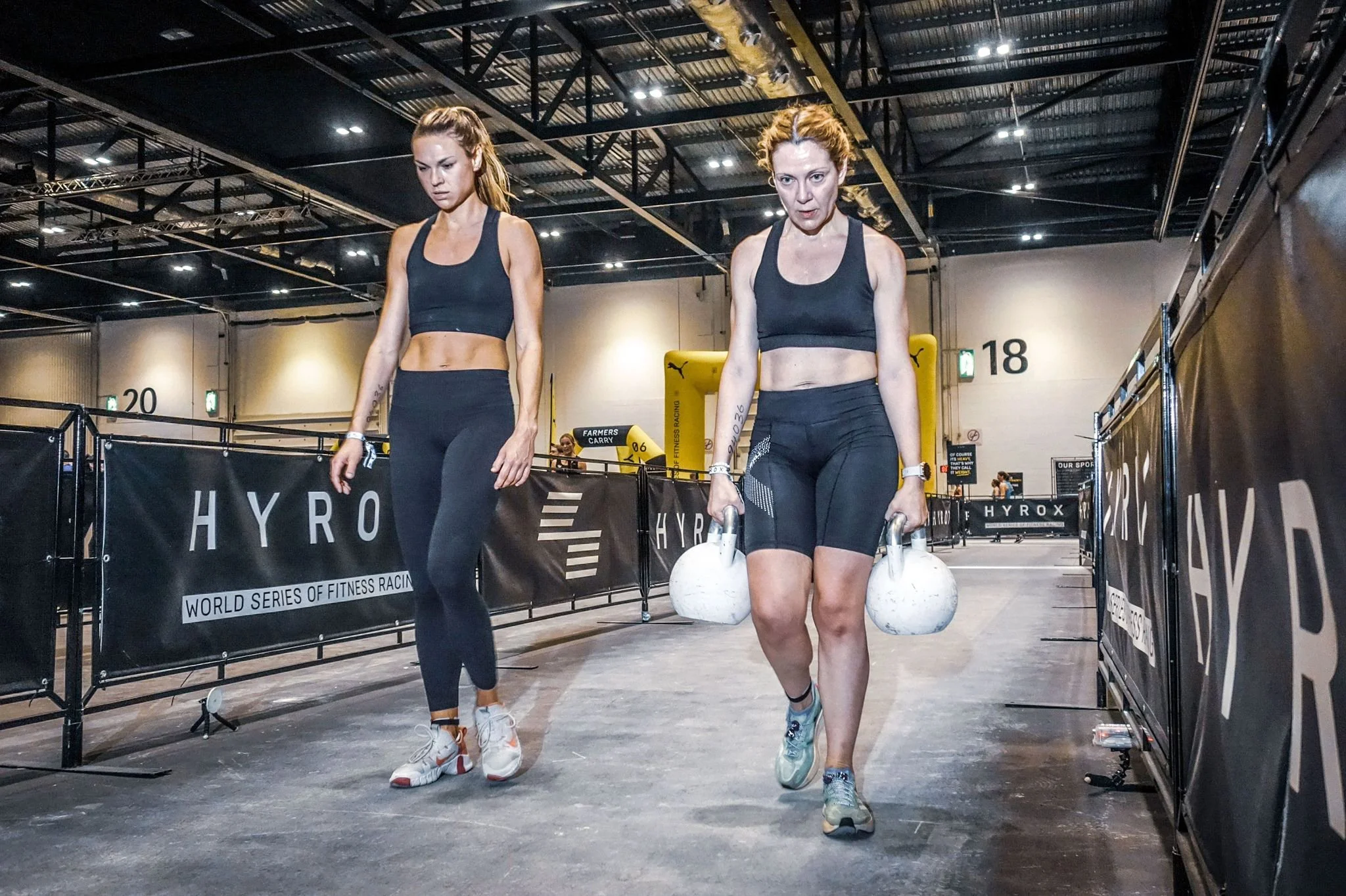
In this experiment, walking direction did not have a statistically significant overall effect on the monitored EMG readings. The careful interpretation is that a significant average difference was not detected in these conditions and this small sample. It is not evidence that forward and backward carries are identical, or that walking backward is necessarily safe with a heavy trap bar.
The practical problem with backward walking is visibility. You cannot continuously see the path behind you, and the frame may obstruct your ability to correct a step. For most lifters, forward walking on a clear, level lane is the better starting point. If you specifically practice backward movement, use a short, unobstructed route with supervision and a manageable load. Do not copy the heaviest experimental condition as a workout prescription.
Training frequency also interacted with the activation pattern. Less-experienced participants showed relatively more front-deltoid and chest activity in some comparisons, while the highest-frequency group showed more erector-spinae and latissimus activity than the middle group. Since the categories included very few people each, this is a hypothesis about different movement strategies, not a rule that your training experience determines which muscles should grow.
A safe and useful carry must be evaluated as a complete movement: the pickup, walking line, turns, grip, posture and put-down. A single muscle-activation number cannot capture a missed step, a blocked route or a rushed turnaround. Assess the task you can actually see and control before seeking complex variations.
Choose your implement and route before chasing a heavy number
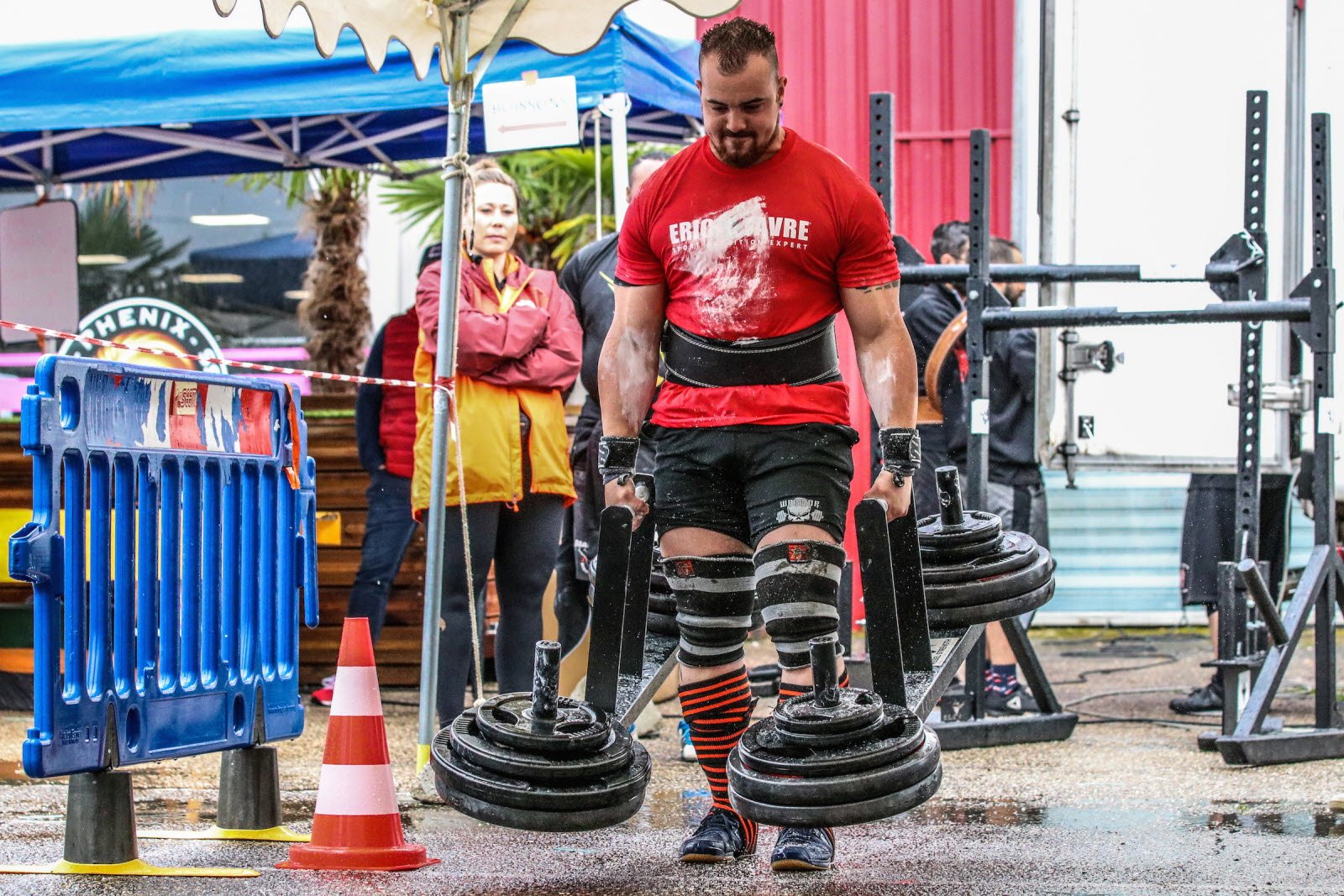
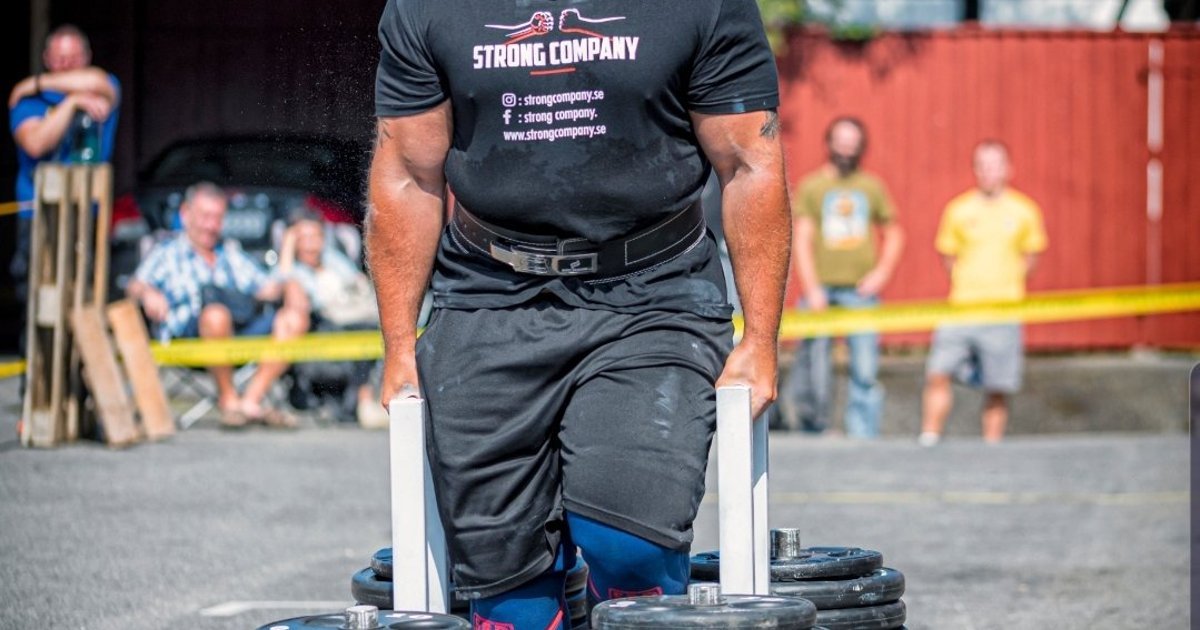
Trap bars place both handles within one connected frame and can be convenient for heavy bilateral walks. Dumbbells are more widely available and make it easy to adjust loading in smaller steps. Kettlebells change the handle and mass distribution. Dedicated strongman farmer handles introduce their own swing and balance demands. All can work, but their loading does not transfer perfectly from one implement to another.
Choose a clear route with a deliberate set-down area. Check that no benches, plates, stairs or people will interrupt your walk. Set the weights beside your legs, grip securely, brace, and stand using a controlled leg-and-hip drive. Before moving, take a moment to organize your balance. During the walk, keep your head oriented toward the direction of travel and use comfortable, deliberate steps instead of overstriding or racing.
Short controlled passes are perfectly valid. If your gym has only ten meters of usable floor, consider multiple fully reset passes instead of sharp pivots with maximum weight. Do not make a heroic turnaround the hardest or most dangerous part of the workout. If your grip opens, the frame swings violently or your torso twists repeatedly, stop, set the weight down and adjust the next attempt.
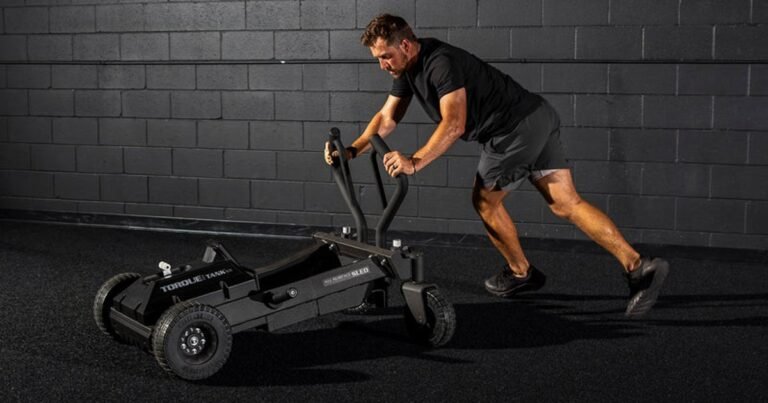
A one-sided suitcase carry is not the same exercise: the asymmetric load creates a different trunk-control challenge. It can be a useful accessory, but it should have its own training entry. The same is true of sled pushes or drags. They provide conditioning alternatives, yet they are not replacements for a specific farmer’s carry performance test.

Powerlifting Shirts & Lifting Gear
Powerlifting shirts and gym gear for squat, bench and deadlift lifters who live for heavy numbers.

Deadlift Lovers – Grim Reaper Skeleton , Bros & Leg T-Shirt
Rep “Deadlift Lovers” humor in and out of the gym.

Shirt – Deadlift – Meme Gains & Bros T-Shirt
Heavy lifts, good laughs, and a little “Deadlift” energy.

Forged In Iron Shirt – Essential & Top T-Shirt
Heavy lifts, good laughs, and a little “Forged In Iron” energy.

Old School Weight Strongman – Meme Shirt & Top T-Shirt
Show some powerlifting attitude with a playful “Old School Weight Lifter Strongman Graphic” tee.

Lift Heavy Be Happy Meme Bros & Gains Top T-Shirt
Show some powerlifting attitude with a playful “Lift Heavy Be Happy” tee.

Shirt & Barbell Heartbeat , Gymbros & Meme Lovers T-Shirt
Heavy lifts, good laughs, and a little “Funny Gym Shirt & Pump” energy.


Raise The Barbell Shirt – Motivational & T-Shirt
Show some powerlifting attitude with a playful “Raise The Barbell” tee.

Funny Lift Time Gym | Workout Sweater For Gym Bros & Li T-Shirt
Keep things casual with a little “Lift Time” attitude.

Iron Is My Therapy – Gymbro Meme , & Gains Top T-Shirt
Bring “Iron Is My Therapy” humor to your next gym day.
A repeatable four-week carry progression and race-day context
The small muscle-activation experiment did not test a four-week training program. The following plan is an adjustable coaching example, not a scientifically proven optimal dose. One or two weekly sessions can be enough to practice the movement without overwhelming other pulling, deadlift or grip work. Begin with conservative loads and choose a clear place to stop each set.
- Week 1: Perform three controlled walks of roughly 10 to 15 meters. Record the implement, total load, route, rest and whether straps were used. Avoid working until an unsafe grip failure.
- Week 2: Keep the load steady and make the pickup, pace and set-down more repeatable. If all walks remain solid, add a little distance rather than changing everything at once.
- Week 3: Increase the load modestly and return to the original shorter distance. If loading options are limited, retain the weight and add a controlled fourth set instead.
- Week 4: Repeat a previous load and route to compare quality, walking control, grip stability and recovery. Do not assume that an all-out maximal carry is necessary to assess progress.
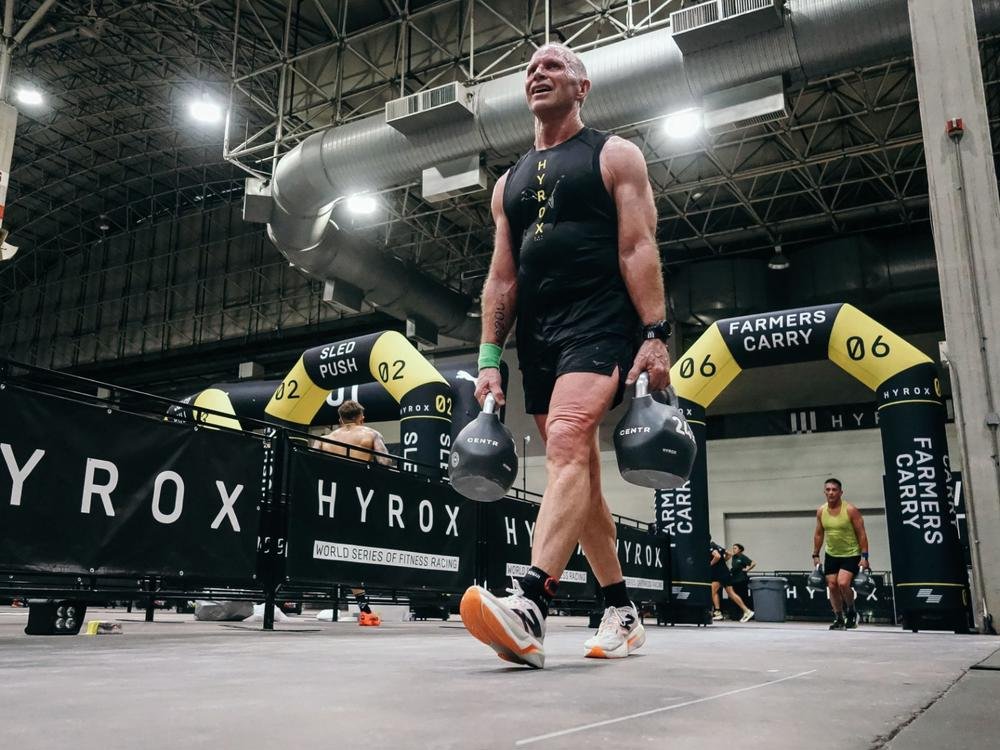
Fitness-race training adds another variable: the competition standard. Some HYROX formats involve a farmer’s carry station, but required weights and other details vary by division and event rules. Use the actual race implement and verify the current standards before treating a gym walk as a precise simulation. Even when the prescribed race distance is longer, practice steady segments first and build toward continuity rather than starting with an uncontrolled full-distance effort.
Common mistakes include lifting too explosively off the ground, changing route and load simultaneously, choosing straps before considering the goal, and letting exhaustion determine where a heavy implement lands. Sharp pain is a reason to stop. If carries interfere with your main strength work for several sessions, lower the total dose or change the schedule. Consistent, controlled practice gives you something worth progressing.
Functional Fitness Shirts & Workout Gear
Functional-fitness shirts, tanks and workout gear for athletes who train strength, conditioning and everything in between.

High Rocks Functional Fitness Tee
Show some lifting attitude with a playful “Hyrox High Rocks Gym Bro” tee.


Lift Together Grow Stronger for Gym Buddies Who Train T T-Shirt
Show some gym-day personality with “Lift Together Grow Stronger”.

Live Love Lift – Gymbro Meme & Gains – Shirt T-Shirt
Rep “Live Love Lift” humor in and out of the gym.

Skull Kettlebell Gym | Heavy Metal Lifting Funny Workou T-Shirt
For laid-back days and metalhead humor: “Skull Kettlebell”.

Atlas Kettlebell Earth Meme Greek God Top T-Shirt
Make gym days more fun with “Atlas Kettlebell Earth Lifter” style.

Happy Kettlebell Emoji Smiley Kettlebell Meme T-Shirt
Show some gym-day personality with “Happy Kettlebell Emoji”.


The takeaway: heavier trap-bar loads affected shoulder-muscle activation in this small test, straps changed the overall EMG profile, and walking direction did not show a significant average effect. These are useful observations about acute demand, not guarantees about hypertrophy. Keep your goal, implement, grip assistance and route clear, and let consistent technique guide your progression.